
The awkward sleep-tracker morning is easy to recognize: the app gives you a respectable total — maybe even a green checkmark — while your body reports something closer to a hangover. You were in bed long enough. The chart says you slept. Still, the morning feels thin, heavy, and oddly unrepaired.
That mismatch matters for anyone trying to understand air quality and sleep quality, because the most interesting signal is not always shorter sleep. In a large wearable-data study from China, higher ambient nitrogen dioxide exposure was associated with longer total sleep time, while some pollutants were associated with less deep sleep — the kind of architectural shift that can make a night look adequate by duration and disappointing by recovery.[1]
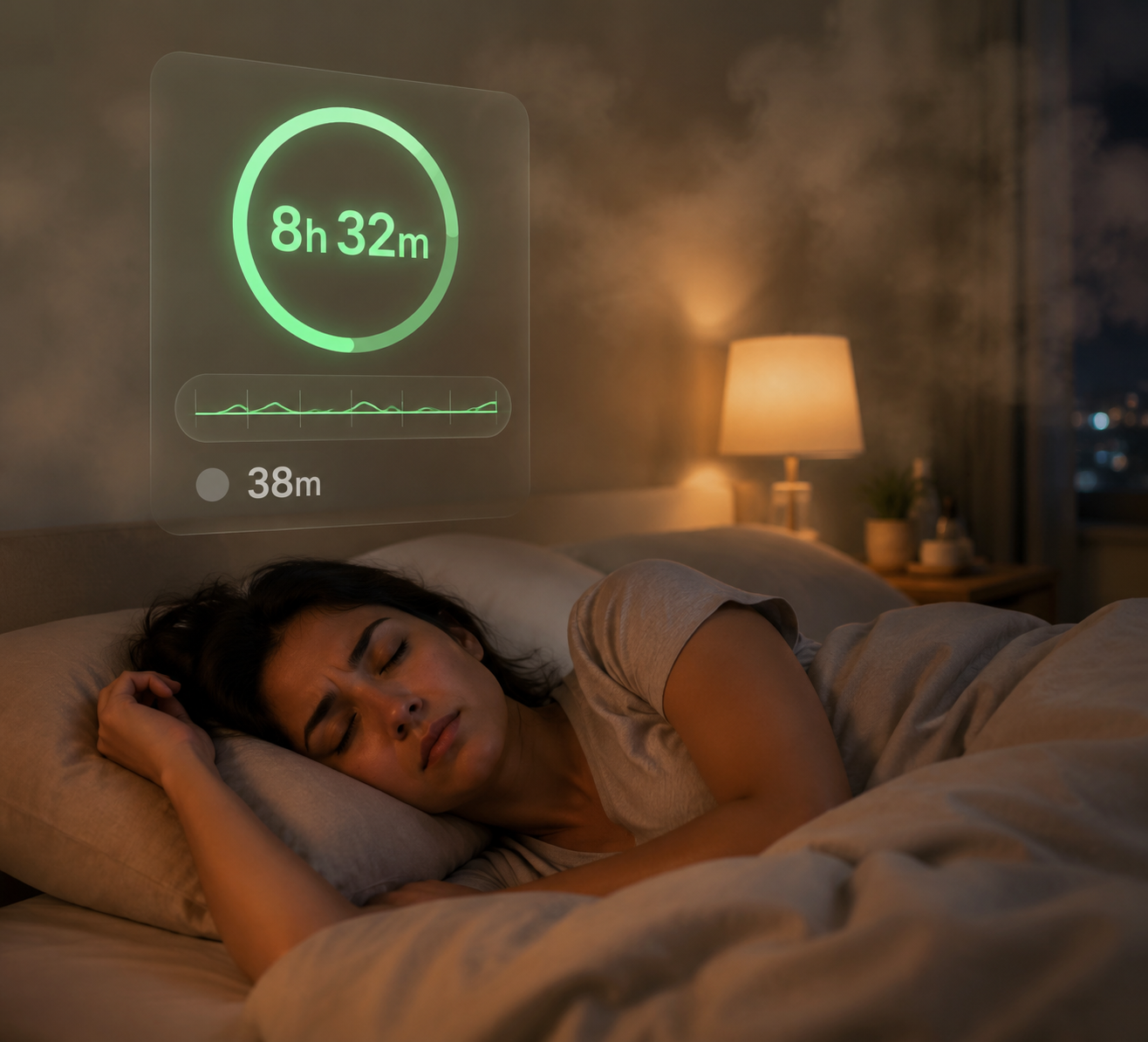
This does not mean dirty air simply “makes you sleep longer.” The evidence is observational, the sleep was measured by consumer bracelets rather than lab polysomnography, and residential outdoor pollution is not the same as the air at your pillow. But it does give a useful shape to a familiar complaint: a longer night can still be a less restorative night.
The wearable paradox: more recorded sleep, less deep sleep
The central study followed 7,682 participants and analyzed more than 1.2 million nights of sleep records from consumer wearable devices, specifically Jawbone UP and Xiaomi Mi Band bracelets.[1] That scale is the reason the finding is worth taking seriously. It is not a single sleeper’s bad week, and it is not a small lab night under artificial conditions.
The study linked sleep records with ambient air pollutants and found that a 1-IQR increase in NO₂ was associated with 8.7 minutes longer total sleep time, with a 95% confidence interval from 5.6 to 11.8 minutes.[1] On its own, that sounds almost reassuring. More minutes are usually treated as a win by sleep apps, workplace wellness dashboards, and tired adults negotiating with themselves at 7 a.m.
The same paper points in a less comforting direction when sleep architecture is considered. Carbon monoxide exposure was associated with 5.0 minutes less deep sleep, with a 95% confidence interval from 8.1 to 2.0 fewer minutes.[1] The researchers also reported disruption patterns for both short-term exposure, including a 1-week cumulative window, and longer-term exposure, which makes the signal harder to dismiss as a one-off seasonal oddity.[1]
| What the tracker may show | What the pollution-linked pattern suggests | How to read it |
|---|---|---|
| Longer total sleep time | Higher NO₂ was associated with more recorded sleep minutes | Duration may rise without recovery improving |
| Less deep sleep | CO was associated with reduced deep sleep | Slow-wave sleep may be a better clue than total time alone |
| A decent overall score | Consumer algorithms compress many signals into one grade | The score can hide fragmentation, breathing strain, or shallow sleep |
The important distinction is between a device’s estimate and a clinical measurement. Consumer wearables are useful for trends, but they tend to overestimate total sleep time and underestimate wakefulness compared with polysomnography. In this study, that means the exact minute changes should not be read as a personal diagnostic conversion table. The better reading is directional: ambient pollution may be linked with a shift in sleep structure, not merely a loss of sleep opportunity.
That is why the “I slept eight and a half hours, so why do I feel awful?” question deserves more than the usual lecture about bedtime consistency. If your tracker is flattening the night into total sleep time, it may be missing the part of the story your body is reporting.
How polluted air could change sleep without simply shortening it
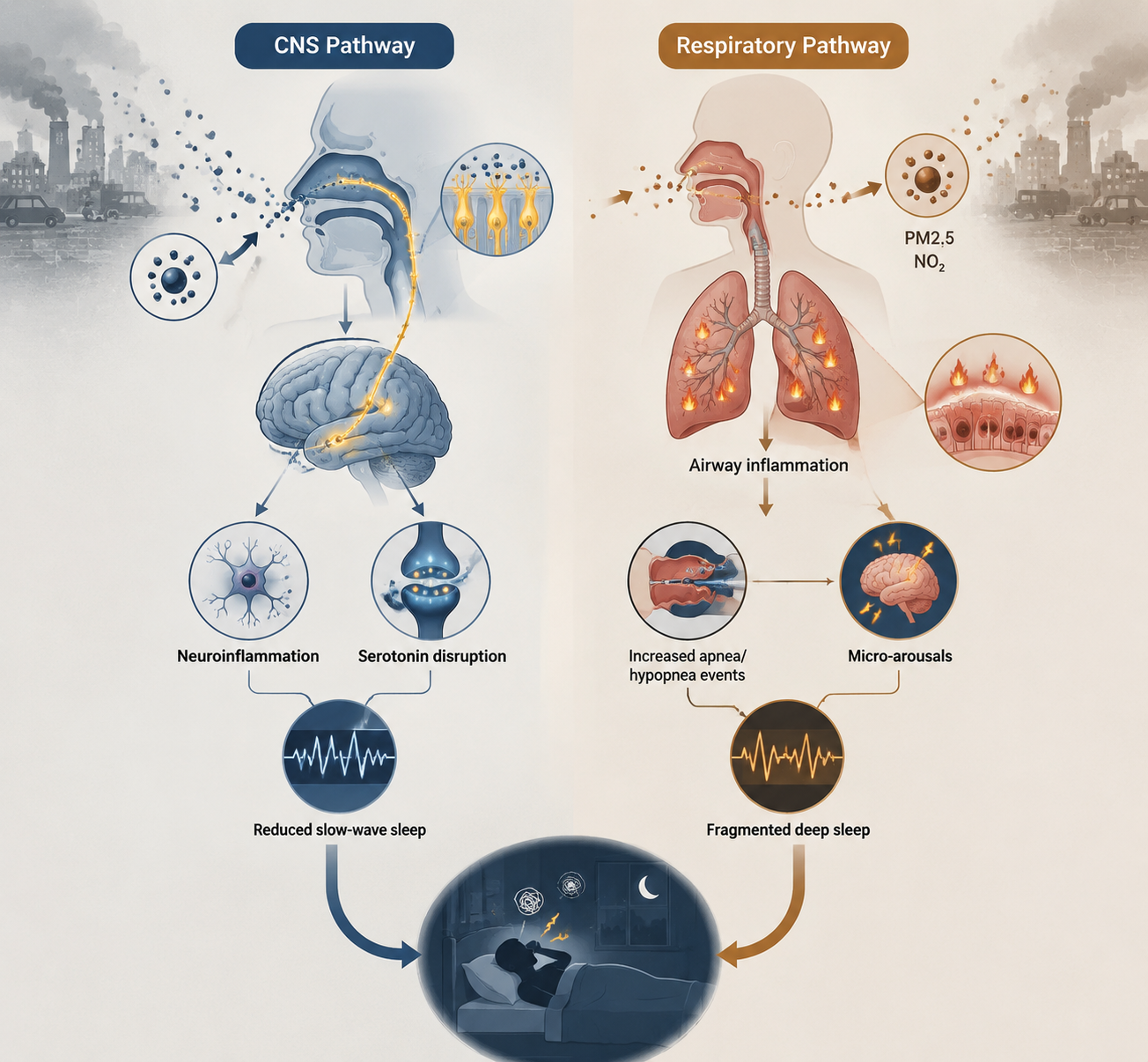
There are two plausible routes from inhaled pollution to worse recovery: one through the nervous system and one through breathing. Neither proves that a particular bad night came from a particular pollutant spike. Together, they make the wearable paradox biologically plausible.
The nervous-system route
A 2024 review describes a direct central-nervous-system pathway in which ultrafine particles and gaseous pollutants may reach the brain through the olfactory nerve, contributing to neuroinflammation and disruption in neurotransmitter systems, including serotonin and dopamine signaling.[2] These systems are involved in sleep regulation, so the concern is not only whether someone stays asleep. It is whether the sleeping brain moves through its architecture in the usual way.
Slow-wave sleep is especially relevant here because it is not just “extra deep” sleep on a consumer chart. It is a stage linked with physical restoration, metabolic regulation, and the feeling that sleep actually did something. A night can contain many recorded minutes and still be light, restless, or poorly consolidated.
The airway route
The second pathway is more mechanical. PM2.5 and NO₂ can irritate and inflame the upper airway, potentially narrowing the pharyngeal airway and increasing breathing instability during sleep.[2] That kind of irritation does not have to wake you fully for long stretches. It can create micro-arousals — small interruptions that fragment sleep architecture while leaving total time in bed largely intact.
The Multi-Ethnic Study of Atherosclerosis offers a useful supporting case. Billings and colleagues examined long-term residential ambient PM2.5 and NO₂ exposure and found associations with sleep apnea risk, including a higher apnea-hypopnea index, or AHI.[3] AHI counts breathing interruptions and shallow-breathing events; when it rises, sleep may become more fragmented even if a wearable still records a long night.
This is also where interpretation has to stay modest. The MESA analysis estimated outdoor pollution at residential addresses, not bedroom-level exposure.[3] A person’s actual nighttime air can be shaped by open windows, building ventilation, cooking, filtration, nearby traffic, wildfire smoke, and room layout. Outdoor exposure is an important proxy, not a sensor beside the bed.
This is not just one odd study
A 2021 systematic review of air pollution exposure and sleep health across the life course found broader epidemiological evidence linking pollution exposure with adverse sleep outcomes.[4] The literature is not uniform, and it is not built mostly from randomized trials. Still, the pattern is large enough that the wearable finding sits inside an existing field rather than outside it.
A later population-level analysis summarized by The Guardian reported that reducing PM2.5 by half — from busy London road levels to World Health Organization guideline levels — could reduce the likelihood of poor sleep by roughly 1 in 10 among middle-aged and older adults.[5] That figure should be treated carefully: it is an inference from pooled evidence, not the result of a direct intervention trial in which people’s bedrooms were cleaned and their sleep was then measured under controlled conditions.
The Zhou study also reported stronger associations in some groups, including women, younger adults, and during colder seasons.[1] Those subgroup patterns are useful context, not a personal forecast. They may reflect differences in exposure, physiology, behavior, housing, seasonal ventilation, or other factors the data cannot fully separate.
What to do with your own sleep data
If your tracker shows a long night but you wake unrecovered, do not let total sleep time be the whole verdict. It is the most visible number, not necessarily the most revealing one.
- Look at repeated patterns, not single nights. One poor recovery morning can come from stress, alcohol, illness, temperature, noise, travel, or measurement error.
- Compare total sleep time with deep sleep, awakenings, restlessness, heart-rate patterns, and breathing-related flags if your device provides them.
- Notice timing. If shallow sleep clusters during high-pollution days, wildfire-smoke periods, cold-season closed-window weeks, or heavy traffic exposure, the pattern is worth taking seriously.
- Separate outdoor exposure from bedroom exposure. Ambient data can suggest a possible burden, but it does not tell you exactly what you inhaled overnight.
- Treat loud snoring, witnessed pauses in breathing, gasping, persistent morning headaches, or major daytime sleepiness as clinical clues, not wearable curiosities.
None of this turns a ring, watch, or bracelet into a sleep lab. It does make the data more useful. A night with more recorded sleep and less recovery is not automatically a mystery, and it is not automatically your fault. Sometimes the number that looks most reassuring is the one least able to describe what happened.
References
- The long-term and short-term effects of ambient air pollutants on sleep characteristics in the Chinese population: big data analysis from real world by sleep records of consumer wearable devices, BMC Medicine, 2023.
- Air pollution and sleep, 2024.
- The Association of Ambient Air Pollution with Sleep Apnea: The Multi-Ethnic Study of Atherosclerosis, Annals of the American Thoracic Society, 2019.
- Air pollution exposure and adverse sleep health across the life course: A systematic review, 2021.
- Air pollution can affect how well we sleep, scientists discover, The Guardian, September 2025.
Comments
Join the discussion with an anonymous comment.