
The honest answer to whether Boeing 787 Dreamliner sleep quality is genuinely better starts with a missing study: there is no published controlled trial that puts passengers on a 787 and a comparable older aircraft, on the same route, then measures sleep architecture, awakenings, oxygen saturation, and next-day jet lag. That matters. A quieter, dimmer, less dehydrating cabin is not the same thing as proven better sleep.
But the absence of that trial does not make the Dreamliner claim empty. The 787 is unusual because several of its design choices line up with known physiological barriers to sleeping at altitude: mild hypoxia, dry mucous membranes, noise arousal, vibration, turbulence-related awakenings, poorly timed light, and circadian misalignment. The evidence is strongest for cabin altitude, more mechanistic for humidity and noise, and most tempting to overstate for lighting.
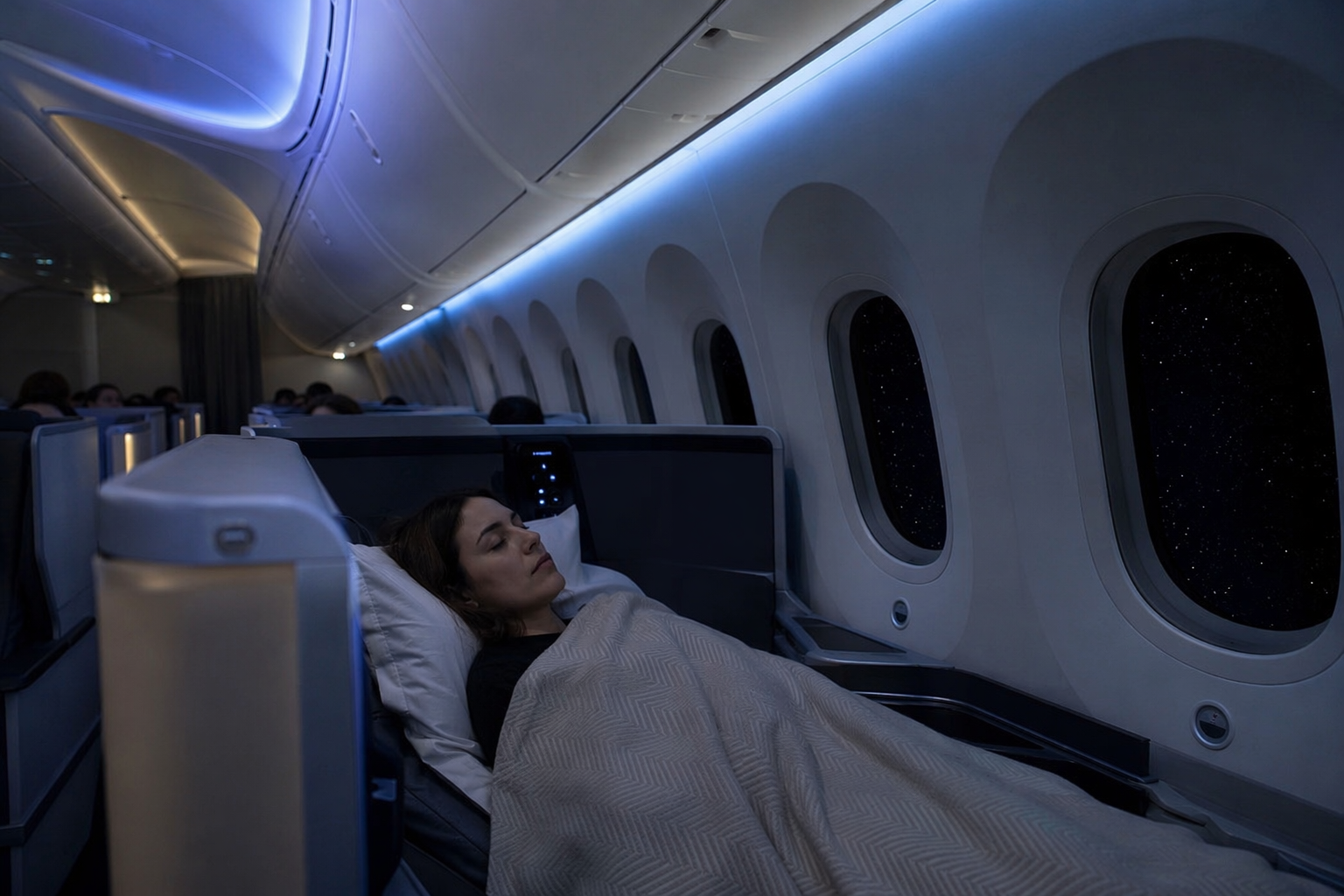
The clearest sleep-relevant change is lower cabin altitude
Sleep on an aircraft begins with a respiratory compromise. Commercial cabins are pressurized, but not to sea level. In many older long-haul aircraft, the cabin altitude can approach 8,000 feet. At that pressure, healthy passengers usually remain safe, but safety is a low bar for sleep. Mild oxygen desaturation, headache, fatigue, and general discomfort can all raise the chance that sleep becomes shallow or fragmented.
The key evidence here is not a Boeing brochure. In a hypobaric chamber study published in the New England Journal of Medicine, Muhm and colleagues exposed 502 participants to four simulated cabin altitudes and found that passenger discomfort increased significantly at 7,000 to 8,000 feet after 3 to 9 hours. The study also reported an oxygen saturation drop of about 4.4 percentage points at 8,000 feet and concluded that maintaining cabin altitude at 6,000 feet or lower reduces passenger discomfort.[1]
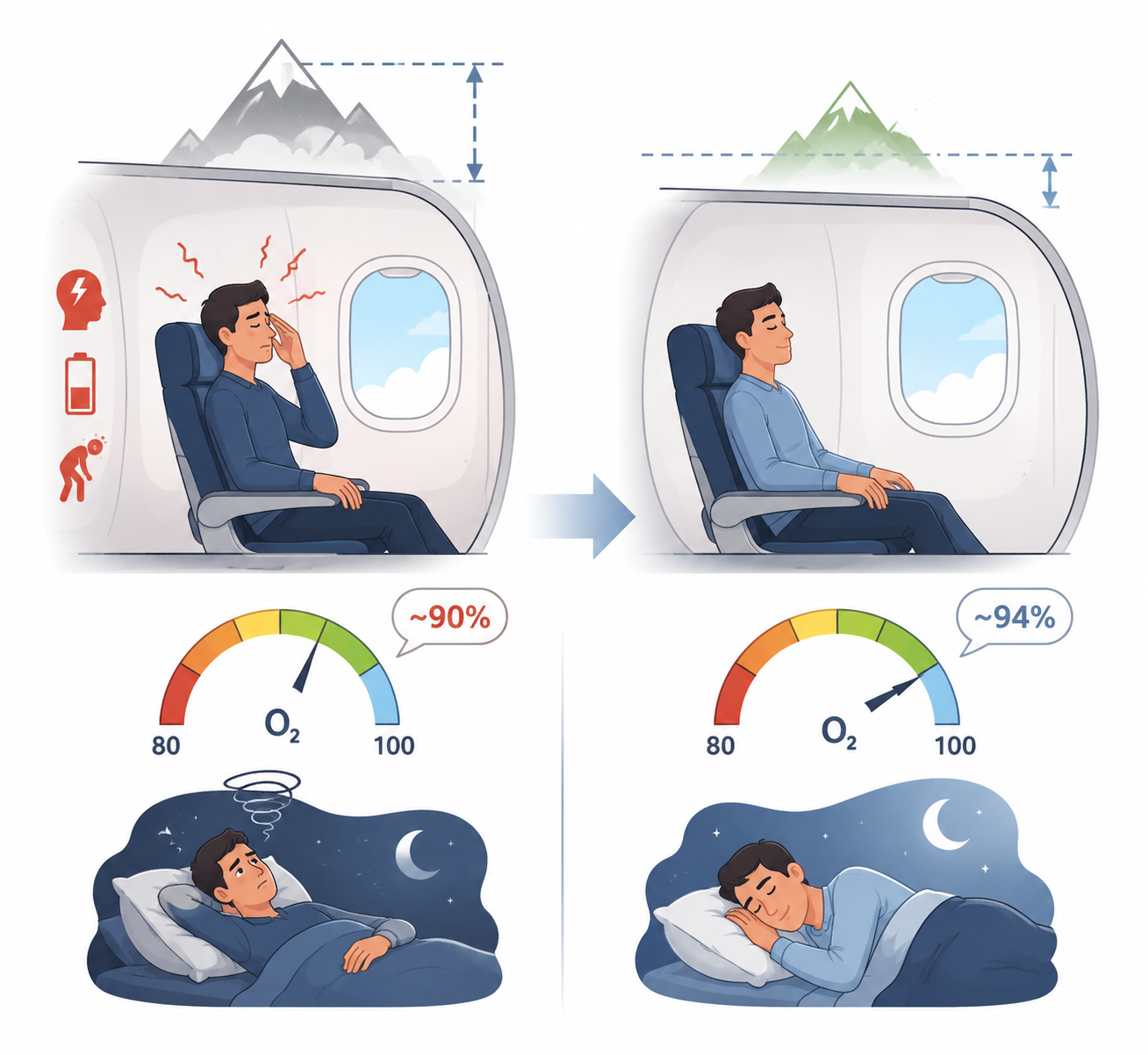
That is the physiological floor under the Dreamliner argument. The 787 is designed for a lower cabin altitude, commonly discussed around the 6,000-foot level rather than the 8,000-foot ceiling used as a typical certification reference point. A few thousand feet of pressure difference will not turn an economy seat into a bed, but it does address a real bottleneck: the body has less work to do maintaining oxygenation while the passenger is trying to sleep.
The caveat is important. The NEJM study was conducted in a chamber, not in a 787 cabin crossing the Pacific. It was also funded by Boeing. Still, the measured direction of effect is hard to dismiss: lower simulated cabin altitude reduced discomfort, and lower discomfort is a plausible precondition for fewer awakenings. It is not direct proof of better sleep quality on the 787, but it is the strongest piece of evidence supporting the aircraft’s sleep-related reputation.
Dry air wakes people in less dramatic ways
Cabin dryness is less cinematic than oxygen saturation, but anyone who has woken over Greenland with a scratchy throat knows it is not trivial. Dry air irritates nasal and pharyngeal membranes. That irritation can produce swallowing, coughing, thirst, mouth breathing, and the small awakenings people often forget by morning but still feel as poor sleep.
Aircraft cabins are dry partly because outside air at cruise altitude contains very little moisture and partly because older aluminum structures create corrosion constraints. A review of the aircraft cabin environment notes that cabin humidity averages around 15% in cruise on modern aircraft.[2] Boeing-related and aviation reporting on the 787 commonly describes a higher humidity range of about 15% to 25%, compared with roughly 4% to 7% on older aircraft; the enabling change is the 787’s composite fuselage, which is less vulnerable to corrosion than conventional aluminum structures.[3]
This is a modest improvement, not a spa-humidity cabin. Even 15% to 25% is dry compared with a comfortable bedroom. The sleep-relevant point is narrower: moving away from extremely dry air reduces one source of mucosal irritation. For a passenger already balancing low humidity, mouth breathing, alcohol, and recirculated air, that reduction can matter.
Quieter is useful, but it is still an airplane
Noise disrupts sleep by causing arousals even when the sleeper does not fully wake. On aircraft, the problem is not only volume; it is the persistence of low-frequency engine noise, airflow, cabin service sounds, lavatory doors, seat mechanisms, and nearby passengers. The 787 improves one part of that problem at the aircraft level.
Boeing’s noise claim is often summarized as the Dreamliner being about 20% quieter, but that phrasing is less useful than the acoustic translation. Reporting on the aircraft describes the 787 cabin as roughly 6 dB lower than a 777, with chevron-shaped engine nacelles reducing noise at the source and the composite fuselage helping damp vibration transmission.[4]
A 6 dB reduction is perceptually meaningful; it can feel like a large reduction in loudness. Yet the reported 787 cruise cabin level is still around 85 dB, nowhere near the 30 to 40 dB range of a quiet bedroom.[4] So the sensible claim is not that the Dreamliner creates a sleep-friendly acoustic environment. It creates a less hostile one. Earplugs or noise-canceling headphones still do real work.
A smoother ride protects sleep continuity
Turbulence is not mainly a sleep-onset problem. It is a sleep-continuity problem. A passenger can drift off during light chop, then lose the next hour to a sudden drop, a seatbelt announcement, a neighbor grabbing the armrest, or the nervous vigilance that follows.
The 787 uses wing-mounted sensors and flight-control adjustments intended to detect gusts and respond before the full disturbance reaches the passenger cabin. Aviation reporting describes the system as reducing both the frequency and amplitude of turbulence felt inside the aircraft.[5]
This is harder to translate into sleep evidence than cabin altitude. No cited study shows fewer EEG-defined awakenings on a 787 because of gust suppression. But the mechanism is direct enough to take seriously: fewer abrupt body movements and fewer cabin disruptions should make it easier to maintain sleep once it begins. The effect will also be route- and weather-dependent. A smoother system cannot make the jet stream behave.
Light control is powerful, and easy to overclaim
Light is the cabin variable most likely to be described in magical language. It deserves better than that, because the physiology is already strong enough. Light reaching melanopsin-containing intrinsically photosensitive retinal ganglion cells influences signals to the suprachiasmatic nucleus, the brain’s central circadian pacemaker. Bright, blue-enriched light at the wrong biological time can delay sleep or shift circadian timing; dimmer, warmer light is less activating.
The Dreamliner changes both window light and cabin light. PPG Aerospace was selected to provide the 787’s 19-inch dimmable windows, described as about 30% larger than those on the 767, with five adjustable tint levels. The electrochromic system changes opacity when voltage is applied, and the cabin crew can centrally control the windows during designated sleep periods.[6]
The sleep advantage is not that large windows are pleasant, although they are. It is that a crew can darken the cabin without relying on every passenger to close a physical shade. On a long-haul flight, one open shade over a sunlit wing can light up several rows. Central tinting reduces that social and physiological friction.
There are limits. Electrochromic windows may not create the complete blackout that a physical shade can, and some residual light can remain. That matters most when the outside environment is bright and the cabin is trying to simulate night. For sleep, dimmer is useful; fully dark is better.
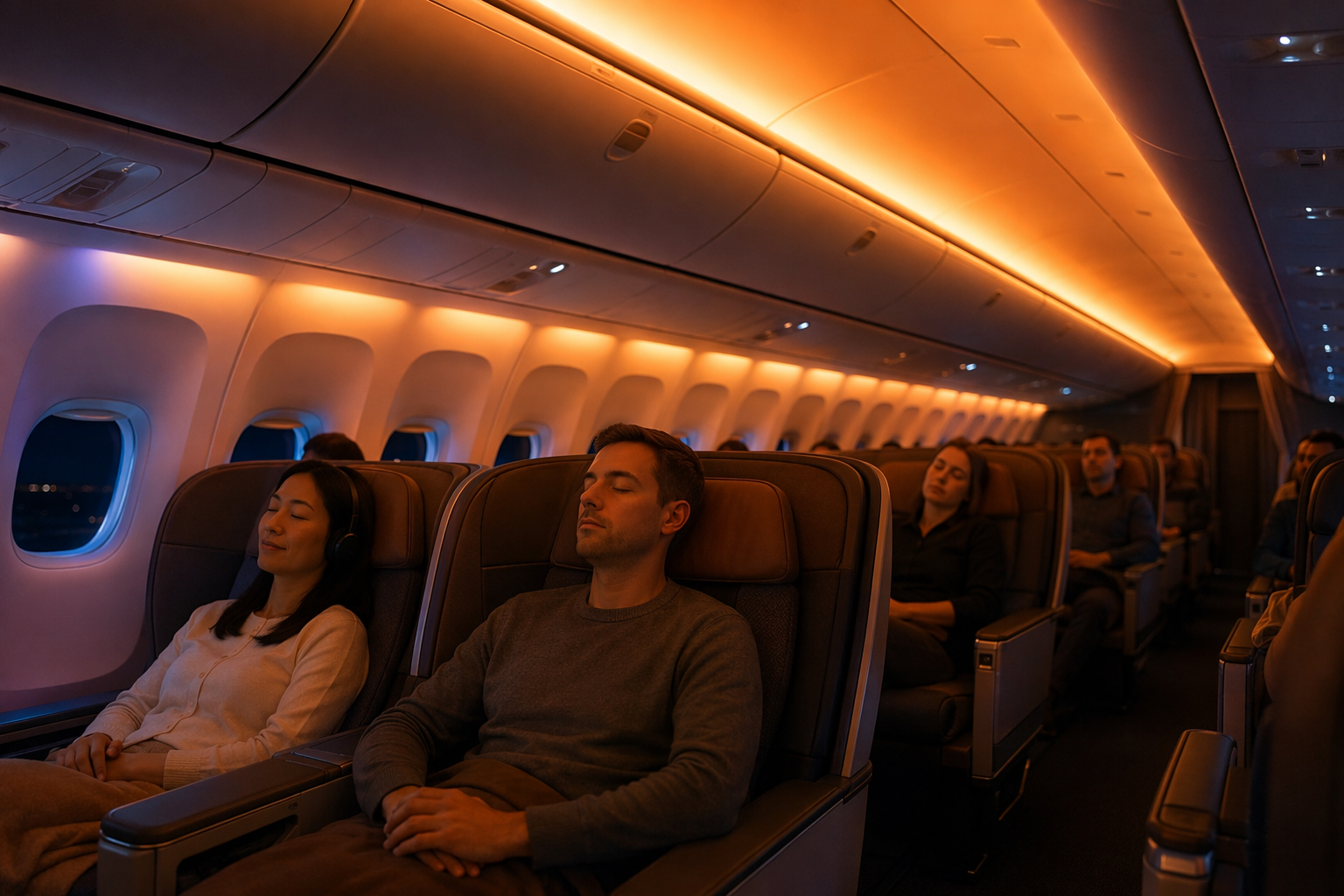
The 787’s LED cabin lighting adds a second layer. Airline and aviation accounts describe software-driven lighting scenes that can simulate sunset with warmer, dimmer light and sunrise with gradually increasing, blue-enriched light, often timed around the destination schedule.[7][3] This is biologically plausible because circadian timing is light-sensitive. It is not, however, proof that the 787 reduces jet lag as a measured clinical outcome.
The distinction matters because light can help or harm depending on timing. Blue-enriched light before the intended sleep window may push sleep later. Bright light near the destination morning may help adaptation. The same LEDs can be useful, neutral, or badly timed depending on the route, departure time, arrival time, and how the airline programs the cabin.
What the aircraft cannot control
Aircraft design can remove friction, but it cannot remove the passenger from the rest of the flight. Seat pitch, recline angle, meal timing, alcohol, caffeine, anxiety, neighbor behavior, crying infants, aisle traffic, and whether the flight departs at a biologically sensible time may dominate the experience. A lower cabin altitude helps less if the passenger is upright, stressed, and being woken for a meal service.
Class of service also complicates any simple Dreamliner claim. A lie-flat seat on an older aircraft may produce better sleep than a cramped economy seat on a 787. That does not undermine the engineering; it just keeps the conclusion in the right category. The Dreamliner changes the cabin environment. It does not equalize the human and commercial realities inside that cabin.
So, does the Boeing 787 Dreamliner improve sleep quality?
The best answer is calibrated: the 787 plausibly improves the conditions for restorative in-flight sleep compared with previous-generation aircraft, but it has not been clinically proven to improve sleep quality as a complete intervention. The lower cabin altitude has the strongest evidence because it maps to measured discomfort and oxygen saturation. Higher humidity, lower noise, gust suppression, dimmable windows, and circadian lighting each address a real sleep disruptor, but the sleep outcome evidence becomes more indirect as the list goes on.
That is still a stronger conclusion than “it is just marketing.” The Dreamliner is one of the rare commercial aircraft where materials engineering, cabin systems, and sleep physiology point in the same direction. It is not a sleep solution, and it does not prove a jet-lag cure. It is a better-designed environment for a body trying to sleep in a place bodies were not built to sleep.
References
- Effect of Aircraft-Cabin Altitude on Passenger Discomfort — NEJM
- The Aircraft Cabin Environment — PMC
- Boeing 787: The Unique Cabin Design That Helps Reduce Jet Lag — Simple Flying
- Dreamliner features — CNN
- Is It True The Boeing 787 Dreamliner Has A Smoother Ride Than The Airbus A350? — Simple Flying
- PPG Selected to Provide Dimmable Windows for Boeing 787 — Boeing MediaRoom, December 15, 2005
- How the Boeing 787 Dreamliner reduces your jet lag — The Points Guy
Comments
Join the discussion with an anonymous comment.