
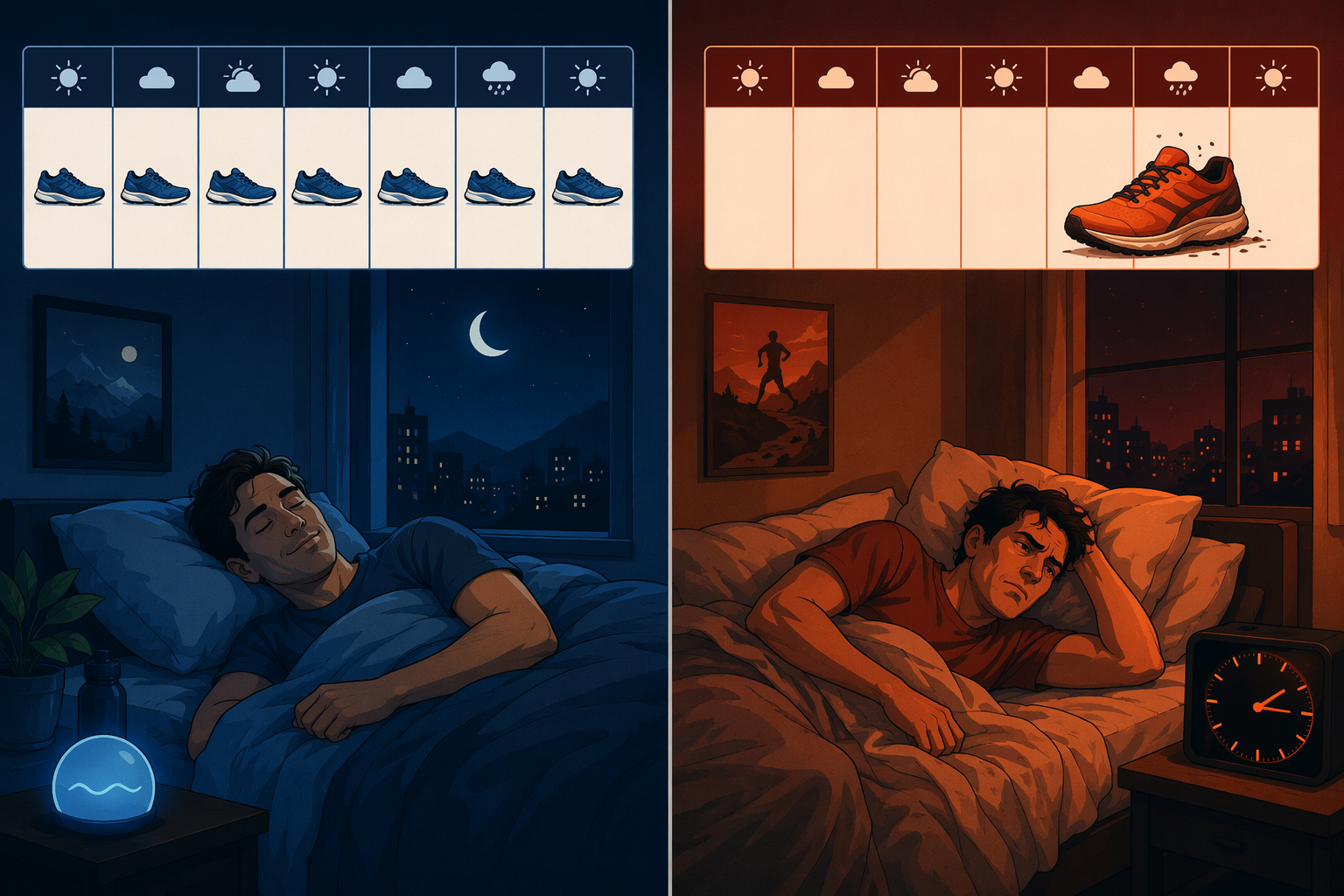
A familiar running week can look successful on paper and still do very little for sleep. One long Saturday run, maybe another hard session on Sunday, brings the weekly mileage total into respectable territory. By bedtime, though, the body may not behave like an accounting sheet. Sleep quality appears to respond less to the heroic lump sum and more to the repeated signal: move often enough, at a tolerable strain, and give the nervous system a rhythm it can use.
That is the practical question behind the running routine effect on sleep quality: not whether exercise is generally good for sleep, but whether distribution matters. The strongest recent answer comes from a July 2026 University of Texas at Austin study reporting that young adults who exercised more frequently got more restorative non-REM sleep, regardless of total weekly exercise minutes. In that study, even 10 minutes a day of moderate-to-vigorous activity, described as roughly a 6 out of 10 effort, was enough to improve sleep quality, next-day mood, and stress levels.[1]
The finding that makes 10 minutes count
The UT Austin study deserves attention because it did not rely on a single exercise questionnaire or a vague memory of “being active lately.” Participants wore Fitbits continuously over months, allowing researchers to compare activity patterns with sleep patterns across time. The important phrase is “more frequently — regardless of total weekly minutes.” It means the sleep signal was not simply explained by people doing more total exercise. The distribution itself mattered.[1]
For runners, that distinction is not trivial. A person who runs 30 minutes five days a week and a person who runs 75 minutes twice a week may both feel that they are “getting the miles in.” For cardiovascular guidelines, that weekly total has real value. For sleep, the newer evidence suggests the nervous system may care about how often it receives the stimulus. A short run can raise body temperature, increase daytime alerting signals, shift stress physiology, and then allow the post-exercise settling process to occur again that night. Repeating that modest pattern may be more sleep-relevant than compressing the strain into one or two large sessions.
The modesty of the dose is the point. Ten minutes is not a magic spell, and it should not be sold as a guarantee of deep sleep. But it weakens a stubborn assumption among busy adults: that anything under 45 minutes is not a “real” run. In the UT Austin data, the useful threshold was not a long training block. It was a repeatable bout of moderate-to-vigorous movement.[1]
There are limits. The sample was made up of university students using consumer wearable devices, so the finding should not be stretched automatically to older adults, people with insomnia disorder, shift workers, people managing chronic illness, or runners using very different training loads. The researchers are planning a broader five-year cohort study, which is the right next step for a claim this practical.[1]
Frequency is not the same as punishment
A 2023 systematic review gives the UT Austin result some broader company. Across the studies it reviewed, practicing free-time physical activity four to seven times per week was associated with better sleep quality.[2] That does not prove that running every day causes better sleep for every runner, and it does not isolate running from walking, cycling, resistance exercise, yoga, or other activity types. It does, however, point in the same direction: sleep tends to look better when activity is regular rather than occasional.
The danger is turning “more often” into “hard every day.” The ESSE-RF epidemiological study supplies the needed boundary. In that general Russian population study, high-intensity physical activity six or more times per week was an independent risk factor for difficulty initiating sleep, with an odds ratio of 1.9 and a 95% confidence interval of 1.4 to 3.4.[3] That is not a runner-specific trial, and “high physical load” in a population study is not identical to a structured training plan. Still, it is enough to rule out the lazy interpretation that daily intensity is automatically better.
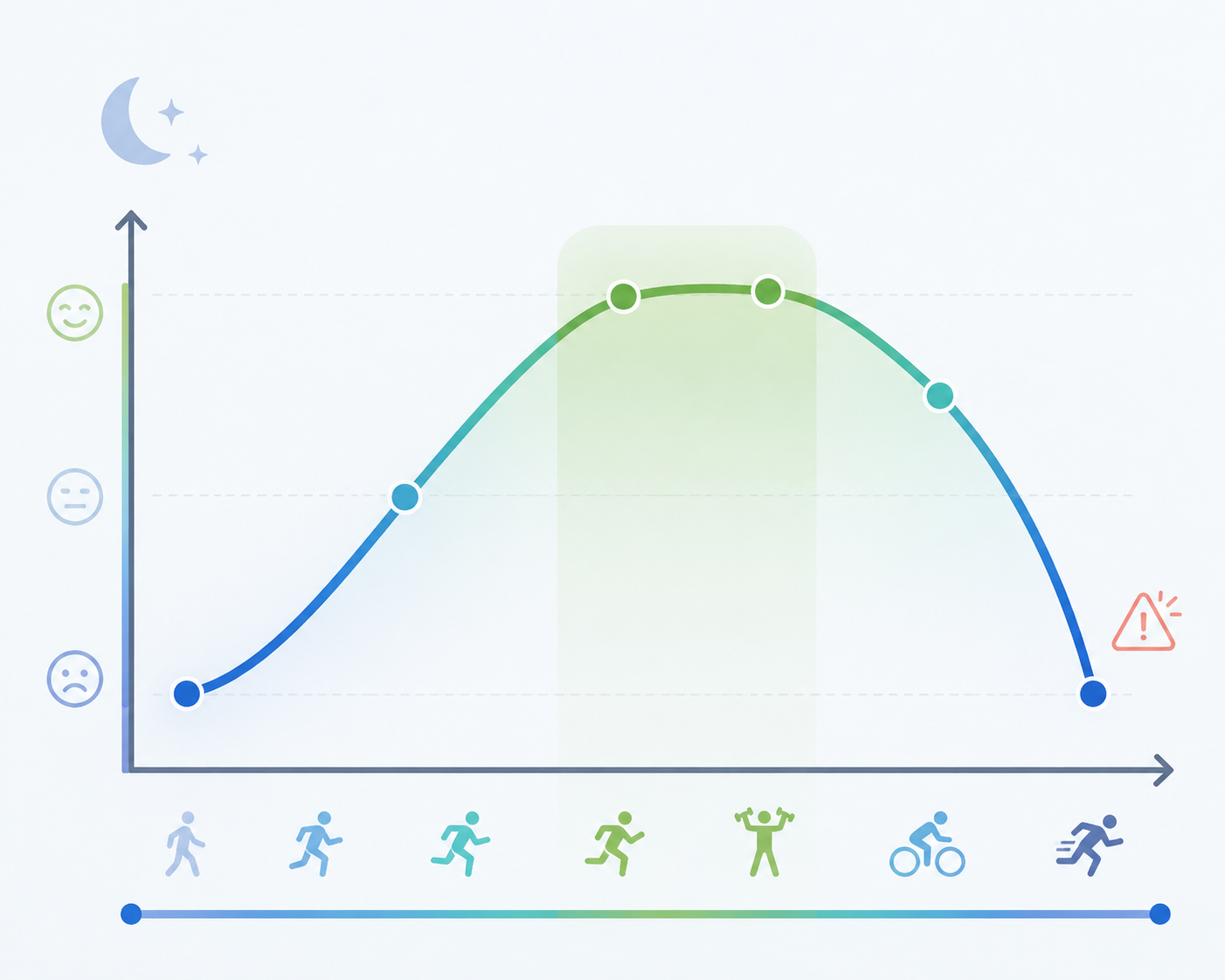
The useful target is boring by design: frequent, mostly moderate running. At about 6 out of 10 effort, breathing is elevated, but the session does not become a race rehearsal. You finish feeling exercised, not emptied. That distinction matters because sleep onset is sensitive to arousal. A short, steady run can act like a nudge; repeated hard sessions can become a demand the body has to keep processing.
| Weekly pattern | Likely sleep implication |
|---|---|
| One or two long, hard runs | May meet a mileage goal, but concentrates strain and may not provide a consistent sleep signal |
| Four to seven moderate sessions | Matches the broader pattern associated with better sleep quality in free-time activity research |
| Six or more high-intensity sessions | Belongs in a different risk category because frequent high load has been linked with difficulty initiating sleep |
| Daily 10-minute moderate-to-vigorous movement | Promising minimum dose in the UT Austin wearable study, especially for repeatability |
Why a repeated moderate signal may change the night
The mechanism is probably not one single switch. Exercise affects sleep through body temperature, circadian timing, stress regulation, and the balance between activation and recovery. Johns Hopkins Medicine describes exercise as raising core body temperature and then allowing a later drop that can support sleepiness; it also notes that aerobic exercise can increase the amount of slow-wave sleep, the deep sleep involved in physical restoration.[5] The Sleep Foundation similarly emphasizes circadian rhythm, mood, and stress pathways in the exercise-sleep relationship.[6]

Those mechanisms make frequency plausible. A run on Monday cannot keep entraining the body on Thursday with the same force. A moderate run repeated across the week gives the body more regular daytime cues: heat up, mobilize, discharge some stress, cool down, sleep. The important part is not that every session must be long. It is that the signal arrives often enough to become part of the daily rhythm.
Timing and strain complicate the picture. A 2025 Nature Communications study from Monash University reported a dose-response relationship between exercise timing, strain, and sleep outcomes.[4] That is the piece that weekend-warrior logic often misses. The same miles placed at a different time of day, or run at a different intensity, may not produce the same night.
For many runners, this makes the evening session the one to watch. A relaxed early evening jog may be harmless or helpful. A late hard workout that leaves the body hot, hungry, mentally keyed up, and chasing a delayed dinner is a different physiological event. The sleep problem may not be “running” at all; it may be the combination of intensity, timing, and insufficient wind-down.
How to use the evidence without overclaiming it
The most defensible adjustment is to distribute running before adding mileage. If the current pattern is two larger runs, the first experiment is not necessarily a bigger week. It may be turning some of that volume into shorter sessions across more days. A runner who already tolerates 60 minutes on Saturday might sleep better with some of that effort moved into Tuesday, Thursday, and Friday, even if the weekly total barely changes.
- Use 10 minutes as a legitimate minimum, not as a consolation prize.
- Keep most runs moderate enough that sleep onset does not worsen.
- Add frequency before adding intensity.
- If hard sessions climb toward six or more per week, treat insomnia symptoms as a warning sign.
- Judge the routine by the next night’s sleep, not just by the Sunday mileage total.
This is not an argument against long runs. Long runs have their place for endurance, confidence, and race preparation. They are just a poor substitute for rhythm if the goal is sleep quality. The body may benefit from both: a longer aerobic session when training calls for it, and smaller movement cues spread across the week when sleep is the outcome being protected.
The cleanest practical test lasts long enough to observe a pattern but does not require a life overhaul. For two or three weeks, replace the all-or-nothing schedule with short moderate runs on more days. Keep bedtime, caffeine, alcohol, and late meals as stable as realistically possible, because otherwise the running signal gets buried under louder sleep disruptors. Track sleep onset, awakenings, perceived depth of sleep, and morning mood. A wearable can help, but the nightly experience matters too.
Where the line should be drawn
The emerging evidence favors frequency over mileage for sleep quality, but the claim should stay narrow. The UT Austin study supports the idea that frequent moderate-to-vigorous activity, even in short daily bouts, is linked with more restorative non-REM sleep in young adults wearing Fitbits.[1] The 2023 review supports the broader association between four to seven weekly free-time activity sessions and better sleep quality.[2] The ESSE-RF study warns that high-intensity activity six or more times per week can move in the wrong direction for sleep initiation.[3]
So the better sleep strategy is not to become a miniature endurance hero every day. It is to stop saving all the effort for the weekend and give the body a repeatable, moderate signal. Daily movement can be small enough to keep. Hard daily training is a different category, and sleep is often one of the first places the difference shows up.
References
- Baird & Corral, Journal of Physical Activity & Health study news release, University of Texas at Austin, July 2026, link
- The Effect of Physical Activity on Sleep Quality and Sleep Disorder: A Systematic Review, Cureus, 2023, link
- Physical Activity and Sleep Quality in the Russian Population in the ESSE-RF Epidemiological Study, Frontiers in Psychology, 2021, link
- Dose-response effects of evening exercise on sleep and physical activity in real-world settings, Nature Communications, April 2025, link
- Exercising for Better Sleep, Johns Hopkins Medicine, link
- Exercise and Sleep, Sleep Foundation, link
Comments
Join the discussion with an anonymous comment.