
The same daylight saving time change can look like three different problems in one house. A toddler may be wide awake at a clock time that says bedtime because the evening still looks biologically active. A school-age child may be pulled out of bed for a darker walk, bus stop, or car line. A teenager may seem to “get over it” by Tuesday and still carry measurable sleep debt into Friday.
That is the first correction to make when asking how daylight saving time affects children's sleep: children are not one sleep group. The clock moves by one hour, but light moves at both ends of the day. In spring, morning light arrives later by the clock, while evening light lingers later by the clock. For a child’s circadian system, that is not a tidy one-hour inconvenience. It changes the timing of the signals that tell the brain when to become alert and when to start preparing for sleep.
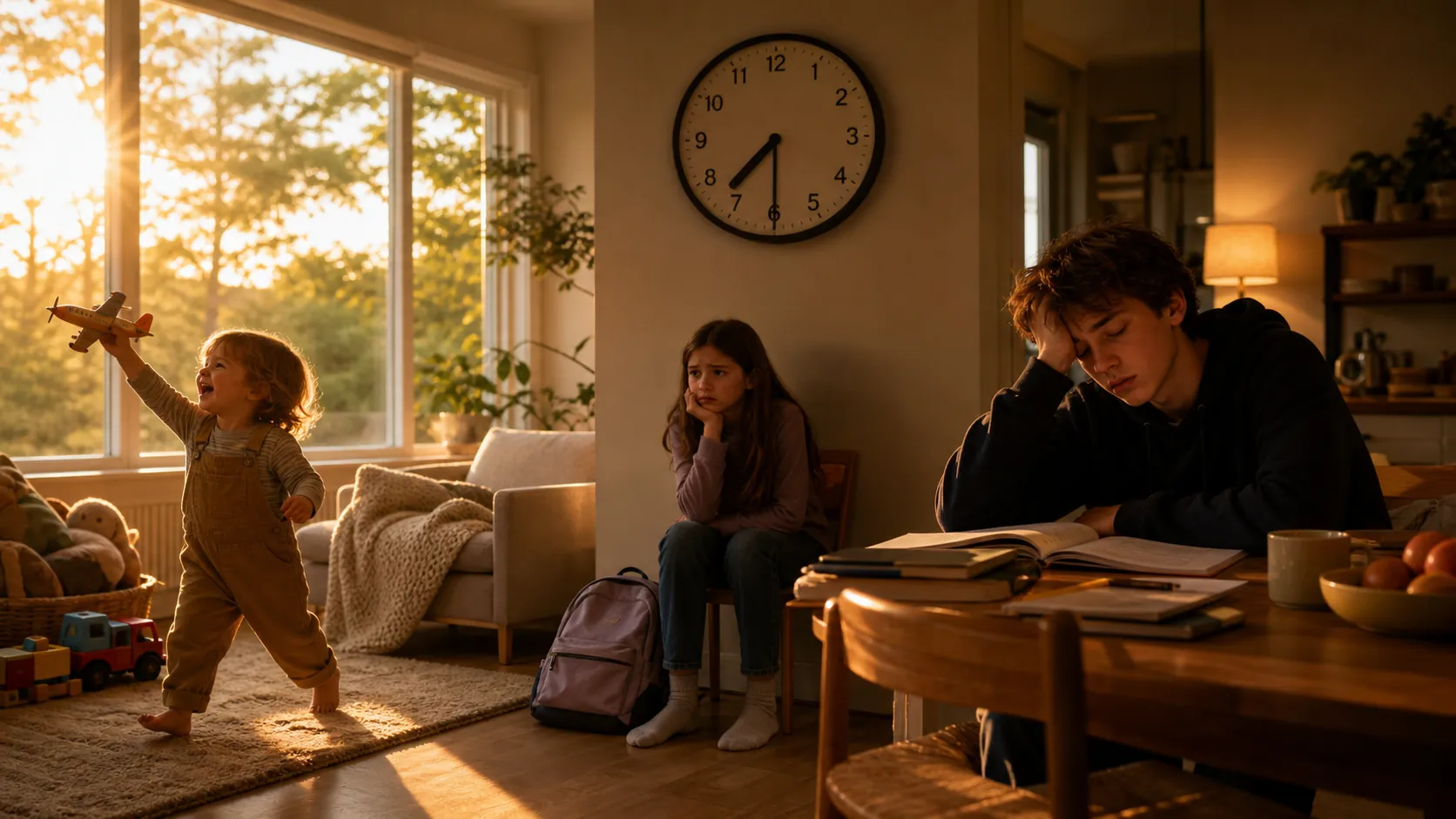
The clock changes once; the biology changes by age
Sleep timing is not controlled only by tiredness. It is shaped by circadian timing, sleep pressure, light exposure, family routines, school schedules, and, for older children, puberty. Daylight saving time pushes on all of those at once, but not equally.
| Age group | Main DST pressure | What parents often see |
|---|---|---|
| Infants, toddlers, and preschoolers | Later evening light and a still-immature ability to handle schedule shifts | Bedtime resistance, early waking after fall-back, disrupted naps, more visible crankiness |
| School-age children | Fixed school start times colliding with darker mornings | Harder wake-ups, sleepiness at breakfast, darker commutes, less margin for morning routines |
| Adolescents | DST layered onto the natural pubertal delay in sleep timing | Later sleep onset, shorter school-night sleep, attention and vigilance problems that can last through the week |
The pattern matters because the useful response depends on the mechanism. A preschooler fighting bedtime under bright evening light is not solving the same problem as a high school student whose body is already shifting later and whose first-period class has not moved with it.
Why younger children can look suddenly impossible at bedtime
For babies and young children, daylight saving time often shows up as a mismatch between the household clock and the child’s internal night. The family may be moving toward pajamas, books, and lights-out, while the child’s brain is still receiving a strong “daytime” message from the environment.
This is especially obvious in spring, when the clock says bedtime but the sky may still be bright. Evening light delays the body’s preparation for sleep by suppressing or postponing melatonin signaling. The exact strength of that effect in preschoolers during DST is not well established by large DST-specific actigraphy studies; the practical guidance here comes mostly from pediatric sleep specialists and children’s hospitals rather than from a large body of primary DST measurement in toddlers and preschoolers.
That does not make the problem imaginary. It means the certainty is clinical rather than large-scale epidemiologic. Pediatric sleep guidance consistently treats light timing, routine timing, and gradual schedule shifts as the main levers for young children. Children’s Hospital of Philadelphia notes that many children adjust within about one week, while some take up to two weeks, and recommends preparing before the clock change rather than waiting for the Sunday-night collision.[2]
Fall can be rough in a different way. When clocks move back, some young children do not sleep in just because adults get an extra clock hour. An early riser whose body expects morning may wake even earlier by the new clock. Pediatric clinicians quoted by Cincinnati Children’s describe fall-back as particularly hard for younger children, while spring-forward is often harder on teens.[3]
School-age children meet DST in the morning
By elementary school, the problem becomes less purely about bedtime and more about the morning handoff to the outside world. School start times, buses, drop-offs, walking routes, breakfast, medications, and before-school care keep moving at clock time even when the child’s light exposure has shifted.
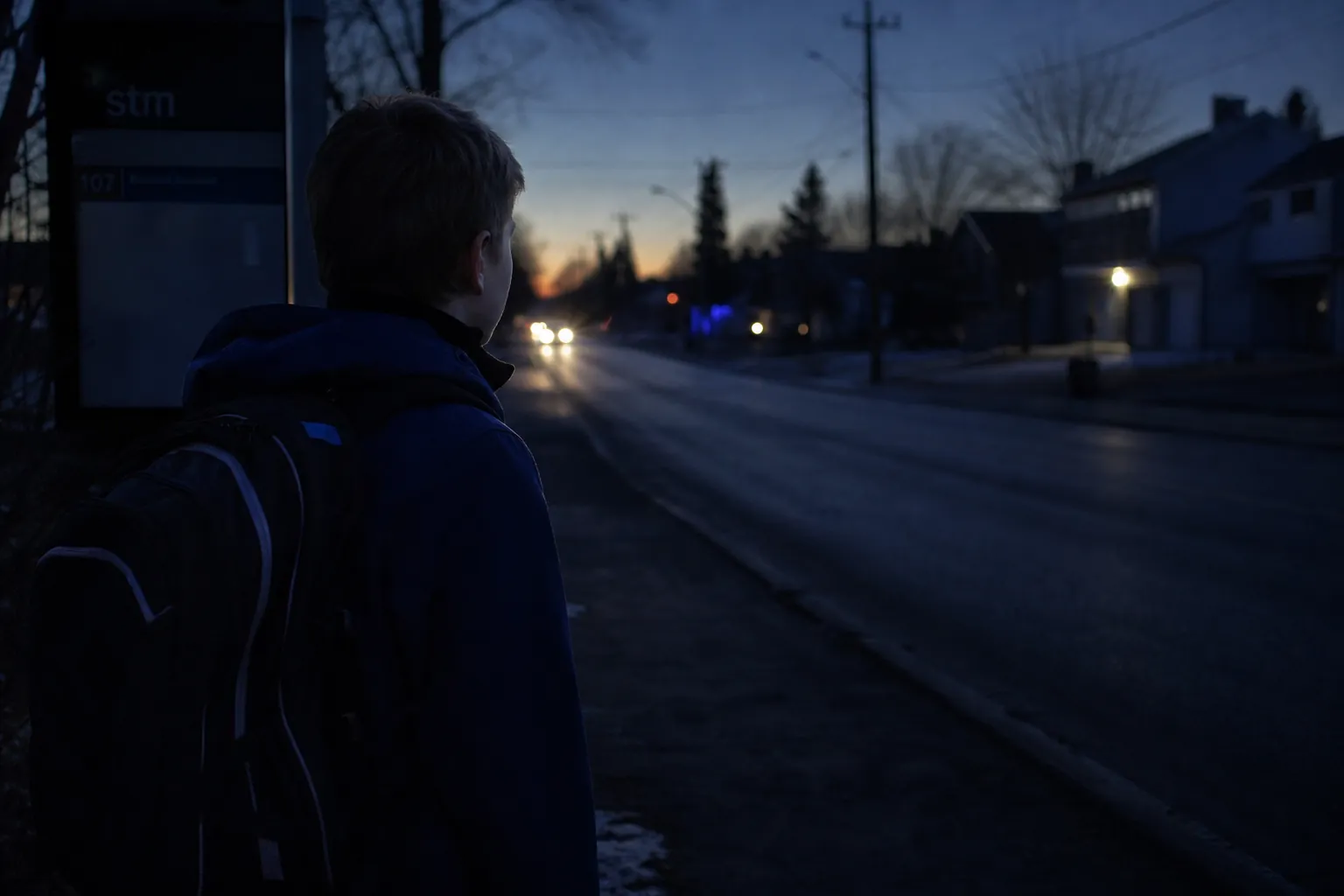
The darker-morning issue is not only about feeling groggy. During the U.S. experiment with year-round daylight saving time in the 1970s, the National Bureau of Standards documented increased fatalities among school-aged children during morning commuting hours between January and April, a finding cited in the American Academy of Sleep Medicine’s position statement supporting permanent standard time.[4]
That historical evidence should not be stretched into a claim that every DST morning commute is dangerous in the same way. It does show why children disappear too easily from adult-centered DST debates. A darker morning is not just an aesthetic inconvenience when a child is waiting near traffic, walking to school, or crossing a road before full daylight.
For school-age children, sleep loss and safety can also reinforce each other. A child who woke before the body was ready may move more slowly, miss breakfast, argue over shoes, or become less attentive near traffic. The body is being asked to perform morning behavior before morning biology has caught up.
The teen problem is measured sleep debt, not laziness
Adolescents deserve the most precise discussion because the strongest child-specific DST sleep data are in teens. Puberty shifts circadian timing later, making it biologically easier for many teens to fall asleep later and harder to wake early. Spring daylight saving time adds a second delay pressure: darker mornings give the body less early light to anchor wake timing, and brighter evenings make it easier to stay alert later.
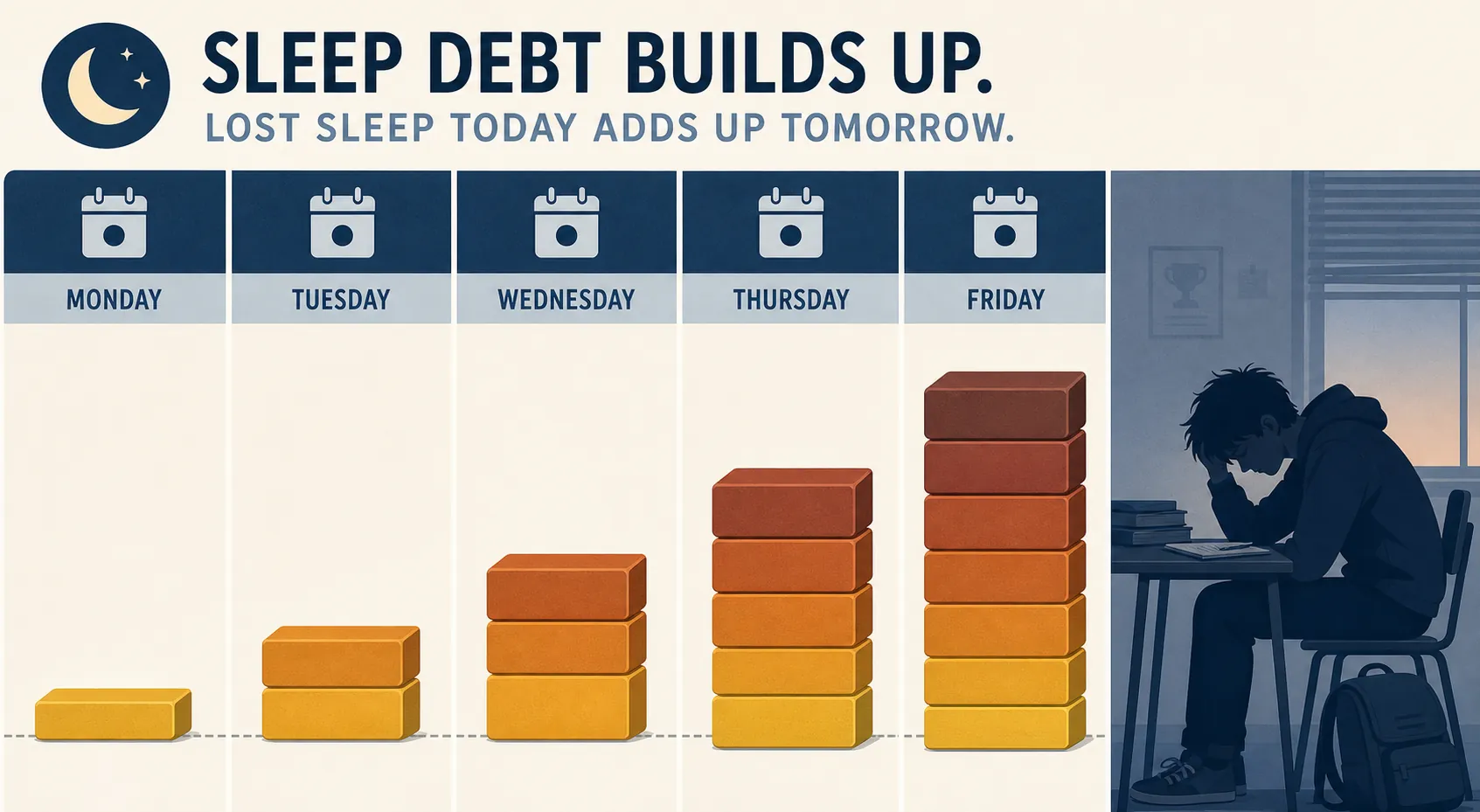
In a 2015 Journal of Clinical Sleep Medicine study, Medina and colleagues measured 35 high school students with actigraphy before and after the spring DST change. The teens lost about 32 minutes of sleep per school night after the change, accumulating 2 hours and 42 minutes of sleep loss across the school week. Their vigilance impairment persisted through Friday.[1]
The study has real limits: 35 students, one high school, and a design that cannot represent every teen, every school schedule, or every family environment. Its value is that it used actigraphy rather than relying only on memory or parent report, and it remains the only published actigraphy-based measurement of DST sleep loss in adolescents identified here. The American Academy of Sleep Medicine has also highlighted the study in its DST discussion, which gives it more weight than its sample size alone might suggest.[1][4]
The Friday finding is the part that should change how parents interpret the week. A teen may stop complaining after the first morning and still be carrying slower reaction time and poorer vigilance. The household may feel as if the transition is over because the clocks have been changed, while the school week is still collecting the cost.
That distinction matters at home. If a teen is more irritable, less alert while driving or commuting, slower with homework, or harder to wake after spring-forward, the first explanation should not be character. DST has been layered onto a developmental stage already tilted toward later sleep.
Why permanent standard time keeps coming up in sleep medicine
The broader sleep-medicine judgment is fairly consistent: permanent standard time aligns better with human circadian biology than permanent daylight saving time. The American Academy of Sleep Medicine’s position statement says permanent standard time is the optimal choice for health and safety and notes endorsement from more than 20 medical, scientific, and advocacy organizations.[4]
The reason is not nostalgia for winter darkness. Standard time places morning light earlier by the clock and evening darkness earlier by the clock, which better supports circadian alignment. The AASM statement also cites evidence that the body clock may not fully adjust to DST even after months, including research on cortisol rhythms.[4]
For children, that policy argument becomes concrete. Morning light helps a sleepy brain wake and reset. Evening darkness helps bedtime become biologically plausible. When the clock arrangement does the opposite, parents can compensate only so much with routines and blackout curtains.
What parents can actually change
The most useful DST advice follows directly from the mechanism: move timing gradually, strengthen morning light, reduce evening light, and protect routine. These steps do not erase the clock change, but they reduce the size of the biological surprise.
- Shift sleep and wake times by 10 to 15 minutes per day for several days before the transition. This gradual approach is recommended across pediatric sleep guidance, including CHOP and other pediatric sleep clinicians.[2][5]
- Use morning light as the anchor. Seattle Children’s and Stanford Children’s both emphasize morning light exposure as a key circadian reset signal after the clock change.[6][7]
- Dim the evening environment, especially for younger children. Bright rooms, late outdoor play in strong evening light, and a glowing tablet can all tell the brain that night has not arrived.
- Keep screens away from the last 30 to 60 minutes before bed. Pediatric sleep guidance from CHOP and Cincinnati Children’s recommends a screen curfew because evening light exposure can interfere with melatonin timing.[2][3]
- Expect variation. Many children settle within about a week, but some take up to two weeks, especially if they are already short on sleep or have a sensitive schedule.[2]
The age of the child should shape which lever gets the most attention. For toddlers and preschoolers, protect the wind-down: dim rooms, consistent bedtime cues, and a gradual schedule shift matter more than explaining the clock. For school-age children, build more margin into the morning if possible, because darkness and sleep inertia make rushing worse. For teens, the priority is preventing the spring change from becoming a five-night sleep-debt event: earlier light in the morning, fewer late-night screens, and a realistic reduction in evening demands during the transition week.
When the problem is not just DST
DST can expose a sleep problem that was already there. Loud snoring, breathing pauses, extreme daytime sleepiness, persistent insomnia, regular morning headaches, or a sleep disruption that does not improve after the adjustment window deserves more than another week of clock-change patience. In those cases, the issue is no longer only seasonal timing; it is worth discussing with a pediatrician or pediatric sleep specialist.
The child who struggles is not failing the clock change
Daylight saving time affects children’s sleep differently because development changes the point of collision. Younger children are more exposed to the bedtime consequences of evening light and fragile routines. School-age children feel the fixed morning schedule and, in some settings, darker commute conditions. Adolescents absorb DST on top of a natural biological delay and can accumulate measurable sleep debt across the school week.
Parents can soften the transition with gradual timing, morning sunlight, darker evenings, screen limits, and steady routines. They cannot make every child respond the same way, because the disruption is not caused by parental inconsistency or children being difficult. It is biology meeting a social clock.
References
- Adverse Effects of Daylight Saving Time on Adolescents' Sleep and Vigilance, Journal of Clinical Sleep Medicine, 2015.
- 5 Ways to Help Kids Adjust to Daylight Saving Time, Children's Hospital of Philadelphia.
- Why Daylight Saving Time Is Hard on Kids, Cincinnati Children's.
- Permanent standard time is the optimal choice for health and safety: an American Academy of Sleep Medicine position statement, Journal of Clinical Sleep Medicine.
- Daylight Savings Time and Your Child: Springing Ahead, Dr. Craig Canapari.
- Daylight Savings Time, Seattle Children's.
- Spring Forward Into Better Sleep, Stanford Children's.
Comments
Join the discussion with an anonymous comment.