
The most persuasive defense of evening coffee is also the most ordinary one: I can still fall asleep. If the lights go out, the mind settles, and sleep arrives without a fight, it seems reasonable to assume caffeine is not the problem.
That assumption runs into a stubborn finding from a controlled sleep-lab study. In Drake and colleagues’ 2013 trial, 400 mg of caffeine taken six hours before bedtime reduced objective total sleep time by more than one hour. The participants’ sleep diaries did not capture the same disruption.[1] In other words, the sleeper’s experience and the sleeper’s measured night separated.
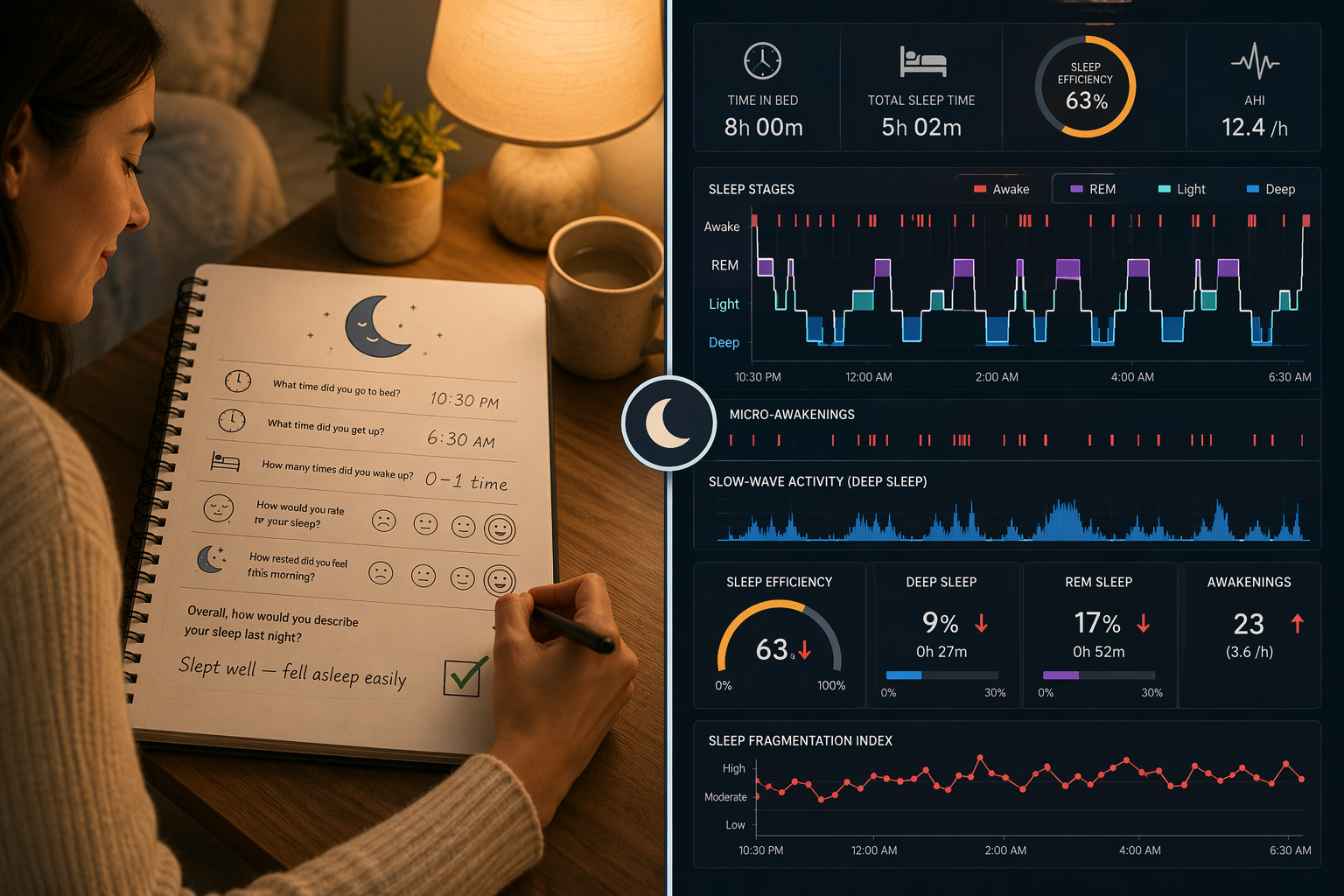
This is the answer to the practical question: caffeine may not announce itself as insomnia. It can shorten sleep, make the night less efficient, increase wakefulness after sleep begins, reduce deep sleep pressure, and shift circadian timing while leaving the person with the perfectly honest impression that nothing dramatic happened.
Falling asleep is only one measurement
Sleep onset gets too much attention because it is the part of sleep we can narrate. We remember lying awake. We remember not lying awake. But sleep quality is not one event at the front door of the night. It includes how much sleep occurs, how consolidated it is, how often wakefulness intrudes after sleep begins, how much slow-wave sleep the brain builds, and whether the night is aligned with the body’s circadian signal.
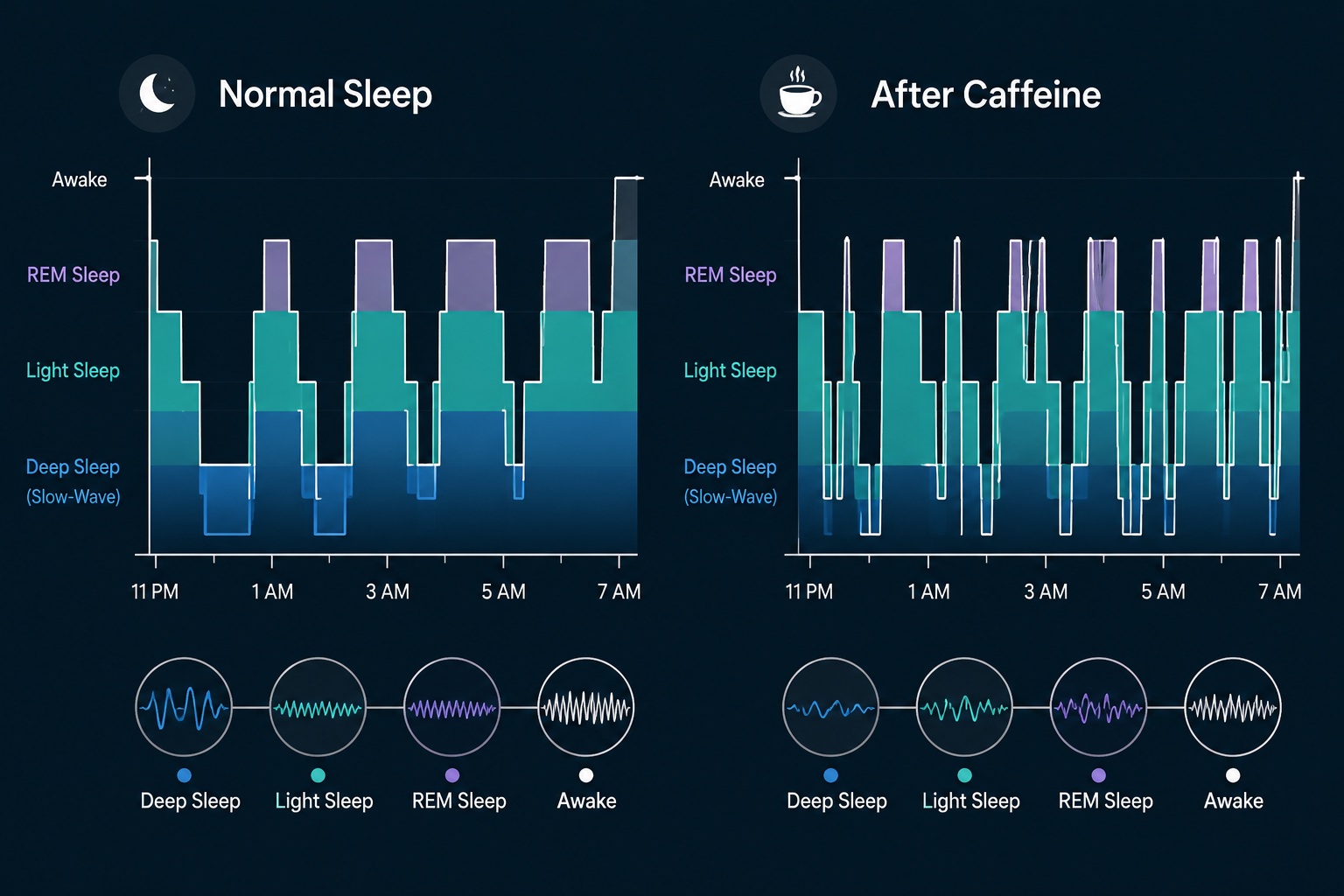
A 2023 systematic review and meta-analysis by Gardiner and colleagues, covering 24 studies, found that caffeine reduced total sleep time by about 45 minutes, reduced sleep efficiency by about 7%, and increased wake after sleep onset by about 12 minutes.[2] Those are not all the same problem. A person can fall asleep quickly and still lose total sleep. A person can spend enough time in bed and still have poorer sleep efficiency. A person can believe the night was continuous and still show more wakefulness after sleep begins.
| Sleep measure | What it asks | Why caffeine can be missed |
|---|---|---|
| Sleep onset | How long it takes to fall asleep | Many people judge the whole night by this single step |
| Total sleep time | How much sleep actually occurred | Lost minutes can be spread across the night rather than felt as one obvious awakening |
| Sleep efficiency | How much time in bed was spent asleep | Small awakenings and lighter sleep can lower efficiency without feeling memorable |
| Wake after sleep onset | How much wakefulness occurs after sleep begins | Brief awakenings may not be encoded as a clear memory |
| Slow-wave activity | How strongly the brain expresses deep sleep pressure | The sleeper may feel asleep while the architecture of sleep has changed |
The Drake study matters because it does not rely on the sleeper noticing the damage. A diary is useful for many things: bedtime habits, perceived rest, awakenings someone remembers, and day-to-day patterns. It is less suited to detecting subtle changes in sleep stages or short awakenings that never become a story in the morning. That is not denial or carelessness. It is a limitation of consciousness during a state in which consciousness is partly offline.
Why caffeine can disturb sleep without making you feel wired
Caffeine’s familiar alerting effect begins with adenosine. Across wakefulness, adenosine signaling helps express sleep pressure; caffeine interferes partly by blocking adenosine receptors, including A2A receptors involved in sleep-wake regulation.[3] For a deeper walk through that biology, see adenosine and sleep pressure.
The important point is not simply that caffeine makes people feel more awake. Feeling awake is only the conscious edge of the mechanism. Adenosine signaling is also tied to the pressure that helps shape deeper sleep. Reichert and colleagues’ 2022 review describes caffeine-related changes in EEG slow-wave activity and sigma activity after caffeine exposure, which means the sleeping brain can look different even when the sleeper is not lying there thinking, “I am stimulated.”[3]
That distinction explains why “I did not feel wired” is not the same as “my sleep architecture was untouched.” A person may have enough sleep pressure to fall asleep, while caffeine still blunts or reshapes the expression of that pressure after sleep begins. The felt experience can be ordinary; the night can still contain less restorative depth or more fragmentation.
This is also why deep sleep deserves separate attention from sleep duration. A long night is not automatically a deep night. If the question is how to protect slow-wave sleep specifically, the practical conversation overlaps with broader habits discussed in natural remedies for deep sleep, but caffeine belongs in the science discussion because it acts directly on one of the systems that helps the brain register and respond to prior wakefulness.
Caffeine can also move biological night later
There is a second mechanism that is easy to overlook if caffeine is treated only as a stimulant. In a 2015 Science Translational Medicine study, evening caffeine at about 200 mg delayed the circadian melatonin rhythm by approximately 40 minutes.[4] That does not mean every coffee drinker shifts by the same amount, and it does not turn caffeine into the only driver of circadian timing. Light exposure, schedule, age, and individual biology still matter. But it shows that caffeine can nudge the timing system, not just the feeling of alertness.
A melatonin delay changes the interpretation of a “normal” bedtime. Someone may go to bed at the usual clock time, fall asleep, and still be sleeping against a slightly later biological night. The result may show up as lighter early sleep, altered timing of sleep stages, or a morning that feels less restored than the diary would predict.
Why people disagree about whether caffeine affects them
Caffeine is not one exposure. A 400 mg dose is not a small cup of tea. Three hours before bed is not twelve hours before bed. A daily coffee drinker in early adulthood is not the same biological experiment as an older adult with lighter sleep. The research is strongest when it shows patterns under controlled conditions; it is weaker when those patterns are turned into a universal cutoff that pretends everyone clears and responds to caffeine the same way.
The range of caffeine half-life alone makes tidy rules fragile. Published research places typical variability at roughly 2 to 12 hours, and genetic sensitivity, including variation related to ADORA2A, can change how strongly people experience caffeine’s effects. That does not make the sleep findings irrelevant. It means the same dose and timing can produce different conscious experiences and different sleep measurements in different people.
The SleepSmart study is a useful complication. In a small 2025 study of young adults, 240 mg of caffeine three hours before bed did not change objective sleep duration, but reports of poor sleep increased by 8% with coffee and 20% with energy drinks.[5] That pattern is almost the mirror image of Drake’s objective-subjective gap: here, participants reported worse sleep without an objective duration change. The study was small, with 40 participants and a short intervention, so it should not overrule the controlled sleep-lab and meta-analytic evidence. It does, however, remind us that “sleep quality” is not a single dial and that subjective discomfort can move separately from measured duration.
There is also emerging evidence pushing the timing question earlier. A 2024 Sleep abstract reported that 400 mg of caffeine disrupted sleep architecture even when consumed 12 hours before bedtime.[6] Because that point comes from an abstract rather than a full-text report, it should be treated as a boundary-stretcher, not a settled household rule. It fits the pharmacology well enough to take seriously: residual caffeine may still matter below the level at which a person consciously feels stimulated. But it does not justify telling every reader that one fixed cutoff will protect every night.
The morning-after trap
The quietest consequence of caffeine-disrupted sleep is not always the night itself. It is the next morning, when the person wakes up less restored and reaches for caffeine earlier or more strongly. That decision may be completely reasonable from the inside. The body feels underpowered. Coffee works. The day starts.
The problem is that the morning fix can conceal the previous evening’s cost. If caffeine shortened sleep, lowered efficiency, fragmented the night, reduced deep sleep expression, or nudged circadian timing later, the fatigue being treated today may partly belong to yesterday’s caffeine. This does not make coffee a moral failure. It makes it a variable worth measuring more honestly than “I fell asleep.”
A better self-test starts by separating the parts of sleep that usually get blurred together:
- Did caffeine change how fast you fell asleep?
- Did it change how often you woke or shifted into lighter sleep?
- Did it change how restored you felt before the first cup the next morning?
- Did the same dose feel different when taken earlier, reduced, or skipped?
- Did weekend or low-caffeine days reveal a different baseline?
Those questions are not as clean as a lab study, and consumer trackers cannot replace polysomnography. But they move the personal experiment toward the right target. The relevant question is not only whether sleep begins. It is what kind of sleep caffeine leaves behind.
Readers who want the practical timing side after the science can use a separate guide on when to stop drinking coffee for better sleep. The narrower point here is to make “I can fall asleep” feel less conclusive than it once did.
References
- Caffeine Effects on Sleep Taken 0, 3, or 6 Hours before Going to Bed, Journal of Clinical Sleep Medicine, 2013.
- The effect of caffeine on subsequent sleep: A systematic review and meta-analysis, PubMed, 2023.
- Adenosine, caffeine, and sleep-wake regulation: state of the science and perspectives, 2022.
- Effects of caffeine on the human circadian clock in vivo and in vitro, Science Translational Medicine, 2015.
- SleepSmart Study, 2025.
- Dose and timing effects of caffeine on sleep architecture, Sleep, 2024.
Comments
Join the discussion with an anonymous comment.