
The most useful way to think about how sleep affects memory formation through tau protein is not to begin with fear of Alzheimer’s disease. Begin instead with movement. During sleep, the brain appears to shift into a different fluid-handling state: cerebrospinal fluid moves through tissue, resistance in the brain’s extracellular spaces changes, and proteins associated with Alzheimer’s pathology, including tau and amyloid-beta, can be transported out toward the blood.
That is the wash-cycle idea behind the glymphatic system. In a 2026 human trial, Dagum and colleagues reported direct evidence that sleep-active glymphatic clearance transports tau and Aβ from the brain to plasma. NREM sleep duration predicted overnight tau clearance, and reduced parenchymal resistance was the dominant physiological predictor of morning biomarker variance, explaining more than 50% of that variance in amyloid-positive participants and more than 90% in amyloid-negative participants.[1]
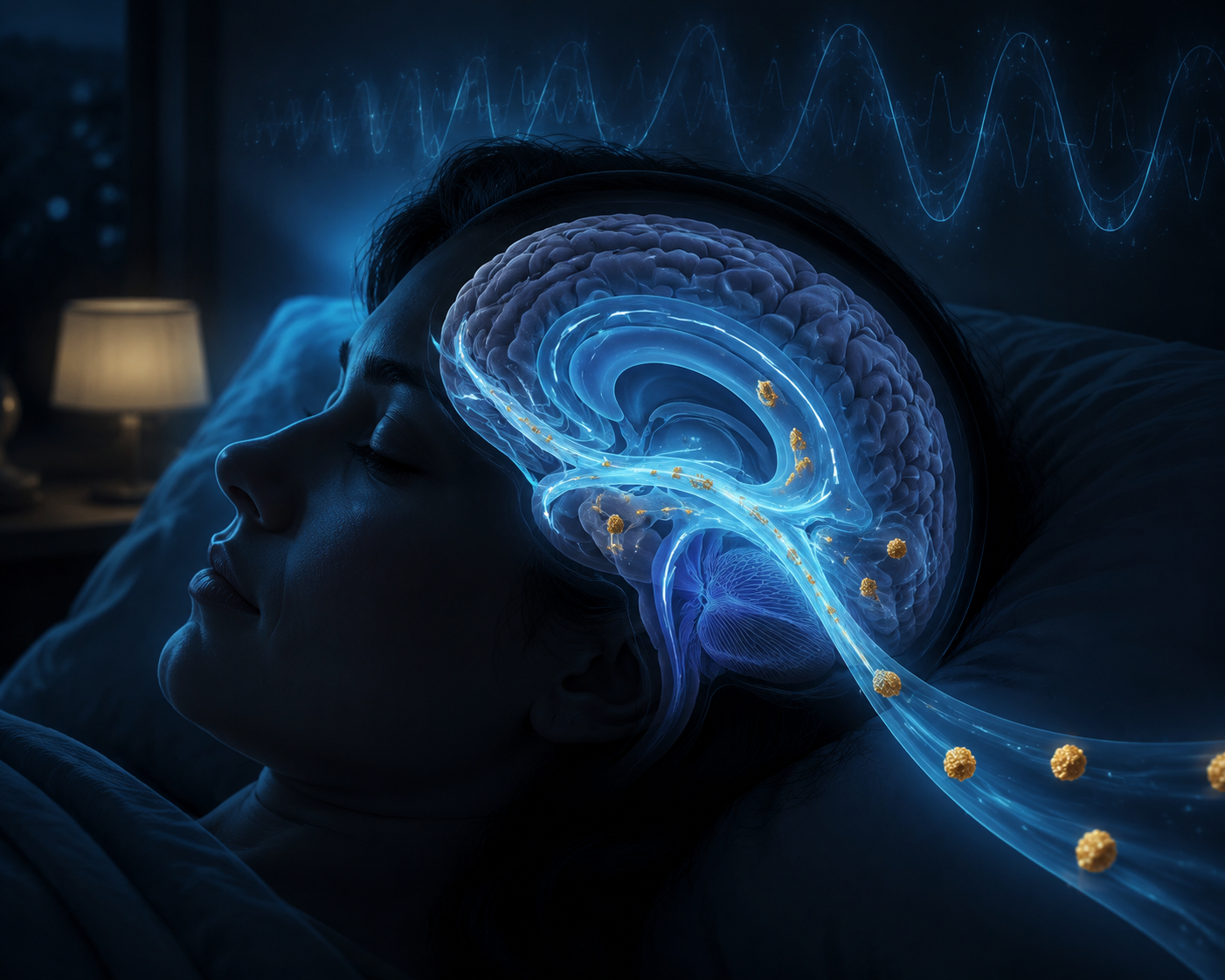
Those measurements do not mean that a blood test after one night can tell a person whether Alzheimer’s disease is coming. They do mean that sleep is harder to describe as passive rest. At least in this line of evidence, sleep is a state in which the brain’s physical environment changes in ways that matter for protein traffic.
Tau is useful until it starts moving the wrong way
Tau is not an intruder. In healthy neurons, tau helps stabilize internal structures that support transport along the cell. The problem begins when tau becomes abnormal, misfolds, accumulates, and spreads through connected brain regions. In Alzheimer’s disease, tau tangles are closely tied to neurodegeneration and cognitive decline, especially when pathology reaches memory-relevant networks.
Memory formation depends on more than one brain region, but the hippocampus and entorhinal cortex are especially important for forming and organizing new memories. These are also regions that appear in tau-spread models. That overlap is why tau clearance during sleep is not a side issue for memory; it sits near the machinery that lets yesterday’s experience become tomorrow’s retrievable memory.
A startling human signal came from a small sleep-deprivation study published in 2019. Eight healthy adults underwent lumbar puncture after a normal night and after a sleepless night; after sleep deprivation, cerebrospinal fluid tau rose by about 50%. Parallel mouse work supported the interpretation that wakefulness itself, rather than stress alone, was driving the effect.[2]
That 50% number is memorable, and it should also be held carefully. The human sample was eight people. The measurement was acute CSF tau after one night, not a diagnosis, not a forecast of dementia, and not evidence that one bad night causes permanent damage. Its importance is that tau can move quickly with sleep-wake state, and that observation fits with the larger glymphatic clearance chain.
Why NREM slow-wave sleep gets so much attention
Sleep is not one uniform condition. REM sleep, light NREM sleep, and deeper NREM slow-wave sleep have different electrical patterns and different physiological roles. For tau clearance, the evidence now points most strongly toward NREM sleep, especially the slow-wave state that dominates the deepest part of non-REM sleep.
| Part of the chain | What the evidence suggests | What it does not prove by itself |
|---|---|---|
| NREM sleep duration | Predicts overnight tau clearance in the 2026 human glymphatic trial | That longer NREM sleep alone prevents Alzheimer’s disease |
| Reduced parenchymal resistance | Appears to make brain-to-plasma biomarker movement more efficient | That plasma tau is the same as long-term brain tau accumulation |
| One sleepless night | Can acutely raise CSF tau in a small human study | That one night of insomnia causes lasting memory loss |
| Tau pathology | Correlates with reduced slow-wave activity in older adults | That every poor sleeper has tau pathology |
Slow waves are large, synchronized electrical oscillations. They are not merely a sign that someone is “sleeping hard.” They coincide with changes in blood flow, cerebrospinal fluid movement, and the timing of neural activity. When the 2026 human trial identified NREM duration and reduced tissue resistance as central predictors of tau clearance, it gave the sleep-clearance mechanism a more human footing than animal imaging alone could provide.[1]
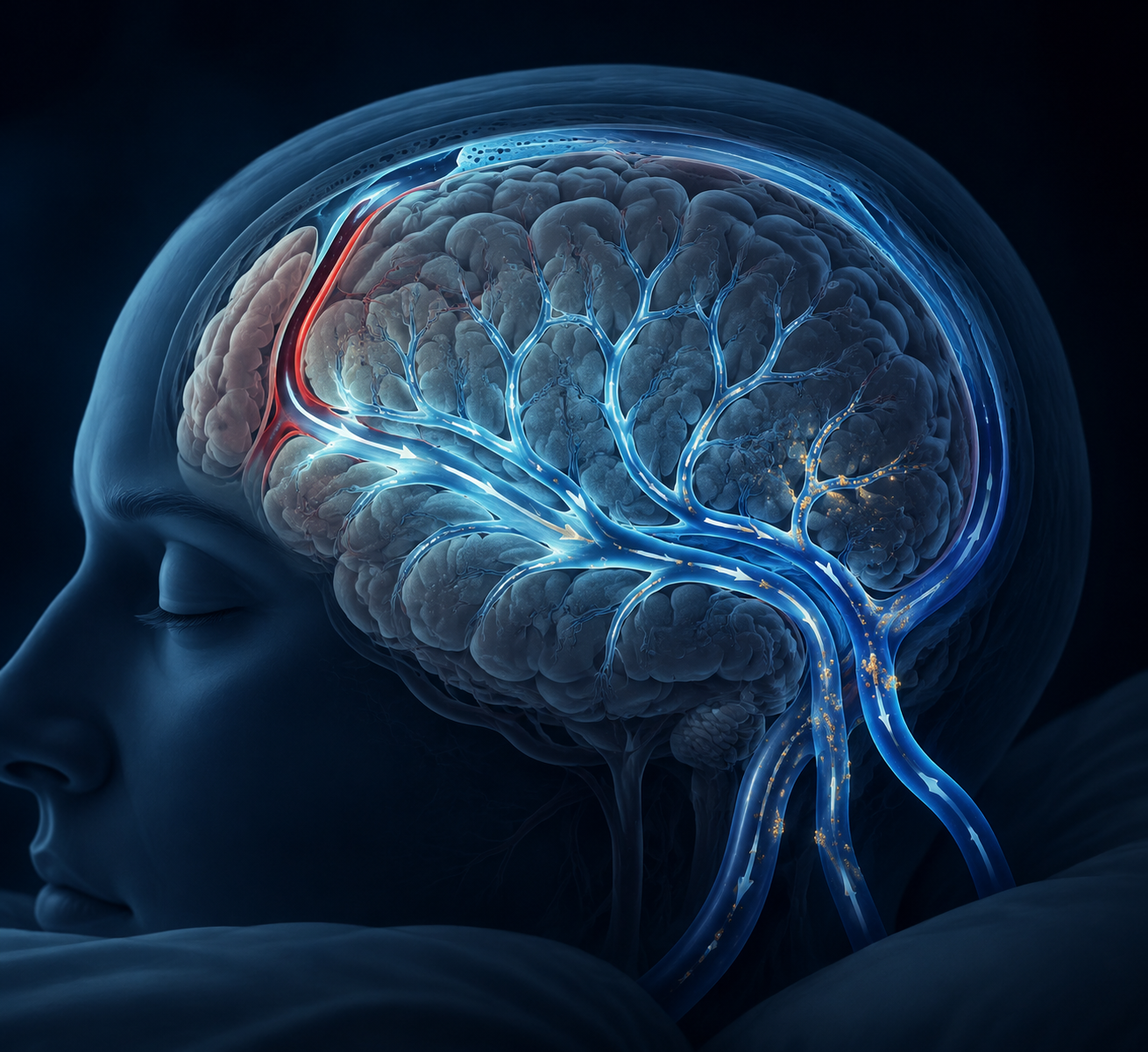
The simplest version is this: during deeper NREM sleep, the brain’s fluid pathways appear to become more favorable for moving waste-related proteins out. Tau and Aβ are among the proteins that can be carried along this route. If sleep is shortened, fragmented, or shifted away from slow-wave-rich stages, that clearance opportunity may shrink.
The word “may” matters. Plasma tau clearance dynamics are not the same as proving that a person’s future Alzheimer’s course has changed. A short-term biomarker movement can be biologically meaningful without being a direct individual prognosis.
The trap: tau can disturb the sleep that helps clear tau
The most troubling part of the sleep-tau story is not simply that poor sleep may leave more tau behind. It is that tau pathology may interfere with the very sleep architecture needed for clearance.
In a 2019 study of 119 participants with an average age of 74 years, tau pathology correlated more strongly with reduced slow-wave activity than Aβ pathology did.[3] This was human evidence, but it was correlational: it showed that tau burden and impaired slow-wave activity traveled together more closely than amyloid and slow-wave impairment did, not that tau alone caused every sleep change.
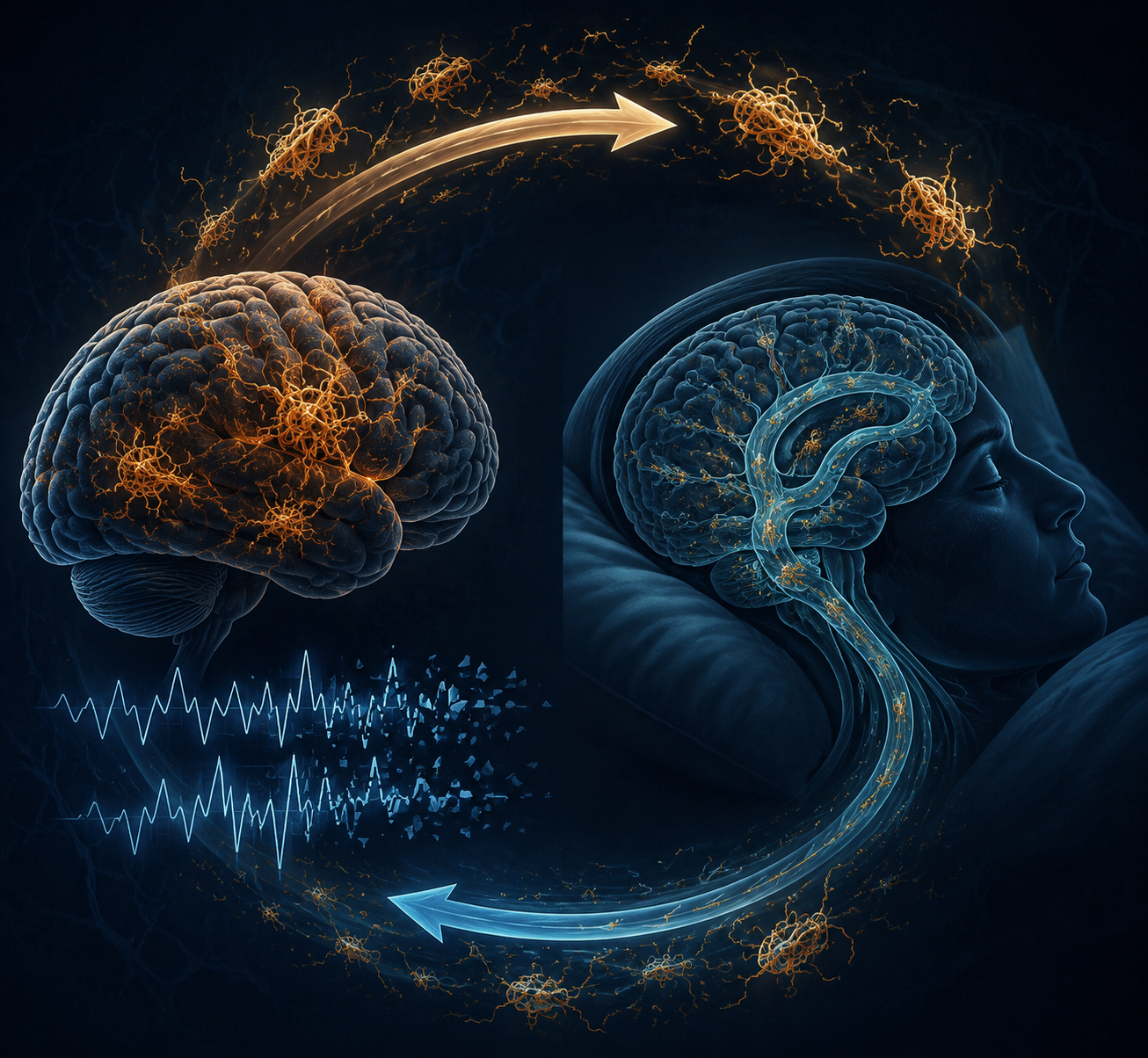
Animal work makes the loop look more forceful. In the 2019 mouse model, sleep-deprived mice injected with tau seeds developed tangles that spread significantly farther over four weeks into memory-critical regions, including from the hippocampus and entorhinal cortex toward broader cortical areas, compared with rested controls.[2] That is pathology spread in mice, not proof that the same four-week pattern occurs in humans. Still, it gives the human correlation a plausible biological direction.
The loop is easy to overstate and important enough not to. A reasonable reading is that sleep disruption can raise extracellular tau and reduce clearance opportunity; tau pathology, once present, may then degrade slow-wave sleep; degraded slow-wave sleep may further weaken clearance. That is a self-reinforcing mechanism, not a bedtime morality tale.
Memory formation sits in the middle of the biology
Sleep supports memory formation in several ways: it helps stabilize new learning, reorganize recent experiences, and tune synaptic connections. Tau enters this picture because the regions vulnerable to tau spread are also regions needed for forming and retrieving memories. When sleep is disrupted, the concern is not only feeling foggy the next day; it is whether the brain is losing repeated opportunities to maintain the protein environment around those memory circuits.
Amyloid evidence points in the same general direction without replacing the tau story. In a 2020 Current Biology study, baseline deep sleep quantity predicted future beta-amyloid accumulation over two to six years in 32 participants.[4] That finding supports the broader idea that deep sleep quality can forecast Alzheimer’s-related biomarker change, but it does not show that amyloid is the only relevant protein or that improving deep sleep will necessarily reverse biomarker trajectories.
For a person in their 50s or 60s watching a sleep tracker with dread, the useful distinction is between signal and sentence. Poor sleep is a biological signal worth taking seriously. It is not a sentence that memory decline has already begun, and it is not proof that a parent’s illness is being repeated.
Where the glymphatic debate leaves the reader
The glymphatic clearance theory is still an active scientific dispute. Some researchers have published findings arguing that brain clearance may be reduced during sleep, which conflicts with the sleep-active clearance model. That disagreement should not be waved away. It means the mechanism is not settled in the way, say, blood carrying oxygen is settled.
But disagreement is not the same as emptiness. The current sleep-clearance case has several linked pieces: sleep state changes fluid movement; NREM sleep predicts tau clearance in humans; wakefulness can acutely raise CSF tau; tau pathology is associated with weaker slow-wave activity in older adults; and animal models show sleep loss can accelerate tau spread into memory-related regions.[1][2][3]
The cautious position is not “sleep prevents Alzheimer’s.” It is that sleep quality appears biologically relevant to tau handling and memory-related brain maintenance, and the evidence is now strong enough that chronic sleep disruption should not be treated as harmless background noise.
A practical boundary on sleep aids
One tempting conclusion is to treat any longer sleep as automatically better clearance. The biology is not that simple. In the 2026 context, Nedergaard noted a caveat that zolpidem, sold as Ambien, reduces glymphatic flow.[1] That does not make sleep medication categorically good or bad; medication decisions belong with a clinician who knows the person’s insomnia pattern, risks, and other conditions. It does mean that “knocked out” is not the same concept as natural NREM slow-wave sleep.
The practical takeaway stays modest because the evidence asks for modesty. Protecting sleep quality is likely relevant to tau clearance and memory biology. It may help delay or slow disease processes if they have begun, as Holtzman has cautiously suggested in relation to the sleep-deprivation findings.[2] It does not guarantee Alzheimer’s prevention, and one bad night does not equal lasting brain damage.
References
- Sleep-active glymphatic clearance transports tau and Aβ from brain to plasma, Nature Communications, 2026.
- Sleep deprivation accelerates Alzheimer’s brain damage, Washington University School of Medicine.
- Tau, More Than Aβ, Affects Sleep in Early Alzheimer’s, Alzforum.
- Deep Sleep Protects Against Alzheimer's, Growing Evidence Shows, NPR, November 17, 2020.
Comments
Join the discussion with an anonymous comment.