
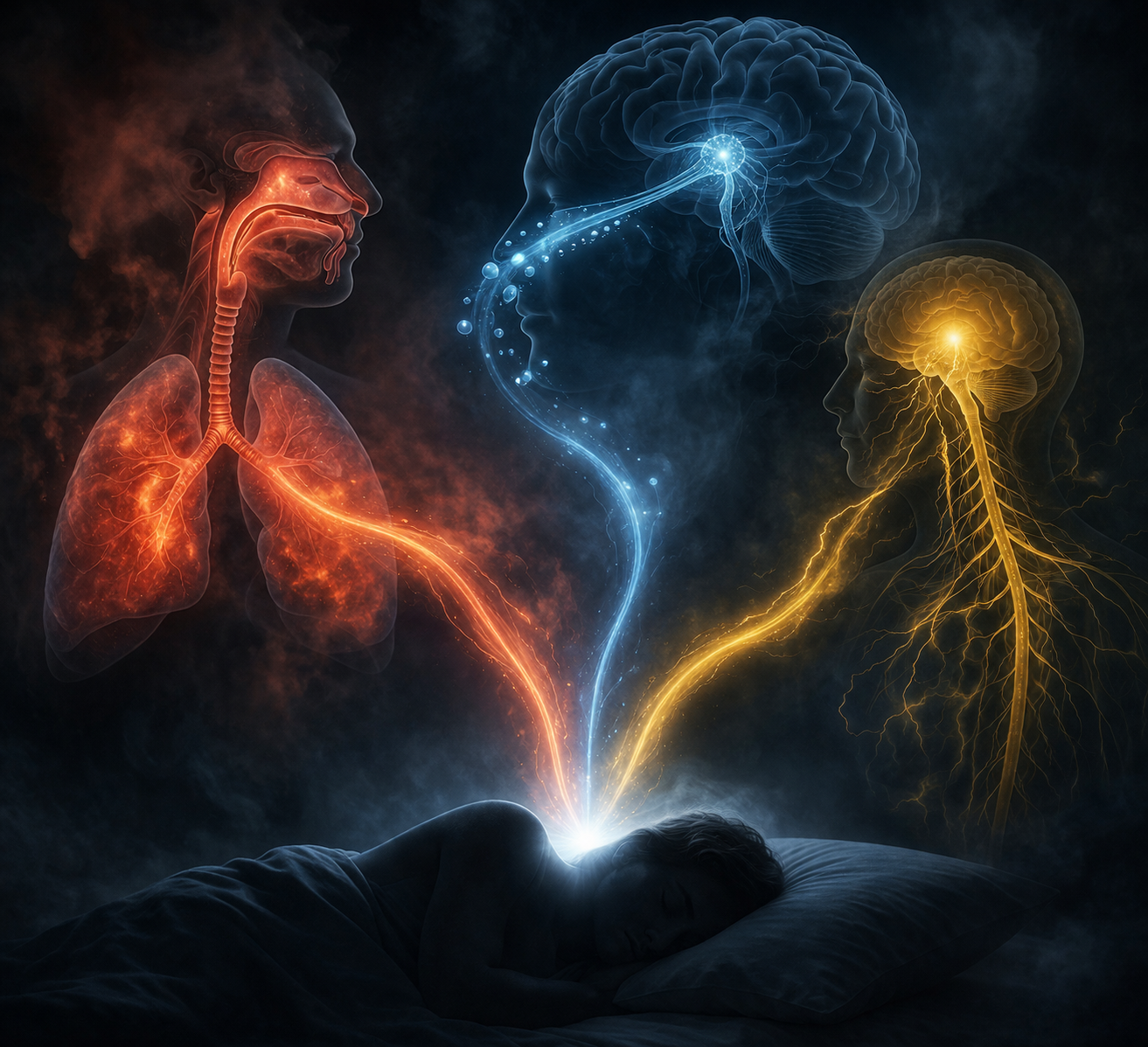
A smoke advisory changes the bedroom before anyone lies down. The window stays shut. The air may smell faintly burned even indoors. The usual sleep routine can still be in place — same bedtime, no late caffeine, lights down — and yet sleep becomes lighter, more interrupted, or harder to start. That pattern is easy to dismiss as worry. It is also easy to reduce it to “bad air.” The better explanation is that smoke advisory sleep effects usually sit at the overlap of three pathways: irritated breathing, particle-linked neurological signaling, and stress-driven hyperarousal.
The advisory itself is a public signal, not a biological exposure measure. No study cleanly isolates the government alert from the smoke and particulate pollution that prompted it. So the useful question is narrower: when a smoke advisory reflects elevated wildfire smoke or particulate pollution, what mechanisms can plausibly make sleep worse? For a broader overview of the same problem, How Wildfire Smoke Affects Your Sleep Quality covers the general sleep-quality picture. This article stays closer to the physiology.
The Evidence Starts Broad, Then Gets More Specific
The broadest sleep-and-air-pollution finding is not subtle. In a 2020 systematic review, Liu and colleagues found that 21 of 22 studies reported a positive association between air pollution and poor sleep quality across age groups.[1] That does not prove every smoky night will ruin sleep, and it does not make wildfire smoke identical to traffic pollution. It does establish that the sleep system is repeatedly sensitive to polluted air in human studies.
More specific studies sharpen the picture. In a hospital-based adult cohort in Taipei with a mean age of about 61, each 1 μg/m³ increment in PM2.5 was associated with roughly 61% higher odds of insomnia.[2] The population matters: older, hospital-based adults are not the same as younger, healthy adults sleeping at home during a temporary advisory. Still, the result is a useful warning against treating particulate exposure as background scenery.
The most interesting evidence is not just whether people say they slept poorly. It is what changes when sleep is measured. An exploratory 2025 polysomnographic pilot study reported that PM2.5 exposure during sleep negatively affected NREM stage 1, respiratory disturbance index, and snoring, while PM10 negatively correlated with wake after sleep onset.[3] The study included only 10 participants, so it should not be inflated into a definitive clinical rule. Its value is different: it points toward the kinds of sleep architecture and breathing metrics that can move when particles enter the sleeping environment.
Pathway One: Smoke Irritates the Airway Before It Reaches Sleep
The airway pathway is the hardest one to wave away as “just stress.” PM2.5 and PM10 are small enough to enter the nose, throat, and lower airways. During a smoke event, those particles can irritate airway lining, contribute to inflammation, and make the passages that normally conduct quiet sleep breathing more reactive. Wildfire smoke particulates may also be biologically different from some other PM2.5 sources: one review of the science reported that smoke particles may be up to four times more toxic to lung tissue than PM2.5 from other sources, with toxicity doubling within hours after emission.[4] That finding should not be used to dramatize every advisory, but it does explain why the source of particulate matter can matter.
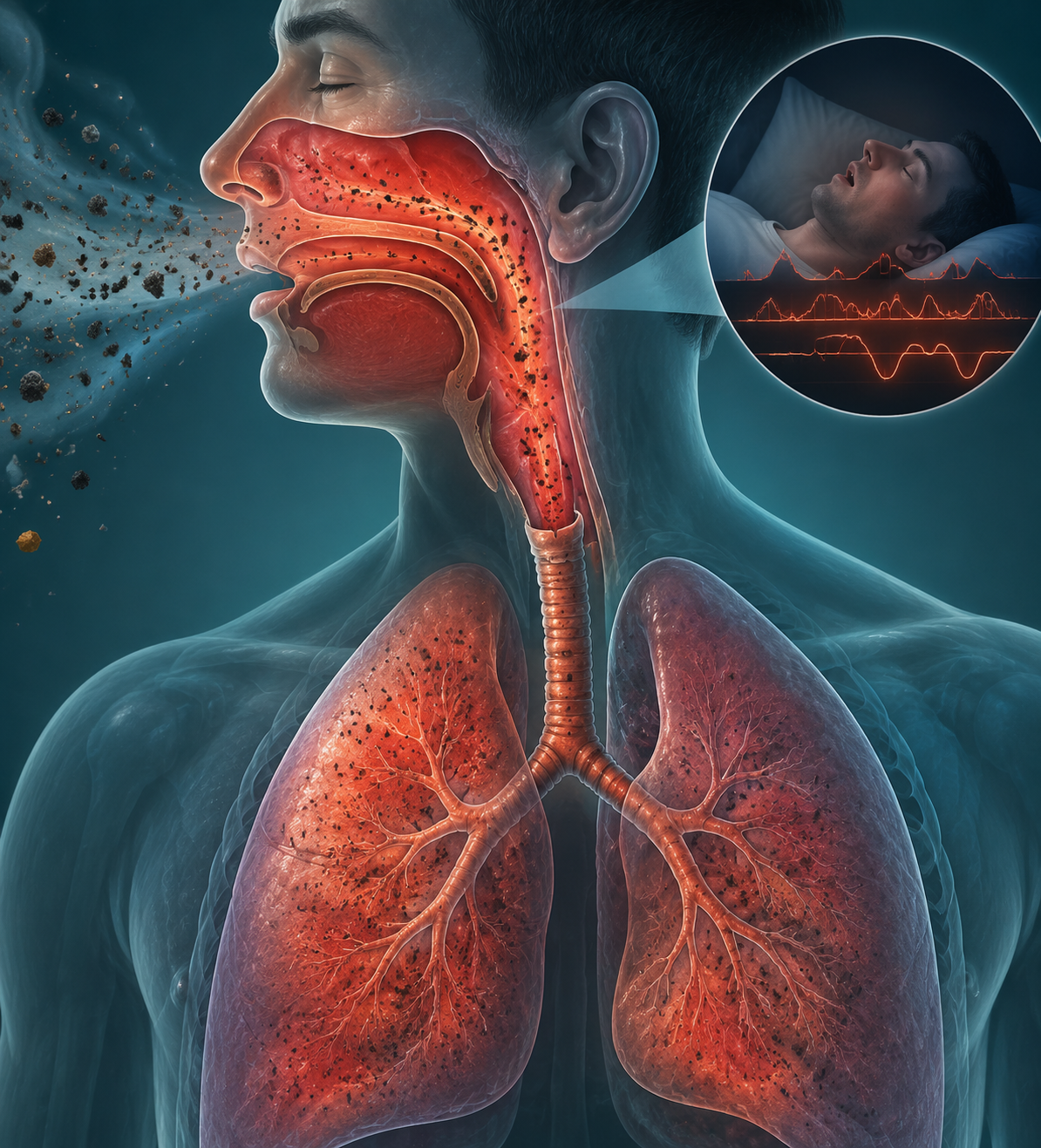
Sleep breathing is already a vulnerable system. Muscle tone falls during sleep. The upper airway becomes more collapsible. A mildly congested nose can shift breathing toward the mouth, increase resistance, and make snoring more likely. If the airway is inflamed, the sleeper may not fully wake each time breathing becomes harder; instead, the night can fragment into microarousals, lighter sleep, changes in oxygenation, and repeated respiratory effort.
That is why metrics such as AHI, RDI, snoring, hypoxia, and wake after sleep onset matter. They describe different pieces of a night that can feel subjectively like “I kept waking up” or “I slept but did not recover.” AHI counts apnea and hypopnea events. RDI captures a broader set of respiratory disturbances. WASO measures time awake after sleep begins. Snoring can signal increased airway resistance, even when it does not by itself prove apnea. Hypoxia measures the oxygen consequence when breathing disruption becomes physiologically meaningful.
| Sleep or Breathing Measure | What It Helps Explain During Smoke Exposure |
|---|---|
| NREM stage 1 | More light sleep can reflect a less stable night rather than restorative depth. |
| RDI | Respiratory disturbances can rise even when the sleeper remembers only vague awakenings. |
| Snoring | Airway resistance may increase when nasal and throat tissues are irritated. |
| WASO | Time awake after sleep onset captures the broken middle of the night. |
| AHI and hypoxia | Sleep-disordered breathing severity and oxygen consequences become especially relevant in susceptible sleepers. |
Large observational sleep studies line up with this airway story, even though they are not all wildfire-specific. In the Multi-Ethnic Study of Atherosclerosis, higher annual NO2 and PM2.5 exposure was associated with 39% increased odds of sleep apnea.[5] A population-based study in Northern Taiwan found PM2.5 positively associated with AHI, a core sleep-disordered breathing metric.[6] A bedroom-environment study of obstructive sleep apnea found PM10 exposure positively associated with OSA severity measures including AHI, RDI, and hypoxia.[7]
None of those studies says that a single evening advisory creates sleep apnea in an otherwise unaffected person. The more defensible interpretation is that particulate exposure can push an already delicate breathing system toward instability. People with asthma, allergic rhinitis, chronic congestion, OSA, older age, or cardiopulmonary vulnerability have less room for that push. But even without a diagnosis, a smoky night can make the nose and throat feel like poor sleep equipment.
Pathway Two: Ultrafine Particles and Inflammatory Signals May Reach Sleep-Regulating Systems
The neurological pathway needs a lighter hand. It is biologically plausible and important, but the human sleep evidence is not as clean as “particles entered the brain and changed this sleep stage.” The stronger statement is that inhaled ultrafine particles can move along olfactory routes toward brain regions involved in regulation, while inflammatory signaling from the airway and lungs can communicate with the nervous system. Those routes give smoke exposure more than one way to influence arousal, autonomic tone, and sleep architecture.
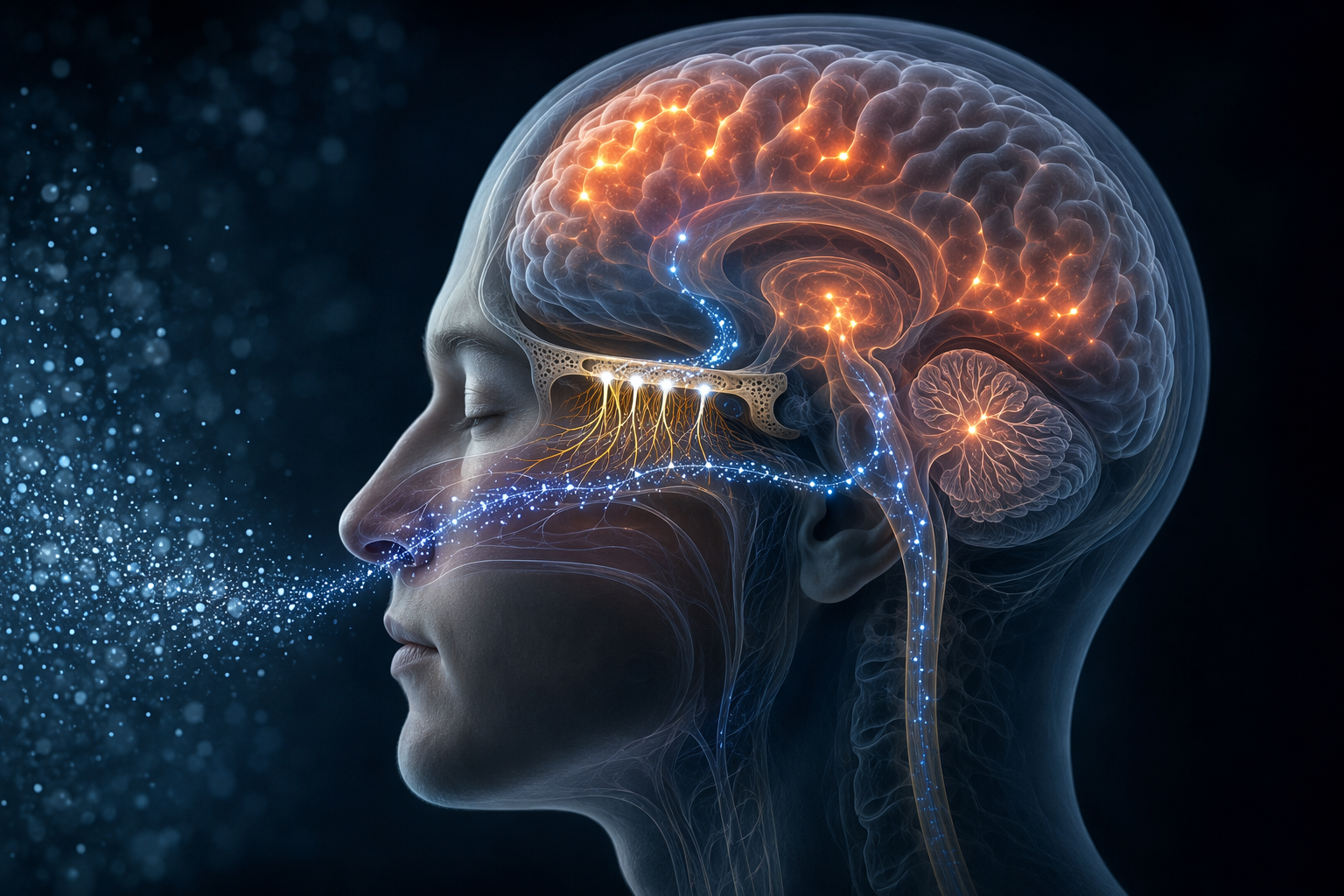
The olfactory route matters because the nose is not only a filter. It is also near neural tissue. Very small particles may travel from the nasal cavity through olfactory pathways toward regions such as the frontal cortex and cerebellum, areas involved in regulation and coordination. That does not mean a sleeper can feel particles traveling along a nerve. It means the boundary between inhaled exposure and nervous-system response is less sealed than ordinary bedroom advice implies.
Inflammation provides the other bridge. When airway tissues respond to particulate matter, the body can generate immune and inflammatory signals that affect the brain’s sleep-wake regulation. The hypothalamic-pituitary-adrenal axis is also relevant because it links stress hormones, threat monitoring, and arousal. During a smoke event, the body may be dealing with both a physical irritant and a contextual threat signal; those two inputs can converge on systems that decide whether sleep remains deep, consolidated, and quiet.
This is where the 2025 polysomnographic pilot is interesting but not conclusive. Its PM2.5 findings involving NREM stage 1, RDI, and snoring sit near both the breathing and architecture sides of sleep.[3] With only 10 participants, it cannot carry the argument alone. But it does fit the larger pattern: particulate exposure is associated with sleep disruption in population studies, and measured sleep can show changes in domains that ordinary self-report would blur.
This also helps explain a common tracker puzzle. A wearable may show more time in bed or even more apparent sleep during a bad-air period, while the person wakes less restored. Consumer trackers are not polysomnography, and they cannot reliably separate airway inflammation, respiratory effort, arousal threshold, and stress physiology. For that distinction, Your sleep tracker is not a sleep study is the more useful frame.
Pathway Three: The Advisory Itself Can Keep the Nervous System on Watch
The psychological pathway is real. It just should not be asked to explain everything. Smoke events carry uncertainty: whether the air will worsen overnight, whether children or older relatives are safe, whether the HVAC system is enough, whether work or school plans will change. In a scoping review of wildfire smoke and mental health, Eisenman and Galway reported that 45.3% of surveyed adults reported anxiety and 37% reported disrupted or poor sleep during smoke events.[8]
Anxiety affects sleep through familiar channels. It delays sleep onset, increases monitoring of bodily sensations, raises the chance that a normal awakening becomes a long one, and can make the bedroom feel like a place where the next bad-air update is waiting. Smoke adds a sensory cue that many other stressors do not have. If the air smells wrong, the threat is not abstract; it is breathed.
There is also a behavioral layer. Staying indoors can cancel evening plans, reduce daylight exposure, change exercise timing, and compress everyone into the same indoor space. The sleep disruption that follows a canceled outdoor event is not identical to airway inflammation, but it can land on the same night. For that angle, How Wildfire Smoke Event Cancellations Affect Your Sleep belongs beside the stress pathway rather than the respiratory one.
Why Closed Windows Can Solve One Problem and Create Another
During a smoke advisory, closing windows is often the obvious exposure move. It can also make the bedroom warmer and stuffier. That matters because heat and poor ventilation can fragment sleep even when outdoor particles are kept out. The result can be a confusing tradeoff: opening the window may bring in smoke, while closing it may worsen heat-related restlessness.
This is not a reason to ignore air-quality warnings. It is a reason to treat the bedroom as an environment with competing pressures. AQI, indoor filtration, bedroom temperature, humidity, and nasal symptoms all belong in the same decision, especially for people who already know their sleep breathing is fragile. Readers using forecast data to anticipate bad sleep nights may find How to use your weather forecast to predict and prevent bad sleep nights useful; readers fighting a sealed, overheated room may need the more practical cooling angle in How to Fix 6 Cooling Mistakes for Better Hot Weather Sleep.
What the Three-Pathway Model Clarifies
The useful distinction is not between “physical” and “mental” sleep disruption as if only one can be real. Smoke exposure can irritate the airway and destabilize breathing. Ultrafine particles and inflammatory signaling may affect regulatory systems that influence arousal and sleep architecture. The advisory context can independently raise vigilance and anxiety. On a bad night, those pressures do not politely take turns.
The evidence is strongest at the broad association level: air pollution is repeatedly linked with poorer sleep quality.[1] It is also fairly persuasive for the respiratory pathway, where PM exposure connects to insomnia odds, sleep apnea odds, AHI, RDI, snoring, WASO, and hypoxia-related measures across several kinds of studies.[2][3][5][6][7] The neurological pathway is mechanistically plausible but should be stated more cautiously, especially when translating particle movement and inflammatory signaling into specific human sleep-stage changes. The psychological pathway is well supported as part of smoke-event experience, but it should not swallow the airway and nervous-system biology that may be happening at the same time.[8]
That is the most grounded way to understand smoke advisory sleep effects: the alert tells you the outside air may be unsafe, but the night worsens because exposure and threat become bodily. The nose clogs. Breathing becomes less stable. Arousal systems stay easier to trigger. The mind may worry because the situation is worrying, while the airway and nervous system are also responding to the air itself.
References
- The Effect of Air Pollution on Sleep: A Systematic Review and Meta-analysis. PMC. 2020.
- Association between PM2.5 air pollution and insomnia among adults in Taipei City. Scientific Reports. 2022.
- Effects of particulate matter exposure during sleep on sleep quality: A polysomnographic pilot study. Atmospheric Pollution Research. 2025.
- Why wildfire smoke is more dangerous than other air pollution. BBC Future.
- The association of ambient air pollution with sleep apnea: The Multi-Ethnic Study of Atherosclerosis. PMC. 2019.
- Ambient air pollution exposure and sleep-disordered breathing in Northern Taiwan. ScienceDirect.
- Bedroom Particulate Matter and Sleep Disordered Breathing among Patients with Obstructive Sleep Apnea. PMC.
- The mental health and well-being effects of wildfire smoke: a scoping review. PMC. 2022.
Comments
Join the discussion with an anonymous comment.