
You wake up with the house still in your body before you can remember the plot. Maybe it was your childhood home, except the hallway was longer than it ever was. Maybe it was a beautiful house you somehow owned, full of rooms you had not opened yet. Maybe the walls were soft with rot, or water was coming up through the floor. If you searched for “dream home dream meaning sleep,” the most honest short answer is this: the house probably matters, but not because every room has a fixed symbolic translation.
House dreams are not rare, and they are not a sign that your mind has chosen an unusually mystical object. In the Sleep and Dream Database, house and architectural references appeared in 47% of women’s dreams and 42% of men’s dreams, making them a strikingly common dream setting in that collection.[1] Those figures should not be treated as a universal rate for all sleepers everywhere; dream databases depend on what people remember, write down, and choose to report. Still, they give a useful directional clue: houses are one of the dreaming mind’s favorite containers.

Why the Dream House Feels More Important Than the Plot
A house is unusually useful to the sleeping brain. It has rooms, thresholds, hidden spaces, familiar routes, private areas, and public-facing surfaces. It can hold family memory, safety, embarrassment, loneliness, status, care, neglect, and control without needing a spoken explanation. That does not make “house” a universal code for “self,” although many therapeutic traditions have used it that way. It means the house is an efficient stage.
This is where sleep science helps without pretending to decode every image. Dreams often draw from waking emotional concerns, a view commonly discussed as continuity between waking life and dream life.[4] The point is not that yesterday’s argument or this month’s stressor appears in a literal replay. More often, the dream borrows the emotional problem and builds a scene that can carry it.
That is why the setting can feel more important than the action. You may forget who was in the dream but remember that the upstairs was unsafe, the basement was flooded, or the front door would not lock. The dream has preserved the emotional architecture. The question becomes less “What does a dream house mean?” and more “What kind of emotional space did this house create, and why did that feeling stay with me after waking?”
What REM Sleep Can—and Cannot—Explain
The strongest evidence here is not for a symbolic dictionary. It is for a sleeping brain that continues working with emotional material. In one REM sleep study, frontal theta activity in the 5–8 Hz range was associated with the incorporation of recent waking emotional experiences into dreams.[2] That matters because it connects dream content to measurable sleep physiology rather than to a list of meanings invented after the fact.
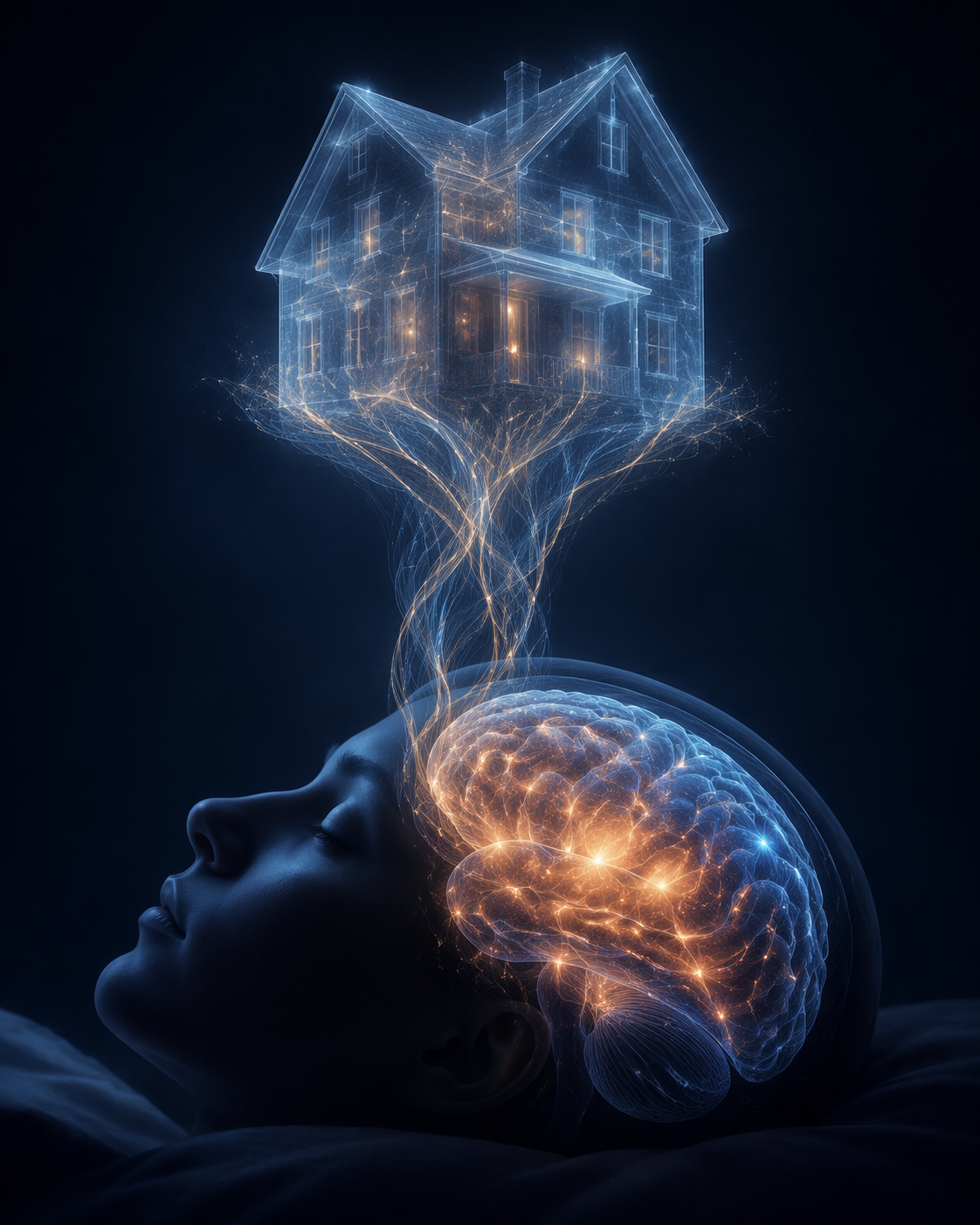
REM sleep has also been studied as part of emotional memory processing. Reviews of the field describe dreaming, REM physiology, and emotional regulation as connected, while also making clear that the system is complicated and not reducible to one simple function.[3] This is the safer and more useful claim: emotional waking experiences can be carried into dreams, and REM sleep appears to be one state in which the brain processes emotionally significant material.
That does not prove that a flooded kitchen means one thing, or that discovering an attic means another. A sleep lab can measure brain activity, sleep stage, recall, and reported dream content. It cannot verify that “new room” equals “latent capacity” in every dreamer. Those interpretations may be clinically familiar, and sometimes they are personally useful, but they are not the same kind of evidence as REM theta findings.
Older and newer dream research also complicates the easy claim that dreams are simply negative by default. The more careful reading is that emotional intensity helps determine what gets incorporated into dreams; the emotion may be fear, grief, desire, curiosity, shame, tenderness, or a mixture that is hard to name on waking. A dream home can therefore feel beautiful and unsettling at the same time.
The Childhood Home Dream
Among house dreams, the childhood home deserves special care. It is tempting to flatten it into a slogan: you are “returning to the past,” or you have “unfinished childhood issues.” Sometimes that may be close enough to be useful. But the better question is more specific: what version of the old home returned, and what did the dream ask you to feel inside it?
Childhood homes are dense memory structures. They are places where the body learned routes before it had adult language for fear, comfort, privacy, conflict, or belonging. When such a house appears in a dream, it may not be pointing to childhood as a historical period so much as borrowing a setting where an older emotional pattern was first organized.
This fits with continuity-based accounts of dreaming, which suggest that dream content often reflects waking concerns rather than arriving as random, sealed-off fantasy.[4] It also fits the everyday observation that major adult transitions can make old settings feel newly active: moving, parenting, divorce, caregiving, bereavement, estrangement, recovery, or a change in status can all put pressure on earlier templates of safety and identity. That is not a diagnosis. It is a way to ask why that house, now.
There is a related idea in dream research often called dream lag: waking experiences may appear in dreams after a delay rather than only on the same night. That idea is useful here, especially for childhood-home dreams, but direct experimental work on childhood homes as a specific subtype remains limited. So the careful claim is this: an old home may be a plausible dream setting when current life activates older emotional material, but the dream itself still has to be read in context.
A childhood home dream after a calm family visit is different from one that follows weeks of dread before seeing a parent. A dream of standing outside the house unable to enter differs from a dream of hiding in a bedroom, repairing the roof, or finding strangers living there. The emotional action matters. Who has access? What is protected? What has changed? What has stayed exactly the same?
Other House Dreams: Read the Pattern, Not the Object
The common variants are worth naming, as long as they are not treated like a decoding chart. These are not controlled sleep-lab translations. They are pattern prompts: ways to notice what the dream is repeatedly staging.

| Dream variant | What to notice |
|---|---|
| An unfamiliar house | Whether the feeling is exploration, threat, exposure, freedom, or being lost |
| A beautiful dream home | Whether the dream feels like desire, relief, pressure, performance, or an unreachable standard |
| New rooms or hidden rooms | Whether the discovery feels exciting, forbidden, overwhelming, or overdue |
| Damage, decay, or structural problems | Whether the dream centers on neglect, repair, danger, shame, or responsibility |
| Water or flooding | Whether the water is cleansing, rising, destructive, contained, or impossible to stop |
An unfamiliar house often has less to do with real estate than with orientation. The dream may put you in a place where you should know the rules but do not. If the mood is curious, the house may stage expansion or transition. If the mood is menacing, it may stage uncertainty, exposure, or lack of control. The same image can carry different emotional work.
A beautiful dream home is not automatically a promise that life is improving. It may be a wish, a rehearsal of stability, a fantasy of privacy, or a scene where the dreamer feels pressure to maintain an ideal. The important detail is whether you wake restored, bereft, embarrassed, anxious, or determined. The “dream home” part tells you the image was attractive; the waking residue tells you what it cost.
Hidden rooms are especially easy to overinterpret. Many readers like the idea that a new room means an undiscovered part of the self, and in therapy that can sometimes be a useful way to explore the dream. But the dream may also be about intrusion, inheritance, avoidance, clutter, opportunity, or something that has become available too quickly. Again, the emotional pattern decides more than the object does.
Damage and decay tend to draw attention because they make the house’s basic promise unstable. A house is supposed to shelter. When the ceiling sags, the stairs break, or the walls peel, the dream often stages a problem of maintenance: what has been left too long, what cannot be safely ignored, what you are expected to fix, or what you fear is already beyond repair. That can correspond with stress, but it is too broad to diagnose from a dream alone.
Water and flooding are similar. Many interpretive traditions connect water with emotion, and that association is easy to understand. But the useful question is not “Does water mean emotion?” It is “What is the water doing?” Water in a sink, rain through a roof, a flooded basement, and an ocean inside a bedroom are different scenes. The scale, containment, and urgency tell you more than the category.
How to Work With a House Dream Without Overbelieving It
A useful reading of a house dream is usually modest. It does not ask the dream to predict the future or reveal a hidden truth in one dramatic gesture. It asks for pattern, recurrence, and intensity.
- Write the house first, not the plot: old home, new home, impossible home, damaged home, flooded home, locked home.
- Name the strongest feeling on waking: dread, grief, curiosity, relief, shame, longing, urgency, numbness.
- Track the repeated action: searching, hiding, repairing, escaping, discovering, cleaning, protecting, being watched.
- Compare it with current life, not with a universal symbol list: what situation is asking for the same emotional posture?
- Notice intensity: a mildly strange dream and a dream that disturbs your sleep for days deserve different levels of attention.
This approach also protects against two common mistakes. The first is false certainty: “I dreamed of a basement, therefore this must mean X.” The second is false dismissal: “It was only a dream, therefore the feeling means nothing.” Sleep research gives a middle path. Dream content can be connected to waking emotional life, but the connection is usually probabilistic, personal, and shaped by memory.
The broader neuroscience of dreaming supports this kind of humility. Reviews of dreaming and the brain describe dream experience as a product of complex neurophysiology, not as either pure noise or a supernatural message system.[5] That leaves room for meaning, but it is meaning built through the dreamer’s history, current concerns, and emotional state.
When the Dream Becomes a Sleep Problem
Most house dreams do not need treatment. Even a disturbing one may simply be a vivid dream that fades after a day or two. The threshold changes when the dream is repetitive, frightening, sleep-disrupting, or tied to avoidance of sleep. At that point, the practical issue is not whether the house “means” the correct thing. The issue is that the dream has become part of a distress cycle.
This is where clinical work with dream narratives matters. Imagery Rehearsal Therapy, often used for recurrent nightmares, does not require a universal symbol dictionary. Its basic logic is that a person can rewrite and rehearse a distressing dream scenario while awake, changing the relationship to the nightmare narrative. The existence of such approaches is not proof that every dream image has a fixed interpretation; it is evidence that dream content can be workable.
For a recurring house nightmare, that might mean changing the route through the house, adding a working exit, repairing a broken threshold, lowering the water, turning on lights, or bringing in help. The exact revision matters less than the shift from helpless repetition to rehearsed agency. If the dream is connected to trauma symptoms, severe anxiety, or persistent insomnia, that is a reason to work with a qualified clinician rather than trying to solve it through interpretation alone.
So What Does a Dream Home Mean?
A dream home or recurring house dream is not a diagnosis, a prophecy, or a coded message with one correct translation. It is more often a spatial-emotional framework: a familiar kind of place the sleeping brain can use while processing concerns that matter.
If the house keeps returning, pay attention to what repeats. The same staircase, the same locked room, the same flood, the same impossible expansion, the same childhood kitchen with a different emotional weather. The meaning is not hidden in the object. It is in the pattern the dream keeps staging, the intensity it leaves behind, and the waking life that makes that pattern recognizable.
References
- The Meanings of Houses in Dreams, Kelly Bulkeley, 2025.
- Incorporation of recent waking-life experiences in dreams correlates with frontal theta activity in REM sleep, Social Cognitive and Affective Neuroscience, 2018.
- The Functional Role of Dreaming in Emotional Processes, Frontiers in Psychology, 2019.
- Dreams and their relationship to waking life, The British Psychological Society.
- Dreaming and the brain: from phenomenology to neurophysiology, Trends in Cognitive Sciences.
Comments
Join the discussion with an anonymous comment.