
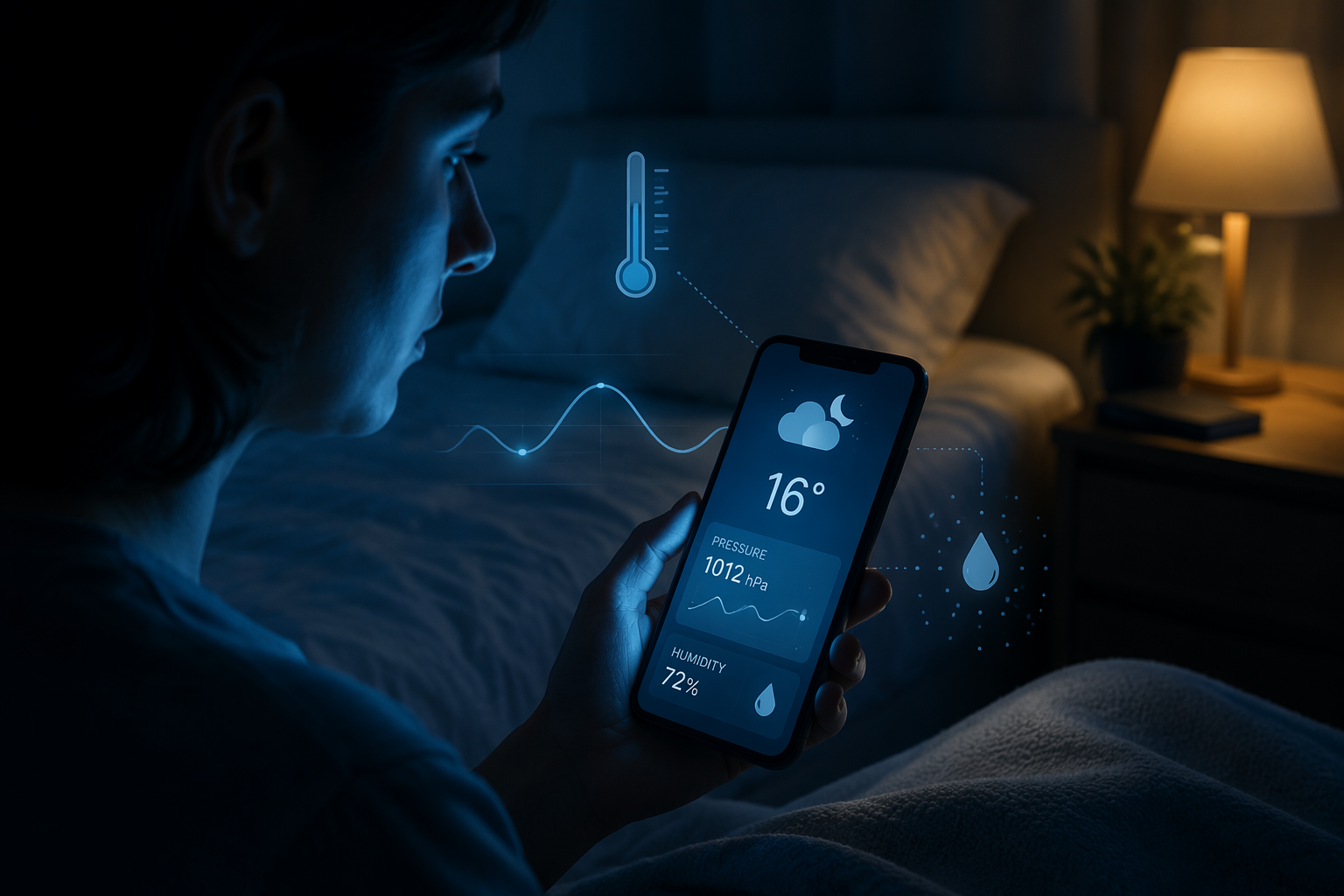
Tonight’s weather app has more sleep information in it than most people use. You do not need to study the whole forecast. For sleep, the useful scan is narrower: how warm the night will be compared with normal, whether pressure is falling before a storm, and whether humidity will make heat or breathing discomfort harder to escape.
That scan answers the practical question: is tonight’s environment likely to push your body away from normal sleep conditions, and can you change the bedroom before that happens? The forecast will not diagnose a bad night. It can, however, warn you when the room, your airway, or your light exposure needs help before bedtime.
Start With The Nighttime Temperature, Not The Daily High
The daily high is useful for planning your commute. For sleep, look at the overnight low and the hourly temperature between your usual bedtime and wake time. A day that peaks hot but cools quickly after sunset is a different sleep problem from a night that stays warm until dawn.
The next question is not only “Is it hot?” but “Is it unusually hot for this date?” A forecast low that is more than 5°F above the 30-year normal is a reasonable warning point: not a medical threshold, but a practical cue to prepare the room earlier instead of discovering at midnight that the mattress, walls, and air are still holding heat.
Bedroom temperature matters because sleep normally depends on heat loss. The National Sleep Foundation gives 60–67°F as a commonly cited optimal bedroom range for adults, with some variation across sources and personal needs.[1] That number is not magic, and outdoor temperature is not the same as indoor exposure. Air conditioning, insulation, window placement, fans, building materials, and whether you live on an upper floor all change the room you actually sleep in.
Still, the large temperature studies are hard to ignore. In a U.S. analysis of 765,000 survey respondents, each 1°C increase in nighttime temperature anomaly was associated with about three additional nights of insufficient sleep per 100 people per month.[2] The study measured self-reported insufficient sleep, not sleep stages in a lab, so it tells us about population-level bad nights rather than exactly what happened inside the brain of each sleeper.
A later analysis using 23 million wearable sleep records found that each 10°C increase in daily mean temperature was associated with 20.1% higher odds of sleep insufficiency and 9.67 fewer minutes of total sleep.[3] The same paper reported declines across sleep stages, with deep sleep showing the largest relative decrease at 2.82% per 10°C increase, but those stage estimates came from Huawei wearable staging rather than gold-standard polysomnography.[3]
The useful conclusion is modest and actionable: warm nights are repeatedly associated with worse sleep, but your risk depends on whether the heat reaches your bed. If the hourly forecast says the outside air will not cool until after midnight, assume your bedroom may need intervention before you are tired enough to stop caring.
What To Do When The Forecast Low Is Too Warm
If you have air conditioning, the main mistake is waiting too long. Pre-cool the bedroom before bedtime, especially if the walls, bedding, and furniture have absorbed heat all afternoon. A short pre-cooling window often feels more effective than trying to rescue the room after you are already sweating under the covers.
- Check the hourly overnight temperature, not only the forecast low.
- Compare tonight with the seasonal normal; treat more than 5°F above normal as a warning cue.
- Aim the bedroom toward the 60–67°F range if your home and budget allow it.
- Pre-cool the room before bed rather than waiting until the room feels unbearable.
- If you cannot cool the whole room, cool the body: lighter bedding, breathable sleepwear, a fan, a cool shower before bed, or targeted cooling at the neck, wrists, and feet.
For apartments without reliable AC, the goal shifts from perfect room temperature to reducing heat load. Close blinds during the hottest part of the day, open windows only when outdoor air is cooler than indoor air, and use fans to move heat away from the body. More detailed heat strategies belong in Sleep in heat without AC? Cool your body instead, especially for nights when the room itself cannot be brought into the ideal range.
Extreme heat nights also deserve a backup plan. If storms, grid strain, or local outages are possible, cooling advice has to include what happens when the fan or AC stops. The guide to sleeping during a power outage is the more practical continuation for those conditions.
Then Check Whether Pressure Is Falling
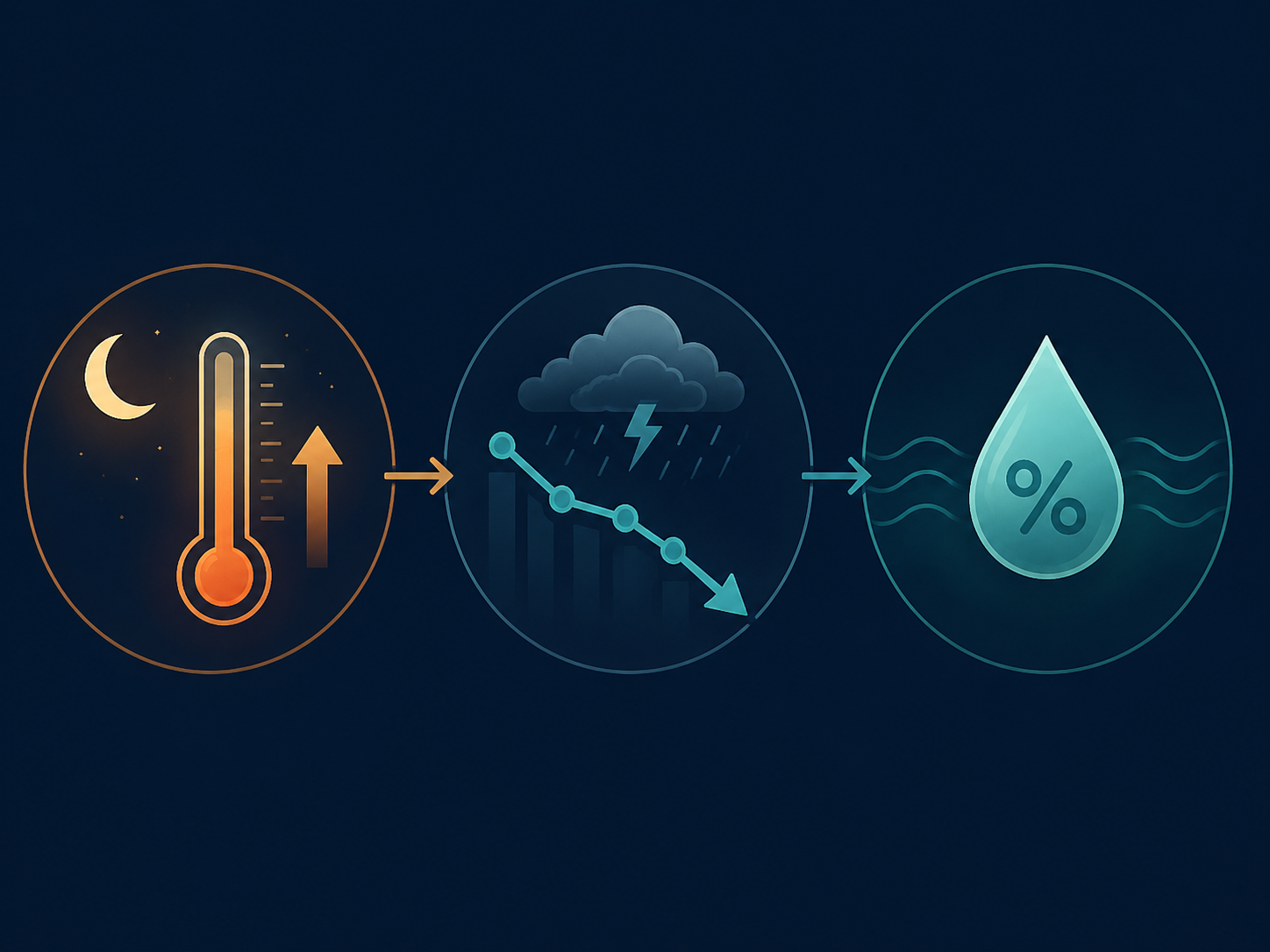
After temperature, look for an approaching low-pressure system: a falling barometer over the next 6–12 hours, storm icons moving in overnight, or a forecast that shows pressure dropping before rain. This cue is not equally important for everyone. It matters most if you snore, have diagnosed or suspected obstructive sleep apnea, wake with a dry mouth, or notice worse breathing on stormy nights.
The strongest evidence here is narrower than the everyday complaint “storms ruin my sleep.” In a study of 537 people evaluated for sleep-disordered breathing, each 1 mbar decrease in barometric pressure was associated with 0.3 more obstructive apnea events per hour.[4] That is a real forecast-relevant signal, but it comes from a sleep-disordered breathing sample. It should not be stretched into a claim that falling pressure disrupts sleep equally in the general population.
For a snorer or someone with mild apnea risk, though, the cue is useful. A falling barometer before a humid storm is a night to avoid extra alcohol, sedating bedtime choices, or sleeping flat on the back if those already worsen breathing. If you use prescribed apnea treatment, it is also the kind of night when skipping it is especially unwise.
Rain itself can add noise, light changes, and schedule disruption, but the sleep-relevant weather pattern is often bigger than the sound of drops on a window. The related guide to how heavy rain affects sleep quality goes deeper into those rain-specific mechanisms.
Use Humidity As The Amplifier
Humidity is rarely the first sleep signal to check, but it can explain why a merely warm night feels oppressive. When the air is humid, sweat evaporates less efficiently, bedding feels heavier, and the body has a harder time dumping heat. If the outdoor humidity forecast is above 60%, treat it as an amplifier, especially when temperature is already high or pressure is falling.
The humidity evidence is less clean than the temperature evidence because humidity often travels with heat, storms, and pressure changes. A review of NIH-linked literature summarized by Amerisleep describes stronger disruption when high humidity combines with low pressure, with proposed pathways including increased breathing effort and tissue swelling.[5] That is useful for mechanism and caution, not proof that every humid night independently causes poor sleep.
The bedroom action is straightforward. If your forecast shows humidity above 60% overnight, run a dehumidifier before bed if you have one, keep damp laundry out of the bedroom, and avoid adding moisture with long hot showers right before sleep. If you are choosing between cooling and drying the air, prioritize the change that makes the room feel easier to breathe and less sticky at your actual bedtime.
| Forecast cue | Why it matters for sleep | Before-bed move |
|---|---|---|
| Nighttime temperature more than 5°F above normal | Warm nights are linked with insufficient sleep and shorter sleep duration | Pre-cool the room, lighten bedding, or cool the body directly |
| Falling pressure before storms | Most relevant for snoring or obstructive sleep apnea risk | Reduce avoidable breathing burdens and use prescribed apnea treatment |
| Humidity above 60% | Can amplify heat retention and breathing discomfort | Dehumidify, ventilate when outdoor air is better, and keep bedding dry |
| Spring or summer light shift | Longer day length can shorten sleep timing or duration | Use blackout support and protect the wind-down window |
Do Not Ignore Seasonal Light
Some bad sleep weeks are not about one storm or one hot night. Seasonal transitions change both light exposure and temperature expectations. In a longitudinal study of 216 participants with 51,836 observations, spring was associated with 12.6 minutes less sleep than winter, a pattern the authors linked in part to increasing day length.[6]
That does not mean spring itself is a sleep disorder. It means your bedroom may need more light control before you think it does. Blackout curtains, a consistent wake time, and reducing bright evening light can matter more during the weeks when sunrise creeps earlier and evenings stay bright later.
Regional habits also affect sensitivity. In an analysis of 14,232 U.S. adults across 12 million Fitbit nights, a 10°C increase in nighttime temperature was associated with 2.63 fewer minutes of sleep, and West Coast residents were affected about three times more than residents in other regions.[7] That kind of regional difference is a reminder to compare tonight with what your housing and local climate are built for, not with someone else’s idea of “hot.”
A Two-Minute Forecast Routine
The routine works best if it happens before the bedroom has already drifted into the wrong conditions. Check the forecast in late afternoon or early evening, when there is still time to close blinds, run a dehumidifier, pre-cool the room, change bedding, or plan for a fan.
- Open the hourly forecast for your actual sleep window.
- Compare the overnight temperature with the seasonal normal; if it is more than 5°F high, prepare for heat retention.
- Look for falling pressure or an approaching low-pressure system, especially if storms arrive overnight.
- Check humidity; above 60% is a practical cue to reduce moisture and expect heat to feel worse.
- Notice seasonal light changes, especially in spring and early summer, and use blackout support if light is shifting your sleep timing.
If you are deciding which habits deserve effort, start with the strongest signals: temperature first, then pressure for people with snoring or apnea risk, then humidity as an amplifier. The broader evidence hierarchy in Sleep Tips Ranked by Evidence Strength is a useful companion when you want to separate high-value changes from bedtime folklore.
The final decision can stay simple. If the night is unusually warm, cool the room or your body before bed. If pressure is falling and humidity is high, especially with snoring or apnea risk, reduce bedroom moisture and be alert to breathing disruption. If seasonal light is shifting, control morning and evening light with blackout support. Weather does not predict every bad night, but it often gives enough warning to make the bedroom less hostile before sleep quality deteriorates.
References
- National Sleep Foundation Bedroom Temperature Guidance, National Sleep Foundation.
- Nighttime temperature and human sleep loss in a changing climate, Science Advances, 2017.
- Daily ambient temperature and sleep health: evidence from 23 million sleep records, Nature Communications, 2025.
- The effect of weather on the objective measurement of sleep-disordered breathing, Journal of Clinical Sleep Medicine, 2010.
- How Humidity Affects Sleep, Amerisleep.
- The effects of seasons and weather on sleep patterns measured through longitudinal multimodal sensing, Nature, 2021.
- Study links rising temperatures to reduced sleep in U.S. adults, Keck School of Medicine of USC.
Comments
Join the discussion with an anonymous comment.