
Mechanism explainer
How Older Adults Can Sleep Through a Fire Power Shutoff
Fire-season power shutoffs can last two to six days, taking out both cooling and the electricity your sleep devices run on. Older adults get a shutoff-specific sleep plan: backup power for a CPAP or oxygen concentrator, heat-safe ways to sleep without AC, and clear signs it's time to relocate.
Last reviewed: August 2, 2026. Evidence tier: moderate for PSPS duration and heat-related sleep physiology; practical guidance is based on utility and public-health instructions that can change by program and location.
A fire power shutoff sleep plan has to start before the lights go out. A Public Safety Power Shutoff, or PSPS, is usually planned, often arrives during hot fire-season weather, and can remove cooling and medical-device power at the same time. For an older adult who sleeps with a CPAP, uses an oxygen concentrator, needs refrigerated medication, or cannot safely sleep in a hot room, this is not the same problem as finding a flashlight after a storm.
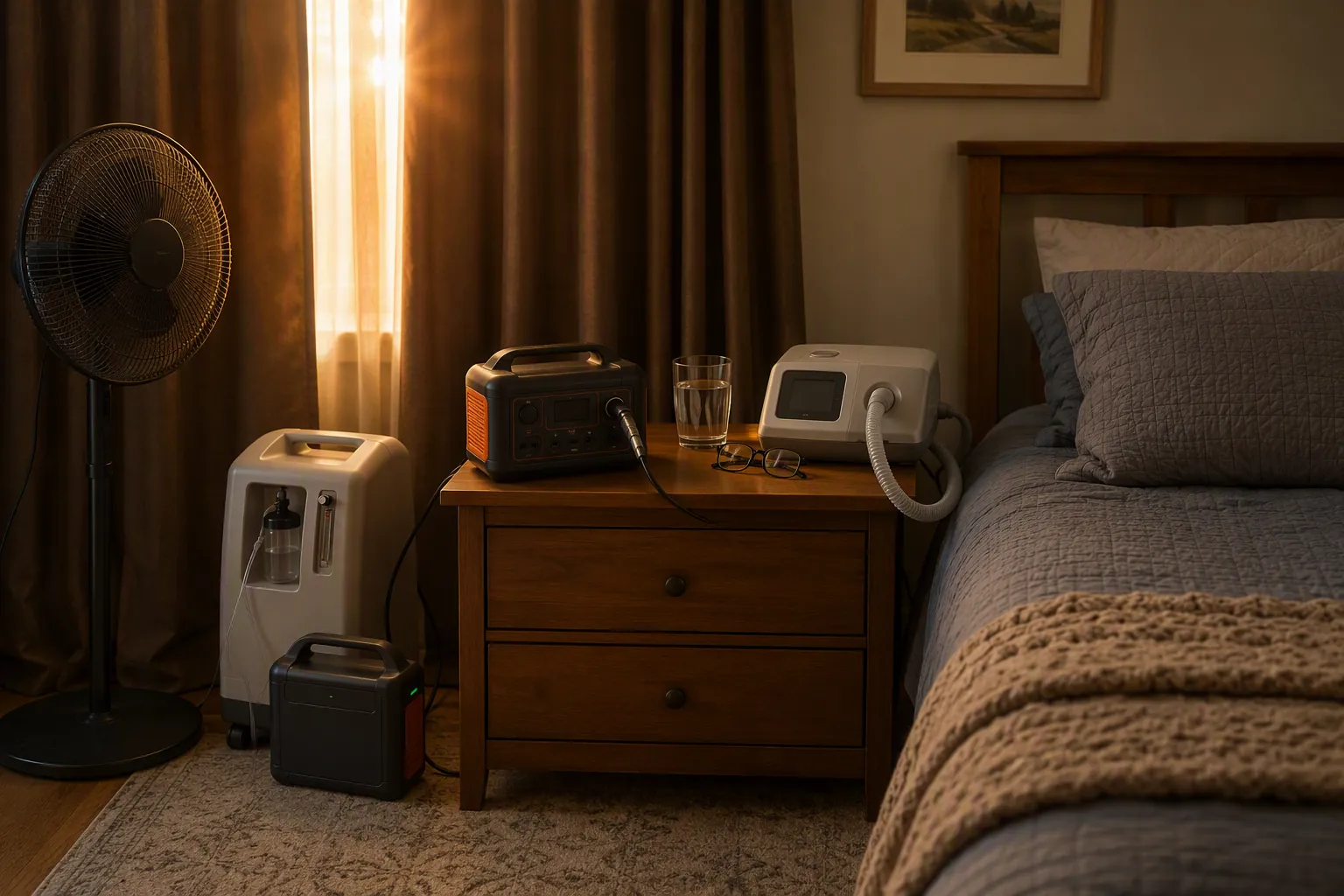
The planning window should be measured in days, not hours. PSE Healthy Energy’s analysis of California PSPS events found an average outage duration of about 41 hours, median durations around 42 to 44 hours, a maximum recorded duration of 162.8 hours, and 95% of events under about 98 hours.[1] For sleep, that means the second night is not an edge case. The third, fourth, or even sixth day may need to be accounted for before fire season starts.
There is no clean body of research on “sleep during a PSPS” itself. These recommendations synthesize three adjacent bodies of evidence: how long PSPS events last, what heat does to older-adult sleep, and what utilities and health agencies say about medical devices, batteries, refrigeration, generators, and relocation.
Plan for the actual shutoff duration
Generic blackout advice often assumes one uncomfortable evening. A PSPS plan should assume the household may need to get through two nights without grid power, and should know what it will do if the shutoff stretches toward four or more days.
| PSPS timing fact | What it changes for sleep |
|---|---|
| Average duration about 41 hours | A one-night battery or one charged phone is not enough for many older adults. |
| Median duration around 42 to 44 hours | The second night should be treated as normal planning, not backup planning. |
| 95% of events under about 98 hours | A four-day home plan may cover many events, but not the longest ones. |
| Maximum recorded duration 162.8 hours | The plan needs a relocation option if device power, cooling, or medication safety cannot be protected at home. |
The working standard is simple: if the home plan cannot keep required medical devices powered, the sleeping space heat-safe, and essential medications protected for the likely outage duration, the sleep plan is incomplete. That does not mean panic. It means the plan includes leaving early enough that the older adult is not making transportation and medical-device decisions at midnight in a hot room.
Start with the device that has to run while the person sleeps
For a CPAP user, the sleep plan starts with continuous overnight power. PG&E lists CPAP machines among devices that may qualify for its Medical Baseline program, which can provide additional energy allowance and can identify a household as having medical energy needs, though it does not prevent shutoffs or guarantee power during a PSPS.[2]
Medical Baseline enrollment is worth doing before fire season because it can put the household into the utility’s medical-needs process before there is smoke in the air. Eligibility, documentation, and benefits vary by utility, so the practical step is to check the current program page, call the utility if needed, and keep a copy of the approval where the adult child or caregiver can find it.
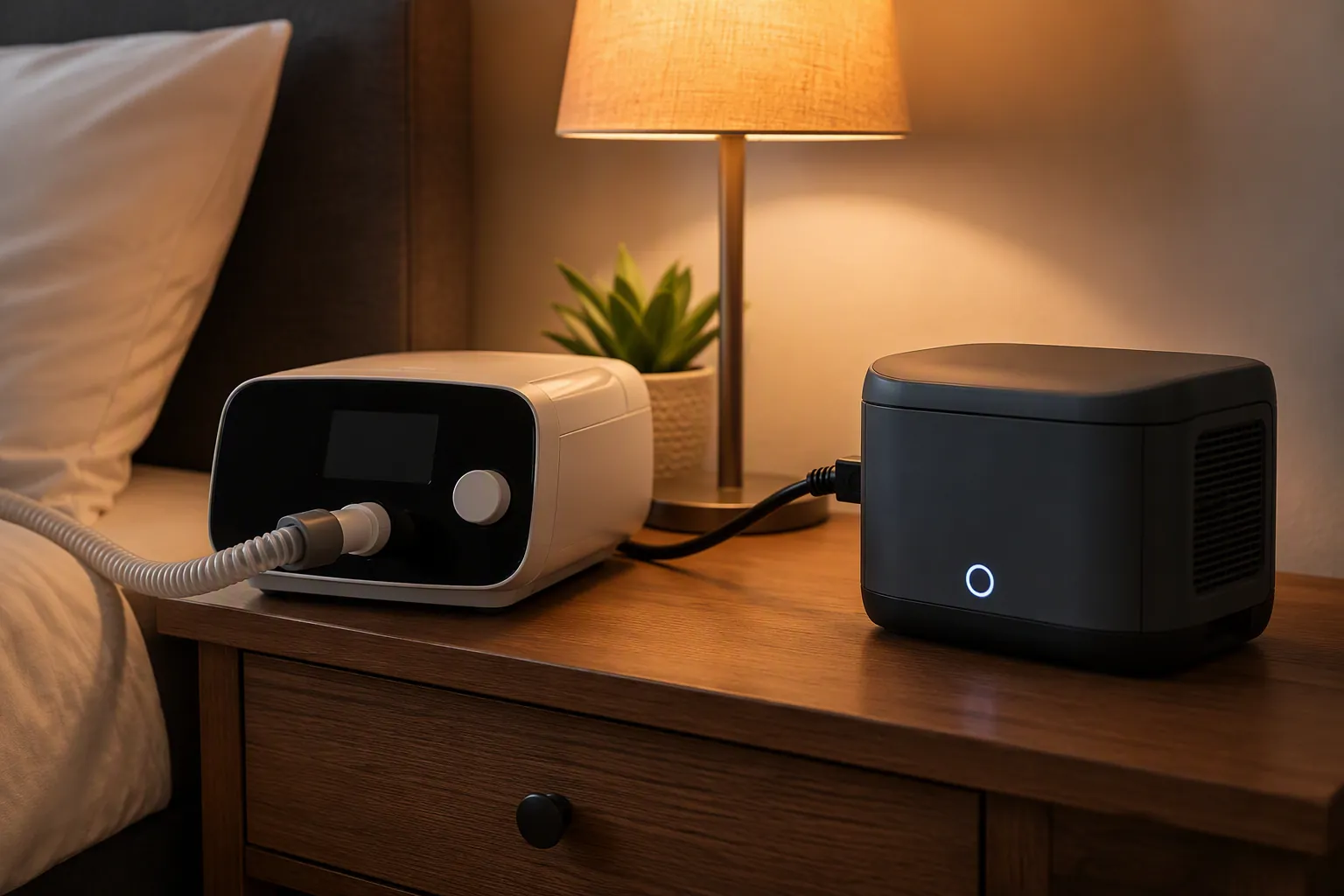
Battery programs can help, but they should be treated as program options, not assumptions. PG&E’s Portable Battery Program is designed for eligible customers who depend on power for medical needs, and its current eligibility language includes customers who experienced at least one PSPS since 2024 or three or more Enhanced Powerline Safety Settings outages, among other requirements.[3] Southern California Edison’s Critical Care Backup Battery Program is another utility example for eligible critical-care customers.[4] Other California and western utilities may use different names, rules, vendors, and waiting lists.
What to confirm before buying or accepting a battery
- The exact device model: CPAP, BiPAP, oxygen concentrator, nebulizer, bed lift, or another powered device.
- The device’s power draw in normal use, not only the maximum number printed on a label.
- Whether heated humidification, heated tubing, high flow settings, or continuous oxygen use changes runtime.
- How many nights the battery can support the device at the settings actually prescribed.
- Whether the battery can be safely recharged from a vehicle, solar panel, generator, or another source if the outage continues.
- Who will move, plug in, monitor, and recharge the battery if the older adult cannot comfortably lift or troubleshoot it.
A simple runtime calculation is useful, but it should not be treated as a medical clearance: device watts multiplied by hours of use gives the approximate watt-hours needed. If a CPAP setup uses a heated humidifier, the humidifier may materially change the load. If the device is an oxygen concentrator, assume the planning conversation is more serious; concentrators often need more continuous power than a basic CPAP setup, and the person’s oxygen supplier, clinician, or durable medical equipment provider should be involved before fire season.
The uncomfortable question is not “Do we own a battery?” It is “Can this specific device run for the nights this shutoff may last?” A battery that handles one night is useful only if there is a second-night plan: recharge, swap, relocate, or use a utility-provided or medically arranged alternative.
Heat changes sleep before it feels like an emergency
Older adults are often told to “sleep downstairs,” “use a fan,” or “open a window at night.” Those can help in the right conditions, but they do not erase the physiology. In a review of thermal environment, sleep, and circadian rhythm, Okamoto-Mizuno and Mizuno reported that mild heat exposure increases wakefulness, reduces REM sleep, roughly doubles sleep sweat loss, and that heat-related sleep disruption may not habituate even after five days of continuous exposure.[5]
That matters during a PSPS because the room may be warm for more than one night. A person can appear to be “managing” on the first evening and still accumulate poor sleep, dehydration risk, medication timing problems, and next-day confusion or fatigue. The older adult is the one lying in the room through the slowest hours; the plan should be built around that experience, not around what a younger visitor can tolerate for ten minutes.
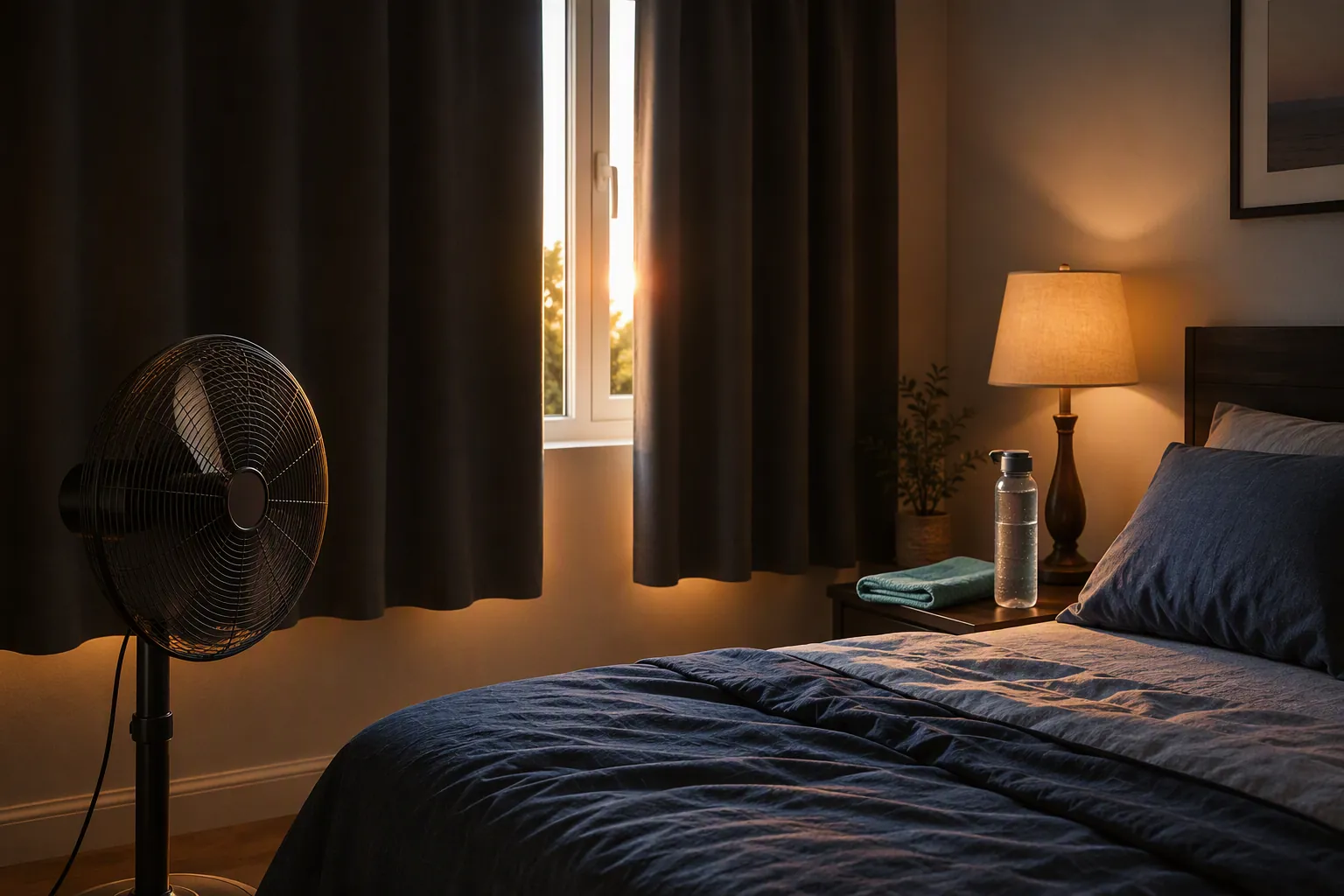
Clinical temperature advice does not land on one perfect bedroom number. Some sleep guidance favors a cooler room, while other guidance allows a somewhat warmer comfort range and warns that both too-cold and too-warm rooms can fragment sleep. During a PSPS, the more useful translation is this: cooler is usually easier for sleep, but once the room is persistently above the mid-70s, the person cannot cool down, or symptoms appear, this has moved from sleep comfort into heat-safety planning.
A home cooling plan should be set up before the shutoff notice window, because the best heat moves are often daytime moves: block sun with thermal or blackout curtains, cool the room before power is cut if there is warning, move sleep to the lowest and coolest room, reduce cooking heat, and decide whether a fan is actually helping. For more detail on fan use during hot outages, see the site’s decision rule on whether to use a fan during a heat wave outage.
At night, the low-tech sleep setup should be boring and reachable: water by the bed, a light blanket instead of heavy bedding, loose sleep clothes, a damp cooling towel if the person tolerates it, a charged phone within reach, and a clear walking path to the bathroom. If windows are opened for cooling, wildfire smoke and security still matter; for smoke-specific bedroom decisions, use a separate smoke plan rather than treating open air as automatically safer.
If the person is also dealing with extreme regional heat, the PSPS plan should borrow from heat-dome planning rather than ordinary summer comfort advice. The site’s older-adult guide to sleeping during a heat dome goes deeper on heat risk, nighttime cooling, and when a home stops being a safe sleep location.
Medication, food, and generator rules affect the sleep plan
Medication safety is not separate from sleep. If insulin, liquid antibiotics, biologics, or another essential medication depends on refrigeration, the household needs a cold-storage plan before the PSPS begins. Marin County Health and Human Services notes that insulin can degrade above 77°F, that a refrigerator generally keeps food cold for about four hours during an outage if unopened, and that a full freezer may hold temperature for about 48 hours.[6]
Those time limits can decide whether home is still the right sleep location on night two or three. If medication can no longer be kept within safe limits, the household should not wait for bedtime to solve it. Call the clinician, pharmacy, utility medical-needs line, county health department, or emergency information line early enough to move the medication and the person together if needed.
Generators create another boundary. Carbon monoxide risk means a generator should be kept outdoors and at least 20 feet from windows, doors, and vents; it should not run in a garage, on a balcony, near an open window, or in any partly enclosed space.[6] A generator that keeps a device powered but sends exhaust toward the bedroom has not made the night safer.
Set relocation triggers while everyone is still calm
Relocation should be written into the plan as a normal branch, not as a last-minute defeat. The question is where the older adult can sleep safely with the device, medications, mobility equipment, pets if applicable, and a person who knows the care routine.
- Leave before bedtime if the CPAP, oxygen concentrator, or other required device cannot be powered through the night.
- Leave before the room becomes dangerously hot if the person cannot cool down, is sweating heavily, seems confused, becomes weak or dizzy, or cannot sleep because of heat.
- Leave if refrigerated medication cannot be kept safe for the expected remaining outage.
- Leave if smoke, heat, mobility limits, or caregiver availability make nighttime bathroom trips, hydration, or device troubleshooting unsafe.
- Leave earlier if transportation requires help from family, paratransit, a neighbor, or a community program that may not be available late at night.
The destination does not have to be dramatic. It may be an adult child’s home outside the outage area, a hotel with confirmed power and elevator access, a cooling center that can accommodate medical equipment, or a medically appropriate facility arranged through a clinician or county service. What matters is that the destination has been called in advance, not imagined.
Write the relocation plan on paper. Include the utility account number, Medical Baseline or medical-needs status, device model, oxygen prescription details if applicable, medication list, pharmacy phone number, clinician phone number, battery instructions, and the names of people allowed to make calls. A charged phone is helpful; a paper plan is still readable when the phone is dead.
Handle the anxiety layer without pretending it is the whole problem
Wildfire season carries its own sleep burden. Research on wildfire exposure and insomnia is useful adjacent evidence for the anxiety layer, but it should not be read as direct evidence about sleeping through PSPS events.[7] Worry, alerts, smoke, evacuation memories, and repeated checking of the utility map can all make sleep harder even when the room and device plan are technically adequate.
The practical answer is to assign alert-checking before nightfall. One person checks the utility status, one person confirms the device battery, one person confirms medication storage, and one person knows the relocation trigger. If the older adult lives alone, that role can be a family member, neighbor, caregiver, or community contact who agrees to call at set times.
Calming routines help only after the safety questions are answered. A quiet room, familiar bedding, and fewer overnight phone checks are worthwhile. They are not substitutes for oxygen, PAP therapy, cooling, or safe medication storage.
The pre-season standard
Before fire season, the household should be able to answer four questions without guessing: What device must run overnight? How many nights can it run without grid power? How will the bedroom stay cool enough for safe sleep? Where will the older adult sleep if either answer fails?
Flashlights, phone banks, battery lanterns, and comfort items still belong in the kit. They just come after the load-bearing parts of the sleep plan. For an older adult who depends on powered therapy or cooling, the PSPS plan is not ready until it protects the medical device, the room temperature, and essential medications for the likely duration, with a relocation plan that starts before the shutoff becomes a nighttime emergency.
References
- Preventing wildfires with power outages: the growing impacts of California’s Public Safety Power Shutoffs, PSE Healthy Energy.
- Medical Baseline Fact Sheet, PG&E.
- Portable Battery Program, PG&E.
- Critical Care Backup Battery Program, Southern California Edison.
- Effects of thermal environment on sleep and circadian rhythm, Journal of Physiological Anthropology, 2012.
- Managing Health Conditions & Food Safety During Power Outage, Marin County Health and Human Services.
- Wildfire exposure and insomnia, 2024.
Supports these guides
Spot an error or have clinical feedback?
Because this article covers clinical, medication, or safety information, we use a moderated correction channel instead of open public comments. Let us know if something about “How Older Adults Can Sleep Through a Fire Power Shutoff” needs a closer look.
Send feedback on this article