
Mechanism explainer
How older adults can sleep safely during a heat dome
Hot nights disrupt sleep roughly twice as much in adults 65+, and most heat-related deaths occur in people 60+, so a heat dome is a safety event rather than simple discomfort. This guide explains why and lays out the night-by-night cooling plan, hydration guardrails, and caregiver red-flag checklist that follow.
For adults 65 and older, the question of how to sleep during a heat dome is not mainly about finding the perfect pillowcase or tolerating one sticky night. It is a heat-safety question that happens to arrive at bedtime. In a large analysis of nighttime temperature and sleep, the sleep-loss effect of warmer nights was roughly twice as large for adults 65 and older as it was for younger adults; in the elderly, low-income, summer subgroup, the estimated effect was far larger still.[1] That matters because heat illness is already concentrated in older age: AARP’s 2026 reporting on extreme heat notes that U.S. heat deaths rose 117% from 1999 to 2023, and that during the 2021 Pacific Northwest heat dome, 78% of those who died in Multnomah County, Oregon, were 60 or older.[2]
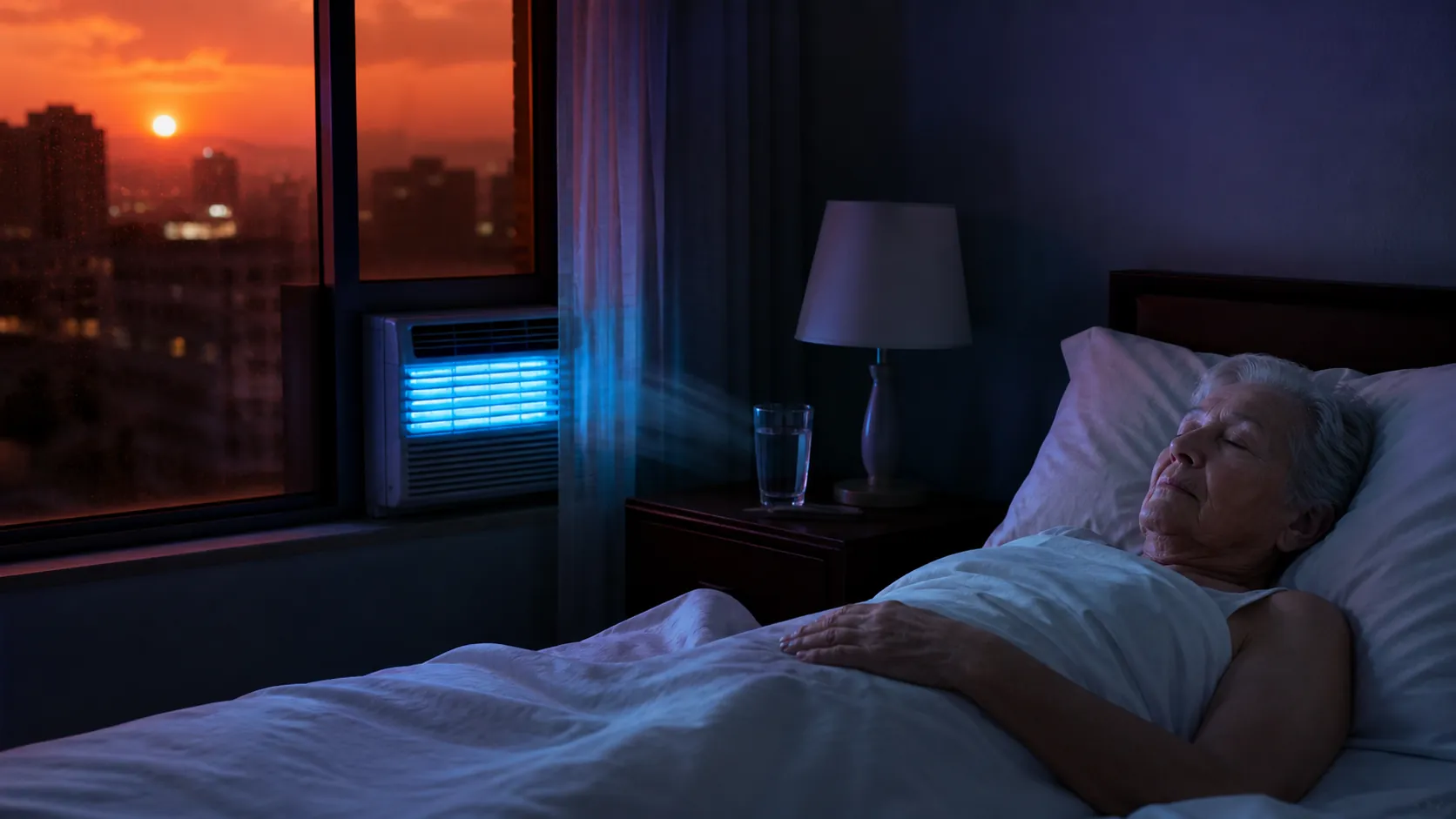
The nighttime piece is the part many ordinary heatwave tips glide past. Heat domes can trap hot air for days, and recent AP reporting described record warm overnight lows with “little to no overnight relief.” Experts quoted in that coverage warned that high overnight temperatures are especially dangerous because the body loses the cooler recovery window it normally uses, with mortality risk able to begin rising after day two or three of sustained heat.[3] For an older adult, a bedroom that never cools down is not just uncomfortable. It removes the safest part of the daily cycle.
The evidence is strong enough to change the plan, even if it is not one perfect heat-dome sleep study
There is no single study that places older adults inside a multi-day heat dome and measures every night of sleep, medication effect, indoor temperature, and clinical outcome. The safer way to read the evidence is in layers.
- The weather layer explains the exposure: a heat dome can keep nights unusually warm, leaving little overnight cooling.[3]
- The sleep layer shows that older adults are more vulnerable to hot-night sleep loss, including a roughly doubled temperature effect in the 65+ group in one large analysis.[1]
- The older-adult home layer is more specific: in a cohort with a mean age of 79 and 10,903 person-nights, sleep efficiency was best around 20–25°C, or 68–77°F, and dropped by about 5–10% as bedroom temperature rose from 25°C to 30°C, or 77°F to 86°F.[4]
- The physiology and public-health layer explains why the same room can carry more risk for an older person than for a healthy younger adult.[5][6][7]
That mix does not justify panic, but it does justify a more serious plan than “open a window and hope.” The aim is to create a genuinely cooler sleeping environment before the older adult is exhausted, dehydrated, confused, or too weak to make a good decision.
Why heat changes sleep differently after 65
Older bodies do not regulate heat with the same reserve they once did. Harvard Medicine Magazine’s review of heat and aging describes several reasons: older adults tend to sweat less efficiently, have reduced cardiovascular reserve for moving heat from the body’s core to the skin, and are more likely to live with chronic conditions or take medications that complicate heat response.[6] None of that makes an older person fragile by definition. It does mean the margin for a hot bedroom is thinner.
The sleep mechanism is not abstract. In a controlled study of older men, mild heat during sleep increased wakefulness, reduced REM sleep, roughly doubled whole-body sweat loss, and showed a blunted core-temperature response compared with younger men.[5] That is the kind of finding that changes how bedtime advice should sound. If an older adult is sweating more, waking more, and losing restorative sleep while the apartment stays hot, the next day begins with less reserve.
Sleep loss also makes the safety problem harder to manage. A tired person may delay drinking, misjudge dizziness, forget to turn on cooling early, or resist leaving a hot apartment because the effort feels too large. Heat exhaustion itself can impair judgment, so the plan cannot depend on making the best decision at midnight on the second or third hot night.
Medications are part of the same picture. The CDC warns that older adults are at higher heat risk partly because of chronic medical conditions and medicines that can affect heat response.[7] Blood pressure medicines, diuretics, and medicines with anticholinergic effects are common examples clinicians may want to review before summer or during heat alerts. The safe instruction is narrow and important: ask a clinician or pharmacist what to watch for; do not stop prescribed medication on your own.
Do not turn bedroom temperature into a false precision contest
Sleep-temperature advice can become oddly exact. Some consumer sleep guidance favors a cooler bedroom range, while the older-adult cohort found the best sleep efficiency around 20–25°C, or 68–77°F.[4] Those numbers are useful as comfort and planning references, not as a universal medical line. A 77°F room with functioning air conditioning, low humidity, and a monitored older adult is not the same as an 86°F room in a sealed apartment after two days of heat.
During a heat dome, the practical rule is simpler: the sleeping space must become meaningfully cooler than the day’s accumulated heat, and it must stay cool enough that the older adult can sleep without escalating symptoms. If that cannot happen at home, the plan needs another air-conditioned location before the night turns into a test of endurance.
A night-by-night cooling plan for adults 65+
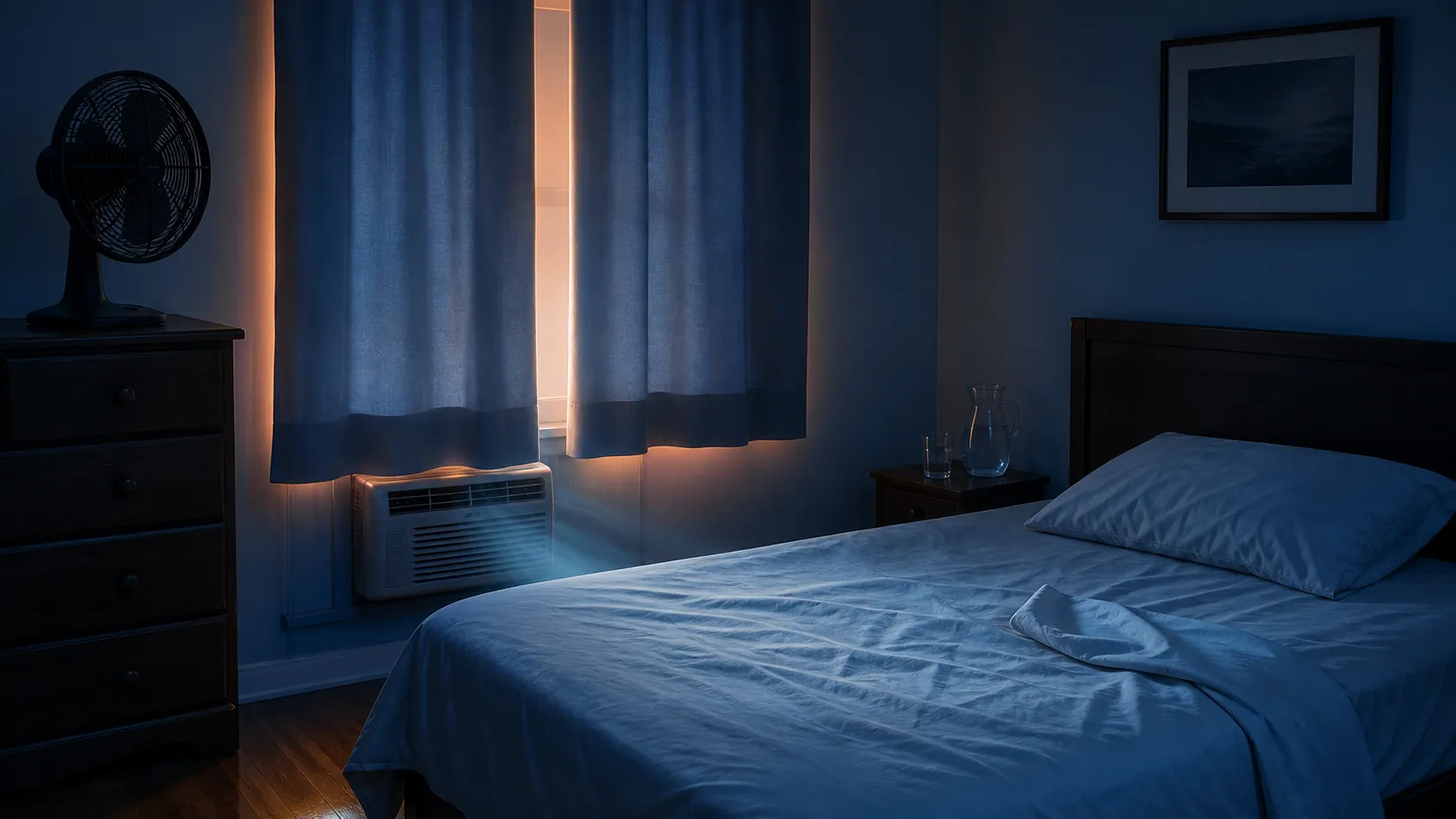
The plan starts before bedtime because the worst decision point is a hot, sleep-deprived room after midnight. If the forecast calls for several days of extreme heat, treat the first day as setup day, not as a wait-and-see day.
| Timing | Main decision | What to do |
|---|---|---|
| Before night 1 | Where will the older adult sleep if home stays hot? | Identify the coolest safe room and a backup air-conditioned location: a relative’s home, a public cooling center, a senior center, a library during open hours, or another site the person will realistically accept. |
| Night 1 | Can the sleeping space be cooled with air conditioning? | Use air conditioning as the baseline when available. Pre-cool the room before bedtime, close blinds or curtains against direct sun, and move sleep to the lowest, coolest safe part of the home if needed. |
| Night 2 | Did the room cool down overnight? | If the bedroom never felt cooler, sleep was badly broken, or the older adult woke weak, dizzy, nauseated, unusually tired, or confused, activate the backup cooling location rather than repeating the same setup. |
| Night 3 and beyond | Is the plan still safe? | Sustained hot nights deserve a lower threshold. Recheck hydration limits, medications, indoor temperature, mobility, and symptoms. If cooling is not reliable, use community cooling help or clinician guidance. |
Name the air-conditioned sleep option early
Air conditioning is the baseline for a high-risk hot night, not a luxury add-on. That does not always mean central air in the bedroom. It may mean a window unit in one room, a portable unit set up before the heat peaks, sleeping in a living room that cools better than the bedroom, or spending the hottest nights with family.
For someone who values independence, “go to a cooling center” can sound like losing control. It often lands better as a pre-decided threshold: if the bedroom is still hot by a certain evening hour, if sleep was broken the night before, or if there are early heat symptoms, the next night happens somewhere cooler. The decision is made while everyone is clear-headed.
If transportation is the barrier, solve that before the second night. Decide who can drive, whether a ride service is realistic, whether a local agency offers heat-emergency transportation, and what the older adult needs to bring: medications, glasses, hearing aids, mobility aids, phone charger, water plan, and a light layer in case the cooling site feels too cold.
Use fans only within the CDC caveat
A fan can help move cooled air or make a mildly warm room feel better. It should not be treated as the main safety tool in dangerous indoor heat. The CDC advises that fans should not be used as the primary way to cool off when temperatures are in the high 90s and notes that fans do not prevent heat-related illness when temperatures are above 90°F.[7]
That caveat is easy to miss because a fan feels active. Air is moving; the person may feel less trapped. But if the room itself is very hot, the fan may be moving hot air across skin that already has a weaker cooling response. Use it as support for air conditioning, cross-ventilation when outdoor air is actually cooler, or comfort below the CDC’s danger range—not as the plan that keeps an older adult safe through a heat dome.
Pre-cool the room instead of waiting for bedtime
Bedrooms often hold heat from the afternoon well into the night. If air conditioning is available, start cooling the sleeping area before the older adult is ready for bed. Close curtains or blinds before direct sun hits the room. Keep heat-producing tasks—oven use, long appliance cycles, unnecessary lighting—away from the late afternoon and evening when possible.
Move the bed, not just the thermostat, if the current room is the wrong room. A ground-floor room, a shaded room, or a room with the best window unit may be safer than the usual bedroom. Clear the walking path before dark. Heat plus a temporary sleeping arrangement can raise fall risk if the route to the bathroom is cluttered or poorly lit.
Hydration has to fit the person, not the slogan
“Drink more water” is not precise enough for many older adults. The CDC advises drinking more fluids during heat but also says people whose doctors limit fluids or who take water pills should ask how much they should drink during hot weather.[7] That includes many people with heart failure, kidney disease, certain blood pressure regimens, or diuretic prescriptions.
A practical plan is to write down the clinician’s heat-day guidance before the next heat alert: usual daily fluid limit, whether electrolytes are appropriate, what symptoms should trigger a call, and whether daily weight, blood pressure, or dizziness should be monitored. Keep water within reach overnight if allowed, but do not turn hydration into an unsupervised contest.
Use ordinary sleep tips only after the cooling baseline is handled
Light pajamas, breathable sheets, closed blinds, a cooler shower, and avoiding a heavy late meal can all help comfort. They are secondary tactics. They do not replace air-conditioned cooling when the room remains dangerously hot.
If you want the broader life-stage version of heatwave sleep tactics, see Heatwave Sleep Tips for Pregnancy, Menopause, and Older Adults. This guide stays narrower because the 65+ heat-dome problem has different stakes: medication review, mobility, overnight monitoring, and the decision to leave a hot sleeping space.
Caregiver checks should be concrete, brief, and earlier than feels necessary
A good check-in does not need to feel like surveillance. It should answer a few practical questions: Is the room actually cooler? Did the person sleep? Are they drinking within their allowed plan? Can they stand, walk, think, and speak normally? Are symptoms getting better after cooling, or not?
| What you notice | Why it matters | What to do |
|---|---|---|
| Heavy sweating, cold or clammy skin, weakness, dizziness, headache, nausea, muscle cramps, or fainting | These fit CDC-listed heat exhaustion signs. | Move the person to a cooler place, loosen clothing, use cool cloths, and have them sip water if allowed. Get medical help if symptoms worsen or last longer than one hour.[8] |
| Confusion, loss of consciousness, very high body temperature, hot red skin, or a fast strong pulse | These fit CDC-listed heat stroke warning signs. | Call 911. Move the person to a cooler place and use cooling measures while waiting. Do not give anything to drink if heat stroke is suspected.[8] |
| Unusual sleepiness, new weakness, missed medications, inability to get to the bathroom safely, or refusal to leave a hot room despite symptoms | Heat and sleep loss can weaken judgment and mobility before the situation looks dramatic. | Use the lower threshold: call a clinician, local nurse line, emergency services, or move to prearranged cooling help depending on severity. |
| The home cannot be cooled below a dangerous level and outdoor heat will persist overnight | There may be little recovery window before the next day’s heat. | Do not spend another night testing the same setup. Use the backup air-conditioned location. |
The lower threshold is not overprotective when the person is 78, lives alone, takes blood pressure medication, and is sleeping in a room that stayed hot the previous night. Waiting for unmistakable crisis signs gives heat too much time. If an older adult seems newly confused, unusually tired, weak, dizzy, nauseated, or unable to cool down, the next step should be cooling help or medical guidance, not another round of sleep tips.
After the heat emergency, sleep still deserves attention
Once the dangerous nights pass, it is reasonable to return to the slower work of improving sleep continuity. Older-adult sleep is tied to cognition, metabolic health, pain, mood, and daytime function. For related reading, see How Poor Sleep Drives Alzheimer’s Pathology and Can Time-Restricted Eating Help Older Adults Sleep Better?. For the cold-weather counterpart to thermal sleep planning, see How to sleep better in cold weather by life stage.
During the heat dome itself, keep the line plain. If the sleeping space cannot be cooled safely, if fluid intake is medically complicated, or if heat-illness signs appear, the answer is no longer another sleep hack. It is cooling help, clinician guidance, or emergency care.
References
- Nighttime temperature and human sleep loss in a changing climate — Science Advances, 2017
- Extreme Heat Is More Dangerous for Older Adults — AARP, May 2026
- Heat dome brings record temperatures — AP News, July 2026
- Nighttime ambient temperature and sleep in community-dwelling older adults — PMC, 2023
- Effects of thermal environment on sleep and circadian rhythm — Journal of Physiological Anthropology, 2012
- The Effects of Heat on Older Adults — Harvard Medicine Magazine
- Heat and Older Adults Aged 65+ — CDC
- About Heat and Your Health — CDC
Supports these guides
Spot an error or have clinical feedback?
Because this article covers clinical, medication, or safety information, we use a moderated correction channel instead of open public comments. Let us know if something about “How older adults can sleep safely during a heat dome” needs a closer look.
Send feedback on this article