
Mechanism explainer
How to Sleep During Wildfire Smoke With Clean Bedroom Air
Wildfire smoke disrupts sleep through airway irritation, micro-arousals, and stress, which is why standard sleep hygiene is secondary on smoky nights. The higher-yield fix is a clean-air bedroom with AQI-checked filtration and sealing — plus clear red-flag symptoms that warrant medical care.
If you are trying to figure out how to sleep during wildfire smoke tonight, put standard sleep hygiene in second place for a moment. Bedtime consistency, dim lights, and a calmer wind-down can help, but smoke is a breathing-pathway problem first. If fine particles are getting into the room where you sleep, they can irritate your airways, make sleep lighter and more broken, and add stress at the exact time your body is supposed to downshift.
The higher-yield move is to make one clean-air bedroom before you start fine-tuning your routine: check the AQI, close and seal the room, run correctly sized HEPA filtration continuously, keep HVAC or AC settings from pulling in smoky outdoor air, and avoid creating indoor particles before bed.
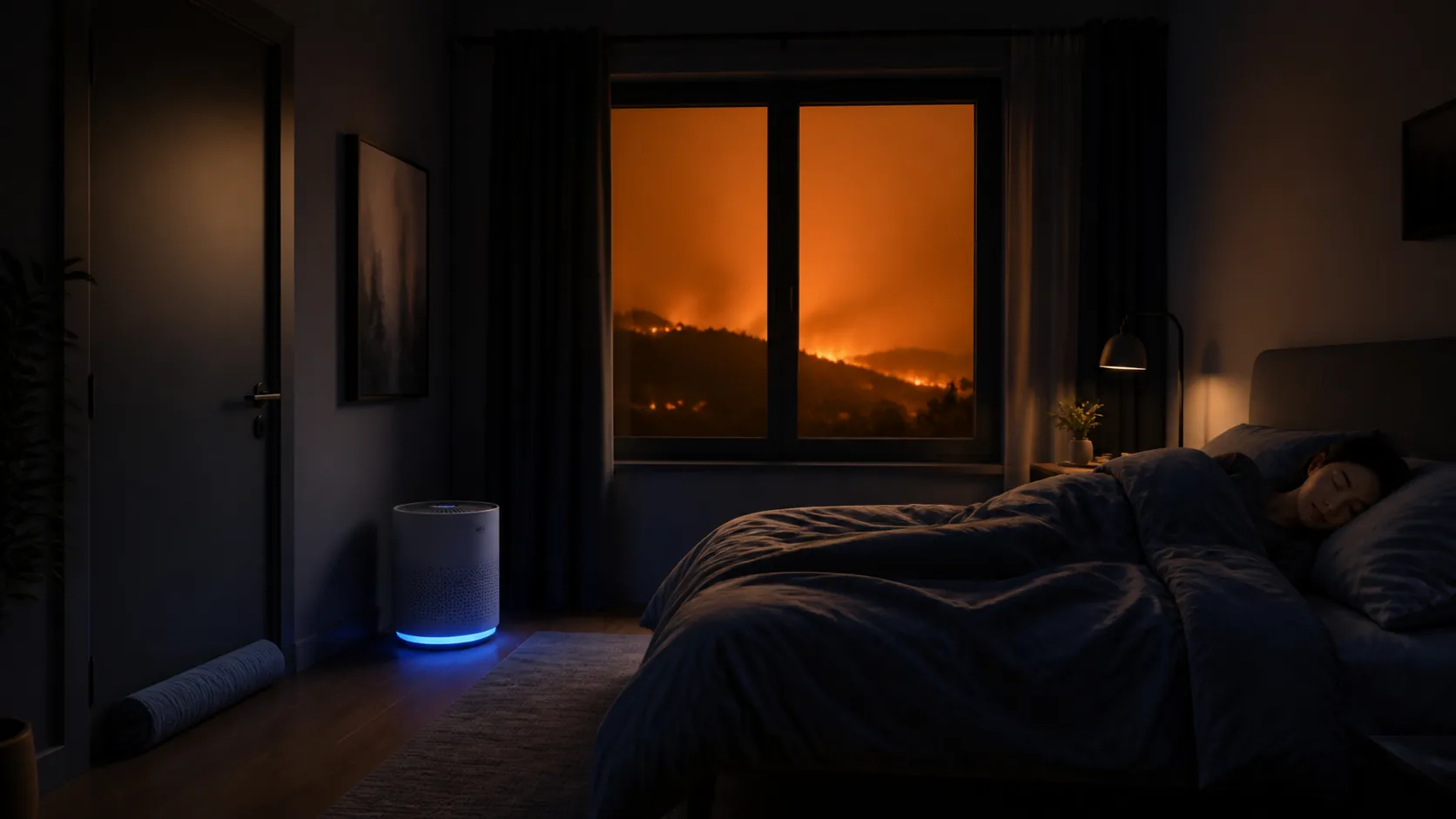
Tonight’s priority: one filtered room for sleep
Start with the room, not the pillow. Public-health guidance from the CDC, EPA, American Lung Association, and South Coast AQMD points in the same practical direction during smoke events: reduce outdoor-air entry, filter indoor air, avoid indoor combustion or particle sources, and pay closer attention if you are in a higher-risk group.[1][2][3][4]
- Check the AQI before bed. Use AirNow or your local air agency. If the AQI is 101 or higher, treat the night as a smoke-exposure night, especially if anyone in the home is pregnant, older, has asthma, COPD, heart disease, sleep apnea, or uses CPAP. If it reaches 151 or higher, reduce exertion and keep the clean-room plan in place. At 201 or higher, assume outdoor air is very unhealthy and keep activity, errands, and window-opening to a minimum unless local emergency instructions say otherwise.[1][2][4]
- Pick one sleep room. A whole home is harder to protect than a bedroom. Choose the smallest practical room where the sleeper, a child, an older parent, or a coughing partner can safely sleep.
- Close windows and doors. Use weatherstripping if you have it; for tonight, a rolled towel at the bottom of the door is a reasonable short-term seal. Keep exterior doors from being opened repeatedly near bedtime.
- Run a portable HEPA air purifier continuously in the sleep room. Use a unit sized for the room, keep it away from walls or furniture that block airflow, and run it on a higher setting before bed if the noise is tolerable. Consumer Reports, citing EPA figures, reports that the best HEPA units can cut particles by up to about 85% in sealed-room testing; real bedrooms vary because of room size, leakage, filter condition, fan speed, and how often doors open.[5]
- If you have central HVAC, use the best filter your system can safely handle. EPA guidance supports using a high-efficiency filter, often MERV-13 or higher when compatible with the system, and running the fan to circulate filtered air.[2]
- Set AC to recirculate when available. Avoid settings that bring in outdoor air during a smoke episode.[2][4]
- Do not add particles indoors. Skip candles, incense, smoking, frying, grilling, fireplaces, and non-HEPA vacuuming before bed. Vacuuming can resuspend particles if the vacuum does not have adequate filtration.[2][3][4]
- Change the bedding situation if smoke has already entered. If windows were open earlier, replace the pillowcase, do not shake bedding indoors, and keep smoky clothing out of the bedroom. If you were outside in smoke, showering and changing clothes can reduce what you carry into bed.
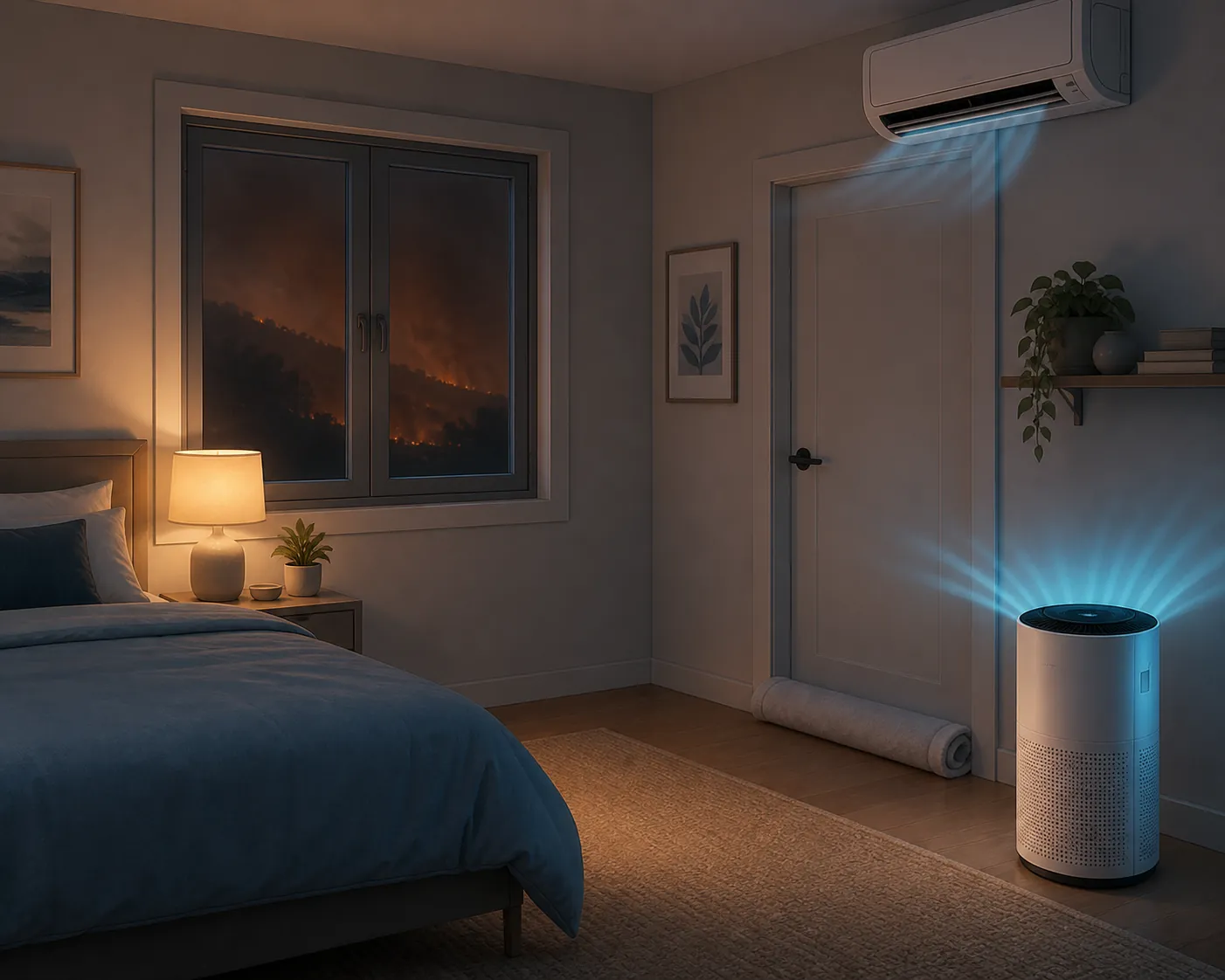
The point is not to create a perfect laboratory room. The point is to stop making the breathing zone worse during the hours when you are lying still, breathing through the same air again and again.
Why smoke makes sleep feel lighter, noisier, or more restless
The sleep-and-air-pollution evidence is strong enough to take seriously, but not strong enough to pretend every pathway is settled. A 2020 systematic review by Liu and colleagues found that 21 of 22 included studies reported a positive association between air pollution and poorer sleep across age groups; in adults, the associations were strongest for sleep-disordered breathing. The same review notes important limits: most included studies were cross-sectional, one study found the opposite direction, and mechanisms remained inconclusive.[6]
| Evidence tier | What it can support | What it cannot prove |
|---|---|---|
| Consensus public-health guidance | Make a cleaner indoor room: seal, filter, recirculate, avoid indoor particle sources.[1][2][3][4] | It cannot guarantee a specific particle reduction in every bedroom. |
| Observational sleep-pollution literature | Air pollution is associated with poorer sleep and sleep-disordered breathing across many studies.[6] | It does not establish causality for an individual smoky night. |
| Device testing and EPA-derived estimates | Well-performing HEPA purifiers can substantially reduce particles in sealed-room conditions, up to about 85% in the cited testing context.[5] | It does not mean every purifier, room, or setup reaches that reduction. |
| Animal/mechanistic evidence | Smoke plus disrupted sleep may interact with cardiovascular stress responses in controlled lab conditions.[7] | It does not prove the same effect size or timing in humans. |
Last reviewed: July 31, 2026. Evidence status: practical room guidance is consensus-based; sleep effects are supported mainly by observational research; cardiovascular interaction findings from smoke-plus-sleep-disruption experiments should be treated as animal/mechanistic evidence, not direct clinical prediction.
1. Airway irritation can raise breathing resistance
Wildfire smoke contains fine particulate matter that can irritate the nose, throat, and lower airways. That irritation can mean congestion, coughing, throat dryness, and more upper-airway resistance. Sleep specialists often care about that last part because higher resistance can make snoring worse and may increase vulnerability in people who already have obstructive sleep apnea or borderline nighttime breathing problems. Snore MD describes this wildfire-smoke pathway as particulate exposure contributing to airway inflammation, congestion, snoring, and sleep disruption.[8]
This is where a clean-air bedroom is more relevant than a perfect bedtime. A person who lies down in a smoky room may breathe through irritated nasal passages for hours. If they use CPAP, the device can also be moving room air through the system; CPAP users should follow their equipment and clinician instructions, use appropriate filters where prescribed, and have a backup plan for power outages or evacuation.
2. You may not fully wake up, but your sleep can still fragment
Smoke-night sleep can feel strange because the disruption is not always a dramatic awakening. Congestion, coughing, throat irritation, and breathing effort can produce brief arousals that you do not remember clearly the next morning. The result may be more time in lighter sleep, more position changes, a dry mouth, morning headache, or the feeling that you were technically in bed for eight hours but did not recover.
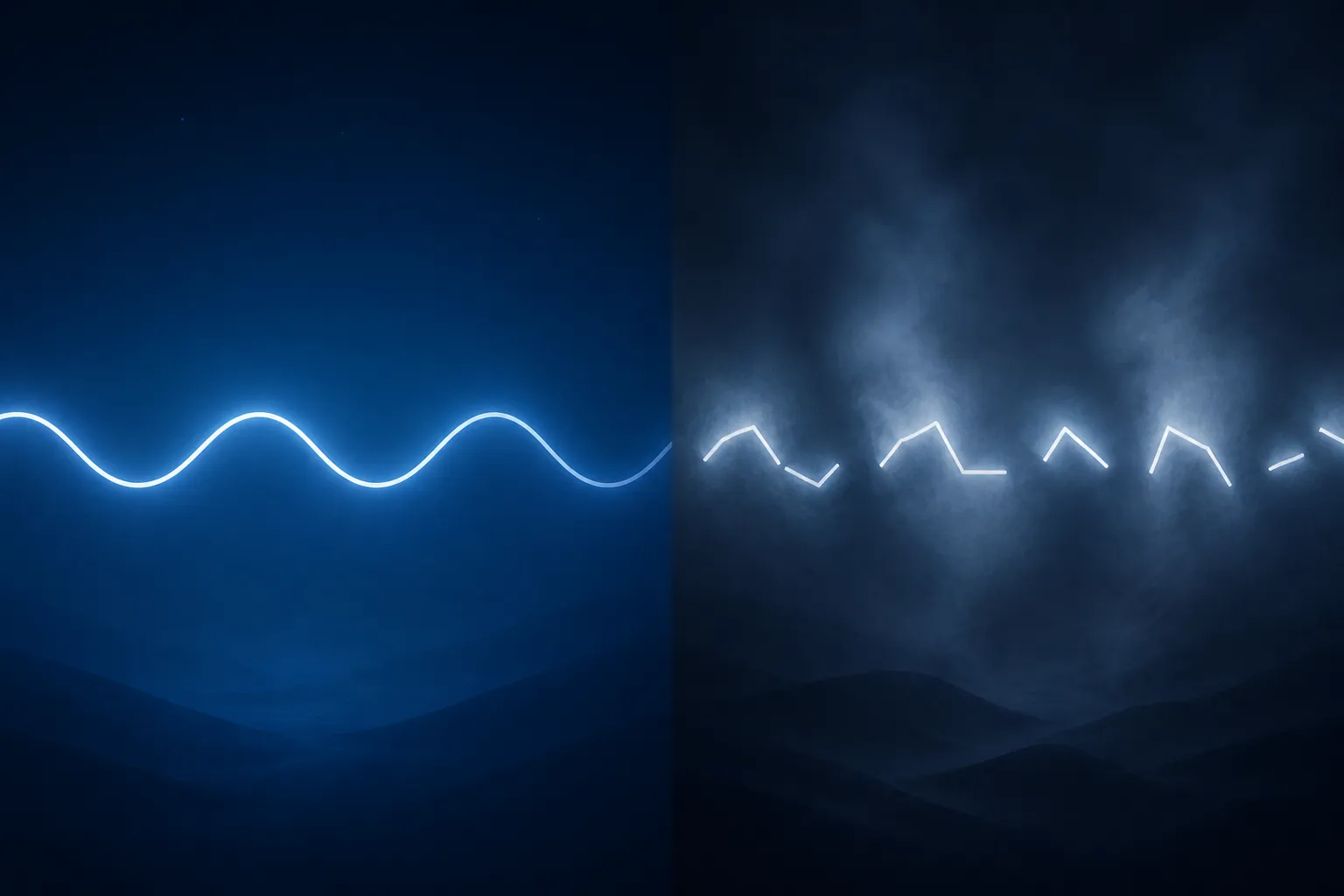
The Liu review’s adult findings are especially relevant here because the clearest adult associations were with sleep-disordered breathing, not simply with how satisfied people felt about sleep.[6] That distinction matters. If smoke increases breathing resistance or irritation, then the first intervention should reduce the irritant load, not merely make the room feel more relaxing.
3. Stress and isolation can keep the body on alert
Smoke also changes the emotional conditions around sleep. People close windows, cancel walks, keep children indoors, check maps repeatedly, worry about older relatives, and wonder whether the purifier is doing enough. That is not the same as wildfire trauma, and survivor-sample insomnia rates should not be applied to an ordinary smoke night. Still, the smoke-night loop is real enough: less outdoor time, more uncertainty, more monitoring, and a stronger sense of being sealed in.
A small amount of planning can reduce that loop. Check the AQI once before bed, set the clean-room conditions, decide who is sleeping where, and stop refreshing maps unless local emergency alerts require it. If you need to monitor conditions, use official alerts rather than keeping a news feed open all night.
What to change after the air is handled
Once the sleep room is sealed and filtered, ordinary sleep supports can come back into the picture. Keep the wind-down simple: lower the lights, avoid hard exercise in smoky air, do not add scented products to the room, and choose the least disruptive sleeping arrangement that keeps the most vulnerable person in the cleanest air.
If someone is coughing, give the purifier the best chance to work instead of turning the room into a mix of remedies and irritants. Candles, incense, smoke, frying, and some “air freshening” products can worsen indoor particle or chemical exposure. Ozone-generating air cleaners are not a shortcut; public-health agencies warn against ozone-producing devices for indoor air cleaning during smoke events.[2][3][4]
If heat is also a problem, do not seal a room so aggressively that it becomes unsafe. Cooling and clean air have to be managed together. When AC is available, recirculate indoor air. If power is unreliable or a medical device is involved, make the backup plan before bedtime, not after the outage starts.
Who should be more cautious on smoky nights
Older adults, pregnant people, children, people with asthma or COPD, people with heart disease, and people with sleep-disordered breathing have less room for trial and error during smoke events. The CDC and American Lung Association identify several of these groups as more vulnerable to wildfire smoke health effects.[1][3]
Older adults deserve special attention during repeated smoke seasons because the broader wildfire-smoke burden is growing. AARP’s 2026 overview notes that wildfires now contribute up to about 25% of total U.S. PM2.5 and cites research suggesting wildfire smoke may be roughly 10 times more toxic than typical fossil-fuel pollution.[9] Those figures do not tell you what will happen in one bedroom tonight, but they do explain why a recurring smoke plan is no longer niche.
For CPAP and sleep-apnea users, the clean-air room matters because the airway is already the vulnerable system. Keep equipment clean, follow the device manufacturer’s filter guidance, and ask your sleep clinician what to do during smoke events if you have frequent leaks, worsening congestion, or power concerns. If you rely on powered medical equipment, see power-grid emergency sleep planning for medical-device users before the next outage risk.
A simple smoke-night sequence
| When | Action | Why it matters |
|---|---|---|
| Early evening | Check AQI and local emergency alerts. | You need to know whether this is a normal bedtime or a clean-room night. |
| Before bedtime | Close windows and doors, block obvious gaps, and start the HEPA purifier in the sleep room. | Filtration needs time and continuous airflow. |
| During dinner | Avoid frying, grilling, candles, incense, smoking, fireplaces, and non-HEPA vacuuming. | Indoor sources can add particles after you have already sealed the room. |
| Wind-down | Move vulnerable sleepers into the cleanest room and keep the routine quiet and short. | The room setup is doing the heavy lifting; the routine should not interfere with it. |
| Overnight | Keep the purifier running and avoid opening the door repeatedly. | Every door opening can mix smoky or less-filtered air back into the sleep room. |
| Morning | Recheck AQI before airing out the room or exercising outdoors. | Smoke conditions can change overnight. |
For future nights, connect this to your regular environmental check. If smoke, heat, winter storms, or power risk are part of your region’s pattern, a short forecast habit can prevent a rushed bedtime scramble; see how to use weather forecasts for sleep preparation and indoor air planning during major weather events.
When sleep symptoms become a medical boundary
Do not try to sleep through serious smoke symptoms. Seek medical care urgently for trouble breathing, chest pain or chest tightness, severe or worsening wheezing, confusion, fainting, blue lips or face, or symptoms that feel like a heart attack or stroke. People with asthma, COPD, heart disease, pregnancy, or significant sleep apnea should use their clinician’s smoke-event plan and seek care earlier if symptoms are escalating.[1][3]
Smoke effects can show up after the night itself; watch for breathing or cardiovascular symptoms over the next 24 to 48 hours after exposure.[9] If the smoke event overlaps with dangerous heat, use heat-wave sleep safety or sleep during a dangerous heat wave alongside the clean-air plan, because overheating a sealed room is not a safe trade.
References
- Risk Factors for Wildfire Smoke, CDC.
- Wildfires and Indoor Air Quality (IAQ), EPA.
- Wildfires, American Lung Association.
- Wildfire Smoke & Ash Health & Safety Tips, South Coast AQMD.
- Best Air Purifiers for Wildfire Smoke, Consumer Reports, July 16, 2026.
- The effect of air pollution on sleep: A systematic review and meta-analysis, 2020.
- Sleep disruption and wildfire smoke exposure: cardiovascular responses in rats, Frontiers in Environmental Health, 2023.
- Wildfires and Your Sleep, Snore MD.
- Wildfire Smoke Health Risks for Older Adults, AARP, July 17, 2026.
Supports these guides
Spot an error or have clinical feedback?
Because this article covers clinical, medication, or safety information, we use a moderated correction channel instead of open public comments. Let us know if something about “How to Sleep During Wildfire Smoke With Clean Bedroom Air” needs a closer look.
Send feedback on this article