
Mechanism explainer
Couldn't sleep after the Santa Rosa fire smoke? Here's why
After wildfire smoke exposure, trouble sleeping is a predictable physiological response. This article explains the three distinct drivers, how long it typically lasts, and when sleeplessness becomes a sign you need clinical care.
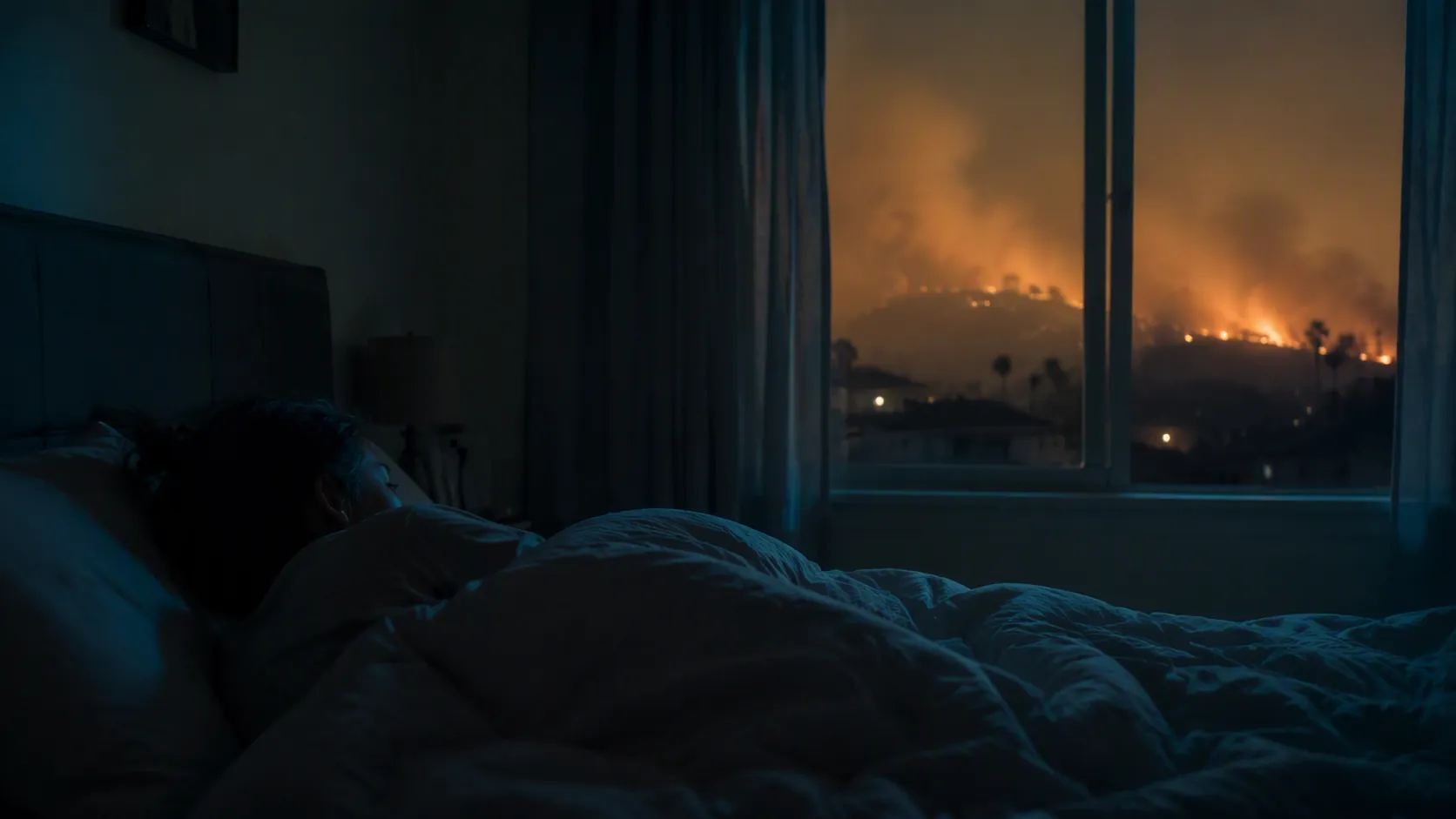
If you could not sleep after Santa Rosa fire smoke exposure, that does not mean your body failed some private test of toughness. Wildfire smoke can make sleep fall apart through the lungs, the nervous system, and memory. Sometimes all three are active in the same night: your nose is blocked, your chest feels tight, your body is keyed up, and the smell outside the window tells your brain that danger may be close again.
The boundary matters. One terrible night after heavy smoke is often an acute body response. Several bad nights can still be part of recovery, especially if coughing, congestion, anxiety, or air-quality checking continues. But recurring sleeplessness that keeps going for weeks, returns every smoke season, or stretches toward the three-month chronic-insomnia line should not be brushed off as “just stress.” It is treatable, and waiting it out indefinitely can make the sleep problem harder to unwind.
Why Santa Rosa smoke can follow you into bed
There is not a published study that directly measures sleep after Santa Rosa fire smoke exposure as its own cohort. That limitation matters. The local connection comes from overlapping evidence: Northern California wildfire health research, Sonoma and Butte County interview work, survivor insomnia studies, and smoke-exposure sleep science.
The 2017 Northern California wildfires, including the Tubbs Fire, did leave documented health needs that were still being named after the immediate disaster period. In the WHAT-Now study, sleep appeared among survivor health needs, and persistent mental-health needs were part of the post-fire picture rather than a rare afterthought.[1]
The Sonoma and Butte County qualitative work is even closer to the feeling many residents recognize. Participants described smoke smell as a trigger that could bring anxiety and previous fire trauma back into the room; one participant described being unable to sleep when a new fire ignited.[2] That is not proof that every sleepless Santa Rosa resident has trauma-related insomnia. It is lived context showing that, in this region, smoke is not just an air-quality measurement. For many people, it is also a cue.
That distinction is important because the fix depends on what is keeping you awake. A smoke night dominated by irritated breathing is handled differently from a smoke night dominated by threat monitoring. A night dominated by fine-particle arousal may feel like your body is “wired” even when you are exhausted. Treating all of those as generic anxiety misses what your body is actually doing.
The three pathways that can break sleep after smoke
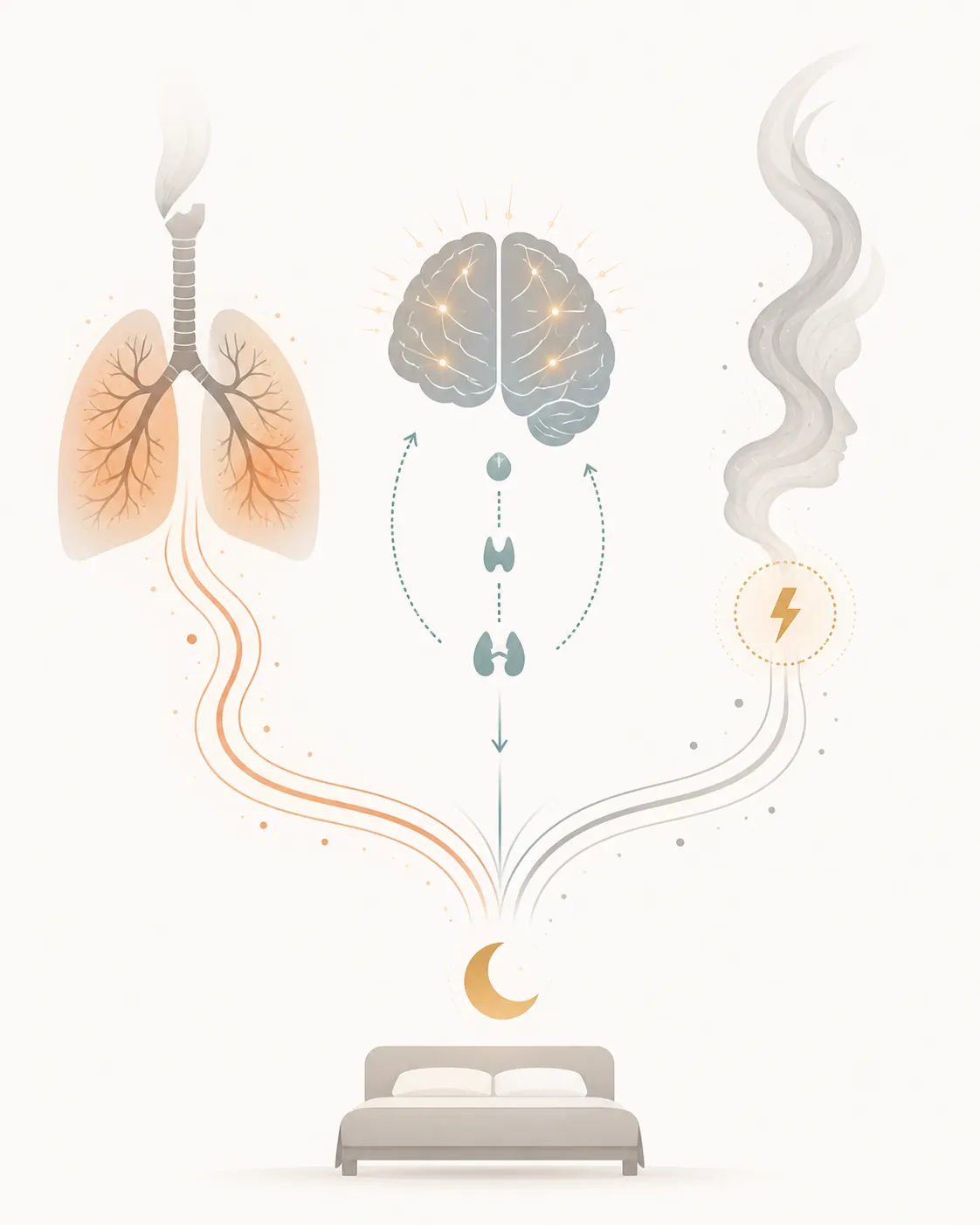
| Likely driver | What it may feel like at night | What usually helps most |
|---|---|---|
| Airway irritation and congested breathing | Blocked nose, cough, scratchy throat, chest tightness, waking because breathing feels effortful | Cleaner indoor air, reducing irritation, managing congestion, and medical care if breathing symptoms are concerning |
| Fine-particle arousal | Tired but wired, shallow sleep, frequent waking, racing body without a clear thought trigger | Reducing exposure, giving the nervous system time to settle, avoiding extra stimulation while the body recovers |
| Smoke as a trauma cue | Feeling unsafe, checking alerts, smelling smoke “again,” images or memories returning, fear when a new fire starts | Safety cues, less overnight monitoring when safe, trauma-informed support if symptoms persist |
1. Irritated airways make sleep lighter and more fragile
Wildfire smoke irritates the nose, throat, and lungs. At night, that can become very practical: you breathe through your mouth, cough yourself awake, notice chest tightness, or keep shifting because your airway does not feel comfortable. Sleep depends on the body being able to drop vigilance. Labored or irritated breathing keeps tugging it back up.
For mild respiratory symptoms, UCLA Health pulmonology guidance says symptoms often clear within 24 to 48 hours after exposure ends.[3] That is useful, but it should not be misread as a sleep guarantee. It is a lung-symptom window, not a promise that your sleep will reset in two nights. If your sleep disruption is mainly from cough or congestion, improvement in breathing may make sleep easier. If your nervous system or trauma memory is still activated, sleep may lag behind your lungs.
2. Fine particles may keep the body in an aroused state
The smallest smoke particles, often discussed as PM2.5, are a different problem from the smell alone. They can penetrate deeply into the respiratory system, and sleep researchers are increasingly interested in how inhaled pollution affects inflammatory and autonomic pathways involved in sleep.
A 2025 EPA-affiliated rodent study found that a single one-hour biomass-smoke exposure increased wake time, reduced NREM and REM sleep, and raised sympathetic tone.[4] That study is preclinical. It should not be translated into a claim that the same exposure produces the same sleep outcome in a person in Santa Rosa. Its value is narrower and still important: smoke exposure can disturb sleep physiology even without an evacuation, a news alert, or a conscious fear story attached.
Human air-pollution data point in a similar direction, though with limits. In a MESA analysis presented at the American Thoracic Society meeting in 2017, people in the highest long-term PM2.5 exposure group had a nearly 50% increased likelihood of low sleep efficiency compared with those in the lowest exposure group.[5] That is observational, conference-level context, not a causal proof about a single wildfire smoke night. It still helps explain why some people describe the same strange pattern after smoke: exhausted, but unable to sink into sleep.
3. Smoke can become a threat cue
In Sonoma County, smoke can carry memory. For someone who lived through the Tubbs Fire, Kincade, Glass, or another evacuation, the body may not treat a smoky night as a neutral environmental nuisance. It may treat it as the first page of a familiar emergency.
That kind of alertness is not irrational in a fire-prone place. It becomes a sleep problem when the checking loop cannot turn off: refreshing air-quality maps, scanning wind forecasts, listening for sirens, rehearsing whether to pack, and waking at every smell or sound. If evacuation hyperarousal is the center of the night, the more relevant companion issue is sleep during Santa Rosa fire evacuation. After the exposure, the question becomes whether your body has stood down or is still monitoring for the next threat.
What helps tonight
The most useful first move is not to ask, “How do I make myself relax?” It is to ask, “Which pathway is loudest right now?” That keeps the plan concrete.
- If breathing is the problem: make the bedroom the cleanest room you can reasonably create. Close windows, reduce indoor particle sources, use filtration if available, and keep the sleeping area away from smoky clothing, ash, or outdoor gear. If you have asthma, COPD, heart disease, pregnancy-related concerns, or symptoms that feel more than mild, use your clinician’s plan rather than trying to sleep through it.
- If your body feels wired: treat the night as recovery after exposure. Keep the room dark and low-stimulation. Stop adding alerts unless you truly need them for safety. Give yourself a single planned check of official information, then put the phone somewhere that does not turn every awakening into another scan.
- If smoke is triggering fire memory: add safety cues that are specific, not vague. Confirm the evacuation status, know where shoes, keys, medications, and documents are, and decide who would wake whom if conditions changed. Once that is done, repeating the same check may feed the alarm system rather than protect you.
- If you are lying awake for a long time: get out of bed briefly and do something quiet in dim light until sleepiness returns. The goal is to keep the bed from becoming the place where your brain practices smoke-season vigilance.
This is deliberately narrower than a full smoke-safety guide. The during-event mechanisms are covered more fully in why wildfire smoke disrupts sleep and why smoke keeps your brain on high alert at night. After the smoke has passed, the work is to reduce lingering exposure, stop unnecessary threat loops, and notice whether sleep is actually recovering.
How long should sleep take to recover?
There is no reliable, Santa Rosa-specific sleep-recovery clock. Mild airway symptoms may ease within 24 to 48 hours after smoke exposure ends, but that clinical guidance is about pulmonary irritation, not insomnia recovery.[3] Sleep may normalize quickly if the main problem was congestion. It may take longer if you are still smelling smoke indoors, checking conditions overnight, or reacting to reminders of a previous fire.
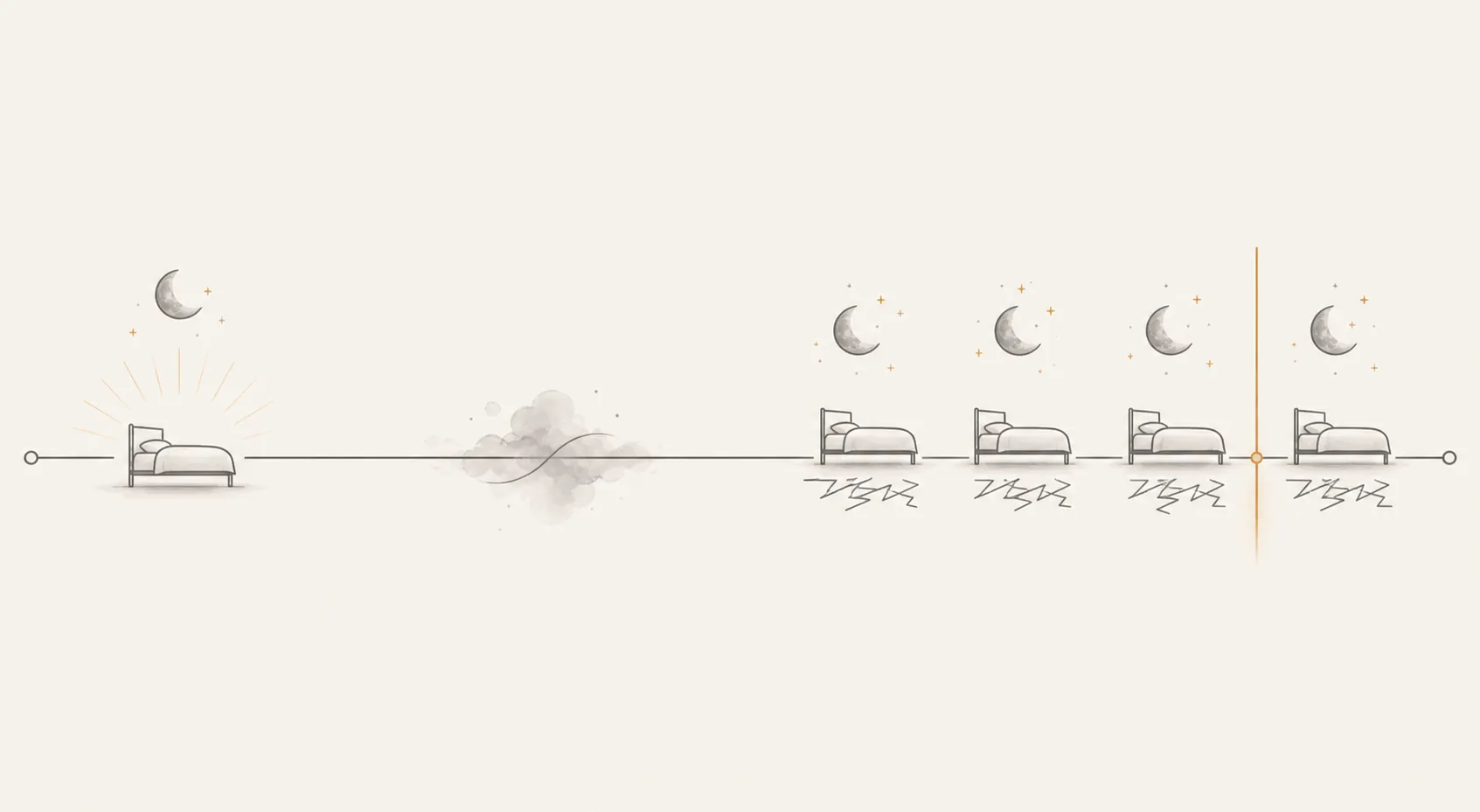
The survivor literature is sobering, but it should be read carefully. A 2021 systematic review found self-reported insomnia in 63% to 72.5% of wildfire survivors and nightmares in 33.3% to 46.5% of survivors assessed one to 10 months after fires. The same review reported clinician-diagnosed insomnia at 43.6% in one community sample, but the evidence came from only five heterogeneous studies using different measurements.[6]
A later multi-country survivor survey found that 49.2% of 126 wildfire survivors met clinical insomnia criteria, and self-reported smoke impact was a significant predictor of insomnia.[7] That does not mean smoke exposure alone caused every case. It does mean that persistent sleep disruption after wildfire exposure is common enough to take seriously, not something a person should be embarrassed to name.
This is where the acute-versus-persistent distinction becomes practical. If you slept badly for a night or two while your throat burned and the AQI was poor, the first response is exposure reduction, airway comfort, and time. If the smoke is gone but your bed still feels like a watch post, or if every smoky morning reopens the same sleepless pattern, the problem has moved beyond simple irritation.
When to stop waiting it out
Do not wait three months if breathing symptoms are severe, if you feel unsafe, or if sleep loss is making driving, work, caregiving, or medication use risky. The three-month chronic-insomnia line is a boundary for not normalizing a long-running pattern, not a rule that you must suffer until then.
Clinical care is especially appropriate when sleeplessness is paired with nightmares, panic when smelling smoke, intrusive fire memories, avoidance of reminders, or constant monitoring that does not match the current danger. In wildfire survivors, insomnia and post-traumatic symptoms often travel together; treating the sleep problem early can be part of reducing the load rather than a side issue.[6][7]
For insomnia itself, the treatment to ask about is CBT-I, or cognitive behavioral therapy for insomnia. That does not mean your distress is “all in your head.” CBT-I targets the learned sleep-wake patterns, bed associations, nighttime behaviors, and worry loops that keep insomnia going after the original trigger has passed. If trauma symptoms are active, CBT-I may need to sit alongside trauma-informed care rather than replace it.
Supplements, alcohol, and willpower are poor foundations for a problem this layered. Alcohol can fragment sleep. Supplements may sedate without addressing why the body is staying alert. Willpower is simply the wrong tool for an airway, nervous system, or trauma cue that has not yet stood down.
A bad night after Santa Rosa fire smoke exposure can be a normal body response. Recurring sleeplessness after fire seasons is also common enough to deserve care. The point is not to prove that nothing is wrong; it is to identify what is still active, treat that part directly, and not let months of insomnia become the price of having lived through smoke before.
References
- Snyder et al. 2025 WHAT-Now study of the 2017 Northern California wildfires, PubMed Central, 2025.
- Wildfire Smoke in Northern California, Natural Hazards Center, 2025.
- The effects of wildfire smoke on your lung health, UCLA Health.
- Rentschler et al. 2025 biomass-smoke sleep study, Springer, 2025.
- Air pollution may disrupt sleep, ScienceDaily, May 22, 2017.
- Sleep disturbances in wildfire survivors: a systematic review, PubMed Central, 2021.
- Prevalence and predictors of sleep disturbance in wildfire survivors, ScienceDirect, 2023.
Supports these guides
Spot an error or have clinical feedback?
Because this article covers clinical, medication, or safety information, we use a moderated correction channel instead of open public comments. Let us know if something about “Couldn't sleep after the Santa Rosa fire smoke? Here's why” needs a closer look.
Send feedback on this article