
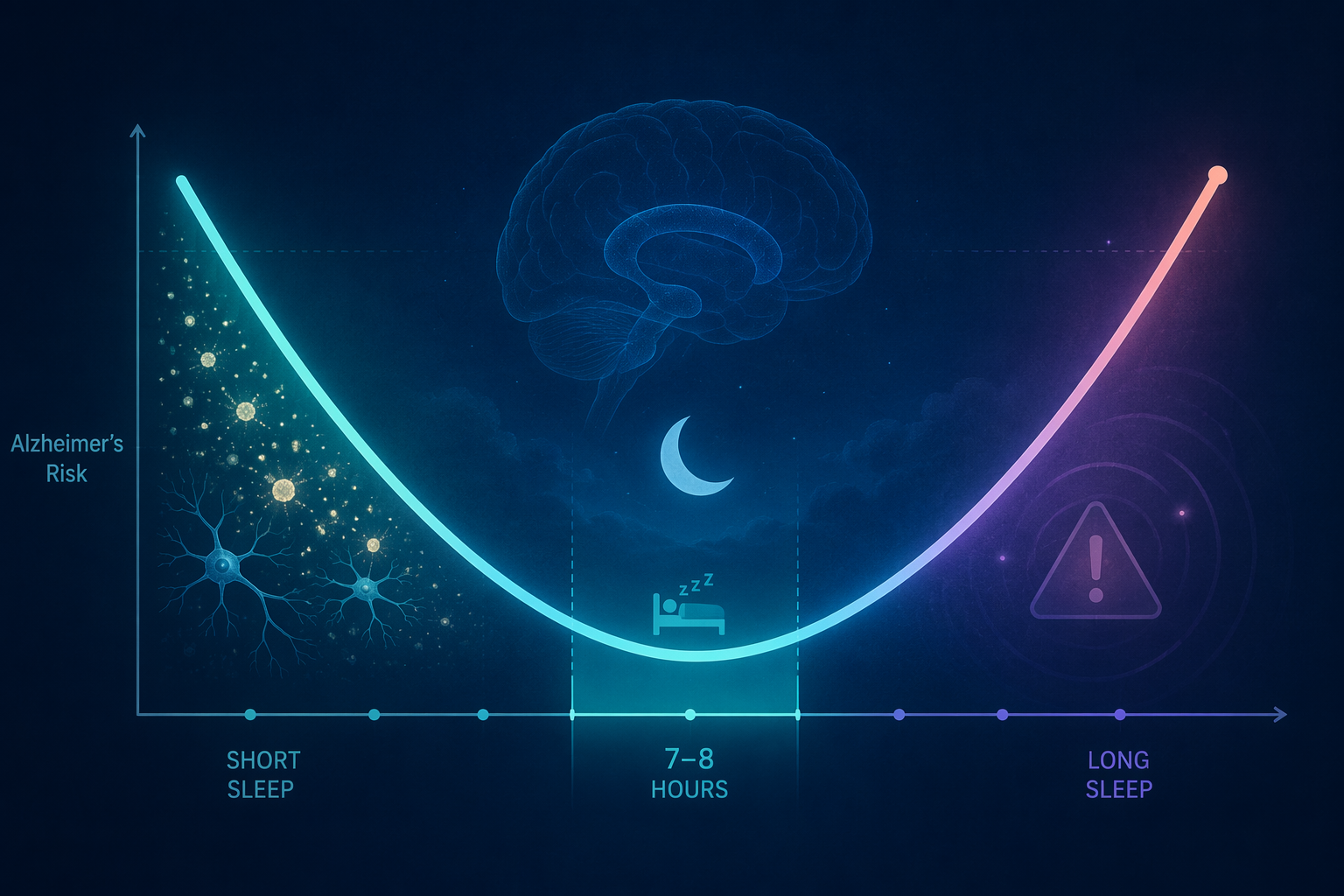
The best-supported answer to how sleep duration affects tau protein and Alzheimer’s risk is not simply “more sleep.” The evidence points to a U-shaped pattern: roughly 7–8 hours per night sits in the lowest-risk zone, while short sleep and very long sleep carry different kinds of concern. The short-sleep side looks biologically active: experimental sleep loss can raise tau in cerebrospinal fluid by about 50% in humans and mice, and mouse work suggests it can accelerate the spread of tau pathology between brain regions.[1] The long-sleep side is more like a clinical clue: in a large Framingham Heart Study analysis, blood p-tau181 rose non-linearly at 8.5 or more hours, most steeply beyond 10 hours, but the study was cross-sectional and does not show that long sleep caused the biomarker increase.[2]
That distinction matters for anyone who is older, sleeping less than they used to, or suddenly sleeping more than they once did. A 68-year-old who needs nine hours after a hard week has not “given themselves Alzheimer’s.” A person who routinely gets five or six hours and feels proud of functioning on it should not treat that pattern as harmless either. Tau is one of the proteins involved in Alzheimer’s disease, and abnormal tau biology is closely tied to neurodegeneration, but a tau biomarker shift is not a diagnosis and not a personal forecast.
The curve is real enough to guide behavior, but not simple enough to scare people
A useful way to read the sleep-duration evidence is to separate two questions that are too often blended together. First: can insufficient sleep plausibly push tau biology in the wrong direction? Here, the answer is increasingly yes, though the strength of evidence varies by study type. Second: does very long sleep in later life mean sleep itself is damaging the brain? Here, the better answer is more cautious: long sleep may be a sign that something has changed in the brain, body, mood, medication profile, or daily activity pattern.
The practical target, then, is not a magic number but a range. For most adults thinking about Alzheimer’s-related tau risk, a consistent 7–8 hours is the most defensible goal. Regularly sleeping below 7 hours deserves attention because the short-sleep mechanism has experimental support. Regularly sleeping 8.5 hours or more, especially if it is new in later life or stretches past 10 hours, deserves a different kind of attention: not self-imposed sleep restriction, but clinical context.
Why short sleep looks biologically active
Sleep is not just time away from thinking. During sleep, brain chemistry, electrical rhythms, fluid movement, and metabolic waste handling shift together. Tau appears to be part of that daily rhythm. In the Washington University work, acute sleep deprivation increased tau in cerebrospinal fluid by about 50% in both mice and humans. The same research line also reported that, in mice engineered to develop tau pathology, sleep deprivation accelerated the spread of toxic tau tangles between brain regions.[1]
The human part of that finding is the biomarker movement: tau rose after sleep loss. The tau-spread finding is animal evidence, not proof that a single sleepless night spreads Alzheimer’s disease in a person. Still, it gives the biomarker result a plausible biological frame. Wakefulness is a more active neuronal state; more neuronal activity can mean more release of proteins into the surrounding fluid. If sleep is shortened repeatedly, the brain may face both more production or release and less time in the state that supports clearance.
A smaller human study makes the signal more vivid, though not broader. In Cedernaes and colleagues’ Neurology study, 15 healthy young men had about a 17% rise in blood tau after one night of total sleep deprivation, compared with about a 2% change after a normal night of sleep.[3] It is a clean warning sign, not a population rule. The sample was small, male, young, and healthy, so it cannot tell us what the same night would do in older women, people with insomnia, or people already developing cognitive symptoms.
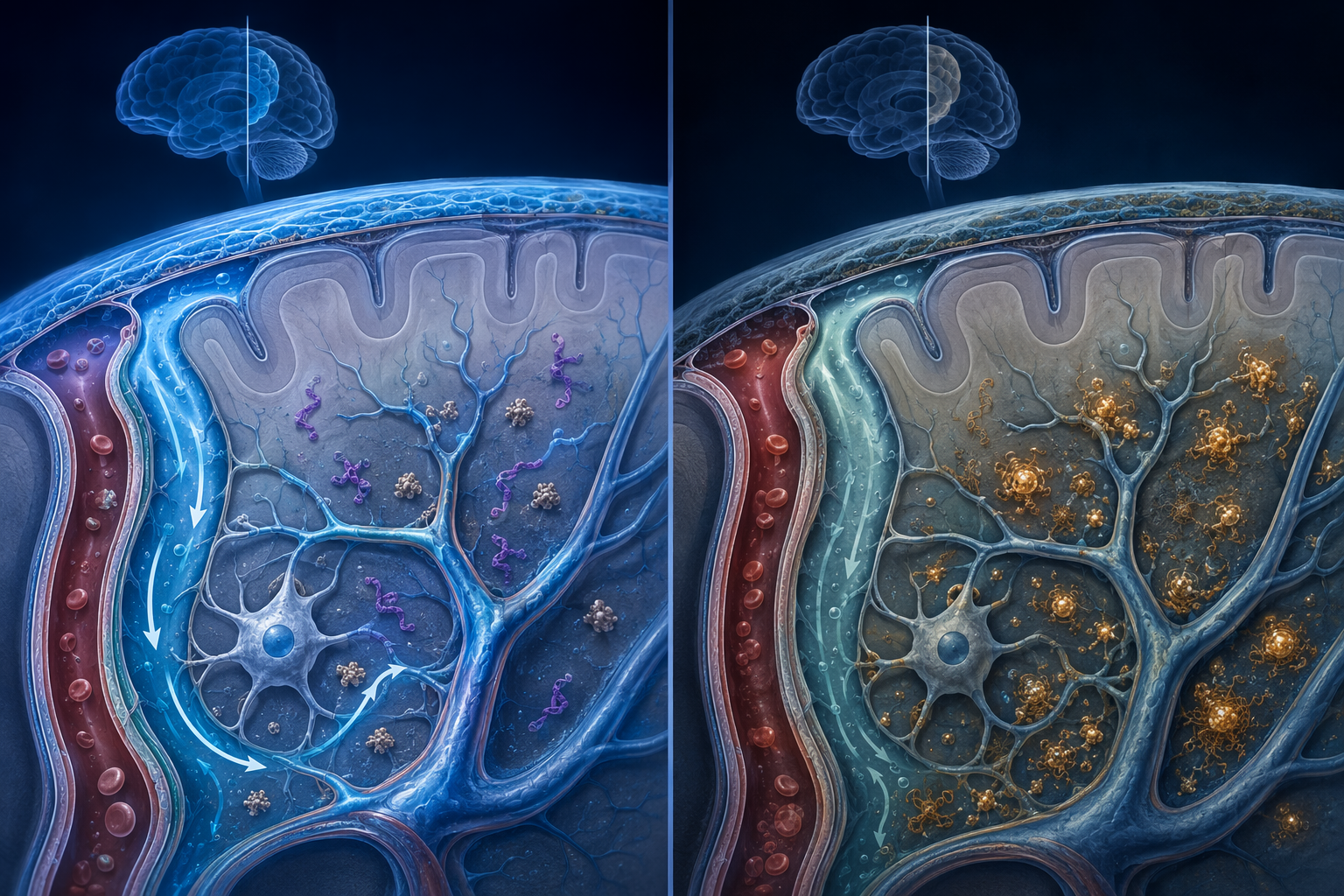
The newer glymphatic evidence is especially important because it tests the clearance side of the argument in humans. In a January 2026 randomized trial with 39 participants, Dagum and colleagues reported that sleep-driven glymphatic activity—measured through reduced brain parenchymal resistance and increased NREM delta power—directly cleared amyloid beta and tau from the brain to the bloodstream. During sleep deprivation, the dominant signal shifted away from clearance and toward synaptic-metabolic release. Among amyloid-positive individuals, the neuro-glymphatic model explained more than 50% of the variance in morning plasma Alzheimer’s disease biomarker levels.[4]
That is a strong mechanistic step, because it moves beyond asking whether poor sleep and Alzheimer’s biomarkers travel together. It asks what sleep is doing. If the finding holds up, the short-sleep problem is not just that a tired person has a worse day. It is that the sleeping brain may be using specific slow-wave and fluid-dynamic conditions to move tau and amyloid-related material out of brain tissue, and deprivation interferes with that process.
The caveat belongs next to the claim, not buried later. The Dagum study was small, and it was funded by Applied Cognition, a company developing glymphatic-targeted therapeutics; the authors also declared competing financial interests.[4] That does not make the data unusable. It does mean the result should be treated as promising human causal evidence that needs replication, not as a finished explanation for every person’s sleep pattern.
What long sleep may be telling us
The long-sleep side of the curve is where interpretation can go wrong fastest. In the 2026 Framingham Heart Study analysis of 2,410 participants, blood p-tau181 levels increased in a non-linear fashion among people reporting 8.5 or more hours of sleep, with the steepest rise beyond 10 hours.[2] That is a substantial sample and a clear association. It is not evidence that cutting a 9-hour sleeper down to 7 hours will lower tau.
The authors emphasized that the finding was cross-sectional and correlational, and that long sleep may be an early behavioral marker of neurodegeneration rather than a cause.[2] This is the dashboard-light interpretation. The light matters, but smashing the light does not fix the engine. If an older adult who usually slept 7.5 hours now sleeps 9.5 or 10 hours most nights, the useful question is not “How do I force myself to sleep less?” It is “What changed?”
There are many possible answers that do not begin with Alzheimer’s disease: depression, untreated sleep apnea, pain, medication effects, reduced daytime activity, infection recovery, alcohol use, or simply a change in schedule. The tau association earns attention because it may be one signal among several. It does not turn long sleep into a behavior that should be corrected by alarm clock alone.
The “more sleep helps” evidence applies only within ordinary ranges
One smaller 2025 study helps refine the middle of the curve. Stiver and colleagues studied 45 older women with a mean age of 72.9 and used actigraphy to measure objective sleep duration. In that group, longer sleep duration weakened the association between APOE ε4 carrier status and tau PET burden, and it buffered the negative effect of tau on memory performance. At higher sleep duration within the study’s observed range, there was no significant link between genetic risk and tau pathology.[5]
That is encouraging, particularly because actigraphy avoids some of the problems of self-reported sleep. But the boundary is narrow. The sample was small, 86.7% non-Latinx white, all participants had at least 11 years of education, and the sleep range did not include very long sleepers above 9–10 hours per night.[5] So this study supports the idea that, within typical sleep ranges, getting enough sleep may help buffer tau-related vulnerability. It does not contradict the Framingham signal about very long sleep.
| Sleep pattern | What the evidence most strongly suggests | Best practical interpretation |
|---|---|---|
| Regularly under 7 hours | Experimental sleep loss can raise tau biomarkers and may impair sleep-linked clearance. | Treat chronic short sleep as biologically relevant, not just a lifestyle preference. |
| About 7–8 hours | This is the most defensible low-risk range based on the U-shaped pattern. | Aim for consistency rather than perfection. |
| 8.5+ hours, especially new or increasing | Associated with higher p-tau181 in cross-sectional data; causality is not established. | Look for medical, mood, medication, breathing, or cognitive context rather than restricting sleep. |
| Occasional long recovery night | Not the same as persistent long sleep. | Do not overinterpret a single night or short recovery period. |
What to do with this information
For Alzheimer’s prevention, sleep duration is worth taking seriously, but it should not become another source of late-life self-surveillance. The reasonable target is a stable 7–8 hours when possible. If life, caregiving, pain, work, or insomnia keeps sleep below 7 hours most nights, that pattern deserves attention because the short-sleep evidence has a plausible pathway: more tau release, less clearance time, and measurable biomarker movement after deprivation.
The first move is not to chase perfect sleep. It is to remove obvious pressure on the system: untreated sleep apnea, late alcohol, irregular bed and wake times, medications that fragment sleep, nighttime pain, and caregiving schedules that leave no protected sleep window. These are not cosmetic sleep-hygiene details for someone worried about tau. They are the conditions that determine whether the brain gets enough consolidated sleep to enter the physiology seen in clearance studies.
For long sleep, the response is different. Occasional 9-hour sleep after travel, illness, stress, or accumulated sleep debt is not the Framingham pattern that should alarm people. Persistent new long sleep in later life, especially when paired with memory changes, low mood, loud snoring, daytime sleepiness, reduced activity, or medication changes, is worth bringing to a clinician. The question is not whether the person is sleeping “too much” by choice. The question is what the longer sleep is reflecting.
The fairest reading of the evidence is restrained but useful: short sleep may help drive tau accumulation through increased release and impaired glymphatic clearance; very long sleep may mark early neurodegenerative or medical change already underway. Aim for consistent 7–8 hour nights, take chronic short sleep seriously, do not panic about occasional long sleep, and treat a persistent new need for much longer sleep as a clinical clue rather than a habit to punish.
References
- Sleep deprivation accelerates Alzheimer’s brain damage, Washington University School of Medicine
- UT Health San Antonio study links sleeping long hours with higher levels of an Alzheimer’s-related protein, UT Health San Antonio, 2026
- One Night of Sleep Loss May Increase Alzheimer’s Protein in the Blood, American Academy of Neurology
- Sleep-driven neuro-glymphatic clearance of Alzheimer’s disease biomarkers, Nature Communications, January 2026
- Sleep duration moderates APOE ε4 effects on tau pathology and memory performance in older women, Alzheimer’s & Dementia, 2025
Comments
Join the discussion with an anonymous comment.