
A thunderstorm can leave behind a strangely specific kind of bad night. The rain stops, the room is quiet again, and yet sleep feels as if it was repeatedly pulled apart: one jolt from thunder, one long stretch of waiting for the next flash, or a heavy morning after breathing felt rougher than usual.
That is why the useful question is not only how thunderstorms affect sleep. It is which sleep system the storm disturbed. Thunderstorms can disrupt sleep through sudden noise and light, through pressure-related breathing changes in people vulnerable to obstructive sleep apnea, and through anxiety-driven hyperarousal. Those pathways can overlap, but they do not call for the same response.
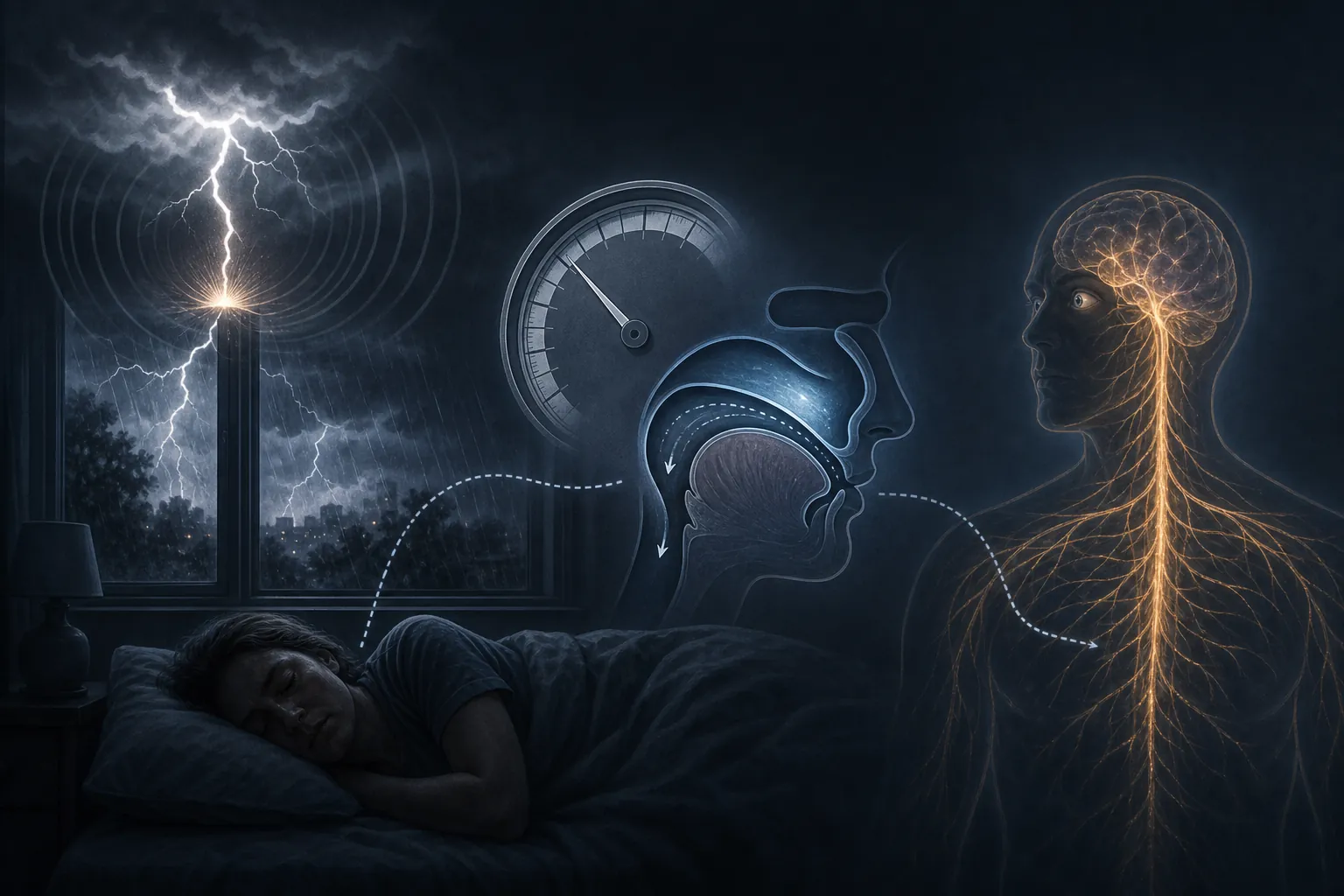
| If the night felt like this | The likely dominant pathway | The first response to test |
|---|---|---|
| You fell asleep, then woke suddenly after thunder or lightning and had lighter, choppier sleep afterward. | Auditory and visual startle | Reduce sudden contrast: steady masking sound, darker room, more distance from window noise. |
| You have known or suspected obstructive sleep apnea, and storm nights leave you more unrefreshed, breathless, or headache-prone. | Low barometric pressure interacting with obstructive breathing | Treat it as a clinical clue, not a pillow problem; review apnea evaluation or treatment adherence. |
| You were awake before the loudest part of the storm, listening for it, checking alerts, or bracing for the next flash. | Anxiety-driven hyperarousal | Use anxiety-specific strategies: reduce threat-monitoring, plan alerts in advance, and calm the nervous system rather than only blocking sound. |
The Obvious Pathway: Thunder And Lightning Fragment Sleep
The easiest pathway to recognize is sensory. Thunder is not just “noise” in the way a fan is noise. It is sudden, irregular, and often paired with a flash of light. The sleeping brain does not need to fully wake for that to matter. Environmental noise is associated with more stage 1 sleep and less slow-wave and REM sleep, and sudden sounds can trigger autonomic arousal that fragments sleep.[1]
That helps explain why someone can say, truthfully, “I only woke up once,” and still feel unrested. The damage may be in sleep architecture rather than in a long period of conscious wakefulness. A loud crack can push the body toward lighter sleep, raise alertness, and make the next sleep cycle less restorative.
Lightning adds a second sensory channel. A bright flash through a thin curtain can become a cue that thunder is coming, so the body begins responding before the sound arrives. In that situation, earplugs alone may fail because they solve only part of the signal.
The clues are usually concrete: you remember the jolt, you wake close to the loudest thunder, the sleep disruption is worst when the storm is directly overhead, and you improve when sound and light are made more predictable. The countermeasure is not silence. Silence can make each thunderclap stand out more sharply. A steady background sound may reduce the contrast between the bedroom and the storm.
Rain sounds can help some people for that reason, especially when they act as a stable masking layer. But the stronger claim that rain or pink noise reliably improves sleep for everyone is not settled. Some research suggests background noise can help people fall asleep faster, while sleep summaries note conflicting evidence on consistent benefit. It is reasonable to test; it is not reasonable to treat it as a cure.
The Missed Pathway: Falling Pressure May Worsen Obstructive Events
The less obvious mechanism is not the sound of the storm but the air mass around it. Thunderstorms often arrive with changing barometric pressure, and one peer-reviewed study found a measurable association between lower nightly pressure and more obstructive apnea events in patients evaluated for sleep-disordered breathing.[2]
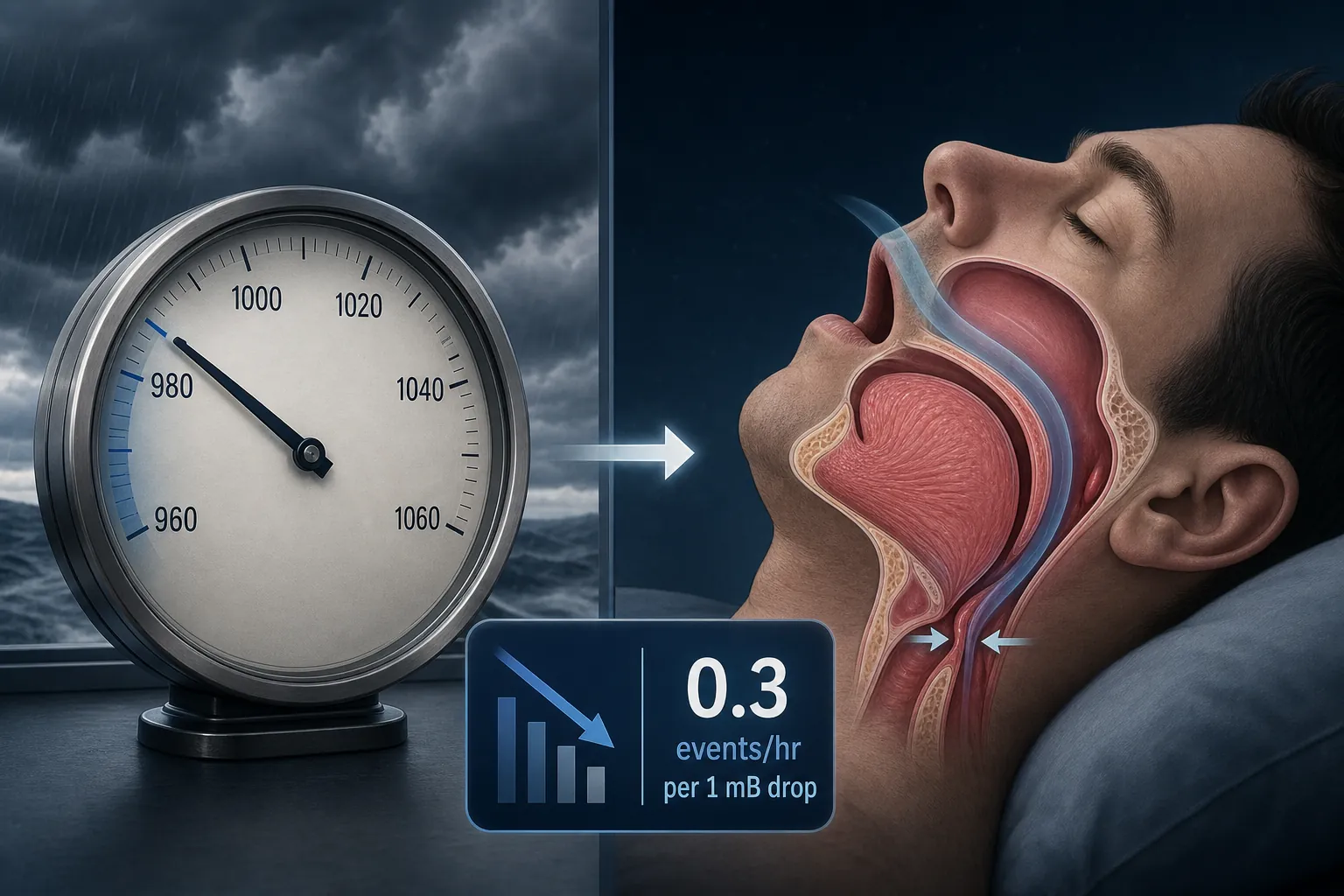
In Doherty and colleagues’ 2010 study of 537 patients, the lowest barometric-pressure quartile had an average obstructive apnea index of 23.9 events per hour, compared with 17.1 events per hour in the highest-pressure quartile. The model estimated about 0.3 additional obstructive events per hour for each 1-mB drop in pressure.[2]
That is a real signal, and it deserves careful reading. It does not mean thunderstorms “cause sleep apnea.” It does not mean every bad storm night is a breathing event. The association was specific to obstructive events; central apnea and overall apnea-hypopnea index did not show a significant association in the same way. The authors also described the effect as modest and possibly without clinical significance for most patients.[2]
The value of the study is that it makes a common bedroom story more precise. Some people do not primarily wake because thunder startled them. They wake because sleep was already being stressed by repeated airway obstruction, and the storm-night pressure pattern may have added a small extra burden. Harvard Health later discussed the same pressure-apnea connection and noted that people with sleep apnea may face added cardiovascular strain during storms.[3]
This pathway is most relevant if there is already known or suspected obstructive sleep apnea: loud snoring, witnessed pauses in breathing, gasping awakenings, morning headaches, high daytime sleepiness, or a CPAP machine that is used inconsistently. A storm-night pattern does not diagnose apnea, but it can be the detail that finally makes the pattern visible.
The response is different from the response to thunder. Heavier curtains may help a startle problem; they will not treat airway collapse. If low-pressure nights repeatedly leave someone with apnea symptoms feeling unusually wrecked, the next useful move is clinical: discuss evaluation, treatment settings, mask fit, congestion, alcohol use, sleep position, or CPAP adherence with a qualified clinician. The bedroom can be made calmer, but the airway still has to be taken seriously.
The Internal Alarm: When The Storm Keeps You On Watch
A third pathway begins before the loudest thunder. The person is already awake, listening. They may check radar, count seconds between flash and thunder, worry about pets or trees or power failure, or keep the body tense because relaxing feels unsafe. By the time the thunder arrives, the nervous system has been rehearsing wakefulness for an hour.
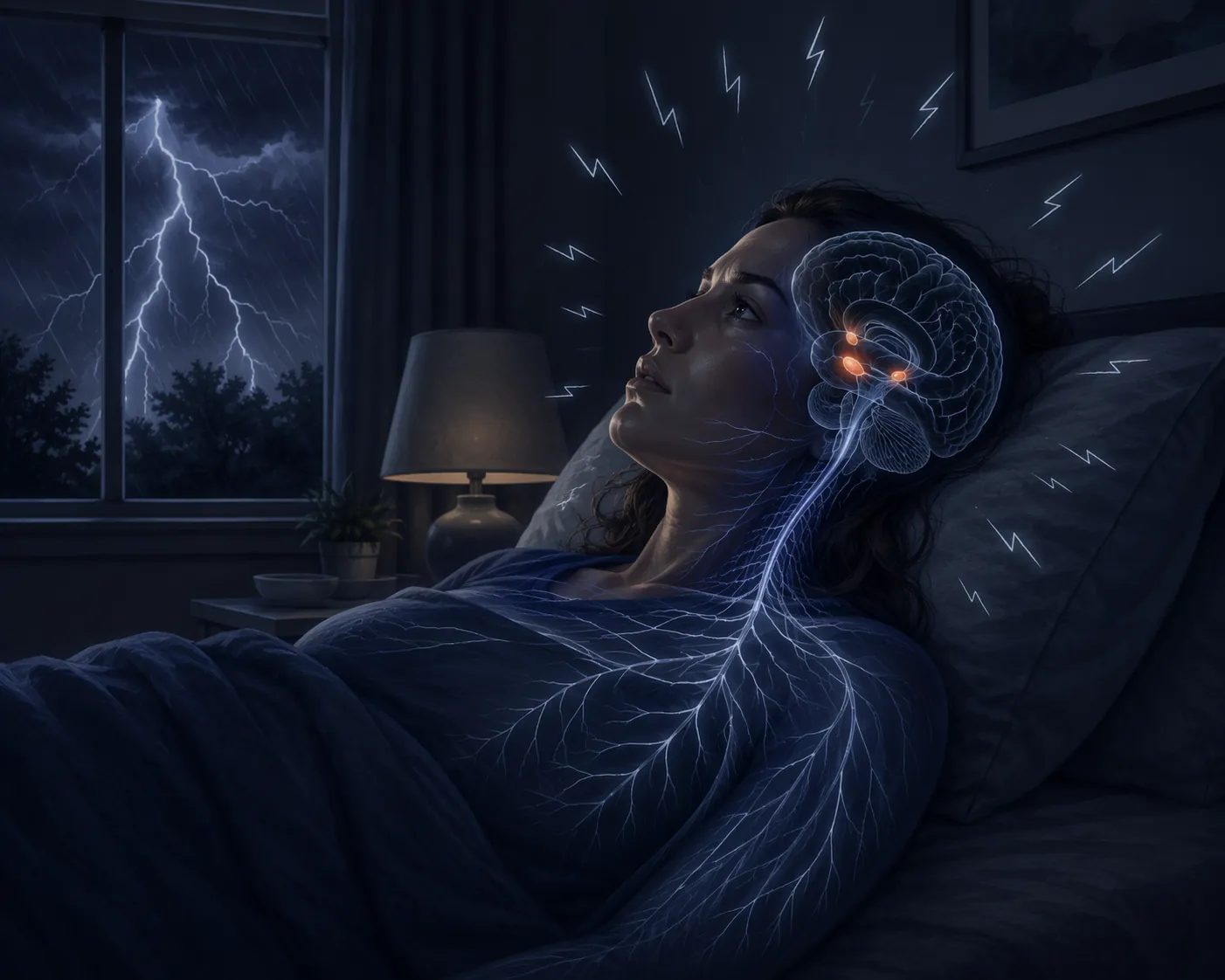
This is not a character flaw. Fear of thunder and lightning, or astraphobia, is described by Cleveland Clinic as one of the more common specific phobias; the page cites an estimated 8% of adults as affected, extrapolated from specific-phobia rates.[4] That estimate should not be read as the share of adults whose sleep is disrupted by thunderstorms. It is a broader phobia estimate, and sleep disturbance is only one possible expression.
There is also a broader weather-anxiety category. A 2025 Thriveworks report, covered by WHSV, said 32% of the general population experiences anxiety related to extreme weather conditions.[5] That number is useful only if kept in its lane: it refers to extreme weather conditions broadly, not specifically to thunderstorms, and it comes from a commercial mental health provider’s survey-based report rather than a peer-reviewed sleep study.
The sleep mechanism is hyperarousal. The body is preparing, monitoring, and scanning for threat. In that state, ordinary sleep instructions can feel almost insulting. “Put in earplugs” does little for someone whose main problem is not the decibel level but the expectation that something dangerous may happen while they are asleep.
The clues are different from sensory startle. You may dread the forecast hours earlier. You may sleep poorly even when the storm misses your neighborhood. You may wake to check alerts rather than to the thunder itself. You may feel more settled once another awake person confirms the storm has passed. For readers who recognize that pattern, why you can’t sleep during storms is the deeper anxiety-focused branch of the problem.
Match The Countermeasure To The Pathway
A storm night often contains more than one pathway. A loud thunderclap can wake someone with apnea. Anxiety can make sensory startle more likely. A power outage can add heat, darkness, household disruption, and alert-checking to the same night; that stacked disruption is why sleep during a power outage often becomes its own problem. Still, one pathway usually deserves first attention.
| Dominant pathway | What to change first | What not to over-rely on |
|---|---|---|
| Thunder and lightning startle | Make the bedroom less contrast-sensitive: blackout curtains or sleep mask, steady masking sound, bed position farther from windows when possible. | Earplugs alone, if flashes or anticipatory tension are part of the wake-up. |
| Pressure-related obstructive breathing | Treat repeated storm-night worsening as a reason to review sleep apnea risk, diagnosis, or treatment consistency. | Noise machines, supplements, or bedding changes as substitutes for apnea care. |
| Anxiety and hyperarousal | Set a storm plan before bed: which alerts matter, where the phone stays, what action would actually be taken, and when checking stops. | Pure sound masking, if the mind is still monitoring danger. |
For the sensory pathway, the best target is suddenness. A fan, white-noise machine, or rain track may help because it reduces the difference between quiet and thunder. A sleep mask or blackout curtain may matter as much as the sound layer if lightning is the cue that wakes you. The test is simple: if the storm is still audible but no longer jolts you fully awake, the intervention is doing its job.
For the breathing pathway, the best target is not the storm. It is the vulnerable airway. If you already have obstructive sleep apnea, storm nights are a reason to be more consistent with prescribed treatment, not less. If you suspect apnea and notice that bad storm sleep comes with gasping, morning headaches, or heavy daytime sleepiness, the useful next step is an apnea conversation rather than another round of bedroom hacks.
For the anxiety pathway, the best target is threat-monitoring. Decide before bed which weather alerts require action, keep the phone out of endless-refresh reach if it is safe to do so, and use a prechosen calming routine when the urge to check returns. If storms trigger panic, trauma memories, or repeated nights of avoidance, a broader support plan is more appropriate than trying to tough it out. How to sleep during a tropical storm when anxiety strikes is a more practical place to continue from that branch.
The Question To Ask The Morning After
The most useful storm-sleep note is not “slept badly.” It is what woke first: the ears and eyes, the breathing, or the alarm system.
- If thunder or lightning woke you abruptly, reduce sensory contrast before the next storm.
- If you have known or suspected obstructive sleep apnea and storm nights feel physically heavier, treat that as a clinical clue.
- If you were awake waiting for the storm, use anxiety-focused strategies rather than only trying to block sound.
A bad storm night does not need to be dismissed as oversensitivity. It also should not be flattened into one explanation. The right countermeasure depends on which system the storm actually reached.
References
- Noise and Sleep, Sleep Foundation.
- Barometric Pressure and the Incidence of Obstructive Sleep Apnea, PMC, 2010.
- Thunderstorms and Your Health, Harvard Health, 2010.
- Astraphobia, Cleveland Clinic.
- New studies show extreme weather conditions common cause anxiety, WHSV, 2026.
Comments
Join the discussion with an anonymous comment.