
Outdoor carbon dioxide is not what usually makes a bedroom feel stale. The sleep question starts after the door closes, the windows stay shut, and one or two breathing adults spend the night in a small room. Under those conditions, indoor CO₂ levels and sleep quality become linked in a way that is measurable before it is obvious.
The practical range to watch is not 400 ppm outdoor air versus some dramatic danger zone. It is the quieter climb from roughly 750 ppm toward 1,000 ppm and beyond. In a controlled field-lab study of 36 healthy young adults, Kang et al. tested the same sleepers under three bedroom CO₂ conditions: 750, 1,000, and 1,300 ppm. At 1,000 ppm, sleep efficiency fell by about 1.3 percentage points and awake time rose by about 5 minutes compared with 750 ppm. At 1,300 ppm, sleep efficiency fell by about 1.8 percentage points, awake time rose by about 7.8 minutes, deep sleep duration was reduced, and salivary cortisol rose significantly.[1]
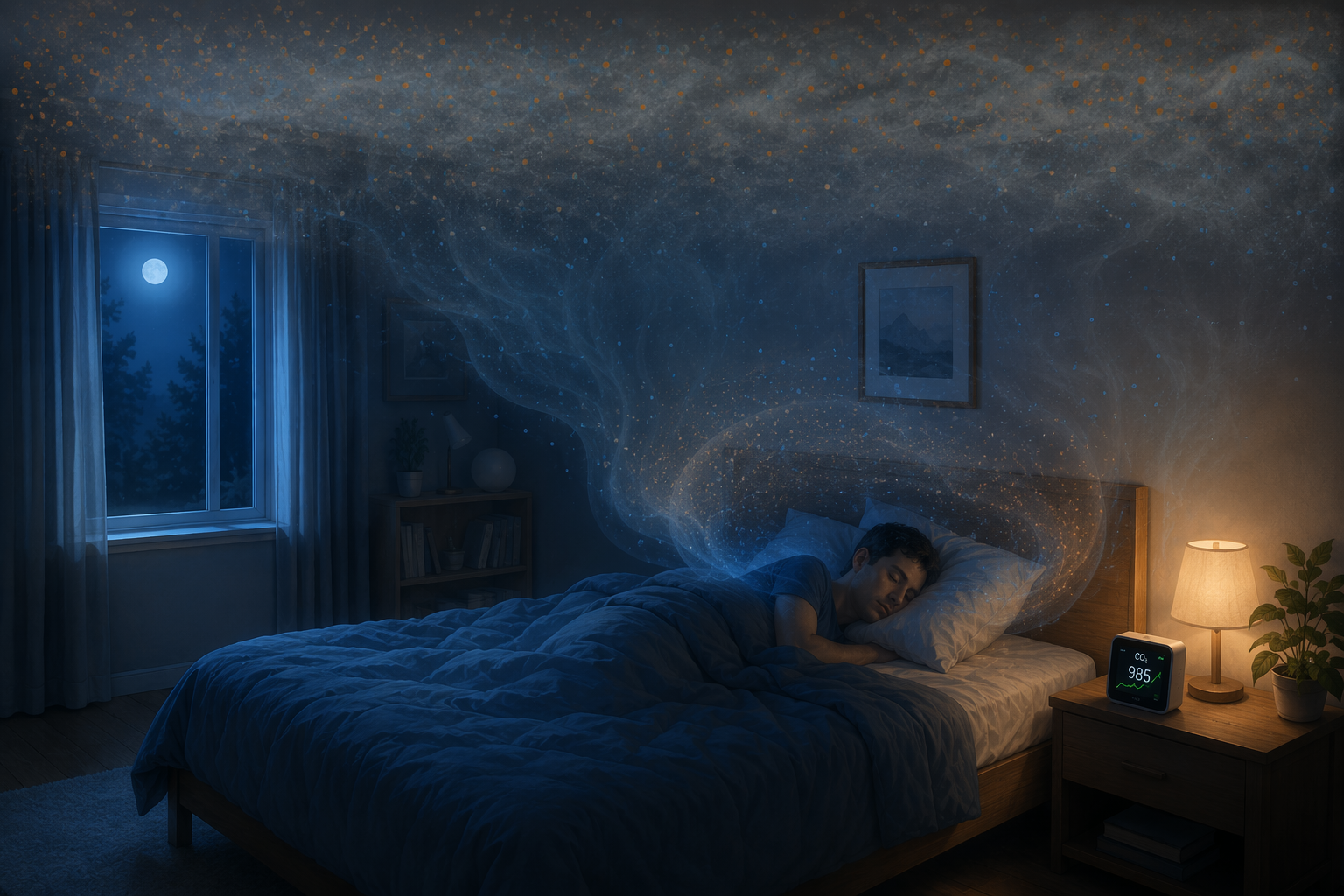
What changes between 750, 1,000, and 1,300 ppm
The Kang study matters because it avoids the usual problem with bedroom-air advice: it does not simply compare “fresh” against “bad.” It asks what happens across concentrations that many closed bedrooms can plausibly reach overnight. The result is not a cliff at 1,000 ppm. It is a dose-response pattern: as CO₂ rises, sleep becomes a little less efficient, wakefulness expands, and the deeper part of sleep is harder to preserve.[1]
A 1.3% drop in sleep efficiency can sound trivial if it is treated like a single-night inconvenience. In sleep measurement, though, efficiency is a compressed summary of how much of the night in bed was actually spent asleep. A few extra waking minutes can be scattered across brief arousals that the sleeper does not remember in the morning. That is one reason a person can honestly say they “slept through the night” and still wake up foggy.
The 1,300 ppm condition is more persuasive than the 1,000 ppm result alone because the study did not just show more wake time. It also found reduced deep sleep duration and a significant cortisol increase.[1] That pairing is important. It suggests the problem is not merely that stale air is annoying or that participants disliked the room. The body was behaving as if the night had become more physiologically stressful.
| Bedroom CO₂ condition | What the study observed |
|---|---|
| 750 ppm | Reference condition in the Kang et al. comparison |
| 1,000 ppm | Sleep efficiency down about 1.3 percentage points; awake time up about 5 minutes versus 750 ppm |
| 1,300 ppm | Sleep efficiency down about 1.8 percentage points; awake time up about 7.8 minutes; deep sleep reduced; salivary cortisol significantly higher |
That is the most useful way to read the threshold. Around 800–1,000 ppm is where risk starts becoming measurable in the better sleep-specific evidence, not where sleep suddenly collapses. A monitor reading of 1,020 ppm for a short interval is not a diagnosis. A bedroom that spends much of the night above 1,000 ppm is different: it is giving you a repeated exposure that the available research says is worth correcting.
Higher exposures make the pattern harder to dismiss
A smaller laboratory study by Xu et al. pushed the contrast further, comparing sleep at 800 ppm and 3,000 ppm in 12 participants. At 3,000 ppm, subjective sleep quality scores were only about 80% of the scores at 800 ppm, and objective sleep fragmentation increased.[2] That does not mean 3,000 ppm is a normal target for comparison in every home. It is useful because it shows the same direction of effect at a more extreme exposure: people feel worse, and their sleep also looks more broken.
The real-bedroom evidence points the same way. In a Copenhagen dormitory field experiment, Strøm-Tejsen et al. lowered overnight CO₂ from about 2,400 ppm to about 835 ppm using an inaudible supply fan. Objective sleep quality improved, and next-day logical thinking performance improved as well.[3] This is the kind of intervention result that matters for a person troubleshooting a room: the change was not a supplement, a new bedtime routine, or a motivational app. It was ventilation.
Another field intervention, Fan et al. 2023, found that increasing bedroom ventilation from low to moderate conditions reduced awakenings and increased the percentage of deep sleep in 35 participants.[4] It is supporting evidence rather than the center of the case, but it helps connect the chamber-style findings to ordinary bedrooms where air exchange, room size, door position, and occupancy all shape the night.
Why you may not notice the disruption
The uncomfortable part of this evidence is that subjective awareness is a poor detector. A sleeper does not need to wake up thinking, “the air is stale,” for the body to respond. The more interesting signal is physiological: sympathetic activation, cortisol rise, fragmented sleep, and reduced slow-wave sleep can occur without a neat memory of waking.
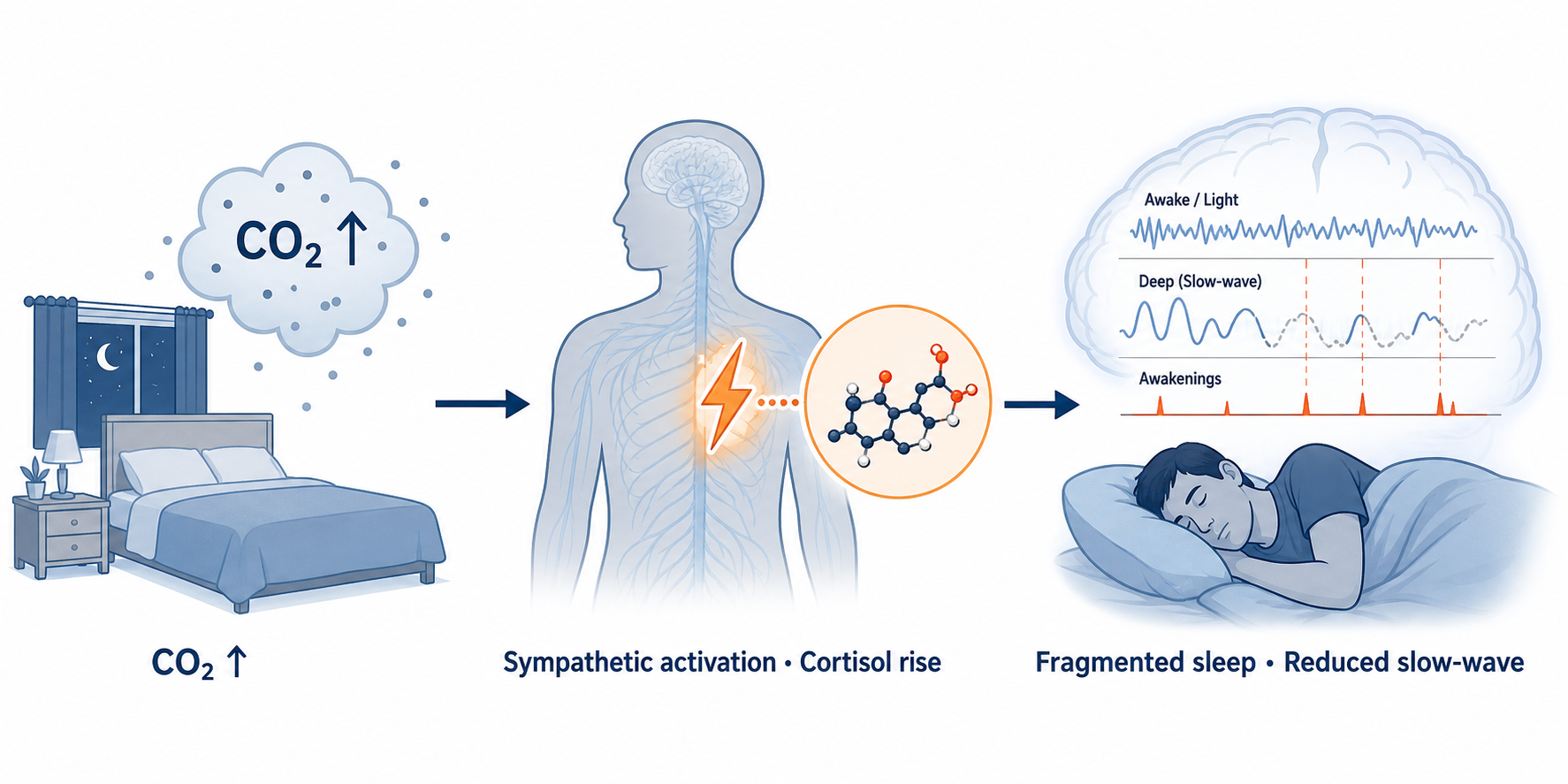
Slow-wave sleep is not just a satisfying line on a sleep graph. It is one of the ways the night becomes physically restorative. When higher CO₂ is associated with less deep sleep and more wakefulness, the likely consequence is not always a dramatic insomnia complaint. It may be a flatter morning: more sleep inertia, less sharpness, or the vague sense that eight hours did not do what eight hours usually should.
This is similar to the problem with caffeine in people who can still fall asleep after drinking it. The sleeper’s report captures one layer of the night; sleep architecture captures another. CO₂ and caffeine are very different exposures, but both can degrade sleep metrics in ways the sleeper may underestimate. That is why the mechanism matters, and why a deeper look at how caffeine disrupts sleep quality even when you fall asleep belongs in the same evidence-verification category as bedroom air.
The 800 ppm target is useful, not magical
A 2025 systematic review from Waseda University looked across 17 studies and proposed an 800 ppm CO₂ target for bedrooms. The review estimated that reaching this target would require about 8 liters per second per person of ventilation, roughly double many current residential building-code levels.[5] That is a stronger statement than the usual “crack a window” advice, because it ties the target to air exchange rather than to a gesture.
Still, 800 ppm should not be treated as a biological switch. Consumer CO₂ sensors have accuracy limits, rooms fluctuate as people move and HVAC cycles change, and a safety margin is not the same thing as an exact disease threshold. The sensible interpretation is narrower and more useful: if you can keep the bedroom near 800 ppm overnight, the available sleep evidence gives you a reason to do so; if the room is consistently above 1,000 ppm, ventilation deserves attention.
How to read your bedroom number
A CO₂ monitor is not necessary for everyone, and it does not need to become another bedtime obsession. Its value is that it turns a hidden exposure into a time series. A single daytime reading near the bed is less useful than an overnight log, especially in the last half of the night when CO₂ often has had hours to accumulate.
- If the room stays mostly below about 800 ppm, CO₂ is less likely to be a major sleep-quality suspect.
- If it rises above roughly 1,000 ppm for long stretches, treat that as a signal to improve air exchange.
- If it reaches 1,300 ppm or higher night after night, the Kang results make the sleep concern more concrete.
- If it approaches much higher levels, such as the 2,400–3,000 ppm ranges studied in intervention and laboratory work, ventilation is not a minor detail.
The first fixes are boring because the physics is boring: more outdoor-air exchange, better transfer of air from the room to the rest of the dwelling, or mechanical ventilation that actually runs during sleep. Opening a window, leaving a door open, or using a fan can help in some homes, but those actions are not automatically equivalent. Noise, outdoor air pollution, temperature, humidity, safety, partners, and apartment constraints all decide what is realistic.
If you change ventilation and also track sleep, look for patterns rather than one perfect night. A sleep tracker cannot diagnose why sleep improved, and many consumer devices estimate deep sleep imperfectly, but repeated changes in awakenings, sleep continuity, or morning alertness can still be useful alongside CO₂ readings. The same caution applies when judging what makes a sleep tracker good: the device is most helpful when it supports a specific question, not when it turns sleep into a nightly score hunt.
Where the evidence should stay modest
The sleep-quality case is stronger than the broadest next-day cognition claim. One 2023 children’s study found no significant next-day cognitive impairment after high-CO₂ sleep, possibly because participants spent 45–70 minutes in fresh air before testing. That does not erase the adult sleep-fragmentation findings, but it does warn against saying that every high-CO₂ night reliably produces measurable cognitive loss the next morning.
There is also a separate insomnia finding that can sound contradictory if stripped of context: a small 2024 trial in 24 insomnia patients reported improved sleep after 15 minutes of 2% CO₂, or about 20,000 ppm, before bed. That is a different population, a very brief exposure, and a far higher concentration than ordinary bedroom accumulation. It should complicate simplistic claims about CO₂ biology, not weaken the practical recommendation to avoid sustained overnight buildup in healthy adults.
Generalizability is the other limit. Much of the evidence comes from young, healthy participants in chambers, dormitories, or controlled field settings. Older adults, people with cardiopulmonary disease, people with insomnia, children, and households with unusual ventilation patterns may not respond identically. The safest conclusion is not that CO₂ explains all bad sleep. It is that sustained bedroom CO₂ above roughly 1,000 ppm is a real sleep-quality variable, and one that is often easier to test than to guess.
Comments
Join the discussion with an anonymous comment.