
One person hears rain against the window and drops into sleep almost gratefully. The person beside them hears the same storm and feels their chest tighten before the next thunderclap arrives. Both reactions can be real, because how storms affect sleep is not answered by treating “storm” as one clean variable.
A storm brings a stack of inputs at once: steady rain, lower light, changing atmospheric pressure, thunder, lightning, and sometimes the old knowledge that weather can become dangerous. Some of those inputs nudge the body toward sleep. Others pull it toward vigilance or make breathing more fragile. The useful question is not whether storms are good or bad for sleep. It is which part of the storm your body is responding to most strongly.
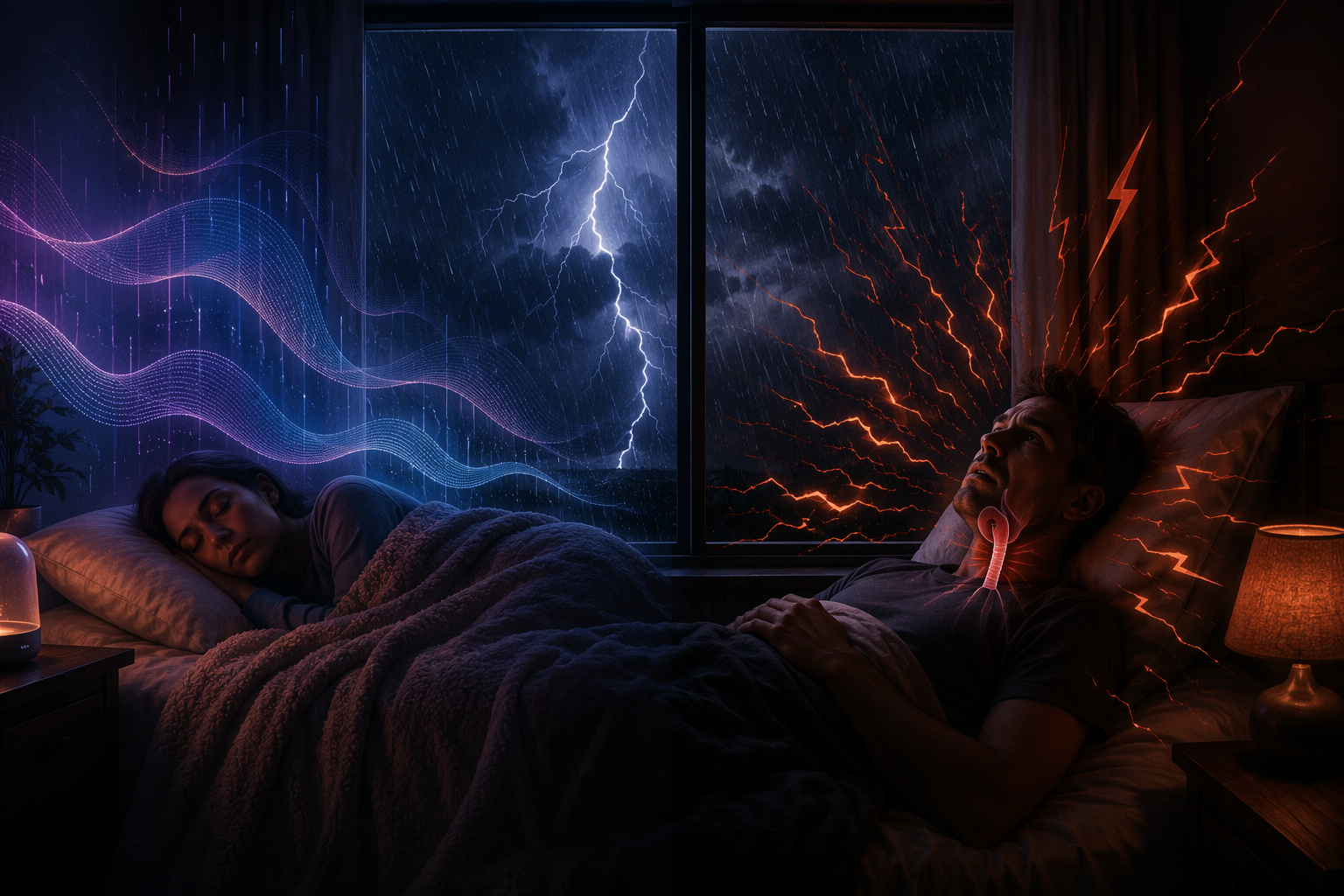
The Sleepy Part of a Storm Is Usually the Rain
The most believable “storms help me sleep” pathway starts with sound. Rain is not silence, and that matters. A steady rainfall can cover small household noises, soften sudden changes in the soundscape, and create the kind of low, even acoustic background that many sleepers find easier to ignore than intermittent quiet.
Sleep Foundation describes pink noise as sound that can help people fall asleep faster and enhance deep sleep when played at about 60 dB, and it notes that rain sounds naturally fall in the pink-noise spectrum.[1] That does not prove every real storm is a sleep treatment. Lab-style pink noise is controlled; actual rain varies by roof, window, wind, thunder, and volume. Still, it gives the storm-sleeper a mechanism better than “you just like cozy weather.”
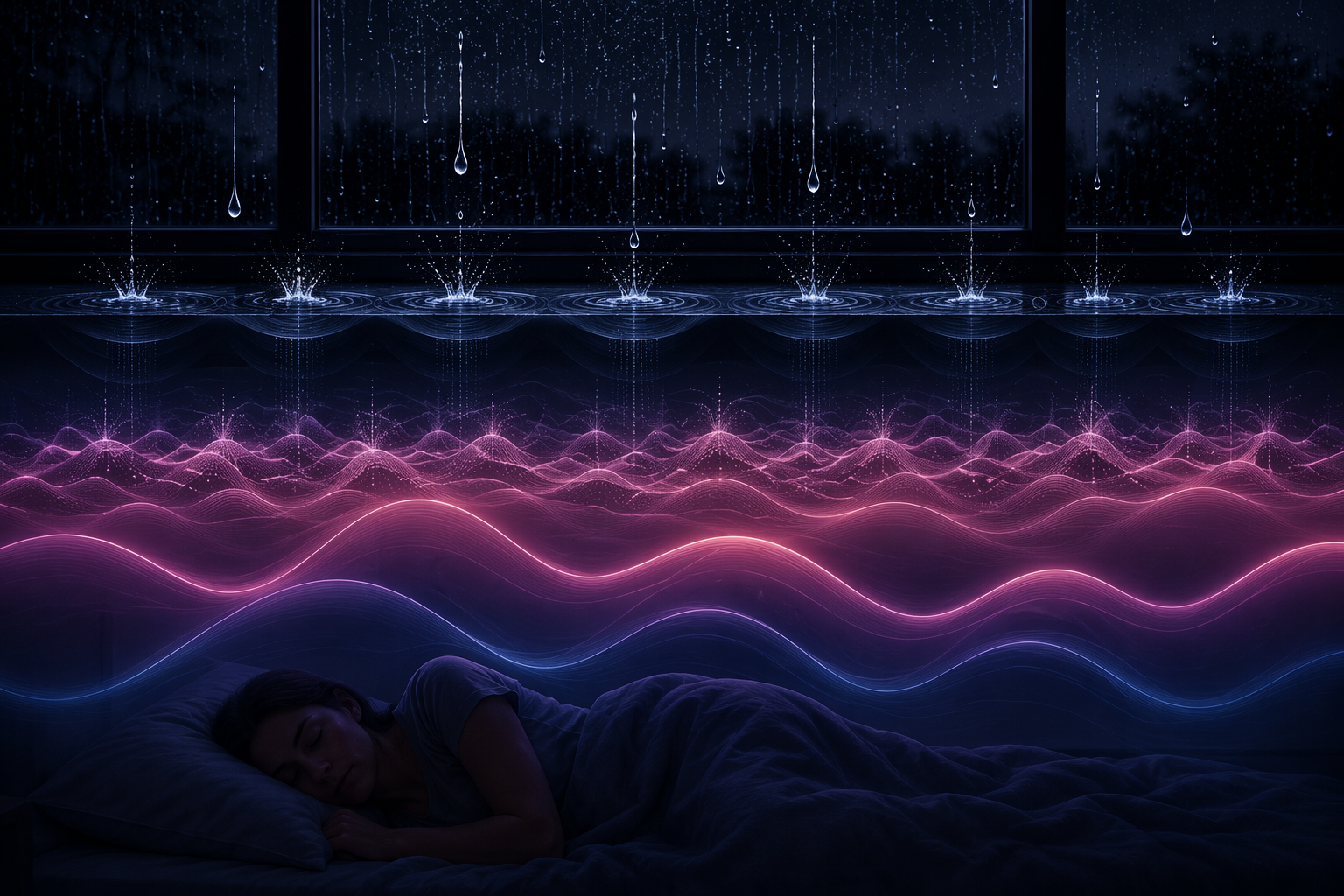
Pink noise is often described by its energy distribution: lower frequencies carry more power than higher frequencies, so the sound tends to feel fuller and less sharp than white noise. Rain can approximate that quality because it is made of many small, overlapping impacts rather than one clean tone. For a sleeper who is not afraid of the storm and is not being jolted by thunder, that acoustic blanket can reduce how often the brain has to notice the room.
There is a boundary here worth keeping. Continuous noise may help stabilize parts of sleep while changing others; the deeper dive on whether heavy rain noise improves sleep quality gets into that trade-off. The simpler point for storm sleep is that rain can genuinely be sedating for some people, especially when it is steady enough to mask sharper environmental sounds without becoming disruptive itself.
Darker Skies Can Add a Second Push
Storms also dim the day. Lower light can prompt the pineal gland to produce more melatonin, the hormone that helps signal biological night and drowsiness. This is a smaller part of the storm-sleep story than rain noise, but it helps explain why a dark afternoon storm can feel physically lulling rather than merely atmospheric.
That same mechanism is not automatically helpful. If daytime darkness encourages a long nap or shifts sleep pressure at the wrong time, it can make nighttime sleep worse. Melatonin is a timing signal, not a moral endorsement of cloudy weather.
Then the Other Body Shows Up
The same storm that supplies rain noise and darkness can also change pressure, shake the room with thunder, flash light through closed eyelids, and tell the nervous system that something outside is unstable. For some sleepers, those inputs are background. For others, they are the whole event.
The clearest physiological concern is breathing. In a University of Washington polysomnography study of 537 patients, each 1-millibar drop in nighttime barometric pressure was associated with a 0.3 events-per-hour rise in the obstructive apnea index. Patients in the lowest pressure quartile averaged 23.9 obstructive events per hour, compared with 17.1 in the highest pressure quartile; the difference was statistically significant.[2]
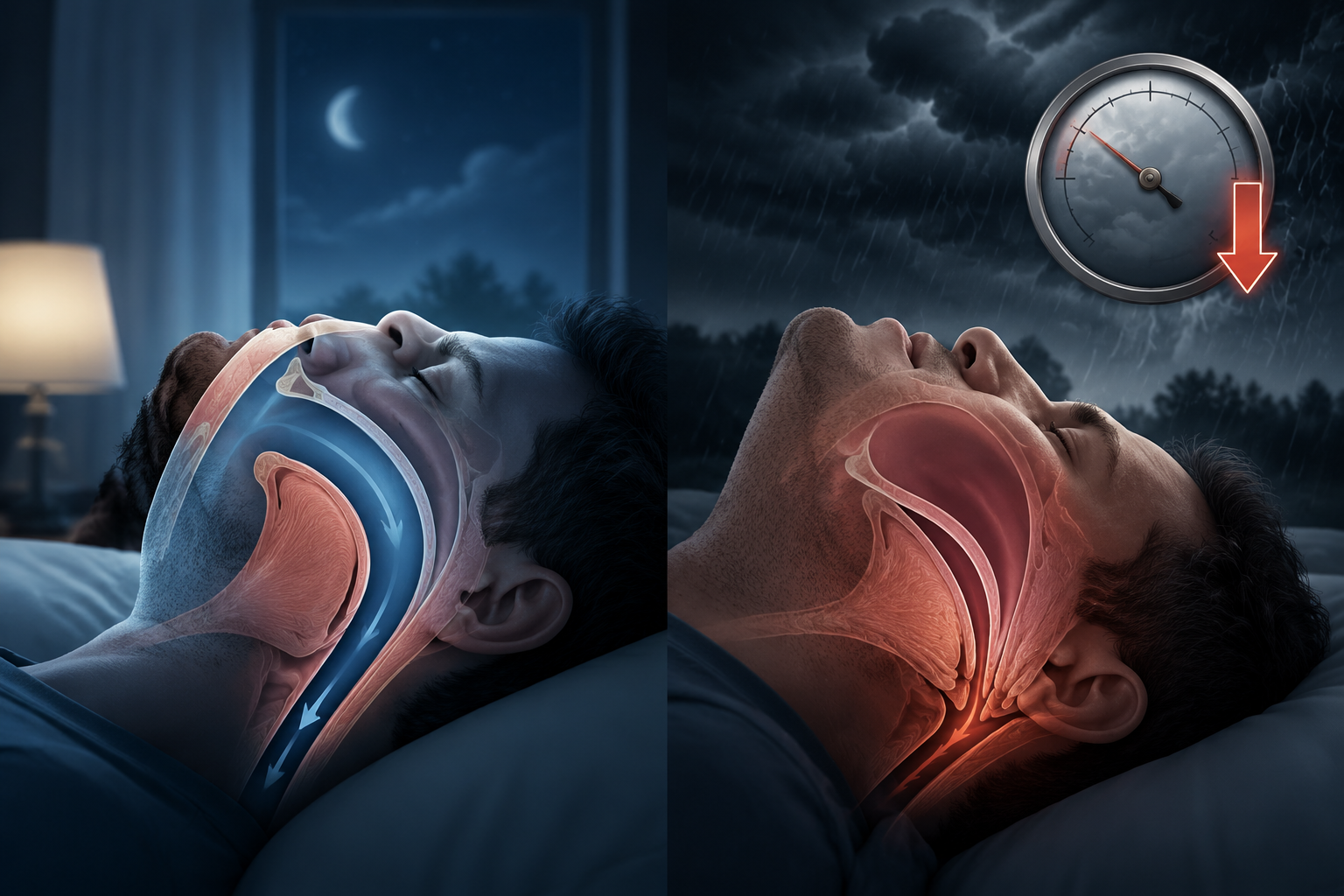
That study does not say that storms create sleep apnea in people who do not have it. It was conducted at a single Seattle sleep center, and the patients had severe sleep-disordered breathing on average, with a mean apnea-hypopnea index of 39.6. The overall apnea-hypopnea index did not show the same significant association; the signal appeared specifically in obstructive events.[2] The narrower conclusion is the important one: if your airway is already prone to collapse, lower nighttime pressure may make the obstructive part worse.
Harvard Health’s review of the same data offered a plausible explanation: atmospheric pressure may help hold pharyngeal tissues open.[3] During pressure drops, that support may be less effective for people whose upper airway is already vulnerable. This is why the storm question can look so different from one bedroom to the next. One person is hearing pink noise. Another is spending more of the night fighting a collapsible airway.
This matters most when sleep apnea is undiagnosed. A person may not think of themselves as having a breathing disorder; they may only notice that storm nights come with more awakenings, morning headaches, dry mouth, heavy snoring reports, or daytime exhaustion. If that pattern appears alongside pressure-heavy weather, it belongs in the apnea column before it gets filed under “bad sleep hygiene.” The related piece on why thunderstorms disrupt sleep quality follows that pathway in more detail.
Thunder Is Not Just Noise When the Body Reads It as Threat
Earplugs can reduce sound. Blackout curtains can reduce flashes. Neither automatically turns off threat detection. Thunder is abrupt, low, and bodily; lightning predicts the next impact before it arrives. If a person already fears storms, the nervous system may start preparing before the loudest part of the weather even reaches the house.
Cleveland Clinic reports that about 8% of adults experience specific phobias and identifies astraphobia, or fear of thunder and lightning, among the most common. Symptoms can include a racing heart, shortness of breath, and chest tightness.[4] Those are not decorative emotions around sleep; they directly compete with sleep onset. A body with a racing heart is doing the opposite of drifting.
This is the place where generic storm advice often fails. “Listen to the rain” is plausible for the sleeper whose main input is rain. It is useless for the person whose main input is alarm. Once anxiety has decided that the night is unsafe, the problem is not only decibels or light leaks. It is the body’s arousal state.
The practical distinction is whether the storm wakes you by interruption or keeps you awake by anticipation. A sharp thunderclap can fragment almost anyone’s sleep. But lying awake before each expected strike, checking weather alerts repeatedly, or feeling chest tightness as clouds build points more toward the anxiety pathway. The guide on how to sleep during a thunderstorm when nothing else works is more useful once that pattern is clear.
A Simple Way to Sort Your Storm Response
Most people do not need a grand theory of weather and sleep. They need to identify which storm input is loudest in their own physiology. The same rainstorm can be a sound machine, a circadian cue, a breathing stressor, and a threat signal. The dominant pathway is usually visible in the details.
| What you notice on storm nights | Most likely pathway | What it suggests |
|---|---|---|
| Steady rain helps you fall asleep, and thunder is distant or rare | Pink-noise-like rain input | Your sleep may be benefiting from masking and sound continuity |
| Cloudy, dark weather makes you drowsy earlier than usual | Dim-light melatonin timing | The storm may be shifting sleepiness, especially during daytime storms |
| You snore heavily, wake gasping, or feel worse after pressure-heavy weather | Obstructive sleep apnea vulnerability | The storm may be amplifying an existing airway problem |
| You feel a racing heart, chest tightness, or dread before thunder | Astraphobia or storm-related anxiety | The main obstacle may be arousal, not the sound itself |
| You sleep well until one loud crash or bright flash wakes you | Sensory fragmentation | The issue may be intermittent disruption rather than the whole storm |
The apnea pathway deserves extra caution because it is easy to mislabel. If a storm seems to make sleep worse in a heavy, physical way—more choking awakenings, more morning fatigue, more reports of loud snoring—the answer is not to force the mouth shut or simply add more noise. A collapsible airway needs a different kind of attention. The piece on why mouth taping is unsafe for sleep apnea is relevant here, as is the framework for deciding whether to sleep on your back, since position can affect airway collapse in vulnerable sleepers.
Storm anxiety deserves the same specificity. If the main event is hypervigilance, then a louder fan may help only at the edges. Weather alerts, household safety routines, where you sleep in the home, and how early the body starts scanning for danger may matter more than the sound of rain. Tropical systems add another layer because the anticipation can last longer than the thunder itself; the articles on how tropical disturbances disrupt sleep quality and tropical storm sleep tips for noise, heat, and anxiety are better fits for that situation.
So Which Camp Are You In?
If you sleep better in storms, the most likely explanation is not that storms are universally calming. You may be getting the useful parts: rain that behaves like a natural pink-noise source, a darker room, and enough emotional safety that thunder stays in the background. Your body is filtering the storm as cover.
If you sleep worse, the soothing pieces may still be present, but they are being outvoted. A pressure-sensitive airway can turn the night into harder breathing. Thunder and lightning can fragment sleep. Storm fear can keep the heart rate and breathing pattern too activated for sleep to arrive. None of that is solved by being told to enjoy the rain.
The contradiction is the clue. Storms do not act on one sleeper. They act on hearing, light exposure, airway mechanics, and threat response at the same time. Once you know which system is carrying the storm for you, the strange split between “best sleep of my life” and “wide awake until dawn” stops looking strange.
References
- Pink Noise for Sleep, Sleep Foundation
- The Effect of Barometric Pressure on Obstructive Sleep Apnea, University of Washington, 2010
- Does Weather Affect Sleep Apnea?, Harvard Health Publishing
- Astraphobia, Cleveland Clinic
Comments
Join the discussion with an anonymous comment.