
Northern lights viewing affects sleep mostly because it keeps you awake at the exact part of the night when your body expects the deepest rest. The aurora is not bright enough to act like a phone screen or a hotel hallway light; its light output is closer to a clear starry sky. The problem is the chase: alarms, driving, cold air, excitement, caffeine, and standing outside between roughly 10 PM and 2 AM, with magnetic midnight often falling around 1-2 AM.[1]
The workable answer is not to “sleep when you can.” That is how people end up with four scattered hours and a heroic story nobody asked for. Plan the night as two real sleep blocks: an early evening block before the viewing window, then a second block after you come back in. Done deliberately, the total can still reach 9-10 hours.
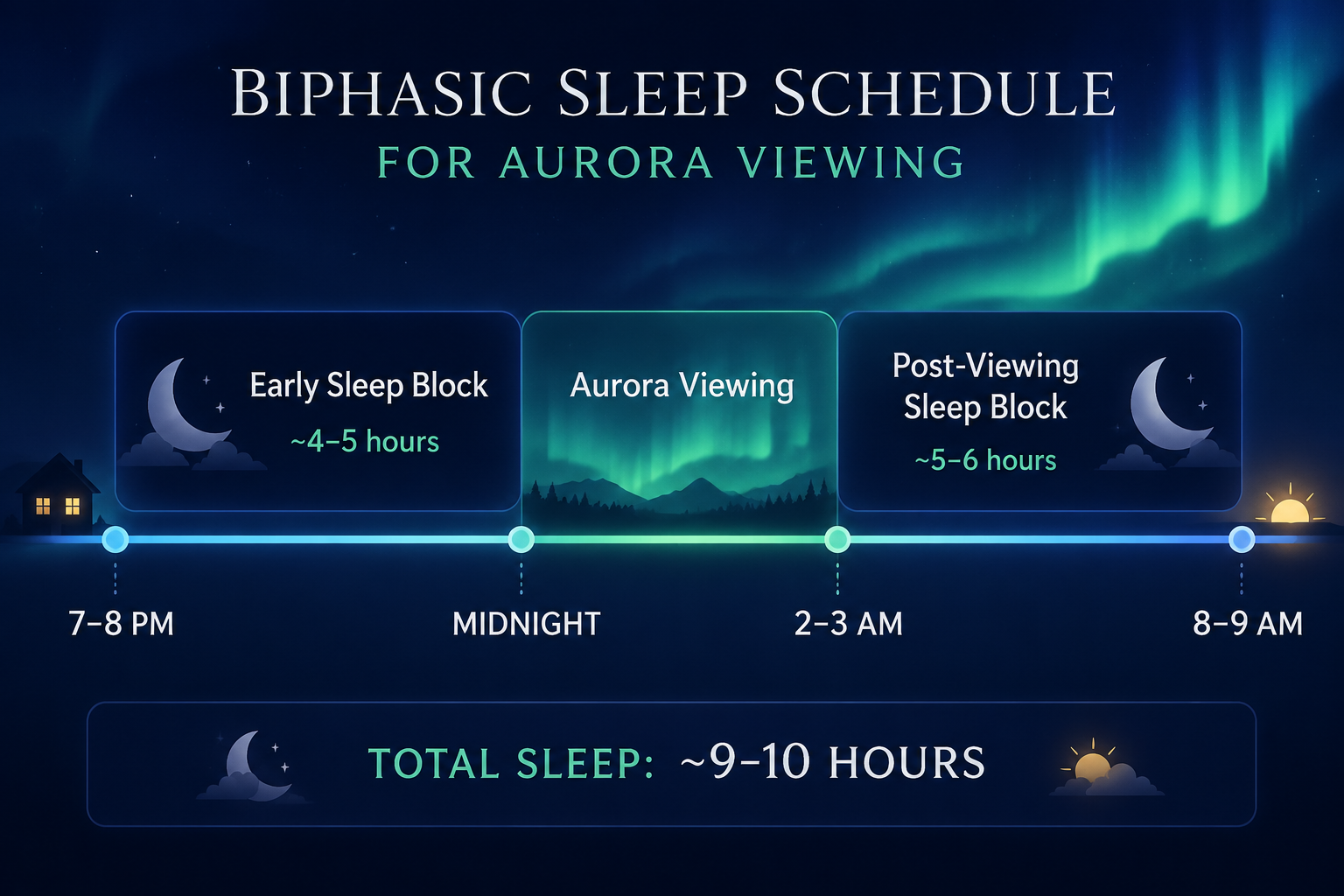
Use a two-block sleep schedule, not a late-night endurance plan
A practical aurora night starts earlier than most travelers want to admit. If you plan to be outside from about midnight to 2 AM, the first sleep block has to begin around 7-8 PM. That gives you roughly 4-5 hours of sleep before the alert, the guide pickup, or the short walk outside. After viewing, the second block runs from about 2-3 AM to 8-9 AM, adding another 5-6 hours.[1]
| Part of the night | What to do | Why it matters |
|---|---|---|
| 7-8 PM to midnight | Sleep in a dark, quiet room | Bank the first 4-5 hours before the aurora window |
| Midnight to 2-3 AM | View only if the conditions justify it | Keep the interruption tied to the actual reason for the trip |
| 2-3 AM to 8-9 AM | Return to bed without turning the night into a second evening | Restore total sleep to about 9-10 hours |
This is a biphasic sleep schedule. The Sleep Foundation describes biphasic sleep as sleeping in two periods within a day rather than one continuous overnight block, and it does not treat the pattern itself as inherently abnormal or damaged sleep.[2] That matters here because the goal is not to survive on a nap. The goal is to split the night cleanly around the event you came to see.
The first block is the one most people sabotage. They eat late, keep checking apps, open another drink, or sit around “waiting to see what happens.” Then, when the sky finally cooperates, they are already behind. Treat 7-8 PM as bedtime on viewing nights. Boring, yes. Also the difference between enjoying the lights and spending breakfast staring into coffee like it owes you an apology.
Only wake up for signals that are worth the cost
Every wake-up has a price. If you are under the auroral oval, KP 3+ can produce visible aurora, while KP 4+ is the more practical threshold for push alerts when you are trying to protect sleep.[1] That does not mean KP is the only thing that matters; cloud cover and local visibility can still ruin a promising number. But it gives the night a decision rule, which is better than letting every app notification drag you out of bed.
- Set alerts for KP 4+ if sleep protection matters more than checking every faint possibility.
- Use KP 3+ as a reasonable “look outside” threshold if you are already awake or staying very close to your lodging.
- Do not leave the first sleep block open-ended while you monitor forecasts manually.
- Decide before dinner what would make you get dressed and go out.
That last point is less romantic than standing under the Arctic sky, but it is the part that protects the rest of the trip. A weak alert at 11:30 PM, a cloudy sky, a 40-minute drive, and a group that wants to “just try” can turn into the kind of night that removes the next day from your vacation.
Let polar night help the first block
High-latitude winter can feel strange on arrival. The long darkness can extend melatonin production and make early evening sleepiness stronger, especially before you have fully adjusted.[1] That sensation is often treated as a nuisance. For aurora viewing, it can be useful. If your body is ready to sleep at 7:30 PM in Tromso, Fairbanks, Yellowknife, or rural Iceland, take the offer.
Arctic residents also do not live in a simple “dark equals sleep” world. BBC Future’s reporting on polar night describes adaptation to extreme seasonal light conditions rather than a single automatic response.[3] Travelers have less time to adapt, so the schedule should not depend on willpower or vibes. It should use the early darkness when it helps and block ambient light when it does not.
Protect both sleep blocks with boring gear
Aurora gear usually gets discussed as if comfort is the only issue. Warm boots and layers matter, obviously. For sleep, the smaller items matter because they keep the viewing window from leaking into the rest of the night.
- Use a red-mode headlamp outside so you are not blasting your eyes with bright white light while checking the camera, trail, or door lock.[1]
- Pack a blackout sleep mask, because moonlight, snow reflection, and bright lodging can still disturb the room even in Arctic winter.[1]
- Use earplugs if you are in a lodge, group cabin, tour hotel, or any place where other people return at different times.
- If you use melatonin, keep it low-dose, around 0.5-1 mg, and use it as a timing cue rather than a knockout tool.[1]
The red light is not there to make the night feel more authentic. It reduces the amount of bright light you take in during the interruption and helps preserve night vision. The sleep mask is not optional for people who are sensitive to light; snow and moonlight can turn a bedroom into a dim lantern. Melatonin deserves even less drama: more is not automatically better, and the common 5-10 mg gummy habit is poorly matched to the job here.[1]
Do not blame the aurora for what the schedule did
There is some research on geomagnetic activity and melatonin, and it is worth acknowledging without letting it hijack the plan. Weydahl and colleagues reported that geomagnetic activity influenced melatonin secretion at latitude 70 degrees N in a 2001 study.[4] Other work has suggested that only a minority of people may show measurable melatonin-related sensitivity to geomagnetic conditions, roughly 10-15% according to the research summary in the aurora sleep guide.[1]
That is a caveat, not a travel strategy. There is no direct experimental study showing polysomnographic sleep outcomes in travelers sleeping through an active auroral event. The stronger, more ordinary explanation is still the one sitting in plain sight: staying awake late, going outside in the cold, drinking caffeine, checking apps, and trying to sleep again after excitement.
Plan recovery before the sleep debt has a chance to pile up
A 5-7 day aurora trip can still accumulate about 5-8 hours of sleep debt, even with a better schedule, especially when travel days, time zones, early tours, alcohol, or repeated weak-signal wake-ups get added to the week.[1] That number is the part many itineraries quietly ignore. One late night is manageable. Several late nights, plus flights, plus a morning excursion, become a different problem.
The recovery window should be treated as part of the trip, not as a personal failure afterward. The aurora sleep guide recommends 3-4 days of extended sleep windows, roughly 8.5-9.5 hours, after a typical aurora trip.[1] Individual recovery will vary with age, baseline sleep quality, and how much debt you actually accumulated, but the planning implication is simple: do not schedule your hardest workday, longest drive, or most demanding training session for the morning after you return.
If you cross several time zones to reach Alaska, Scandinavia, Canada, or Iceland, recovery may also be tangled with jet lag. That is another reason to keep the aurora nights structured. A two-block sleep plan cannot erase travel fatigue, but it keeps late-night viewing from becoming an uncontrolled second source of sleep loss.
A workable aurora night
On a real viewing night, the plan is plain. Eat early. Make the room dark. Set the alert threshold before you get sleepy. Sleep from 7:30 PM to midnight. Wake only if the signal and sky justify it. Go outside with red light, warm layers, and a defined return time. Come back in, avoid turning on bright lights, and sleep again from about 2:30 AM to 8:30 AM.
That gives the aurora the hours it actually needs without letting it take the whole night. Seeing the northern lights and sleeping well are compatible, but only if sleep is planned as a two-block system rather than treated as whatever is left after the sky is done.
References
- Northern Lights Sleep Guide: Chase Aurora & Rest, gotosleep.ca
- Biphasic Sleep: What It Is And How It Works, Sleep Foundation
- What can we learn about sleep from the land of the polar night, BBC Future
- Geomagnetic activity influences the melatonin secretion at latitude 70 degrees N, Weydahl et al., 2001
Comments
Join the discussion with an anonymous comment.