
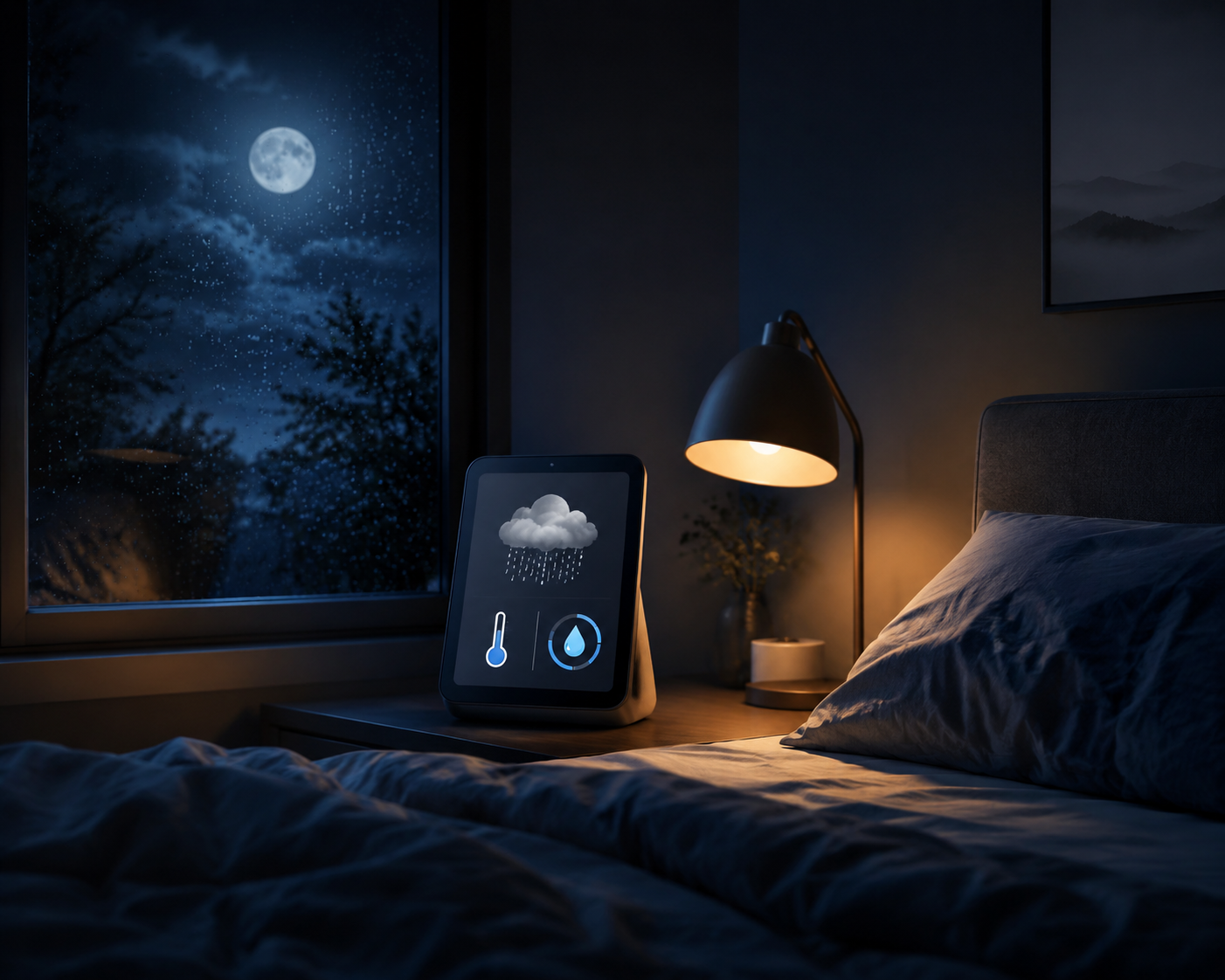
Checking tonight’s forecast can help you sleep better when it leads to one or two specific bedroom changes before you get under the covers. The useful part is not the icon that says “partly cloudy.” It is the overnight low, the humidity, the timing of rain or thunderstorms, and—for some sleepers—the direction of barometric pressure. This is where forecast accuracy affects sleep in a practical way: a more accurate overnight forecast gives you a better chance to cool the room early, choose lighter bedding, run a dehumidifier, close windows before storms arrive, or pay closer attention to breathing-related awakenings.
This is not a cure for insomnia, and it is not a diagnostic tool. But it is a credible early-warning system for nights when the bedroom is likely to drift outside the conditions your body handles well.
Start With The Overnight Low, Not The Daytime High
The strongest evidence starts with nighttime temperature. In a Fitbit-based study of 14,232 adults in the United States, covering more than 12 million nights, each 10°C increase in nighttime temperature was associated with 2.63 fewer minutes of sleep. The same report identifies 60–67°F, or 15–19°C, as an optimal sleep temperature range at the population level.[1]
A few minutes may sound small until it lands on the wrong night: the night before an early shift, the third night of a heat wave, or the night when the room stays warm long after the outdoor temperature falls. The point is not that every warm night ruins sleep. It is that heat has a measurable direction of effect in real-world sleep data, and the adjustment window is before bedtime, not at 3 a.m. when the sheets already feel damp.
The overnight low matters because many bedrooms lag behind the outdoor forecast. A room that absorbed heat all afternoon may still be warm after sunset, especially on upper floors, in poorly ventilated apartments, or in homes where air conditioning is limited to certain rooms. Older adults can be especially exposed to this kind of mismatch when room-cooling options are constrained; broader guidance on this problem belongs with sleep hygiene for older adults, but the weather-specific move is simple: check whether the bedroom will actually cool down before your first sleep cycle.
| Forecast Detail | What It Changes Before Bed |
|---|---|
| Overnight low stays above your comfortable range | Pre-cool the bedroom earlier; use lighter sleepwear or bedding; reduce heat sources in the room. |
| High humidity overnight | Expect fans or open windows to feel less effective; consider dehumidification or air conditioning if available. |
| Storms arrive during your sleep window | Close windows, secure noisy blinds, charge devices, and use steady background sound if it already helps you. |
| Pressure is falling and you have sleep-disordered breathing symptoms | Watch for breathing-related awakenings; follow prescribed CPAP guidance and contact a clinician if patterns persist. |
Why Warm, Humid Nights Are Different
Sleep depends on thermoregulation. As bedtime approaches, the body normally sheds heat, and the sleep environment either helps or interferes with that process. A room can be “only a little warm” on the thermostat and still be difficult to sleep in if bedding traps heat, pajamas limit evaporation, or humidity keeps sweat from cooling the skin.
The thermal-environment literature is useful here because it separates heat from humid heat. Okamoto-Mizuno and Mizuno’s review describes how heat exposure increases wakefulness, and it reports experimental evidence that humid heat increases wakefulness and decreases slow-wave sleep compared with dry heat alone.[2] Slow-wave sleep is not something you can feel moment by moment, but many people recognize its absence the next morning: sleep happened, yet it did not restore much.
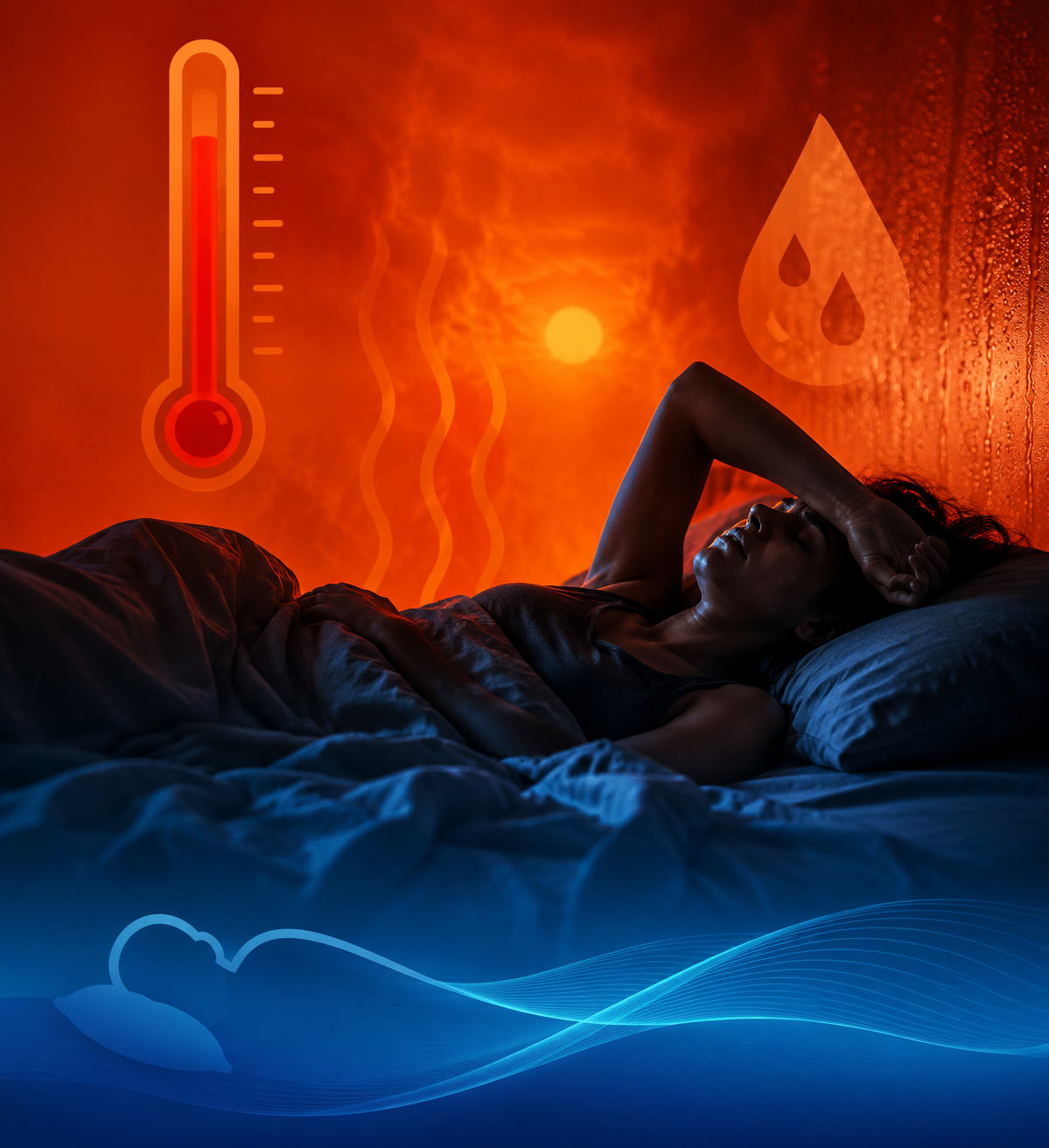
Humidity is why the forecast can matter even when the temperature looks familiar. A 73°F bedroom on a dry night and a 73°F bedroom on a muggy night are not the same sleep environment. Fans move air, but they do not remove moisture. Open windows may help if outdoor air is cooler and drier; they may do very little if the night air is thick and still. Air conditioning, when available, changes both temperature and moisture, which is one reason it can feel disproportionately helpful during humid heat.
There is also an uncomfortable finding for anyone hoping the body simply adapts after several bad nights. The same review cites evidence that heat-related sleep disruption did not attenuate after 5 consecutive days of exposure.[2] That does not mean every hot spell produces identical sleep loss in every person, and bedding practices differ across cultures and households. It does mean repeated hot nights should not be dismissed as something sleep will automatically absorb without consequence.
Turn The Forecast Into A Bedtime Decision
A forecast only helps if it changes the room before the disruption arrives. The most useful check is brief and specific: look at the overnight low, humidity, storm timing, and pressure trend. Then stop. The goal is not to add another sleep-performance ritual; it is to remove one predictable mismatch between the weather outside and the bed you are about to get into.
- If the overnight low will stay warm, cool the room earlier rather than waiting until bedtime.
- If humidity is high, choose moisture control over air movement alone when you have that option.
- If storms are expected during your sleep window, handle noise and window decisions before you are half-awake.
- If pressure is falling and you have sleep apnea or suspected breathing-related awakenings, treat that night as one worth observing more carefully.
For a warm night, the adjustment might be as ordinary as swapping a comforter for a sheet, moving a fan before the room heats up, pre-cooling the bedroom, or taking a warm shower early enough that skin can cool afterward. For a cool night after a warm day, the decision may be the opposite: avoid overcorrecting with heavy bedding if the room will hold heat for several hours. The forecast is not telling you how to sleep; it is telling you what the room is likely to do while you are asleep.
This also keeps forecast-checking in its proper place within sleep hygiene. It complements the basics—regular timing, light exposure, caffeine timing, wind-down routines, and a bedroom that supports sleep—rather than replacing them. If those foundations are shaky, start with an evidence-based sleep hygiene routine and use the forecast as a small environmental layer on top.

Pressure Drops Matter Most For Breathing-Related Sleep Problems
Barometric pressure deserves attention, but not panic. In a Seattle sleep-lab study of 537 patients with severe sleep-disordered breathing, every 1-millibar decrease in mean nightly atmospheric pressure was associated with a 0.3 events-per-hour increase in obstructive apnea index.[3] That is a clinically interesting finding because it links a weather variable to breathing events during sleep, not just to subjective sleep quality.
The limits matter just as much as the association. The study was conducted in one sleep lab at 200 feet elevation, and the participants were not a general community sample; they had severe sleep-disordered breathing, with a mean apnea-hypopnea index of 39.6.[3] That means the result should not be translated into “pressure drops ruin everyone’s sleep.” It is more useful, and more honest, to say that pressure changes may be especially relevant for people with diagnosed sleep apnea, suspected sleep apnea, CPAP use, or repeated awakenings that feel like choking, gasping, or sudden breathlessness.
For CPAP users, the practical step is not to improvise settings based on a weather app unless a clinician has specifically instructed that. The better move is pattern recognition: if low-pressure nights repeatedly coincide with mask discomfort, more awakenings, dry mouth, morning headaches, or a worse device-reported night, bring that pattern to the clinician or sleep clinic. Weather can provide context; treatment settings still belong in medical hands.
Storms, Noise, And The Difference Between A Bad Night And Insomnia
Storm timing is less mysterious than pressure physiology. Thunder, wind, rain against windows, light flashes, power interruptions, pets reacting, children waking, and the decision to get up and check the house can all fragment sleep. The forecast helps because many of those disruptions can be reduced before bedtime: close the window before rain starts, secure blinds, set a fan or white-noise source if you already tolerate it, charge a phone, and keep necessary items where they can be found without turning on bright lights.
It is worth separating weather-sensitive sleep from chronic insomnia. If sleep is usually stable and worsens on hot, humid, stormy, or pressure-shift nights, environmental adjustment is a reasonable first response. If trouble falling asleep, staying asleep, or waking too early persists across ordinary weather and begins to shape daily functioning, the problem has moved beyond forecast management. Cognitive behavioral therapy for insomnia is the evidence-based treatment path to understand; a fuller explanation is available in CBT-I for insomnia.
Seasonal Shifts Support The Same Practical Point
Seasonal data should not carry the whole argument, but it does support the idea that sleep moves with the environment. In a study of 216 people and 51,836 nights, spring was associated with about 12.6 minutes shorter sleep duration compared with winter.[4] That does not prove tonight’s weather caused last night’s bad sleep score. It does make it less surprising that sleep duration and timing drift when temperature, light, and daily routines shift across the year.
The nightly forecast is simply the smaller version of that seasonal reality. It brings the question close enough to act on: will the room be too warm, too humid, too noisy, or unusually relevant to breathing before morning?
What To Check Tonight
A useful forecast check can take less than a minute. It should end in a decision, not more scrolling.
- Look at the hourly overnight low during your actual sleep window, not just the daily high or low.
- Check humidity and decide whether cooling alone is likely to be enough.
- Check when storms are expected, then handle windows, noise, pets, and lights before bed.
- Notice major pressure drops if breathing-related awakenings, diagnosed sleep apnea, or CPAP use are already part of your sleep picture.
- Make one or two changes, then leave the forecast alone for the night.
Weather forecasts cannot make sleep perfectly predictable. They can, however, warn you when the bedroom you set up at 9 p.m. is unlikely to match the conditions your body will face at 3 a.m. That is enough to be useful, as long as the forecast stays in its lane: an early cue for adjusting the sleep environment before the disruption arrives.
References
- Study links rising temperatures to reduced sleep in U.S. adults, Keck School of Medicine of USC.
- Effects of thermal environment on sleep and circadian rhythm, Journal of Physiological Anthropology, 2012.
- The Effect of Atmospheric Pressure on Oxygen Saturation and Apnea-Hypopnea Index in Sleep Apnea Patients, Journal of Clinical Sleep Medicine, 2010.
- The effects of seasons and weather on sleep patterns measured through longitudinal multimodal sensing, npj Digital Medicine, 2021.
Comments
Join the discussion with an anonymous comment.