
As of July 15, 2026, the live congressional proposal is not simply to stop changing the clocks. The House Rules Committee advanced the Sunshine Protection Act on July 13, and that bill would make daylight saving time permanent across most of the United States.[1] That distinction matters for sleep: ending the twice-yearly disruption is one question; choosing which clock to live on all year is another.
The sleep effects of permanent daylight saving time are easiest to misunderstand in July, when later sunsets feel like a gift and winter mornings are abstract. The biological question is less cheerful and more specific: what happens when school, work, commuting, meals, and alarms are shifted one hour later relative to the sun, especially during the darkest months?
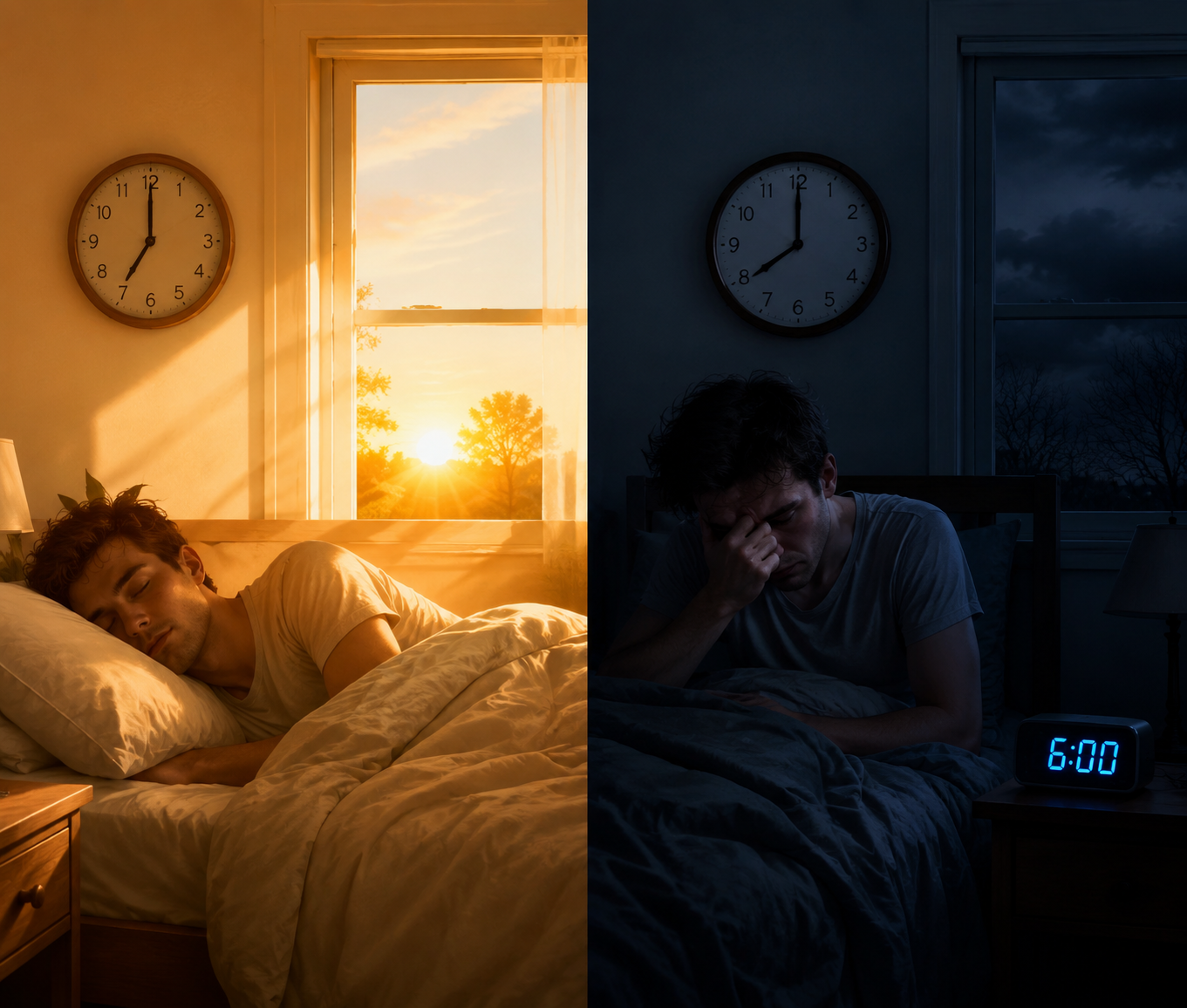
The Choice Is Not Clock Changes Or No Clock Changes
There is a broad public-health case for ending the spring and fall clock changes. The spring transition compresses sleep, moves waking into darker clock time, and has been associated with short-term health and safety effects. A 2026 systematic review of 157 studies from 36 countries found that the spring DST onset was associated with about a 4% increase in myocardial infarction risk and with fatal traffic accidents.[4]
But that review also prevents the debate from becoming too neat. It concluded that the evidence on living with daylight saving time versus living with standard time is thinner than the evidence on transitions; only about one in five included studies were rated high quality, and the review identified only one high-quality study on all-cause mortality.[4] In other words, the spring-forward literature is relevant, but it is not a perfect substitute for asking what happens under a permanent clock.
The sleep-science comparison therefore turns on circadian alignment. Standard time keeps civil clock time closer to solar time. Permanent daylight saving time shifts civil clock time one hour later relative to the sun. That buys more evening light on the clock, but it delays morning light—the signal that helps anchor the body’s internal day.
Why Morning Light Carries So Much Weight
Human circadian rhythms do not read legislation. They respond to light, darkness, meals, activity, and social timing. Morning light is especially important because it helps pull the circadian clock earlier. When sunrise moves later while alarms stay fixed, people may have to wake before their biology has finished the night.
That is the sleep problem hidden inside permanent DST. The evening may feel more usable, but the next morning can become biologically more expensive. A teenager cannot always start school later because sunrise is late. An early-shift worker cannot simply sleep in because the solar day has slipped away from the workday. A parent who liked the 8:30 p.m. summer walk may still have to wake a child in winter darkness.
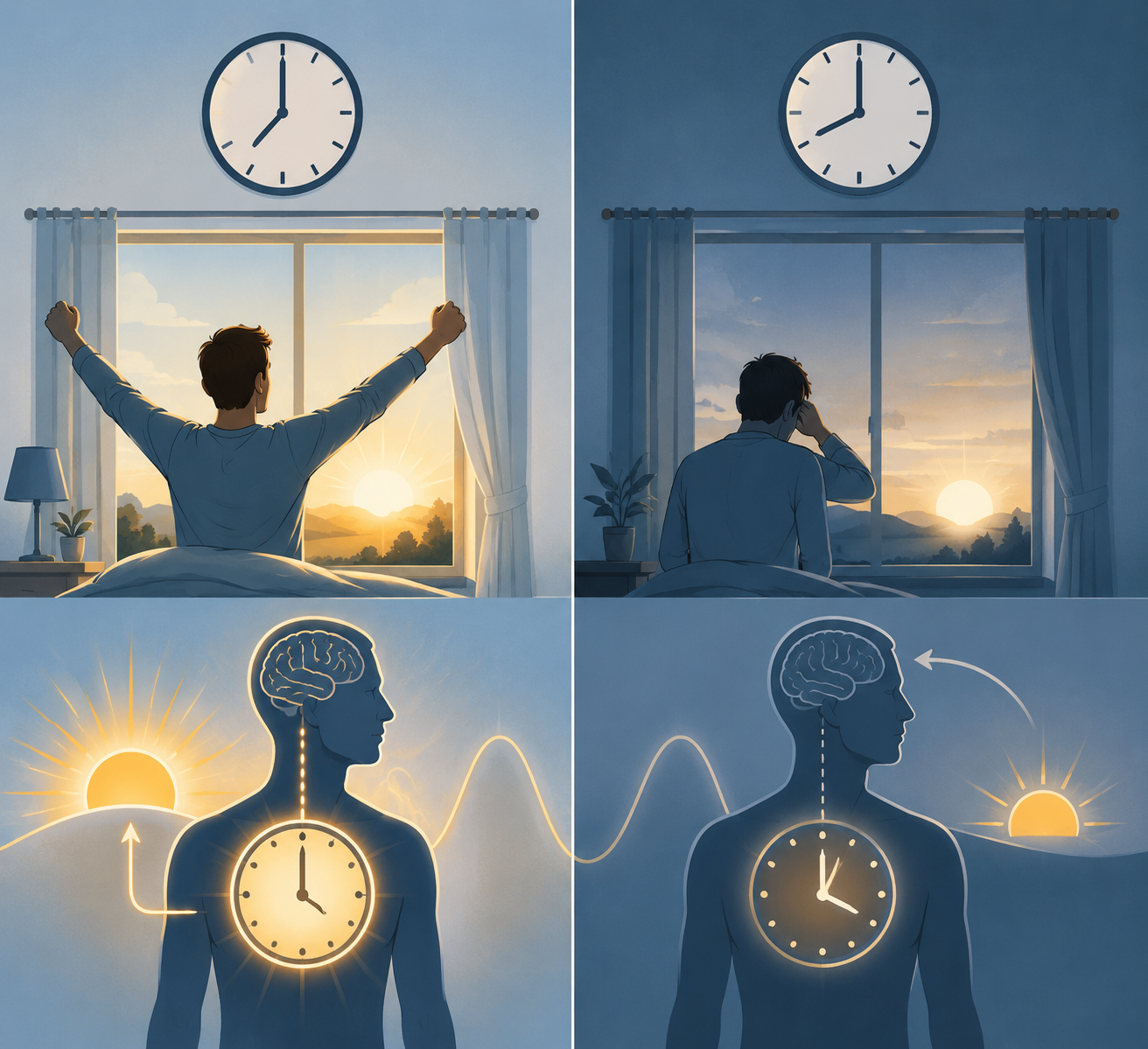
This mismatch is often called social jetlag: the gap between the body’s preferred timing and the schedule imposed by work, school, and clock time. Permanent DST does not create the same acute shock as the March clock change every week. Its concern is chronic: more mornings when the social day begins before the solar day has given the body its strongest timing cue.
The Stanford Model Compared The Two Permanent Clocks Directly
The most useful recent evidence is a 2025 Stanford model published in PNAS because it directly compared three policy conditions: the current system of switching clocks, permanent standard time, and permanent daylight saving time. The model estimated that permanent standard time would reduce obesity prevalence by 0.78 percentage points, corresponding to about 2.6 million people, and reduce stroke prevalence by 0.09 percentage points, corresponding to about 300,000 cases.[2]
Permanent DST also performed better than the current clock-switching system in the model, but less well than permanent standard time. Stanford reported that permanent DST achieved roughly two-thirds of the modeled benefits of permanent standard time: a 0.51 percentage-point reduction in obesity prevalence, or about 1.7 million people, and a 0.04 percentage-point reduction in stroke prevalence, or about 220,000 cases.[2]
| Policy option | Modeled obesity effect | Modeled stroke effect | Sleep-science interpretation |
|---|---|---|---|
| Current clock switching | Baseline comparison | Baseline comparison | Adds twice-yearly disruption and does not solve chronic alignment problems |
| Permanent daylight saving time | 0.51 percentage-point reduction, about 1.7 million people | 0.04 percentage-point reduction, about 220,000 cases | Removes transitions but keeps social time later relative to the sun |
| Permanent standard time | 0.78 percentage-point reduction, about 2.6 million people | 0.09 percentage-point reduction, about 300,000 cases | Removes transitions while keeping clock time closer to solar time |
The important part is not that the model treats standard time as magic. It does not. It suggests that both permanent systems could improve on changing clocks twice a year, while standard time does more to preserve the morning-light relationship that sleep scientists worry about losing. That is a narrower, more defensible claim than saying permanent DST is always harmful in every respect.
The Stanford work also has a practical limitation: it assumes consistent, circadian-friendly light habits. Real people do not always get outdoor morning light, dim their homes at night, or keep regular schedules. If daily light behavior is worse than modeled, the health gains from either permanent system may be smaller in practice. But the direction of the comparison still matters, because a policy that delays winter sunrise makes the best light behavior harder for people with fixed morning obligations.
Medical Groups Have Converged On Permanent Standard Time
Several medical and scientific organizations have taken a clear position: if the United States stops changing clocks, permanent standard time is the better health choice. The American Academy of Sleep Medicine lists support for permanent standard time from the National Sleep Foundation, American Medical Association, American Academy of Neurology, Sleep Research Society, and Society for Research on Biological Rhythms.[3]
Consensus is not a substitute for explanation, but it is useful here because these groups are not judging the romance of summer evenings. They are looking at circadian timing, sleep duration, morning alertness, adolescent sleep vulnerability, accidents, and chronic disease patterns. Their preference follows the same logic as the Stanford model: keep the clock closer to the sun, especially in the morning.
This is also where the phrase “more daylight” becomes misleading. A time policy does not create daylight. It changes what the clock says when daylight occurs. Permanent DST moves light later on the clock; permanent standard time keeps it earlier. For sleep, the timing of light is not a decorative detail.
Winter Mornings Are The Stress Test
The strongest case for permanent DST is emotional and understandable: many people like light after work. Parents see playground time. Runners see a safer route. Restaurants see patio hours. Commuters see an evening that has not already disappeared. Those are real preferences, and they explain why permanent DST repeatedly sounds attractive when discussed in the abstract.
Winter is where the abstraction breaks. An analysis cited in the U.S. debate estimated that under permanent DST, 87% of the U.S. urban population would experience sunrise after 8 a.m. in winter, compared with 3% today.[5] The same analysis noted that 58.8% of U.S. workers leave for work before 8 a.m.[5] Those two facts sit uncomfortably together: the policy would make dark departures ordinary for a large share of people who cannot choose a later morning.
That burden is not evenly distributed. People at the western edge of a time zone already live later relative to the sun than people at the eastern edge. Early-shift workers, schoolchildren, and adolescents have less freedom to compensate. A flexible adult may protect sleep by shifting morning meetings later; a high school student waiting for a bus in January usually cannot.
The 1974 Experiment Is A Warning, Not A Perfect Replay
The United States has tried permanent daylight saving time before. During the energy crisis, the country adopted year-round DST in 1974 and abandoned it after 10 months.[6] Public approval reportedly fell from 79% to 42% after one winter of dark mornings, and schools in at least 18 states adjusted start times to protect children from dark commutes.[5][6]
The 1974 episode cannot answer every 2026 question. Work patterns have changed, school transport has changed, and energy arguments are not the same as sleep-health arguments. But it does show something policy polls often miss: support for permanent DST can look sturdy before people live through the dark mornings.
It also shows who absorbs the adjustment first. In 1974, schools had to respond because children were visible in the risk picture. In a modern permanent-DST system, the same pattern would likely appear in different forms: districts reconsidering start times, parents rearranging commutes, and workers making winter mornings function even when their biology has less morning light to work with. That is not proof of catastrophe. It is evidence that the convenience is partly being financed by people with less schedule control.
Other Natural Experiments Point In The Same Direction
Real-world evidence outside the United States is imperfect but relevant. Russia adopted permanent daylight saving time in 2011 and reversed course in 2014.[3] Studies discussed in sleep-medicine materials have linked that period to more sleep deprivation and depressed mood among adolescents, with particular concern in northern communities where winter light is already scarce.[3]
Adolescents deserve special attention because their circadian timing naturally shifts later during puberty, while school schedules often demand early wake times. A 2026 University of British Columbia discussion of permanent DST noted that one in three Canadian adolescents do not get the recommended 8 to 10 hours of sleep, and projected especially late winter sunrises under permanent DST in parts of western Canada, including after 9 a.m. in Vancouver, Victoria, and Calgary, and after 10:30 a.m. in Fort St. John.[7]
Time-zone border studies add another clue. People living on the western edge of a time zone experience solar noon later on the clock, a DST-like condition relative to people farther east in the same zone. Research cited by sleep and public-health groups has associated that western-edge position with shorter sleep and higher rates of obesity, diabetes, cardiovascular disease, and some cancers.[3] This is not a randomized trial of national permanent DST. It is a natural experiment showing what happens when civil time drifts later from solar time.
What The Evidence Can And Cannot Prove
The case for permanent standard time is strong, but it should not be inflated. There is no large randomized trial assigning a country to permanent DST or permanent standard time for years while controlling all school, work, light exposure, and health variables. Much of the evidence comes from models, historical policy changes, time-zone geography, and studies of clock transitions.
The 2026 systematic review is useful precisely because it complicates easy messaging. It found evidence of acute risk after spring DST onset, but it also reported some findings that do not fit a simple “DST is uniformly detrimental” slogan, including reduced all-cause mortality during summer DST and reduced events after the autumn offset in some analyses.[4] That does not make permanent DST the healthier default. It means the strongest claim is comparative and circadian: among permanent-clock choices, standard time better preserves morning alignment.
It is also possible to value later evening light for reasons outside sleep science. Communities may weigh recreation, retail patterns, perceived safety, or after-work family time differently. The sleep-health evidence does not erase those preferences. It clarifies their cost: permanent DST shifts that benefit toward evening by making winter morning alignment worse.
So Which Is Better For Sleep?
For sleep and circadian health, permanent standard time is the better-supported option. It removes the twice-yearly clock change while keeping social time closer to solar time. It protects morning light more effectively, which matters most for people who cannot move their obligations later: students, early-shift workers, commuters, and families already operating on tight sleep.
Permanent DST is not the same as the March clock change repeated forever, and the evidence should not be described that way. Its main sleep effect is chronic misalignment: darker winter mornings, later circadian timing, and more pressure on people whose wake times are fixed. The Stanford model suggests it may still be better than clock switching, but less beneficial than permanent standard time.[2]
If Congress wants to end clock changes while protecting sleep, the health evidence points to permanent standard time. Permanent DST may feel generous on summer evenings, but it locks in the winter-morning mismatch that circadian scientists are most concerned about.
References
- House committee advances Sunshine Protection Act to make daylight saving time permanent, USA Today, July 14, 2026, link
- Permanent standard time is better for health than daylight saving time, Stanford Medicine, September 2025, link
- Permanent standard time is the optimal choice for health and safety, American Academy of Sleep Medicine, link
- Daylight saving time and health: a systematic review, European Journal of Epidemiology, February 2026, link
- Daylight savers or night wasters? The case against permanent daylight saving time in the United States, United States Studies Centre, link
- Why permanent daylight saving time is a bad idea, CU Boulder Today, March 28, 2022, link
- B.C.’s switch to permanent DST adds to the perfect storm for poorer adolescent sleep and mental health, UBC News, March 2026, link
Comments
Join the discussion with an anonymous comment.