
Mechanism explainer
Home Remedies for Sleep: An Evidence-Tiered Guide to What Actually Works
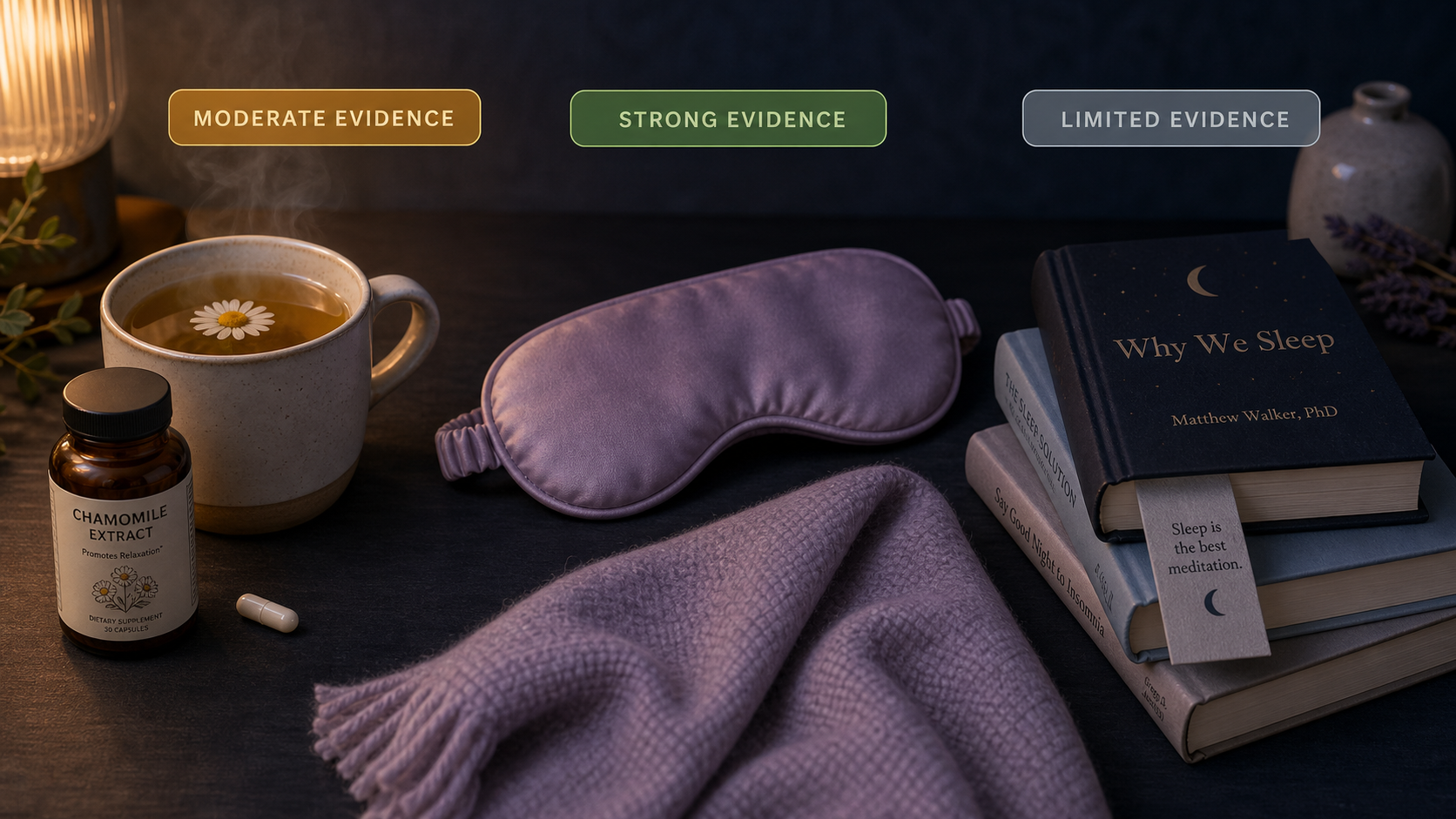
Not all home remedies for sleep are equally supported by research. This guide ranks popular remedies into three evidence tiers — strong, moderate, and limited — to help adults with occasional sleep difficulty make informed, drug-free choices.
Why Evidence Grading Matters for Sleep Remedies
Walk into any pharmacy or scroll through a wellness feed and you will find dozens of products claiming to fix your sleep — melatonin gummies, magnesium powders, valerian tinctures, lavender sprays, tart cherry shots, and teas made from chamomile, passionflower, or lemon balm. The sheer volume of options creates a paradox: the more remedies available, the harder it becomes to know which one is worth trying.
The problem is that these remedies are not created equal. Some have been tested in multiple randomized controlled trials and meta-analyses. Others rest on a single small study or a plausible biological mechanism that has never been rigorously confirmed. A few are backed by centuries of traditional use but almost no modern clinical data. And a small number carry real safety risks that outweigh their potential benefits.
This guide organizes popular home remedies for sleep into three evidence tiers — strong, moderate, and limited — so you can see at a glance where the science stands. The framework is designed for adults with occasional sleep difficulty who want effective, low-risk options before turning to medication. If you have chronic insomnia lasting more than four weeks or suspect an underlying sleep disorder, these remedies may help as part of a broader plan, but they are not a substitute for professional evaluation.
Tier 1: Strong Evidence — Remedies You Can Rely On
These interventions have the strongest research support: multiple randomized trials, consistent findings, and endorsement from major clinical guidelines. If you are looking for a place to start, begin here.
Cognitive Behavioral Therapy for Insomnia (CBT-I)
CBT-I is not a single remedy but a structured, multi-component program that addresses the thoughts and behaviors that perpetuate poor sleep. The AASM recommends it as the first-line treatment for chronic insomnia — ahead of any medication or supplement. Research has found that CBT-I can help most people with insomnia, and sleep experts frequently recommend it as the initial approach.
The core components include stimulus control (going to bed only when sleepy and getting out of bed if awake for more than 20 minutes), sleep restriction (limiting time in bed to match actual sleep time), cognitive restructuring (challenging unhelpful beliefs about sleep), and relaxation training. A full course typically runs 6 to 8 sessions, but self-directed versions using workbooks or digital programs can also produce meaningful improvements.
For readers who want to explore this option further, see our guides on using CBT-I techniques without a therapist and the CBT-I FAQ.
Melatonin for Circadian Alignment
Melatonin is the most studied sleep supplement on the market — nearly two-thirds of American adults have tried it. A meta-analysis of 19 randomized controlled trials found that melatonin significantly reduced sleep latency (the time it takes to fall asleep) and increased total sleep time in people with primary insomnia, with the most pronounced effects seen in older adults and those with delayed sleep phase syndrome.
However, melatonin is not a general-purpose sleep aid. Sleep experts believe it has a stronger track record for circadian alignment — helping reset the body clock after jet lag, shift work, or delayed sleep phase — than for treating chronic insomnia. The timing matters: taking it too late or at the wrong dose can actually shift your circadian rhythm in the wrong direction. Most research uses doses between 1 and 5 mg taken 30 minutes to 2 hours before the desired bedtime, using the lowest effective dose.
For a deeper look at how melatonin interacts with your internal clock, see our article on circadian rhythm mechanisms.
Magnesium Supplementation in Older Adults
A double-blind, randomized controlled trial involving 46 older adults found that taking 500 mg of magnesium daily for 8 weeks produced significant improvements in sleep time, sleep efficiency, and insomnia severity scores. The study also measured physiological changes: participants showed reduced serum cortisol (a stress hormone) and increased levels of both renin and melatonin, suggesting a plausible mechanism for the sleep benefit.
Other research has reported that 500 mg of magnesium daily for 2 months reduced insomnia symptoms and improved sleep patterns. The evidence is strongest for older adults, who are more likely to have low magnesium levels, but the supplement is generally well-tolerated in younger populations as well. For detailed information on dosage, timing, and safety across different forms of magnesium, see our comprehensive magnesium guide and the 2025 clinical trial review.
Exercise Timing and Consistent Sleep Scheduling
These two behavioral interventions are often overlooked because they are not "remedies" in the traditional sense, but their evidence base is as strong as any supplement. A 2015 study found that participants who exercised at least 150 minutes per week for 6 months showed significantly fewer insomnia symptoms. The timing matters: vigorous exercise too close to bedtime can be stimulating, but moderate aerobic activity in the late afternoon or early evening appears to promote deeper sleep.
Consistent sleep scheduling — waking up at the same time every day, even on weekends — is one of the most effective ways to stabilize the circadian rhythm. The Mayo Clinic recommends going to bed only when sleepy, waking at the same time daily, and avoiding daytime napping as core strategies for sleep maintenance insomnia. For a full breakdown of these foundational habits, see our guide on sleep hygiene fundamentals and an evidence-based bedtime routine.
Tier 2: Moderate Evidence — Promising but Not Definitive
These remedies have enough research to suggest they work for some people under some conditions, but the evidence is not as consistent or robust as Tier 1. They are reasonable options to try, especially if you have already addressed the stronger interventions, but you should not expect guaranteed results.
Valerian Root (300–600 mg)
Valerian root is one of the most popular herbal sleep aids, and it has the data to back it up — up to a point. A meta-analysis of 18 randomized controlled trials reported that valerian produced statistically significant reductions in sleep latency (SMD: -0.71, 95% CI: -1.05 to -0.37) and improvements in sleep quality (SMD: -0.46, 95% CI: -0.77 to -0.14) compared to placebo.
However, the quality of the included trials is mixed. Some studies used small sample sizes, and the effect size varies widely between trials. A small percentage of people actually experience the opposite effect — increased sleeplessness rather than sedation. The typical dosage studied is 300 to 600 mg taken up to an hour before bedtime.
Glycine (3 g Before Bed)
Glycine is an amino acid that appears to improve sleep through a specific physiological mechanism: it facilitates a slight drop in body temperature, which is a natural signal for sleep onset. A 2006 study found that 3 g of glycine before bed reduced next-morning fatigue and improved subjective liveliness and clearheadedness. A follow-up study in 2007 reported that the same dose improved objective sleep quality and helped participants fall asleep faster.
The evidence base is smaller than for melatonin or valerian — these are two studies from the same research group — but the mechanism is biologically plausible and the safety profile is excellent. Taking up to 30 grams daily has been shown to have few side effects, though the sleep benefits are typically achieved at the 3-gram dose.
L-Theanine (200 mg)
L-theanine is an amino acid found in green tea that increases the production and release of GABA, a neurotransmitter that promotes relaxation without sedation. Consuming up to 200 mg per day appears safe for most people and does not cause daytime sleepiness — a significant advantage over many OTC sleep aids.
The evidence suggests that L-theanine may enhance sleep quality by reducing nighttime awakenings rather than by helping people fall asleep faster. It does not appear to function as a sleep initiator in the way that melatonin does. For a detailed review of the evidence, dosage, and safety profile, see our L-theanine for sleep guide.
Tart Cherry Juice
Tart cherries are one of the few natural food sources of melatonin. A pilot study of 15 older adults with chronic insomnia who consumed tart cherry juice for 2 weeks reported significant improvements in sleep quality, sleep latency, and insomnia severity. A separate randomized controlled trial in 20 adults who consumed tart cherry juice concentrate for 7 days found significant improvements in time in bed, total sleep time, and sleep efficiency.
The sample sizes are small, and the studies were short-term, but the consistency of the findings across two independent trials is encouraging. Tart cherry juice is generally safe, though it contains natural sugars and calories that may not be ideal for everyone before bed.
Lavender Aromatherapy
Lavender essential oil has been studied primarily for its calming and anxiety-reducing effects, which may indirectly improve sleep. Research has shown that lavender can calm anxiety, reduce pain, and improve sleep duration and quality. A small study in older adults with dementia found that lavender aromatherapy improved sleep disturbance symptoms, increased total sleep time, and reduced early waking.
The evidence is strongest for inhaled lavender (diffuser, pillow spray, or a few drops on a tissue) rather than oral lavender oil capsules, which have been studied at doses of 20 to 80 mg per day but carry more potential for interactions. The effect size is modest, and not everyone finds the scent relaxing, but it is a low-risk option to try.
| Remedy | Typical Dose | Key Finding | Evidence Quality |
|---|---|---|---|
| Valerian root | 300–600 mg | Meta-analysis of 18 RCTs: SMD -0.71 for sleep latency, SMD -0.46 for sleep quality | Moderate (mixed trial quality) |
| Glycine | 3 g before bed | Two studies: reduced next-day fatigue, improved sleep quality and latency | Moderate (small sample, single group) |
| L-theanine | 200 mg daily | Reduces nighttime awakenings; does not appear to help with sleep onset | Moderate (consistent but limited) |
| Tart cherry juice | ~8 oz or concentrate | Two small trials: improved sleep time, efficiency, and quality | Moderate (small samples, short-term) |
| Lavender aromatherapy | Inhaled or 20–80 mg oral | Calms anxiety; improves sleep duration and quality in some populations | Moderate (limited to specific groups) |
Tier 3: Limited Evidence — Traditional Remedies with Plausible Mechanisms
These remedies have plausible biological mechanisms and long histories of traditional use, but clinical trial evidence is sparse or inconclusive. They are generally safe to try, but you should not expect reliable or consistent results.
Chamomile Tea
Chamomile contains apigenin, a flavonoid that is believed to interact with benzodiazepine receptors in the brain — the same receptors targeted by anti-anxiety medications. This gives the herb a plausible mechanism for promoting relaxation and sleep-wake transition. Johns Hopkins sleep specialist Charlene Gamaldo, M.D., notes that chamomile is caffeine-free and that its flavonoids may influence the same brain pathways involved in sleep.
However, there is not much scientific proof that chamomile tea actually improves sleep. The few controlled trials that exist have produced mixed results, and most are too small to draw firm conclusions. Drinking a warm cup of caffeine-free tea as part of a wind-down routine may be helpful as a behavioral ritual, but the direct sedative effect of chamomile itself is likely minimal.
Warm Milk
The classic glass of warm milk before bed is believed to work through tryptophan, an amino acid that serves as a precursor to serotonin — a neurotransmitter involved in the sleep-wake transition. Dr. Gamaldo explains that warm milk is "believed to be associated with chemicals that simulate tryptophan effects on the brain."
The problem is that the amount of tryptophan in a glass of milk is very small, and it must compete with other amino acids to cross the blood-brain barrier. The psychological comfort of a warm, familiar bedtime ritual may be doing more of the work than the tryptophan itself. There is no harm in trying it, but do not expect a pharmacological effect.
Acupressure
Acupressure — applying physical pressure to specific points on the body — has been studied for insomnia in a handful of small trials, with some reporting improvements in sleep quality and latency. The proposed mechanism involves stimulating the release of endorphins and modulating autonomic nervous system activity. However, the evidence is limited by small sample sizes, lack of blinding, and variability in the points and techniques used. It is a low-risk option for those interested in trying it, but the evidence does not yet support it as a reliable intervention.
Kava: A Special Caution
Kava is sometimes included in lists of natural sleep aids because of its calming effects, but it carries a serious safety concern that places it in a different category from the other Tier 3 remedies. Kava has been associated with hepatotoxicity — severe liver damage — in multiple case reports. The Sleep Foundation warns that both valerian root and kava have been linked to potentially serious liver side effects, but the risk is more pronounced and better documented for kava.
Safety Table: Contraindications, Interactions, and Regulation
The following table summarizes key safety information for each remedy discussed in this guide. Because dietary supplements are not strictly regulated by the FDA, the actual content and potency of products can vary between brands. Always check for third-party testing seals and consult a healthcare provider before starting any new supplement, especially if you are pregnant, nursing, over 65, or taking prescription medications.
| Remedy | FDA Status | Common Contraindications | Known Drug Interactions |
|---|---|---|---|
| Melatonin | Dietary supplement | Autoimmune conditions, pregnancy (limited safety data) | Blood thinners, immunosuppressants, diabetes medications |
| Magnesium | Dietary supplement | Kidney disease, myasthenia gravis | Antibiotics, diuretics, bisphosphonates |
| Valerian root | Dietary supplement | Liver disease, pregnancy, children under 3 | Sedatives, CNS depressants, alcohol |
| Glycine | Dietary supplement | None well-documented at 3 g dose | None well-documented |
| L-theanine | Dietary supplement | None well-documented at 200 mg dose | May interact with blood pressure medications |
| Tart cherry juice | Food | Diabetes (sugar content), GERD | None well-documented |
| Lavender (inhaled) | Unregulated (essential oil) | Asthma (inhalation may trigger), skin sensitivity | None well-documented for inhaled use |
| Chamomile | Dietary supplement (tea) | Allergy to ragweed family | Blood thinners, sedatives |
| Warm milk | Food | Lactose intolerance, dairy allergy | None |
| Acupressure | Unregulated (practice) | None (general practice) | None |
| Kava | Dietary supplement (restricted in some countries) | Liver disease, pregnancy, alcohol use | CNS depressants, alcohol, hepatotoxic drugs |
Practical Decision Framework: Matching a Remedy to Your Sleep Complaint
Not all sleep problems are the same, and the most effective remedy often depends on the specific nature of your complaint. The following framework can help you narrow down your options based on your primary symptom.
Trouble Falling Asleep (Sleep Onset Insomnia)
If you lie in bed for 30 minutes or more before falling asleep, your circadian timing system may be misaligned. The strongest options are melatonin (1–5 mg, taken 30 minutes to 2 hours before desired bedtime) and morning light exposure to reinforce your wake-up signal. Consistent sleep scheduling — waking at the same time every day — is the behavioral foundation. For a comparison of melatonin versus magnesium for this specific complaint, see our guide on magnesium glycinate vs. melatonin for sleep.
Trouble Staying Asleep (Sleep Maintenance Insomnia)
Waking up in the middle of the night and struggling to get back to sleep is often driven by hyperarousal — an overactive stress response that keeps the brain alert. Magnesium (500 mg daily, especially in older adults) and glycine (3 g before bed) have both shown benefits for sleep maintenance. Lavender aromatherapy may help by reducing the anxiety that contributes to middle-of-the-night waking. The Mayo Clinic also recommends practical strategies: hide clocks, avoid caffeine after noon, and if you are awake for 20 minutes, get out of bed and do a quiet activity until you feel sleepy again.
General Wind-Down Difficulty
If your mind is racing at bedtime but you do not have a specific sleep onset or maintenance problem, the issue may be the transition from wakefulness to sleep. CBT-I techniques — particularly stimulus control and relaxation training — are the most evidence-backed approach. L-theanine (200 mg) can promote relaxation without sedation, and a consistent wind-down routine that includes a caffeine-free beverage (chamomile tea, warm milk) or a warm shower can signal to your body that it is time to shift gears.
| Primary Complaint | First-Line Options (Tier 1) | Second-Line Options (Tier 2) | Supportive Practices |
|---|---|---|---|
| Trouble falling asleep | Melatonin, consistent sleep scheduling, morning light | Valerian root, tart cherry juice | Avoid screens 1 hour before bed; keep bedroom cool (65–72°F) |
| Trouble staying asleep | CBT-I techniques, magnesium (older adults) | Glycine, lavender aromatherapy | Hide clocks; get out of bed after 20 minutes awake |
| General wind-down difficulty | CBT-I relaxation training, consistent bedtime routine | L-theanine, chamomile tea | Warm shower, soft music, progressive muscle relaxation |
When to See a Doctor
Home remedies are appropriate for occasional sleep difficulty, but they are not a substitute for medical evaluation when sleep problems become persistent or severe. You should consider seeing a healthcare provider if any of the following apply:
- Your sleep difficulty has lasted more than four weeks — this meets the diagnostic threshold for chronic insomnia, which typically requires structured treatment such as CBT-I rather than self-directed remedies.
- You or your bed partner have noticed loud snoring, gasping for air during sleep, or pauses in breathing — these are hallmark symptoms of sleep apnea, a condition that requires formal diagnosis and treatment.
- You experience an uncomfortable crawling or tingling sensation in your legs at night that improves with movement — this may indicate restless legs syndrome, which has specific treatment options.
- Your sleep difficulties are causing significant daytime impairment — excessive sleepiness, difficulty concentrating, mood changes, or reduced performance at work or school.
- You are taking medications that may be interfering with sleep, or you have a medical condition (chronic pain, depression, anxiety, thyroid disorders) that is known to affect sleep quality.
For a detailed comparison of treatment options, see our guide on CBT-I, sleep medication, or both based on the 2026 AASM guideline update.
Supports these guides
Spot an error or have clinical feedback?
Because this article covers clinical, medication, or safety information, we use a moderated correction channel instead of open public comments. Let us know if something about “Home Remedies for Sleep: An Evidence-Tiered Guide to What Actually Works” needs a closer look.
Send feedback on this article