
Mechanism explainer
How to Sleep During Santa Rosa Fire Evacuation Nights
Worried you'll sleep through a real warning on Santa Rosa fire-evacuation nights? This step-by-step playbook converts nighttime worry into pre-decided action — packed go-bag, shoes by the bed, scheduled alarm checks, and shelter-sleep fixes — because hyperarousal, not bad habits, is what keeps you awake when you may have to leave at any moment.
Last reviewed: July 31, 2026. This guide is informational, not medical or evacuation-order advice. As of July 31, 2026, it is not describing an active Santa Rosa fire event; it is for wildfire-season preparedness and for nights when an evacuation warning, wind event, smoke, or nearby fire activity has made sleep feel unsafe. If authorities tell you to evacuate, leave rather than trying to sleep.
Evidence tiers used here: “research” means wildfire or disaster sleep studies; “observational” means cohort or survey findings; “consensus guidance” means public-health, emergency-preparedness, or sleep-organization guidance; “practical safety step” means a household action built from those sources and adapted to an evacuation-threat night.
The real fear is sleeping through the warning
On a Santa Rosa wildfire night, the question is usually not “How do I create a relaxing bedtime routine?” It is: “If I finally fall asleep, will I miss the alert that tells us to leave?” That fear is not a character flaw. It is threat monitoring. The problem is that an unassigned monitoring job will keep recruiting your brain every time the wind hits a window, a truck goes by, or a phone screen lights up.
The job tonight is not to out-will hypervigilance. The job is to decide, before bed, who is watching, what counts as a real signal, what happens if the signal arrives, and what the off-duty sleeper is allowed to ignore.
That distinction matters because wildfire sleep problems are not imaginary. A systematic review of wildfire survivors found insomnia was the most common sleep disturbance in the studies it reviewed, reported in 63% to 72.5% of assessed survivors, while nightmares were reported in 33.3% to 46.5%; those cohorts were not Santa Rosa-specific, and most were assessed weeks to months after different fires, so the numbers should not be read as local rates for tonight [1]. In one wildfire cohort, “fear of imminent death” was reported by 51.1% of participants and independently predicted insomnia one month later, along with female gender and older age; again, that is not a Santa Rosa rate, but it does show why a body that has lived through a close call may stay on watch long after the flames are out [2].
Sleep is also part of the evacuation plan itself. Exhausted people misread messages, argue longer, forget chargers and medications, and drive with a slower brain. On a night when you may need to leave, protected sleep is not indulgent. It is one of the safety systems.
A Santa Rosa fire-season sleep plan starts before bedtime
Santa Rosa and Sonoma County households do not have to be talked into taking fire season seriously. Many people still carry the body memory of the Tubbs, Kincade, and Glass fires: late-night decisions, fast-moving wind, crowded roads, pets that would not load, older relatives who needed time, and the awful half-awake moment of deciding whether to go now or wait.
That history is exactly why the plan has to be physical, boring, and visible. A phone alert setting is not enough if your shoes are under laundry, the flashlight batteries are dead, the dog leash is in the garage, and everyone is relying on everyone else to check updates. The plan should remove decisions from 2 a.m., not add more of them.
| Before sleep, decide this | What it removes from the night | Evidence tier |
|---|---|---|
| What alert sources count | Random refreshing and rumor-checking | Consensus guidance |
| What trigger means “we leave” | Half-awake debate | Consensus guidance |
| Where the go-bag, shoes, flashlight, keys, glasses, medications, and pet supplies sit | Searching in the dark | Consensus guidance / practical safety step |
| Who is on watch, or when scheduled checks happen | Everyone lightly sleeping with one ear open | Consensus guidance |
| What the first 60 seconds look like if someone wakes the house | Panic, duplicated tasks, and missed essentials | Practical safety step |
1. Choose the signals that are allowed to wake you
Before anyone gets into bed, choose the alert sources that count tonight. Use official emergency alerts and the household’s pre-chosen local information sources. Then stop adding more feeds. Ten open tabs do not make you safer if they keep every adult awake and arguing over screenshots.
The Sleep Health Foundation’s bushfire-threat guidance is blunt about this: make a pre-arranged plan, use scheduled checks rather than trying to self-wake all night, and consider night-watch shifts so the rest of the household can sleep [3]. CAL FIRE’s evacuation guidance similarly emphasizes preparing before fire conditions force a rushed departure, including having a go-bag and evacuation plan ready [4].
A useful bedtime sentence sounds like this: “Tonight, we respond to an official evacuation order, a direct emergency alert for our zone, a call from our designated contact, or visible fire/smoke conditions that meet our leave-now rule. Everything else waits for the scheduled check.” The exact sources and trigger should match your household, location, mobility, pets, medical equipment, and road access. The point is that the rule exists before everyone is scared.
2. Put the exit in the room, not in your memory
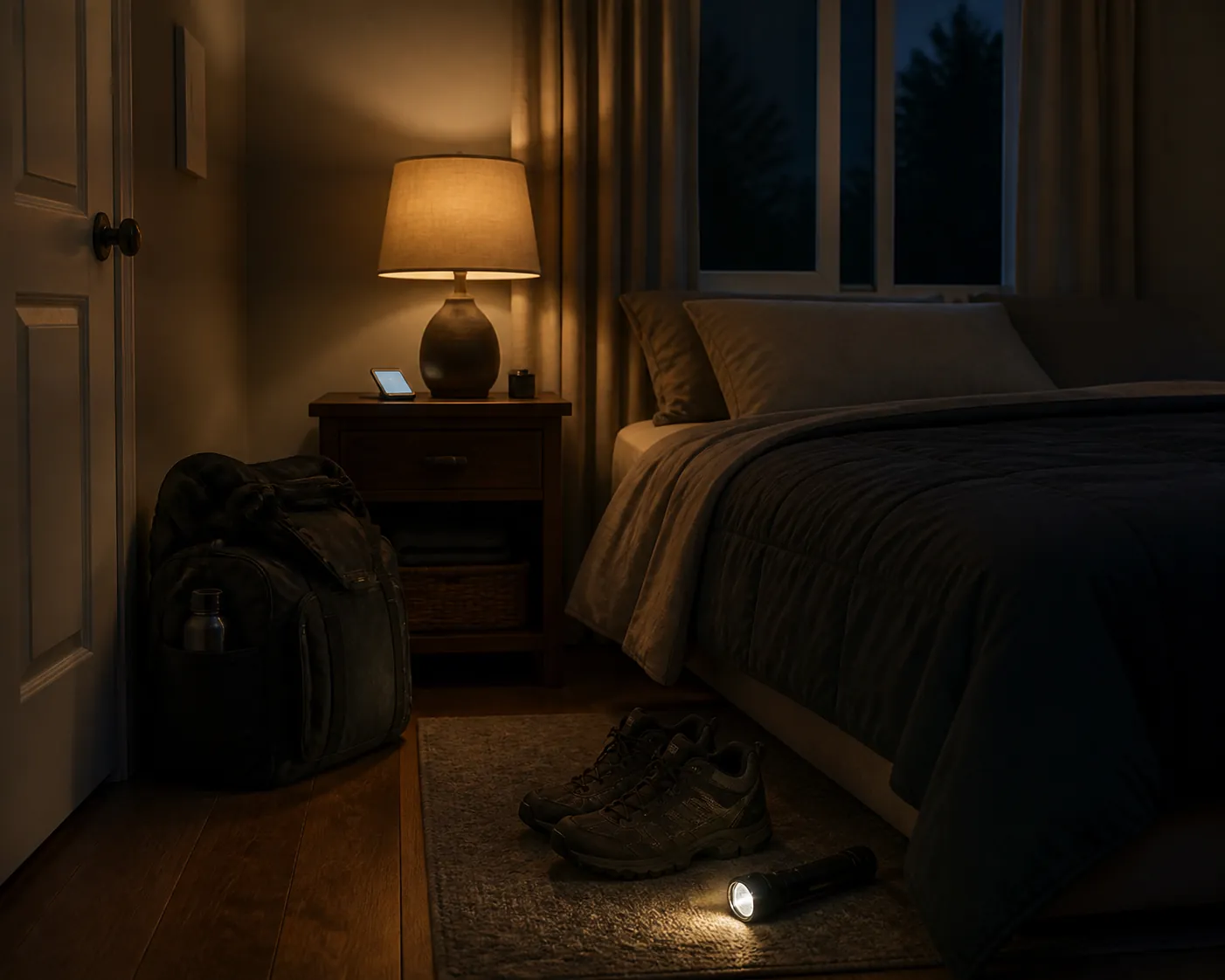
Pack the bag before bed. Not “we know where everything is.” Pack it. Then put shoes, socks, flashlight, phone, charger, keys, wallet, glasses, medications, and any mobility aids where a hand can find them in the dark. If children are in the house, set their shoes and comfort item where an adult can grab them. If pets are in the house, put leashes, carriers, food, and medication in the same exit path.
This is not neatness. It is nervous-system engineering. Every item already staged is one less reason for the brain to keep running a background search while you are trying to sleep. CAL FIRE’s evacuation guide centers the same preparedness logic: be ready to leave, prepare a go-bag, and plan ahead rather than improvising under pressure [4].
- By the bed: shoes, socks, flashlight or headlamp, glasses, phone, charger, wallet, keys.
- By the exit: go-bag, medication bag, pet supplies, copies of key documents if already prepared, mobility aids, child essentials.
- In the car if safe and appropriate: gas or charge checked, seats clear enough for people and pets, garage opener or manual plan known.
- On paper: destination options, household contacts, and the leave-now trigger for anyone too tired to remember it.
Pregnant readers should add prescription medications, prenatal vitamins, medical records, delivery-plan information, and a simple note about labor signs and where to go if labor starts during an evacuation. If you end up at a shelter, tell staff you are pregnant early rather than waiting until you need help. This is a practical safety step, not a substitute for prenatal medical advice.
For older adults, people using CPAP, and caregivers: stage the machine, mask, distilled water if used, extension cord, battery or power-continuity plan, medication list, hearing aids, glasses, mobility devices, and written emergency contacts. If power loss is part of the threat, the CPAP and heat-safety planning in this power-outage sleep guide is the better place to slow down and check the details.
3. Assign the night watch instead of making everyone do it badly
If there are two or more capable adults, do not let every adult half-sleep with a phone in hand. Pick one person for the first watch, then switch. Or set scheduled alarm checks if conditions are uncertain but not yet at your leave-now trigger. The Sleep Health Foundation specifically warns that trying to wake yourself repeatedly can lead to lighter sleep, and it recommends family night-watch shifts or scheduled alarm checks during bushfire threat [3].
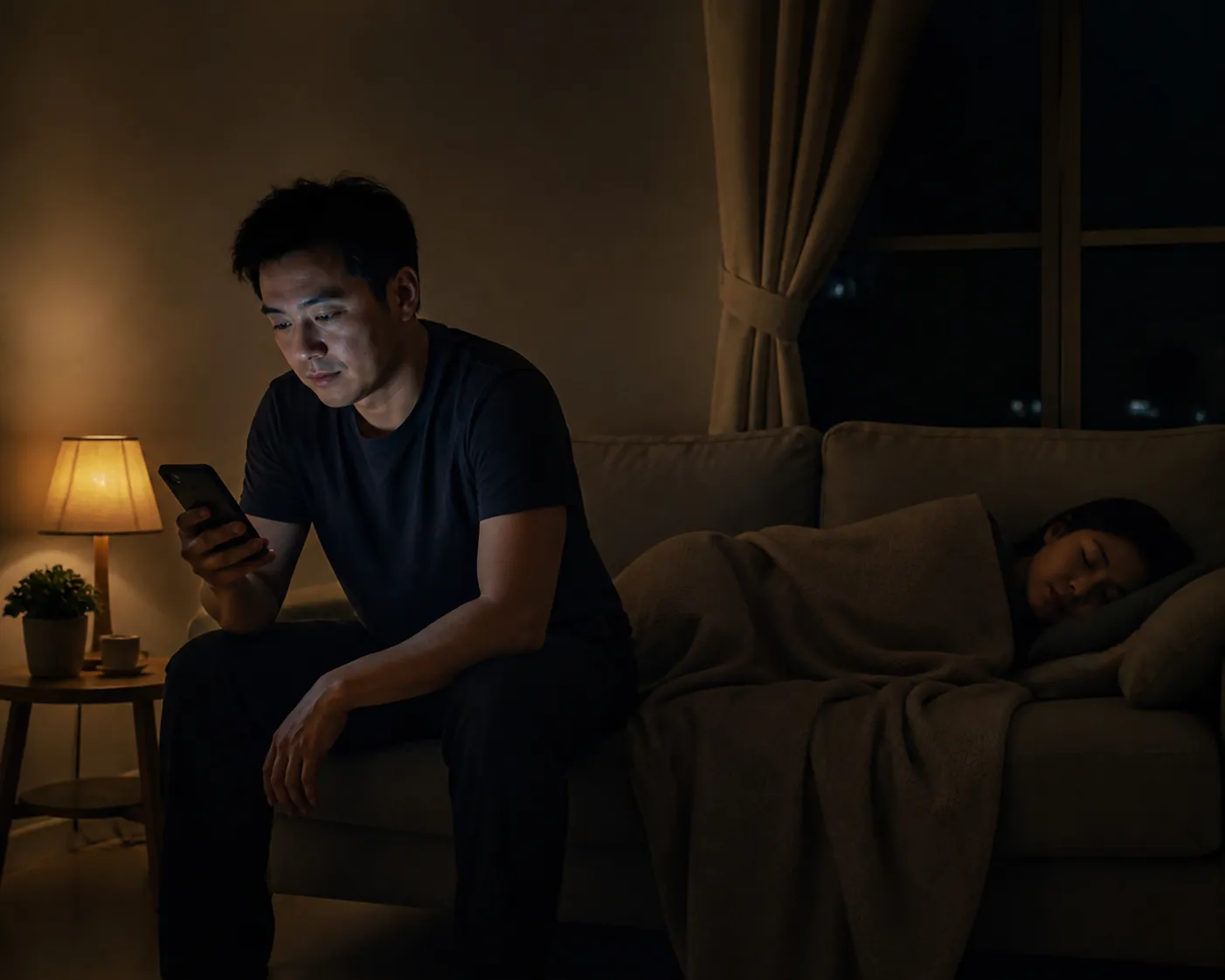
The off-duty sleeper gets a real job too: sleep until woken by the watch person, the scheduled alarm, or the agreed trigger. That sounds bossy because it needs to be. If you are off duty and still checking every sound, the plan is failing at its sleep job.
A simple shift plan might look like this: one adult monitors until the first scheduled check, wakes the next adult only if the trigger is met, then sleeps during the next block. If you live alone, the equivalent is scheduled checks: set an alarm for the next reasonable information point, keep the phone loud enough for official alerts, and put the phone out of doom-scroll reach if you can still hear it.
Do not assign night watch to the person who must drive if there is another good option. Do not assign it to the person already near collapse if someone else can cover. If everyone is exhausted, the safest plan may be to leave earlier, while people can still think and roads are easier to manage.
4. Write the wake-up script while you are still awake
Half-awake people do not need a speech. They need a script. Put it on paper or in a shared note before bed:
- Shoes on.
- Phone, wallet, keys, glasses.
- Medication bag and go-bag.
- Pets or mobility equipment.
- Car. Seatbelts. Route.
- Text the designated contact after leaving, not while blocking the doorway.
If there are children, give them one instruction they can actually do: “Put on shoes and hold the blanket,” not “Get ready.” If there is an older adult, one person is assigned to them. If there is a CPAP machine, oxygen equipment, medication refrigeration issue, wheelchair, walker, or service animal, name the person responsible before sleep.
This is where many households accidentally create insomnia: they have supplies somewhere, alerts somewhere, and a general idea that they will figure it out. The sleeping brain can feel that vagueness. Make the first minute boring.
What to do once you are in bed
After the plan is set, bedtime should be stripped down. This is not the night to perfect your entire sleep life. You are trying to reduce avoidable arousal.
- Put the phone where official alerts and the assigned watch can reach you, but not where your thumb can keep refreshing feeds.
- Use one phrase when your brain restarts the scan: “The plan is set. The next check is scheduled.” Then return to the body: jaw, shoulders, hands, breath.
- If you cannot sleep after a while, rest in the dark rather than turning the whole room into a command center.
- If the threat escalates or the leave-now trigger is met, stop trying to sleep and follow the script.
There is a difference between soothing yourself and gaslighting yourself. If you smell smoke, hear an official alert, get a direct evacuation message, or see conditions changing in a way that meets your household trigger, act. If the plan says the next check is in a set interval and the watch person is on duty, let the off-duty sleeper be off duty.
If wildfire smoke itself is what is keeping you awake — irritated airways, headache, coughing, temperature problems, or light changes through smoky skies — that is a different mechanism layered on top of evacuation stress. The smoke-specific sleep physiology is covered in Why Can’t I Sleep When There’s Wildfire Smoke?. Here, keep the focus on the evacuation-night job: reduce random monitoring and preserve enough sleep to make safer decisions.
If you have to sleep in a shelter, car, or hotel
Once you are away from home, the sleep problem changes. You may be safer from the immediate fire path, but now the room is bright, loud, too warm, unfamiliar, and full of other people’s stress. Do not wait for ideal conditions. Build a small sleep zone.
The American Sleep Apnea Association’s disaster-sleep guidance recommends practical tools such as earplugs or noise-canceling headphones, an eye mask or window covering, keeping the sleep area cool when possible, using air filtration when available, and cutting off caffeine after noon [5]. CDC shelter guidance emphasizes basic safety and hygiene in disaster shelters, including following shelter rules, keeping personal items organized, and telling shelter staff about medical needs [6].
| Problem | Fast fix | Why it helps |
|---|---|---|
| Noise | Earplugs, noise-canceling headphones, or one steady sound if allowed | Reduces startle from other people, doors, engines, and announcements |
| Light | Eye mask, hat brim, towel over eyes, or safe window covering | Gives the brain a stronger night signal |
| Heat | Light layers, shade, safe ventilation, cooling center or hotel if needed | Overheating keeps the body alert and can be dangerous for older adults, pregnant people, and people with medical conditions |
| Smoke or poor air | Filtered indoor space when possible; portable air cleaner if you already have one and power is safe | Reduces irritation and coughing that fragment sleep |
| Caffeine creep | Stop after noon if you can | Prevents an emergency-day coffee from becoming an emergency-night stimulant |
| Medical equipment | Tell shelter staff early; keep CPAP, medications, and chargers together | Avoids a midnight scramble when staff, outlets, and supplies are harder to sort |
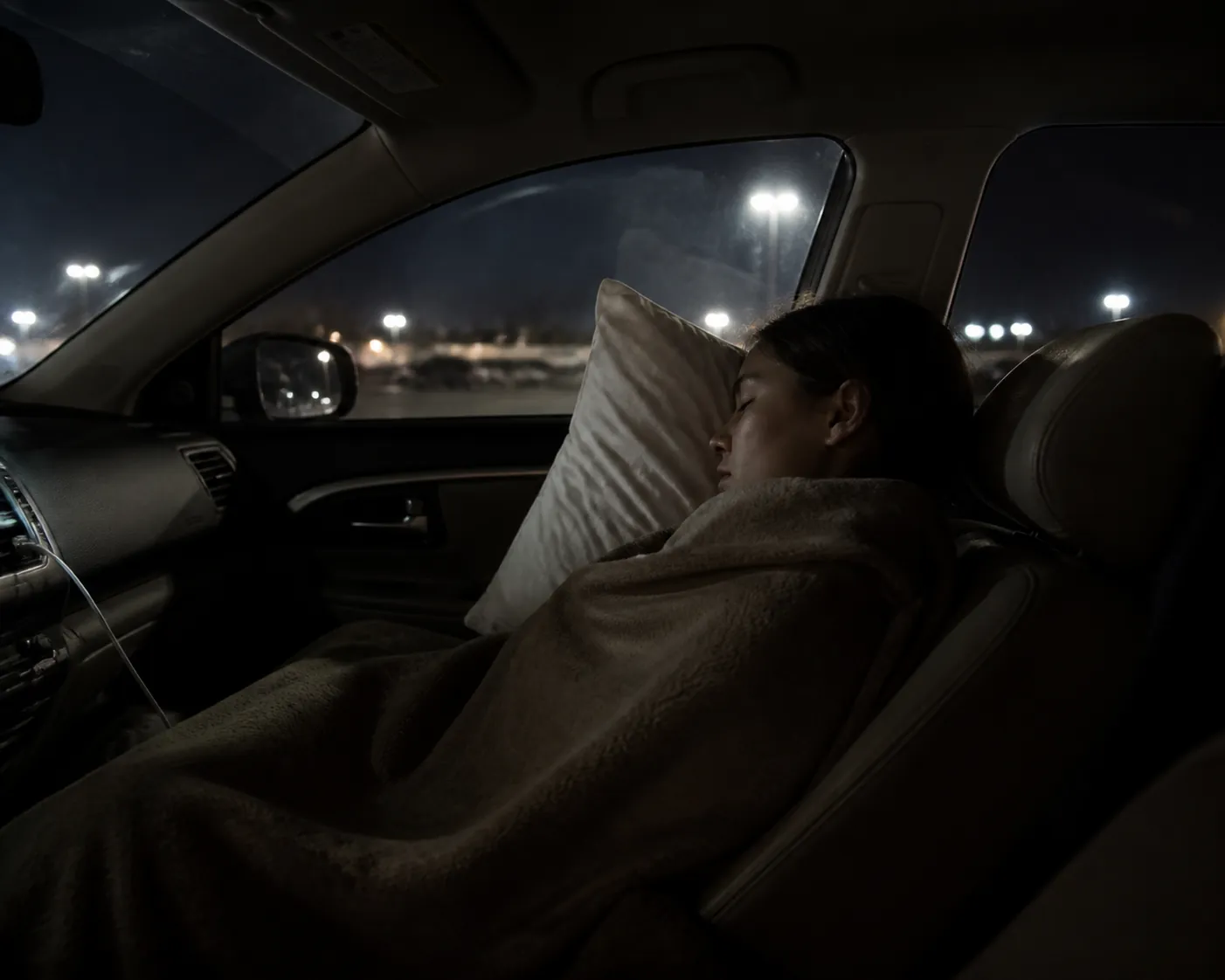
If you are sleeping in a car, prioritize safety over clever sleep hacks: park only where allowed and safe, keep exits clear, avoid unsafe engine use, keep the phone charged, and protect your neck and back as best you can. A reclined seat, pillow, blanket, eye covering, and agreed check-in plan may be enough for a few hours. It does not have to be beautiful to be useful.
Pregnant people, older adults, and anyone with sleep apnea, heart disease, lung disease, limited mobility, or heat sensitivity should not treat “toughing it out” as the default. Ask shelter staff about quieter areas, power access, medical support, cooling, and air filtration. For pregnancy-specific sleep comfort after the immediate evacuation problem is handled, see safe pregnancy insomnia remedies.
When acute stress needs more support
A few bad nights during a real evacuation threat can be a normal acute stress response. Nightmares, jolting awake, checking sounds, crying, irritability, and feeling wired can all happen when the body is trying to keep you alive. That does not mean you have failed at sleep.
Get more help if you feel unable to function, feel unsafe with yourself or others, have panic that will not settle, cannot sleep for multiple nights after the immediate threat passes, are using alcohol or sedatives to force sleep, or are having intrusive fire memories that are taking over the day. Sonoma County’s wildfire stress resources list the Disaster Distress Helpline at 1-800-985-5990, text TalkWithUs to 66746, and the Sonoma County Crisis Stabilization Unit at 707-576-8181 [7].
For adults 60 and older, the Institute on Aging Friendship Line at 1-855-639-7965 can be a useful non-emergency support line when isolation and fear are making nights worse. Caregivers should put that number, medication lists, and emergency contacts on paper; phones die at exactly the wrong time.
If insomnia persists after the evacuation threat is over, cognitive behavioral therapy for insomnia, or CBT-I, is the best-supported first-line treatment. The VA National Center for PTSD says CBT-I improves sleep in about 7 out of 10 people who complete it, including people with PTSD symptoms [8]. Sleep medications may have a short-term role for some people, but the VA cautions that some medications used for sleep can have risks, especially with PTSD symptoms and in adults 65 and older; medication decisions belong with a clinician who knows your health history [8][9].
The goal on a dangerous night is not perfect sleep. It is enough protected sleep to make safer decisions if evacuation becomes necessary. When worry has a job, give it a schedule and a trigger. Once the bag is packed, the shoes are by the bed, the alert plan is assigned, and the wake-up script is written, the sleeper’s job is no longer to monitor every sound.
References
- A Systematic Review of the Impact of Wildfires on Sleep Disturbances, Isaac et al., 2021.
- Insomnia and PTSD one month after wildfires, Psarros et al., 2017.
- Bushfire Threat and Sleep Health, Sleep Health Foundation.
- Go Evacuation Guide, CAL FIRE.
- How To Manage Your Sleep During And After A Disaster, American Sleep Apnea Association.
- Guidelines for Staying Safe at a Disaster Shelter, CDC.
- Coping with Trauma and Stress in the Face of Wildfires, SoCoEmergency.
- Sleep Problems and PTSD, VA National Center for PTSD.
- What to Expect in the Wake of Wildfires, VA National Center for PTSD.
Supports these guides
Spot an error or have clinical feedback?
Because this article covers clinical, medication, or safety information, we use a moderated correction channel instead of open public comments. Let us know if something about “How to Sleep During Santa Rosa Fire Evacuation Nights” needs a closer look.
Send feedback on this article