
If you have insomnia and you are asking whether you should nap, the useful answer is conditional: only if the nap is short, early, occasional, and not working against a sleep restriction plan. A 20- to 30-minute nap in the early afternoon is a different sleep event from a 75-minute nap at 5 PM. They may both feel like “napping,” but they do not take the same amount of pressure off the night.
That distinction matters because the standard advice is genuinely mixed. Some insomnia programs discourage daytime sleep to protect nighttime sleep drive. Stanford Health Care’s stimulus-control guidance, however, allows a brief 15- to 30-minute nap taken 7 to 9 hours after rise time, and Mayo Clinic’s general nap guidance also points toward short naps earlier in the day rather than long or late ones. [1][2]
So the question is not “Is napping good or bad for insomnia?” It is: what kind of nap, on what kind of day, under what treatment rules?

The first thing to protect is sleep pressure
The reason naps can backfire in insomnia is not moral weakness or lack of discipline. It is homeostatic sleep pressure: the longer you stay awake, the more your body accumulates pressure to sleep. Adenosine is one of the key chemicals involved in that process, building during wakefulness and clearing during sleep. A nap clears some adenosine too, because the brain does not treat daytime sleep as fake sleep. [3]
For someone who sleeps easily at night, that may not matter much. For someone with insomnia, especially sleep maintenance insomnia, a small reduction in sleep drive can be the difference between falling back asleep at 3 AM and lying there alert enough to start counting the consequences of tomorrow. If nighttime awakenings are already the main pattern, it may help to think of insomnia partly as a sleep-drive problem, not only as a relaxation problem.
This is why nap duration changes the decision. A short nap that stays mostly in lighter non-REM sleep may take the edge off severe sleepiness without draining the whole reservoir. A longer nap is more likely to enter deeper slow-wave sleep, the stage most relevant to reducing accumulated sleep pressure. The practical threshold is imperfect, but it is still useful: once a nap pushes much beyond 30 minutes, it becomes more likely to behave like a meaningful sleep period rather than a brief reset.
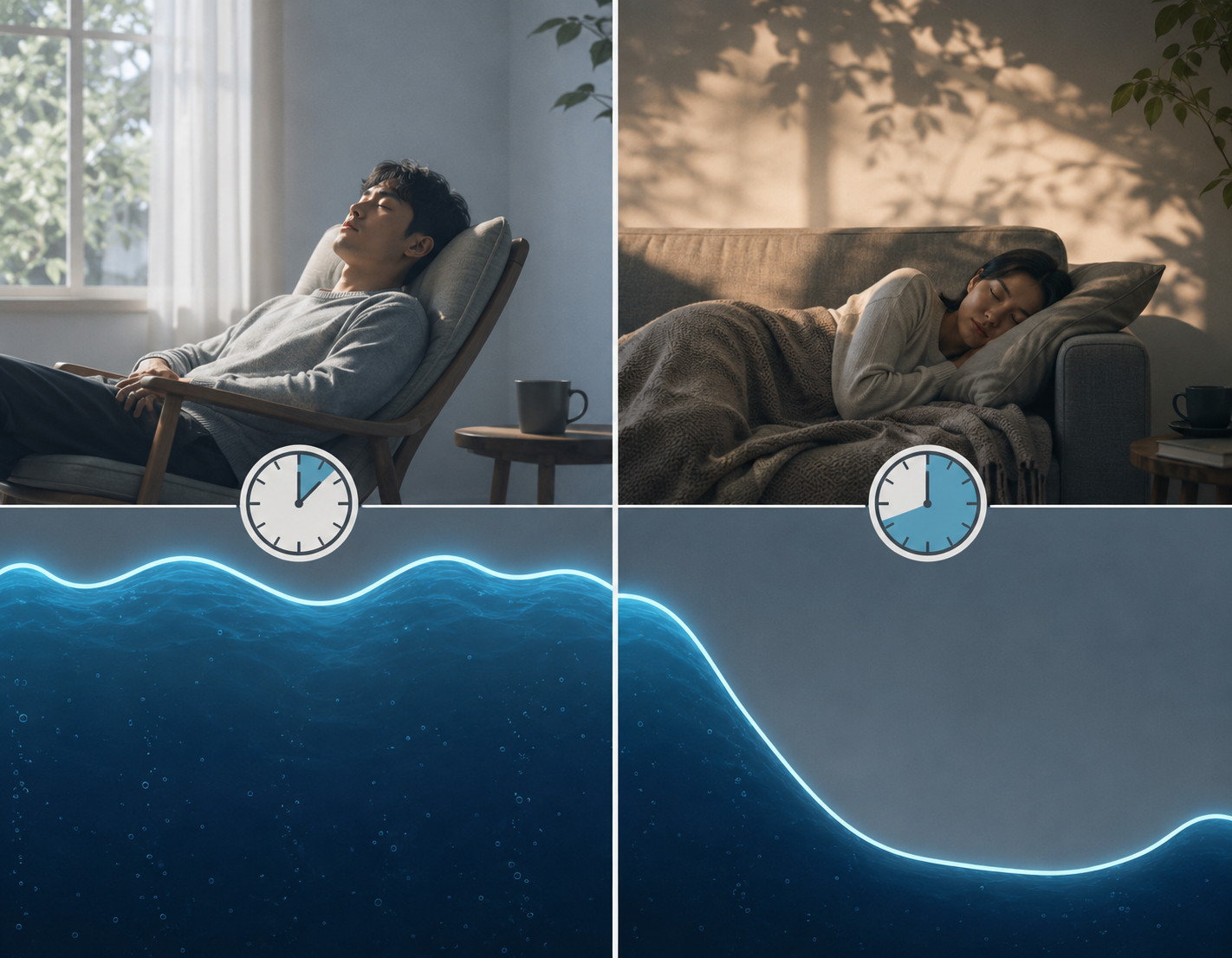
Why 20 to 30 minutes is treated differently
The common 20- to 30-minute recommendation is not a magic safety zone. It is a compromise. It gives a sleepy person some chance to function while trying to avoid two problems: too much adenosine clearance and sleep inertia, the groggy state that can follow waking from deeper sleep.
A 2025 narrative review including more than 10,000 participants described short naps under 30 minutes as generally beneficial for cognition without harming nighttime sleep, while naps longer than 60 minutes were associated with less favorable cognitive patterns, including accelerated cognitive decline. [4] That does not prove that every long nap causes harm, and it does not mean short naps treat insomnia. It does support the practical gradient: the longer the nap, the harder it is to assume it will leave the night untouched.
| Nap pattern | Likely insomnia relevance |
|---|---|
| 10 to 20 minutes, early afternoon | Least likely to reduce nighttime sleep pressure in a meaningful way |
| 20 to 30 minutes, early afternoon | Often a reasonable upper limit when sleepiness is severe and no sleep restriction plan forbids it |
| 45 to 60 minutes | More likely to enter deeper sleep and reduce pressure for the night |
| More than 60 minutes | More concerning, especially if repeated or used to compensate for broken nights |
| Any nap late in the day | More likely to interfere with sleep onset or worsen nighttime awakenings |
For insomnia, the most important line in that table is not the exact minute count. It is the direction of travel. A nap that grows from 20 minutes to 40 minutes, then to an hour, is no longer the same intervention. It has become a second sleep period, and the night has to compete with it.
Timing matters because the afternoon is not one block
The early afternoon is the biologically friendliest place for a nap because many people experience a circadian dip in alertness between about 1 PM and 4 PM. Sleep Foundation describes this early-afternoon window as the period when napping is least likely to interfere with nighttime sleep, while later naps can make it harder to fall asleep at bedtime. [5]
That fits the Stanford allowance: a brief nap 7 to 9 hours after rise time, not a late-day rescue sleep. [1] If you wake at 7 AM, that points roughly to early or midafternoon. If you wake at 10 AM after a bad night, it does not automatically make a 6 PM nap wise. Bedtime is still approaching, and sleep pressure still needs time to rebuild.
A 2022 actigraphy study of 62 healthy young adults found that frequent napping, defined as 3 or more naps across 8 days, was associated with higher nighttime sleep fragmentation. It also found that naps taken within 7 hours of bedtime were associated with longer sleep onset and more awakenings. [6] The study was not conducted in people with clinical insomnia, so it should not be treated as a direct insomnia trial. Still, the pattern is relevant: when naps become frequent or move close to bedtime, nighttime sleep looks less consolidated.
The special case: sleep restriction therapy
If you are currently doing CBT-I with sleep restriction therapy, the nap decision changes. Standard CBT-I protocols commonly discourage napping because the treatment deliberately concentrates sleep pressure into a narrower sleep window. The goal is not to punish tiredness; it is to make the bed and nighttime sleep stronger partners again. [7]
This is the part that can feel brutal in real life. During sleep restriction, a person may be asked to stay awake during the day after a short, tightly scheduled night. That is exactly why naps are tempting, and exactly why they can interfere with the mechanism the treatment is trying to use. For a deeper explanation of that mechanism, see how sleep restriction therapy builds sleep pressure.
The rule is not completely settled, though. A 2024 study reported on 108 CBT-I patients at Hotel-Dieu Hospital Sleep Center and found that patients who napped at least 3 times during treatment week 6 showed equivalent improvements in Insomnia Severity Index and Beck Depression Inventory scores compared with those who did not nap, with both groups improving significantly. The researchers suggested that short recovery naps might help some patients tolerate the sleep restriction phase without sacrificing nighttime sleep pressure. [8]
That finding is useful because it challenges the harshest version of “never nap.” It is not strong enough to turn into “nap whenever you need to.” The study relied on subjective sleep diaries rather than polysomnography, and the result may not generalize to every insomnia subtype or every CBT-I schedule. [8] If your clinician or program has given you a no-nap rule, the safest default is to follow that rule unless the program explicitly allows a narrow recovery nap.
Frequent napping is a different signal than one bad-day nap
One short nap after a particularly broken night is not the same as building a daytime sleep schedule around insomnia. Frequency changes the interpretation. If naps happen most days, they may be doing more than relieving sleepiness; they may be redistributing sleep away from the night.
That is where a diary becomes more useful than memory. Track the nap start time, length, and the following night’s sleep onset and awakenings for a week or two. The pattern to watch is not “I napped, therefore I failed.” The pattern to watch is whether naps are followed by later sleep onset, more wake time after sleep onset, or a need for still more napping the next day.
In older adults, frequent or long daytime napping can also be a health marker worth taking seriously. A 2026 Harvard/Mass General Brigham report following 1,338 older adults for 19 years found that morning napping was associated with 30% higher mortality risk compared with early-afternoon napping, and each additional hour of daytime napping was associated with roughly 13% higher mortality risk. The participants had a mean age around 80, and the researchers emphasized that naps are likely a marker of underlying health conditions rather than proof that napping causes death. [9]
That evidence should not be used to frighten a younger adult with insomnia out of a 20-minute recovery nap. It does suggest that a major change in daytime sleep need, especially in an older adult, deserves medical attention rather than another round of sleep-hygiene self-blame.
A practical decision frame
Use the nap only if it passes all four checks: you are genuinely sleepy enough that staying awake is unsafe or unrealistic; you can keep it to about 20 to 30 minutes; you can take it in the early afternoon rather than near bedtime; and you are not currently under a sleep restriction rule that forbids it.
- A reasonable nap: 20 minutes around the early-afternoon dip after a severely broken night, with an alarm and no return to bed afterward.
- A risky nap: 60 to 90 minutes on the couch after work, especially if bedtime is within several hours.
- A pattern to investigate: needing naps most days because nighttime sleep is fragmented or too short.
- A treatment exception: CBT-I sleep restriction, where naps should be avoided unless your clinician or program gives a specific allowance.
If you are not in sleep restriction therapy and you can keep the nap short and early, it is unlikely to ruin the night. If the nap is long, late, frequent, or used to compensate for an unstable insomnia pattern, it may reduce sleep drive and worsen fragmentation. If you recognize that you are negotiating with naps every day because your nights are not recovering, structured treatment is probably more useful than another perfect nap rule; a guide to choosing a CBT-I app can help if in-person care is not available.
References
- Stimulus Control. Stanford Health Care.
- Napping: Do's and don'ts for healthy adults. Mayo Clinic.
- Adenosine and Sleep. Sleep Foundation.
- The Influence of Napping on Cognitive Function in Adults. PMC. 2025.
- Does Napping Impact Sleep at Night?. Sleep Foundation.
- Daytime napping and nighttime sleep characteristics in healthy young adults. PubMed.
- Cognitive Behavioral Therapy for Insomnia (CBT-I). Sleep Foundation.
- Daytime Napping During CBT-I Linked to Improvements in Insomnia Severity. SleepWakeAdvisor.
- Is napping a sign of a deeper health problem?. Harvard Gazette. 2026.
Comments
Join the discussion with an anonymous comment.