
Sleep does not boost the immune system by putting it on a quiet overnight recharge. The better claim is narrower and more interesting: during early slow-wave sleep, the body creates a hormonal and cytokine setting that helps immune cells recognize threats, move to useful locations, and build longer-lasting memory. That is the version of the familiar sleep-and-immunity claim that survives contact with the biology.
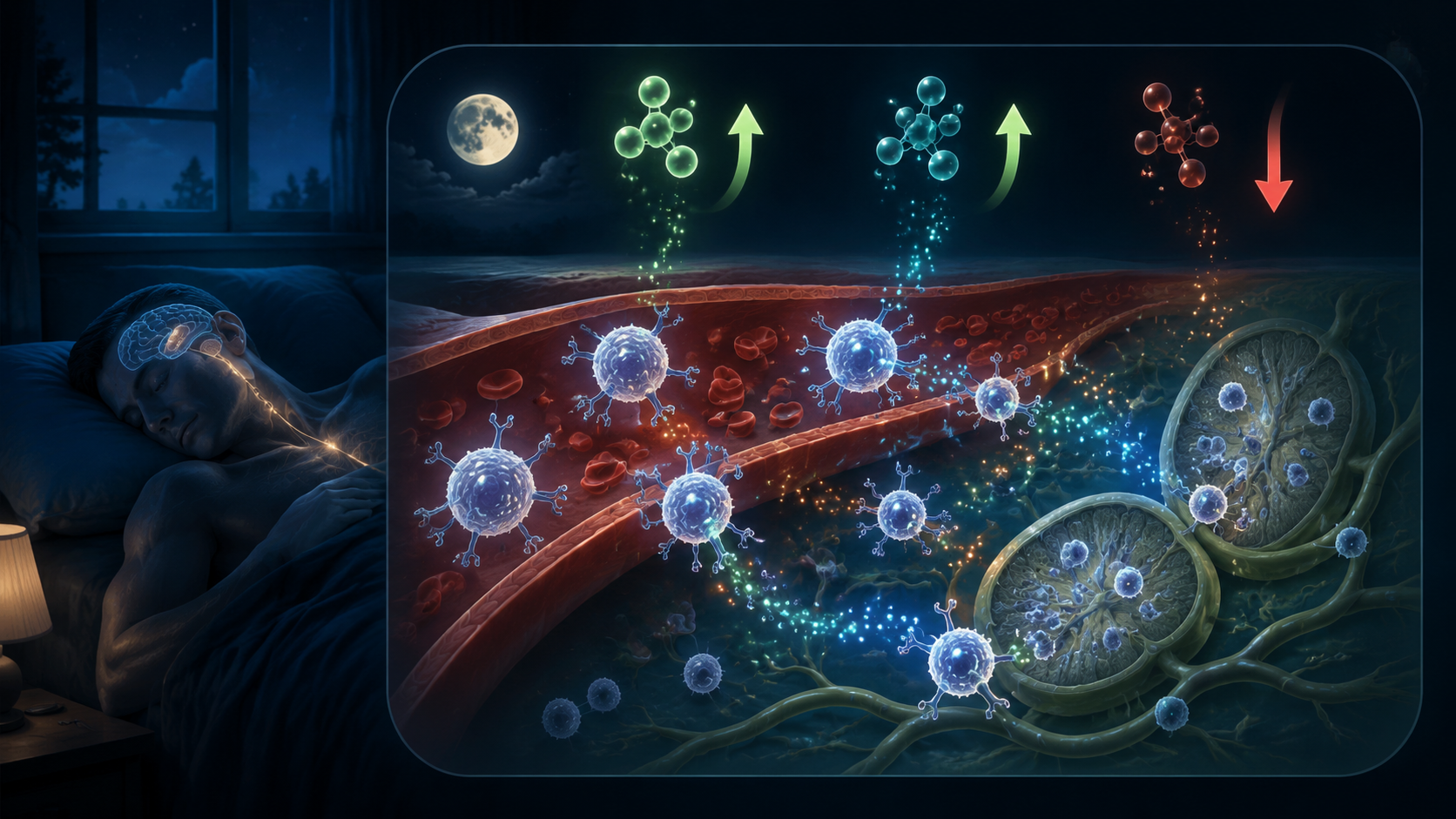
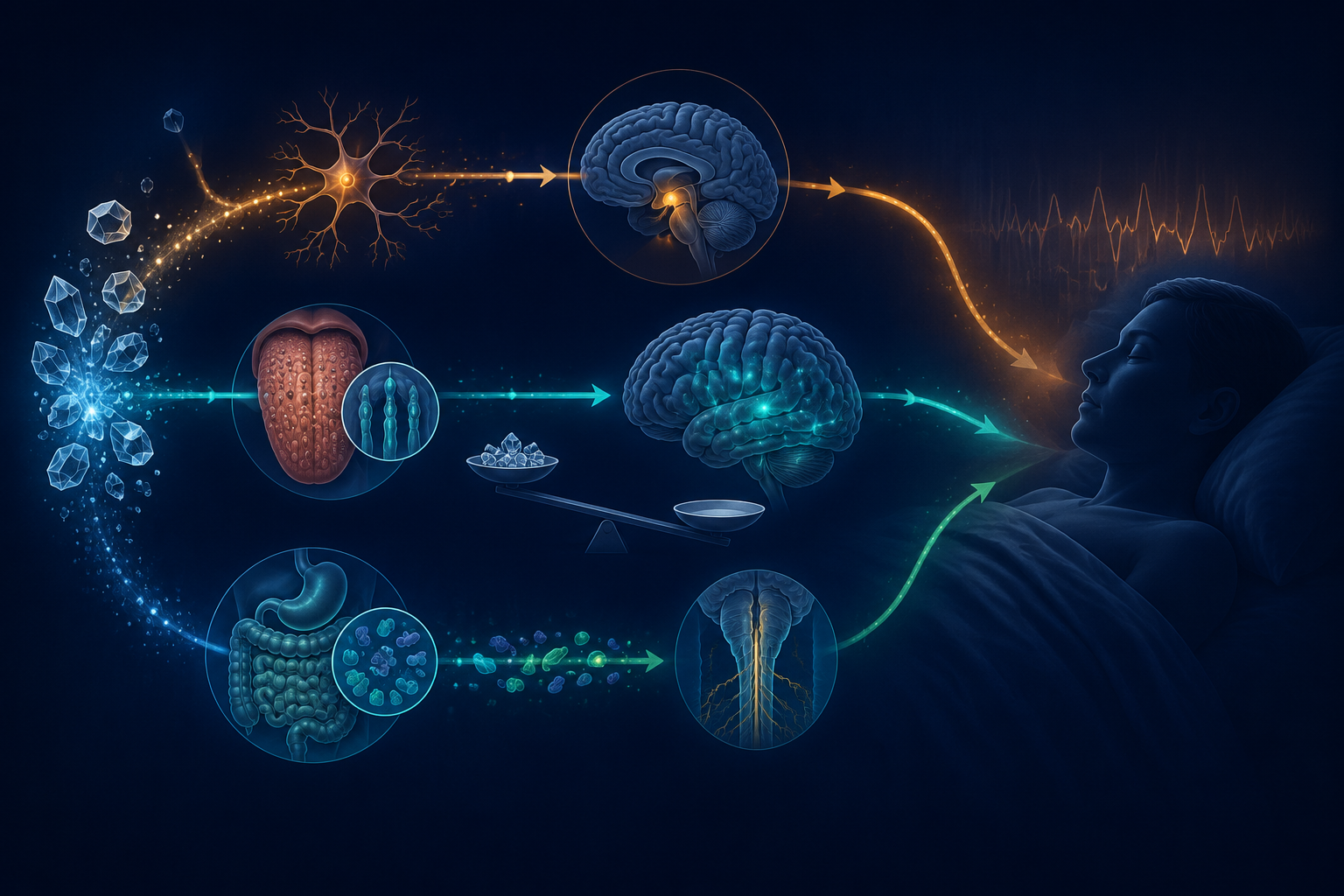
The timing matters. The clearest immune-supportive pattern appears in the first part of the night, when slow-wave sleep is most abundant. In that window, growth hormone and prolactin rise, cortisol falls, and inflammatory immune signals become easier to generate. Those changes do not mean the body is randomly inflamed. They mean antigen-presenting cells, T cells, B cells, and signaling molecules are operating in a state that favors immune priming rather than daytime vigilance or stress response.[1]
The immune shift begins with the early-night hormone window
Early slow-wave sleep is not just deep sleep as a subjective feeling. It is a physiological state with a distinctive endocrine profile. Growth hormone secretion increases. Prolactin also rises. Cortisol, which can suppress several immune-activating pathways, drops to low nighttime levels. Besedovsky, Lange, and Born describe this as a sleep-dependent milieu that favors pro-inflammatory and adaptive immune activity, especially responses involving T helper cells.[1]
That last phrase needs care. “Pro-inflammatory” sounds harmful because chronic inflammation is harmful. But immune defense needs short, controlled inflammatory signaling. When a dendritic cell presents viral or bacterial material to a T cell, the cell-to-cell conversation is not quiet. It uses cytokines, surface receptors, and costimulatory signals to decide whether the immune system should expand a response, stand down, or remember the encounter.
Slow-wave sleep appears to bias that conversation toward immune learning. The drop in cortisol removes one brake. Growth hormone and prolactin support the development of a T helper 1, or Th1-type, response. That matters because Th1 responses are central for fighting intracellular pathogens, including many viruses. The result is not a magical immune upgrade; it is a better biochemical setting for a specific kind of immune instruction.[1]
| During early slow-wave sleep | Immune consequence |
|---|---|
| Growth hormone and prolactin rise | Adaptive immune activation becomes more favorable |
| Cortisol falls | Immune-suppressive pressure is reduced |
| Antigen-presenting cells increase IL-12 signaling | T helper balance shifts toward Th1-type responses |
| Naive T cells leave peripheral blood | More cells traffic toward lymphoid tissue where antigen encounter is more likely |
| IL-6, TNF-alpha, and IL-1beta signaling increases | T-cell activation and B-cell antibody production are supported |
Cytokines turn deep sleep into an immune training period
The cytokine that gives this pathway much of its shape is interleukin-12, usually shortened to IL-12. Antigen-presenting cells such as dendritic cells and monocytes can produce IL-12 after encountering microbial material. IL-12 then helps push naive T helper cells toward a Th1 profile. In plain language: it helps the immune system decide that a cell-mediated response is needed, rather than a weaker or mismatched reaction.[1]
Sleep supports that decision partly by changing the hormonal background in which antigen presentation occurs. Cortisol and catecholamines tend to favor a different immune balance when they are high. During early sleep, their reduction makes it easier for IL-12-associated Th1 activity to emerge. Growth hormone and prolactin push in the same broad direction. The interesting part is the coordination: sleep changes the endocrine setting at the same time immune cells are exchanging instructions.[1]
Other inflammatory cytokines also enter the picture. IL-6, TNF-alpha, and IL-1beta are involved in immune activation and communication between innate and adaptive defenses. These molecules are not simply “bad inflammation.” In the right dose, place, and timing, they help T cells activate and help B cells mature into antibody-producing cells. The same family of signals can become damaging when it is chronic or dysregulated, which is why the sleep story should not be flattened into “more inflammation is good.”[1]
This is also where innate immunity deserves more than a footnote. Monocytes, dendritic cells, and inflammatory cytokines are not background characters while T cells do the real work. They help detect threat, present antigen, and set the tone for the adaptive response. Slow-wave sleep appears to support that handoff from innate sensing to adaptive targeting.
T cells do not just become more active; they move differently
One of the easiest ways to misunderstand sleep and immunity is to imagine immune cells becoming globally stronger in the bloodstream. Some of the best evidence points instead to redistribution. During nocturnal sleep, naive T cells decrease in peripheral blood in a pattern consistent with trafficking toward lymph nodes and other lymphoid tissues. That is where they are more likely to meet antigen-presenting dendritic cells and receive the signals needed to become pathogen-specific effector or memory cells.[1]
This movement is a practical detail, not a decorative mechanism. A naive T cell cannot help much if it never encounters the antigen it is capable of recognizing. Lymph nodes solve that logistical problem by bringing antigen-presenting cells and T cells into the same immune workspace. Sleep appears to alter the distribution of circulating immune cells in ways that make that meeting more likely.[1]
The endocrine signals line up with the trafficking pattern. Research summarized in the sleep-immune literature links growth hormone-releasing hormone, prolactin, and low cortisol conditions with the nighttime redistribution of T-cell subsets. The practical interpretation is modest but important: deep sleep may help put immune cells in the compartments where immune learning can happen efficiently.[1]
Vaccination studies make the mechanism visible
Mechanisms are satisfying, but vaccine studies are where the pathway becomes easier to see. Vaccination gives researchers a defined antigen exposure and a measurable immune response afterward. In studies summarized by Besedovsky, Lange, and Born, sleeping after hepatitis vaccination changed antigen-specific immune outcomes rather than only changing general immune markers.[1]
After hepatitis A vaccination, participants who slept afterward showed about a twofold increase in antibody titers compared with those who stayed awake. In related hepatitis A/B vaccination work, sleep after vaccination doubled circulating antigen-specific T helper cells, and that effect persisted at a 1-year follow-up. Those findings are valuable because they connect the early-night immune setting to a recognizable endpoint: more antigen-specific immune memory after a controlled challenge.[1]
There is also an unusually striking correlation in the same research tradition: EEG slow-wave activity during post-vaccination nights correlated with long-term immune memory at greater than r = 0.9. Correlations that high should not be treated as universal constants, and they do not prove that slow-wave activity alone caused the entire immune effect. Still, the direction is hard to ignore. The deeper slow-wave signal tracked with stronger long-term antigen-specific memory.[1]
This is the cleanest reason to avoid the vague phrase “sleep helps immunity” when a better explanation is available. Sleep after vaccination did not merely make people feel restored. It coincided with stronger antigen-specific T helper cell and antibody responses. That is immune education, not just recovery.
What this means for preventing infection
Preventing infection is not one event. It includes barrier defenses, innate recognition, inflammatory signaling, antigen presentation, T-cell activation, antibody production, and memory formation. Sleep seems most clearly tied to the coordination of those middle and later steps: priming, trafficking, activation, and memory. That helps explain why poor sleep can be associated with greater infection risk without implying that one short night guarantees illness.
A useful way to phrase the claim is this: good sleep appears to lower infection vulnerability partly because slow-wave sleep improves the conditions under which the immune system learns from antigen exposure. That could be exposure from a vaccine, or from a pathogen encountered in ordinary life. The vaccine evidence is stronger because the antigen exposure is defined and the immune response can be measured more cleanly.[1]
This is also why sleep quality belongs inside a broader view of sleep health, not just a nightly duration target. Duration matters, but immune timing also depends on depth, continuity, and circadian placement. Readers who want that broader framework can use What Is Sleep Health? as a companion piece rather than reducing immune readiness to a single number.
Acute sleep loss and chronic restriction are not the same claim
The flip side of the slow-wave sleep model is what happens when sleep is removed. A 2025 report from The Journal of Immunology described 24-hour sleep deprivation altering monocyte profiles toward a pro-inflammatory state. That fits the broader idea that sleep loss can disturb immune regulation, including innate immune behavior.[2]
But the interpretation should stay proportional. A single night of poor sleep can shift cytokines, hormones, and immune-cell distributions. It does not automatically mean a person has become meaningfully defenseless against infection. Acute disruption is a signal that the system is sensitive to sleep timing and sleep loss. Chronic sleep restriction is the stronger concern because repeated disruption gives the immune system less opportunity to cycle through normal nighttime regulation.
That distinction matters for everyday advice. If one bad night made infection unavoidable, the evidence would be simpler and much more frightening. The better reading is that repeated poor sleep can erode the conditions that support immune priming, while a single disrupted night is one perturbation in a resilient system.
The boundaries: REM sleep, study populations, and vaccine types
The strongest mechanistic story here belongs to slow-wave sleep. REM sleep has immune interactions, but they are less clearly mapped for this specific endocrine-cytokine-adaptive-memory pathway. Treating all sleep stages as interchangeable would erase the main finding: the early-night slow-wave window is doing distinctive work.[1]
The human evidence also has population limits. Many mechanistic sleep-immunity studies used young, healthy male participants. That does not make the findings useless; controlled physiology studies often begin with narrower samples to reduce biological variability. It does mean caution is needed before assuming identical effect sizes in older adults, women across menstrual phases, people with chronic inflammatory conditions, shift workers, or people taking immune-modifying medications.[1]
The vaccine evidence has a similar boundary. Hepatitis A and hepatitis B vaccination studies are persuasive because they show antigen-specific T helper cell and antibody differences after sleep manipulation. They do not prove that sleep has the same magnitude of effect for every vaccine platform, every pathogen, or every clinical population. The safe conclusion is that sleep can strengthen measured adaptive immune responses in these controlled vaccine settings, and that this supports a broader mechanism of immune memory formation.[1]
What is worth doing with this information
The practical point is not to chase an “immune-boosting” sleep hack. It is to protect the conditions that allow slow-wave sleep to occur: enough total sleep opportunity, a regular sleep window, and circadian timing that does not constantly push deep sleep into biological daylight. If the question is how sleep helps prevent infection, the answer is less about one heroic habit and more about giving the immune system repeated access to its normal early-night training period.
For readers who want practical benchmarks, what counts as a good night’s sleep is the better place to translate this into sleep quality targets. If the specific interest is deep sleep, an evidence review of natural remedies for deep sleep is more useful than trying to infer interventions from immune markers alone.
The disciplined promise is strong enough without exaggeration: good sleep appears to reduce infection risk because deep slow-wave sleep helps coordinate hormone release, cytokine signaling, immune-cell trafficking, T-cell activation, antibody production, and memory formation. It supports immune preparedness. It does not confer invulnerability.
References
- Sleep and immune function, Physiological Reviews / PMC, 2012.
- One Day Sleep Deprivation Can Alter Immune System, American Association of Immunologists, 2025.
Comments
Join the discussion with an anonymous comment.