
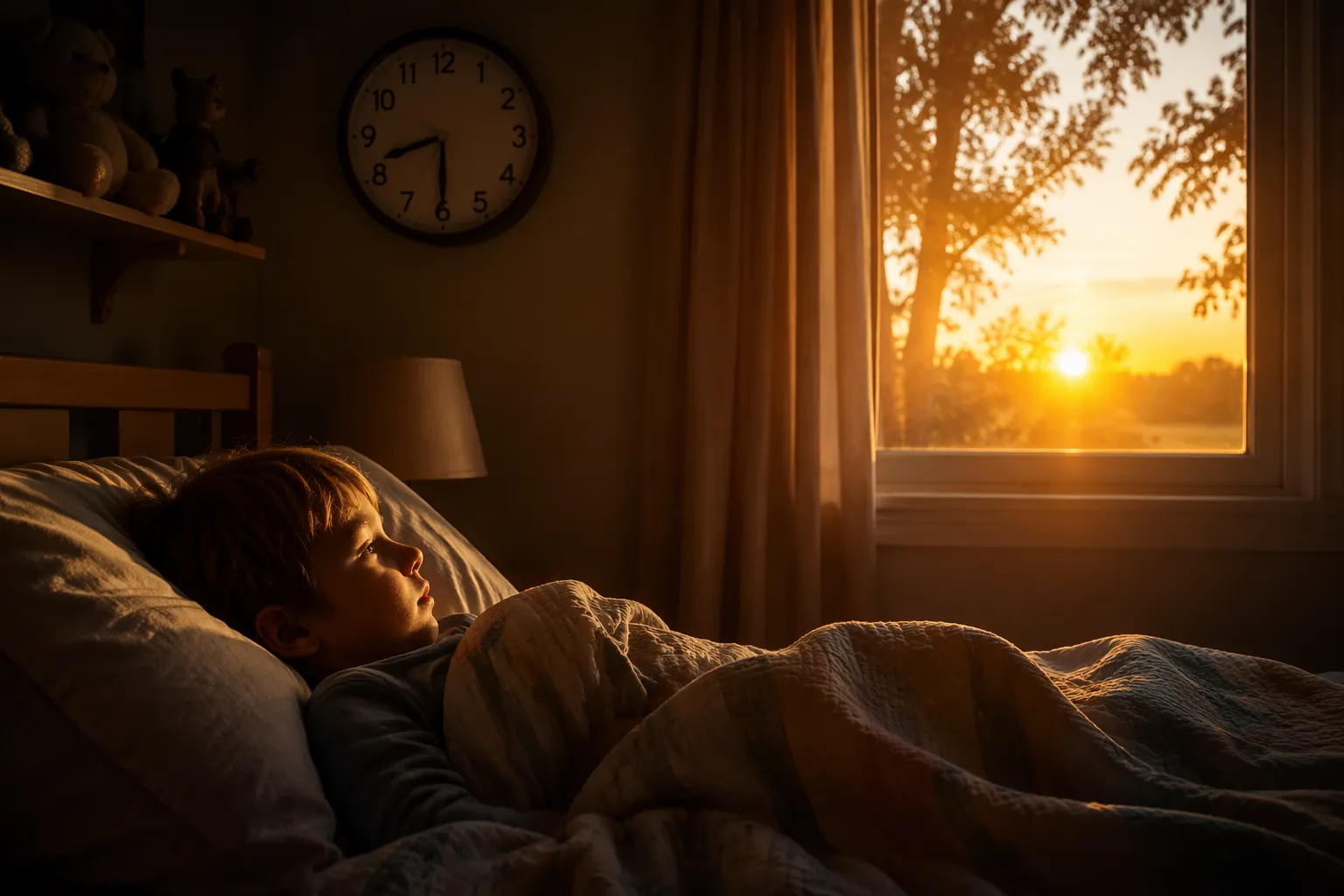
The hard part about permanent daylight saving time is not the spring weekend when everyone complains about losing an hour. It is the ordinary school night months later, when the clock says a child should be asleep, the bedroom is still carrying evening light, and the alarm for school has not moved. That is the child sleep safety issue at the center of the Sunshine Protection Act: a pleasant extra hour of light after dinner can become a nightly push against the biological clock children are still learning to regulate.
Bright evenings are not a fake benefit. Families use them. Kids play outside longer. Parents get a less rushed stretch after work. The problem is that the body does not read the clock on the wall first. It reads light, darkness, meals, movement, and morning demands. If civil time is permanently shifted later while school mornings stay fixed, the child does not simply gain a nicer evening. The child may also lose the darker cue that helps sleep begin.
The Bill Is Not Law Yet, But The Sleep Question Is Already Real
The Sunshine Protection Act, H.R. 139, passed the House 308-117 on July 14, 2026, but it is not yet law and its Senate path remains uncertain. The American Academy of Sleep Medicine condemned the bill in July 2026, saying it “will cause widespread circadian misalignment, leading to health and safety risks especially during short winter days.”[1]
That political status matters because families should not plan as though the change has already happened. But the central issue is not procedural. It is biological. Permanent daylight saving time would move clock time away from solar time all year. Children would still have to wake for school, child care, bus routes, and parents’ work schedules. Their bodies would be asked to sleep and wake by a social clock that is less aligned with the sun.
The Three Clocks Children Have To Obey
A child’s sleep sits between three clocks. Biological time is the circadian rhythm that helps decide when the body is ready for sleep and wakefulness. Solar time is the actual pattern of light and darkness outside. Social time is the schedule imposed by school, work, sports, meals, homework, and bus pickup. The AASM’s position is that permanent standard time best aligns human circadian biology with the light-dark cycle, while daylight saving time creates misalignment that does not disappear simply because people live with it for months.[2]
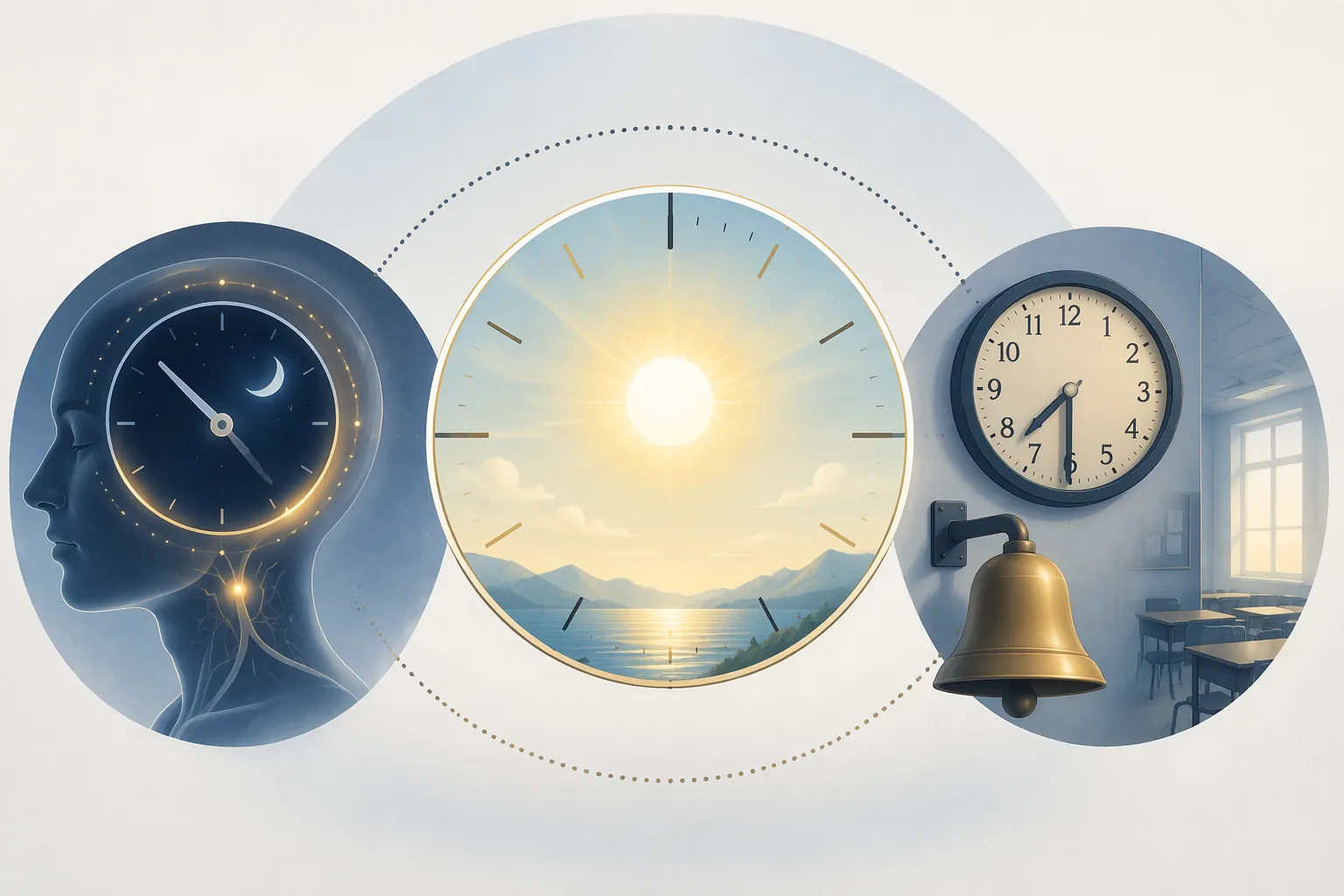
Permanent daylight saving time makes the three-clock problem worse in a specific direction. It keeps evening light later by the clock and delays morning light by the clock, especially during shorter winter days. Evening light is not neutral for sleep. Cincinnati Children’s explains that more light later in the day can delay melatonin onset in children, making it harder for them to fall asleep when the household schedule says bedtime has arrived.[3]
That is why “just put them to bed earlier” often fails in real homes. A child can be exhausted and still not be physiologically ready to sleep. The parent sees the fatigue; the child feels the restlessness; the morning alarm arrives anyway.
Younger Children: Bedtime Depends On Cues They Do Not Control
Young children do not manage sleep like miniature adults. They depend on adults to create the evening environment: lights dimmed, screens stopped, dinner finished, pajamas on, arguments contained, doors closed. When the outside world stays bright later by the clock, the parent has to manufacture nighttime against the evidence coming through the windows.
This is not only a discipline problem or a routine problem. Light is one of the strongest timing signals for the circadian system, and children’s systems are still developing. Under permanent daylight saving time, a preschooler or early elementary child may be asked to settle while the body is still receiving a later-day light signal. The result can look behavioral: stalling, calling out, leaving bed, melting down over small requests. But the starting point may be physiological.
Parents can blunt some of this with darker rooms, predictable routines, and less evening light exposure. Those tools are worth using. They do not change the public-time problem. A family can buy blackout curtains; it cannot move the sun or the school bell.
School-Age Children: The Wake Time Is The Trap
For school-age children, the pressure point is not only bedtime. It is the fixed morning. If bedtime drifts later because evening light delays sleep readiness, but wake time stays the same because school starts when it starts, the missing sleep has to come out of the child’s night. There is no protected place for it to go.
That is the difference between a flexible adult evening and a child’s school week. An adult who likes daylight after work may have some control over commute, bedtime, caffeine, remote work, or weekend recovery. A child is more likely to have a fixed wake time, a fixed classroom start, and limited authority over the household’s evening light and noise.
Cook Children’s notes that it can take up to three weeks for a child to fully adjust to a daylight saving time transition.[4] That helps explain why the spring change is rough. But permanent daylight saving time is not just a longer spring transition. If solar time and social time remain offset, the child may stop looking acutely disrupted while still living with a chronic mismatch.
Adolescents: The Evidence Gets Harder To Dismiss
Teenagers are the group most often blamed for their sleep timing, and also the group for whom the permanent-DST concern becomes especially concrete. Adolescence naturally shifts circadian timing later. Many teens are already trying to fall asleep before their biology is ready, then waking for early school schedules before they have had enough sleep. Permanent daylight saving time would lean into the same direction: later evening light, harder sleep onset, unchanged school mornings.
A 2015 Journal of Clinical Sleep Medicine study measured 35 adolescents with actigraphy before and after the spring daylight saving time change. On school nights after the change, teens slept 32 minutes less per night, adding up to 2 hours and 42 minutes less sleep across the school week.[5]
That study should be read carefully. Thirty-five adolescents is a modest sample, and the spring transition is not the same thing as a direct trial of permanent daylight saving time. Still, the measurement matters because it captured real sleep outside the lab. Actigraphy does not rely only on a teenager’s memory of when they think they fell asleep. It gives a concrete picture of what happens when the clock shifts later and school continues.
The weekly number is the one that should stop a parent. A half hour can sound manageable when adults talk about one night. Across a school week, it becomes another layer on top of existing sleep debt. The teen who is already short on sleep is not starting from zero. The permanent-DST concern is that a policy designed around evening convenience would add pressure exactly where adolescent biology is already under strain.
The Nineteen-Minute Finding Is Useful, But It Is Not A Magic Number
Another often-cited estimate comes from Giuntella and Mazzonna’s 2019 Journal of Health Economics study of time-zone border differences. They found that later sunset time was associated with an average sleep reduction of about 19 minutes per night.[6]
That figure is policy-relevant because it comes from people living with different sunset timing in the real world. It is also not a clean experiment in permanent daylight saving time, and it should not be treated as if every child would lose exactly 19 minutes every night. The better use of the finding is narrower: when clock time exposes people to later daylight, sleep can shrink in measurable ways. For children with fixed wake times, even modest nightly losses can accumulate.
Why “They’ll Adjust” Misses The Main Mechanism
Adjustment is the word adults reach for because it is reassuring. It is also too vague. A child may stop complaining after a clock change. A family may rebuild a routine. A teacher may stop seeing the first-week chaos. None of that proves the circadian system has fully aligned with the imposed schedule.
Short-term adaptation and long-term alignment are different claims. The transition can take weeks for children, but the AASM’s broader position is that daylight saving time produces a persistent mismatch between social time and the natural light-dark cycle, and that permanent standard time is the healthier alignment.[2][4]
This distinction changes how a parent should hear permanent daylight saving time proposals. The question is not whether children can survive a rough week in March. They can, and they do. The question is whether public time should make later circadian timing the default condition while school mornings remain fixed.
What Parents Can Do, And What They Cannot Fix Alone
If daylight saving time is in effect, the practical steps are familiar because they are still the ones that work best at home: dim the house earlier, keep bedtime consistent, protect morning light when it is available, reduce bright evening screens, and make the bedroom dark enough that the child is not negotiating with the sky.
Those measures can help an individual child. They do not erase the policy-level sleep cost. Home routines work inside the social clock; they do not set it. A parent can make bedtime more possible, but cannot make an early winter morning brighter or delay the first bell.
The Science-Aligned Alternative In The Current Debate
The alternative now named in the debate is the Sunshine for Our Kids Act, H.R. 9638, which would establish permanent standard time. The AASM has endorsed that proposal as the option more consistent with circadian health and safety.[7]
That does not mean standard time makes every school schedule healthy. Early school start times would still be early. Some children would still struggle with insomnia, anxiety, neurodevelopmental differences, family stress, or medical sleep disorders. But permanent standard time at least points the civil clock back toward solar time instead of away from it.
Permanent daylight saving time asks children to carry a chronic timing mismatch as if it were a family lifestyle preference. For younger children, it can make bedtime fight the light cues their bodies use. For school-age children, it can turn delayed sleep onset into shortened nights. For adolescents, it pushes in the same direction as an already delayed circadian phase and measurable school-week sleep loss. If children’s clocks are still developing, and school schedules do not move with the sun, permanent DST is not a longer version of a one-week adjustment problem. It is a structural sleep-pressure problem built into the calendar.
References
- AASM opposes Sunshine Protection Act, American Academy of Sleep Medicine, July 2026.
- Permanent standard time is the optimal choice for health and safety: an American Academy of Sleep Medicine position statement, Journal of Clinical Sleep Medicine, 2024.
- Why Daylight Saving Time Is Hard on Kids, Cincinnati Children’s, 2024.
- Daylight saving time: A small clock change with big effects on kids’ sleep, Checkup Newsroom, Cook Children’s, 2026.
- Sleep, Sleepiness, and Circadian Changes in Adolescents in Response to Daylight Saving Time, Journal of Clinical Sleep Medicine, 2015.
- Sunset time and the economic effects of social jetlag, Journal of Health Economics, 2019.
- AASM endorses Sunshine for Our Kids Act to establish permanent standard time, American Academy of Sleep Medicine.
Comments
Join the discussion with an anonymous comment.