
Mechanism explainer
Best Sleep Tracking Watch: A Data-Driven Accuracy Comparison of Oura, Apple, Whoop, Fitbit, and Samsung
No single sleep tracker wins across all metrics. This comparison uses peer-reviewed validation studies to show which device leads in sleep staging, deep sleep detection, HRV accuracy, and sleep apnea screening — so you can choose based on what matters most to you.
Why the “Best” Sleep Tracker Depends on What You Want to Track
The consumer sleep tracking market has matured to the point where nearly every major wearable can tell you how long you slept. But the gap between “it tracks sleep” and “it tracks sleep accurately” remains wide — and unevenly distributed across devices. A watch that nails heart rate variability might systematically undercount deep sleep by nearly an hour. A ring with excellent overall sleep stage agreement might miss REM entirely in certain sleepers. And the device that leads in one published study may trail in another, depending on who funded the research.
This article is not a ranked list. It is a data-driven comparison built from peer-reviewed validation studies — the Brigham and Women’s Hospital study (funded by Oura), the independent University of Antwerp study, the Korean multicenter trial, and the Ohio State HRV study — each with its own methodology, sample size, and funding context. Our goal is to give you the evidence you need to decide which device matches your specific priorities: sleep staging fidelity, deep sleep detection, sleep apnea screening, HRV accuracy, or long-term value.
The Accuracy Landscape: Key Validation Studies at a Glance
Four major studies form the backbone of this comparison. Each uses PSG as the reference standard, but they differ in sample size, device generations tested, population demographics, and — critically — funding source. Understanding these differences is essential before comparing the numbers.
| Study | Sample Size | Devices Tested | Funding Source | Key Metric |
|---|---|---|---|---|
| Brigham & Women’s Hospital (Robbins et al., 2024) | n=35 | Oura Ring Gen3, Fitbit Sense 2, Apple Watch Series 8 | Oura Ring Inc.; lead author is an Oura advisor | Sleep stage agreement (Cohen’s κ) |
| University of Antwerp (Schyvens et al., 2025) | n=62 | Apple Watch 8, WHOOP 4.0, Garmin Vivosmart 4, others | VLAIO (independent; no device manufacturer funding) | Sleep staging κ and deep sleep sensitivity |
| Korean Multicenter (Lee et al., 2023) | n=75 (2 centers, 349,114 epochs) | Google Pixel Watch, Galaxy Watch 5, Fitbit Sense 2, Apple Watch 8, Oura Ring 3 | Not device-funded | Sleep staging κ and macro F1 scores |
| Ohio State (Dial et al., 2025) | n=13 (536 nights) | Oura Ring Gen 4 vs. Polar H10 | Independent | Nocturnal HRV concordance (CCC) |
For deeper dives on individual devices, see our full analyses of the Oura Ring, Apple Watch, and Fitbit. This article focuses on the head-to-head comparison.
Head-to-Head Accuracy Comparison Table
The table below compiles the most directly comparable accuracy metrics across devices. Because studies tested different hardware generations and used different protocols, not every cell has a direct equivalent. Where possible, we cite the study and note the device generation tested.
| Device | Sleep Staging κ (Study) | Deep Sleep Sensitivity | Deep Sleep Bias | HRV Accuracy | FDA Sleep Apnea Clearance |
|---|---|---|---|---|---|
| Oura Ring Gen3/4 | κ=0.65 (Brigham, funded) | Not reported in Brigham study | No significant bias (Brigham) | CCC 0.99 (Ohio State, Gen4) | No |
| Apple Watch Series 8/9/11 | κ=0.53 (Antwerp, independent); κ=0.30 (Korean) | 50.7% (Antwerp, Series 8) | -43 min (Brigham, Series 8) | Not reported in these studies | Yes (Series 9+, Ultra 2) |
| Fitbit Sense 2 | κ=0.55 (Brigham, funded); κ=0.42 (Korean) | Not reported in these studies | -15 min deep sleep (Brigham) | Not reported in these studies | No |
| WHOOP 4.0 | Not reported in these studies | 69.6% (Antwerp, independent) | Not reported in these studies | Not reported in these studies | No |
| Samsung Galaxy Watch 5/7/8 | κ=0.42 (Korean, Watch 5) | Not reported in these studies | Not reported in these studies | Not reported in these studies | Yes (Watch 7, 8, Ultra) |
| Google Pixel Watch | κ=0.40 (Korean) | Macro F1 0.59 (Korean) | Not reported in these studies | Not reported in these studies | No |
| Garmin Vivosmart 4 | κ=0.21 (Antwerp, independent) | Not reported in these studies | Not reported in these studies | Not reported in these studies | No |
Sleep Staging Accuracy: Who Gets Sleep Stages Right?
Sleep staging — classifying each 30-second epoch as wake, light, deep, or REM — is the most technically challenging task for a consumer wearable. Unlike total sleep time, which can be estimated reasonably well from movement and heart rate, staging requires detecting the subtle physiological signatures that distinguish NREM from REM and deep from light sleep.
In the Brigham study, Oura Ring Gen3 achieved the highest sleep stage agreement at κ=0.65, which is considered “substantial” on the Cohen’s kappa scale. The same study found Fitbit Sense 2 at κ=0.55 and Apple Watch Series 8 at κ=0.53. However, the Brigham study was funded by Oura, and its lead author is an Oura advisor — a fact that should temper how much weight you assign to that lead.
The independent Antwerp study, which did not test Oura, ranked Apple Watch 8 highest at κ=0.53 — the same value the Brigham study reported for Apple Watch. Garmin Vivosmart 4 scored lowest at κ=0.21. The Korean multicenter study painted a different picture: Google Pixel Watch (κ=0.40), Galaxy Watch 5 (κ=0.42), and Fitbit Sense 2 (κ=0.42) showed moderate agreement, while Apple Watch 8 (κ=0.30) and Oura Ring 3 (κ=0.35) showed only fair agreement.
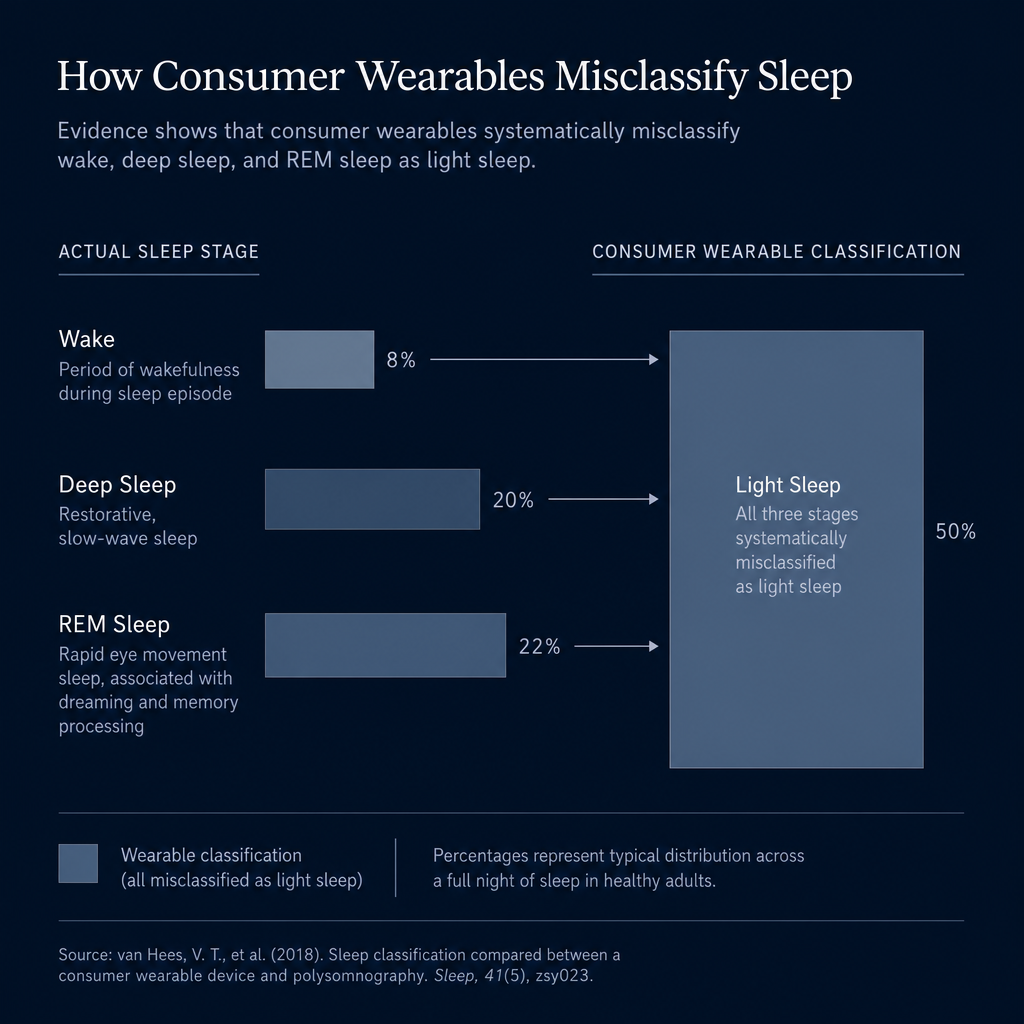
Across all studies, a consistent pattern emerged: devices tend to overestimate light sleep at the expense of wake, deep, and REM. The Brigham study quantified this clearly: Apple Watch overestimated light sleep by 45 minutes and underestimated deep sleep by 43 minutes. Fitbit overestimated light sleep by 18 minutes and underestimated deep sleep by 15 minutes. Oura showed no significant bias for any sleep stage in its funded study.
The practical takeaway: if you rely on your wearable’s sleep stage breakdown to make decisions about your sleep health, understand that the device is likely overreporting light sleep and underreporting everything else. The magnitude of that bias varies by device, but the direction is nearly universal.
Deep Sleep Detection: Whoop Leads, Apple Lags
For readers concerned about restorative sleep, deep sleep detection sensitivity is arguably the most important metric. Deep sleep (N3) is the stage where the body repairs tissue, builds bone and muscle, and strengthens the immune system. Missing it systematically means the device cannot tell you whether you are getting enough of the most physiologically critical sleep stage.
The independent Antwerp study provides the clearest head-to-head data on this metric. WHOOP 4.0 led with a deep sleep detection sensitivity of 69.6%, meaning it correctly identified about 7 out of 10 epochs of true deep sleep. Apple Watch Series 8 trailed significantly at 50.7% — barely better than chance.
| Device | Deep Sleep Sensitivity (Antwerp Study) | Deep Sleep Bias (Brigham Study) |
|---|---|---|
| WHOOP 4.0 | 69.6% | Not reported |
| Apple Watch Series 8 | 50.7% | -43 minutes |
| Oura Ring Gen3 | Not reported in Antwerp study | No significant bias (Brigham) |
| Fitbit Sense 2 | Not reported in Antwerp study | -15 minutes (Brigham) |
Why is deep sleep so hard to measure? Unlike light sleep, which shares many physiological features with wakefulness, deep sleep is characterized by high-amplitude, low-frequency brain waves (delta waves) that cannot be detected by optical sensors on the wrist or finger. Wearables must infer deep sleep from secondary signals — heart rate deceleration, reduced movement, and respiratory patterns — which are less reliable markers. The result is that even the best devices miss a substantial fraction of deep sleep epochs.
Sleep Apnea Screening: Apple and Samsung Lead with FDA Clearance
One area where the consumer wearable market has made genuine clinical progress is sleep apnea screening. As of 2026, only two consumer wearables have FDA authorization for sleep apnea notification: Apple Watch (Series 9 and later, including Ultra 2) and Samsung Galaxy Watch (models 7, 8, and Ultra).
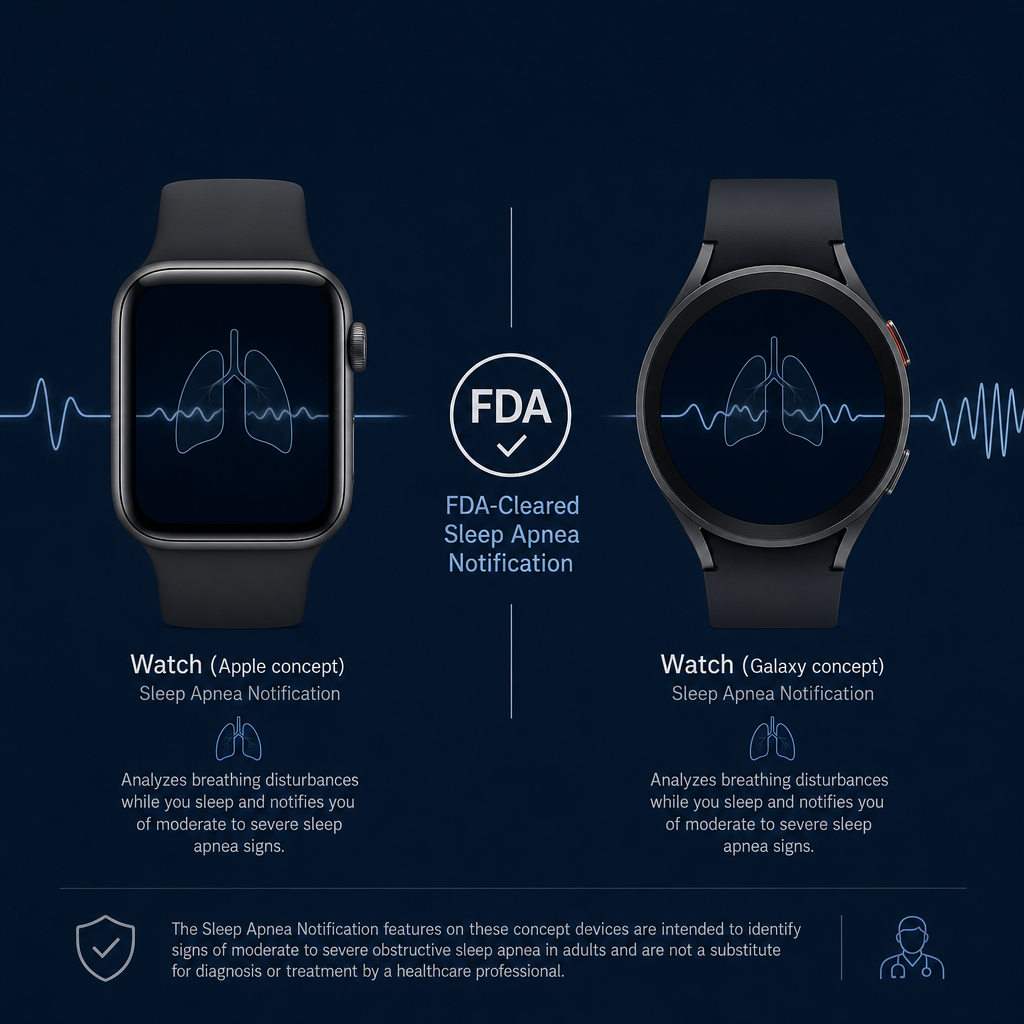
Apple’s feature uses the watch’s accelerometer to track breathing disturbances during sleep. It analyzes data over a 30-day period and notifies the user if signs of moderate-to-severe sleep apnea are consistently detected. Samsung’s approach is different: it requires just 2 nights of at least 4 hours of sleep within a 10-day window in users aged 22 and older. Both features received FDA De Novo authorization, meaning they went through a premarket review process rather than the less rigorous 510(k) clearance.
No other consumer wearable — including Oura Ring, Whoop, Fitbit, or Garmin — has FDA clearance for sleep apnea screening. Some devices offer SpO2 tracking or breathing rate monitoring that can be used for general wellness awareness, but these features have not been validated or authorized for sleep apnea detection.
HRV and Resting Heart Rate Accuracy: Oura Leads Nocturnal HRV
Heart rate variability (HRV) has become a central metric in the sleep tracking ecosystem, used to estimate recovery, autonomic nervous system balance, and sleep quality. But HRV is notoriously sensitive to measurement conditions: daytime readings are heavily influenced by activity, posture, and stress, while nocturnal HRV — measured during stable sleep — is far more reliable.
The independent Ohio State study (Dial et al., 2025) provides the most rigorous HRV comparison available. Over 536 nights with 13 participants, Oura Ring Gen 4 achieved a concordance correlation coefficient (CCC) of 0.99 for nocturnal HRV when compared against the Polar H10 chest strap, which is widely considered a research-grade reference. A CCC of 1.0 represents perfect agreement; 0.99 is exceptionally high.
| Device | HRV Metric | CCC vs. Polar H10 | Study |
|---|---|---|---|
| Oura Ring Gen 4 | Nocturnal HRV | 0.99 | Ohio State (Dial et al., 2025), n=13, 536 nights |
| Apple Watch | Nocturnal HRV | Not reported in these studies | N/A |
| Whoop | Nocturnal HRV | Not reported in these studies | N/A |
| Fitbit | Nocturnal HRV | Not reported in these studies | N/A |
The caveat: the Ohio State study had a small sample size (n=13), and results may not generalize to all populations. Additionally, the study tested Oura Ring Gen 4 specifically; earlier generations may perform differently. For other devices, peer-reviewed HRV validation data against a research-grade reference is sparse or absent in the studies we reviewed, making direct comparison difficult.
If HRV is your primary metric — for example, if you are an athlete tracking recovery or someone monitoring autonomic function — Oura Ring currently has the strongest published evidence for nocturnal HRV accuracy. For other devices, you are relying on manufacturer claims rather than independent validation.
Comfort, Battery Life, and Form Factor: How Hardware Affects Data Quality
Accuracy numbers matter little if the device is uncomfortable to wear at night or runs out of battery before morning. Form factor directly affects data completeness and quality in ways that are often overlooked in spec-sheet comparisons.
| Device | Form Factor | Battery Life (Sleep Tracking) | Key Comfort Consideration |
|---|---|---|---|
| Oura Ring 4 | Ring (finger) | 4–7 days | Minimal wrist bulk; may not fit all finger sizes; must be removed for charging |
| Apple Watch Series 11 | Smartwatch (wrist) | ~18–36 hours (daily charging) | Larger wrist profile; charging window needed during the day |
| Fitbit Sense 2 | Fitness band (wrist) | ~6 days | Lighter than full smartwatch; band material can cause skin irritation in some users |
| Whoop 5.0 | Band (wrist or other) | ~5 days | No screen; designed for 24/7 wear; fabric band options |
| Samsung Galaxy Watch 7 | Smartwatch (wrist) | ~40 hours (daily charging) | Similar to Apple Watch in wrist profile and charging needs |
| Google Pixel Watch 4 | Smartwatch (wrist) | ~24 hours (daily charging) | Compact smartwatch; daily charging required |
Battery life has a direct impact on data quality: a device that needs daily charging is more likely to miss nights of data. Oura Ring’s 4–7 day battery means most users can wear it continuously through the week without a charging gap. Whoop’s 5-day battery offers similar continuity. Apple Watch and Samsung Galaxy Watch users, by contrast, must build a charging routine — typically charging during a morning shower or evening downtime — to ensure the device has enough power for overnight tracking.
Form factor also affects signal quality. Finger-based photoplethysmography (PPG), as used in Oura Ring, may produce cleaner heart rate signals than wrist-based PPG because the finger has higher blood perfusion and less motion artifact. However, ring form factors may not fit all finger sizes comfortably, and some users report that rings feel more intrusive during sleep than a wrist band.
Subscription Costs and Long-Term Value
The upfront hardware cost is only part of the equation. Several major sleep trackers require ongoing subscriptions to access full sleep data, which can significantly increase total cost of ownership over time.
| Device | Upfront Cost (Approx.) | Subscription Required? | Monthly Cost | 2-Year Total Cost | 5-Year Total Cost |
|---|---|---|---|---|---|
| Oura Ring 4 | $299–$399 | Yes (Oura Membership) | $5.99/month | $443–$543 | $659–$759 |
| Apple Watch Series 11 | $399–$749 | No | $0 | $399–$749 | $399–$749 |
| Fitbit Sense 2 | $299 | Optional (Fitbit Premium) | $9.99/month (optional) | $299–$539 | $299–$899 |
| Whoop 5.0 | $0 (hardware included with membership) | Yes (mandatory) | $30/month | $720 | $1,800 |
| Samsung Galaxy Watch 7 | $299–$449 | No | $0 | $299–$449 | $299–$449 |
| Google Pixel Watch 4 | $349–$449 | No | $0 | $349–$449 | $349–$449 |
Whoop’s model is the most expensive over time: at $30/month with no hardware purchase option, a 5-year commitment costs $1,800. Oura’s $5.99/month membership is more moderate but still adds $144 over 2 years and $359 over 5 years. Fitbit Premium is optional — you can use the device without it — but many of the advanced sleep metrics (sleep score breakdown, readiness score, detailed trends) require the subscription.
Apple Watch and Samsung Galaxy Watch offer full sleep tracking without any subscription. If avoiding recurring costs is a priority, these are the most economical choices over the long term.
Decision Framework: Which Device for Which Reader Profile?
No single device is best for everyone. The right choice depends on which metrics matter most to you, how much you trust manufacturer-funded vs. independent studies, and what you are willing to pay over time.
- Best for overall sleep staging accuracy: Oura Ring 4 (if you trust the funded Brigham study, κ=0.65) or Apple Watch (if you prefer independent data, κ=0.53 in Antwerp study). Note that the two devices were never tested head-to-head in an independent study.
- Best for deep sleep detection: Whoop 5.0 (69.6% sensitivity in independent Antwerp study). If deep sleep is your primary concern, Whoop has the strongest published evidence.
- Best for sleep apnea screening: Apple Watch Series 9+ or Samsung Galaxy Watch 7/8/Ultra. These are the only consumer wearables with FDA-authorized sleep apnea notification.
- Best for nocturnal HRV accuracy: Oura Ring 4 (CCC 0.99 vs. Polar H10 in independent Ohio State study). No other device in this comparison has published peer-reviewed HRV validation data.
- Best for no subscription: Apple Watch or Samsung Galaxy Watch. Full sleep tracking with no recurring fees.
- Best for minimal wrist bulk: Oura Ring 4 (finger form factor) or Whoop 5.0 (lightweight band with no screen).
For detailed analyses of individual devices, see our full reviews of the Oura Ring, Apple Watch, Fitbit, and Garmin sleep tracking accuracy.
Supports these guides
Spot an error or have clinical feedback?
Because this article covers clinical, medication, or safety information, we use a moderated correction channel instead of open public comments. Let us know if something about “Best Sleep Tracking Watch: A Data-Driven Accuracy Comparison of Oura, Apple, Whoop, Fitbit, and Samsung” needs a closer look.
Send feedback on this article