
How to Sleep in a Heat Advisory When You're Perimenopausal
When a heat advisory meets perimenopause night sweats, your body's already narrowed thermoneutral zone makes small temperature rises trigger hot-flash cascades. This guide explains the staged cooling interventions—optimal bedroom temperature, active cooling devices, moisture-wicking textiles, and pre-bed rituals—that can help you get through the night.
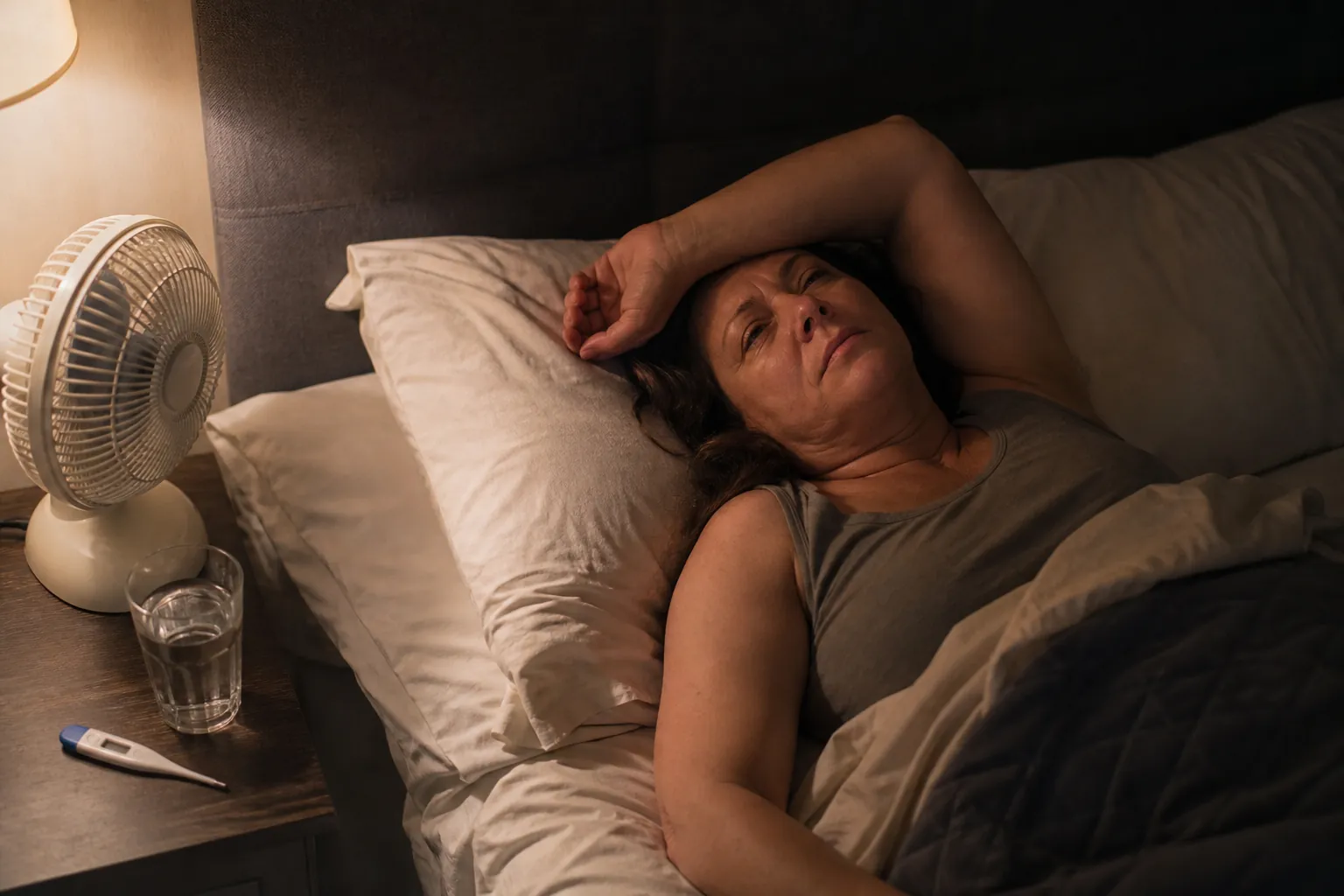
The miserable part of a heat advisory night is often not that the bedroom becomes dramatically hot. It is that the house never really cools. The room that was barely tolerable at bedtime creeps up a couple of degrees after midnight, the sheets hold yesterday’s warmth, and at 3 a.m. your body reacts as if someone flipped an internal alarm.
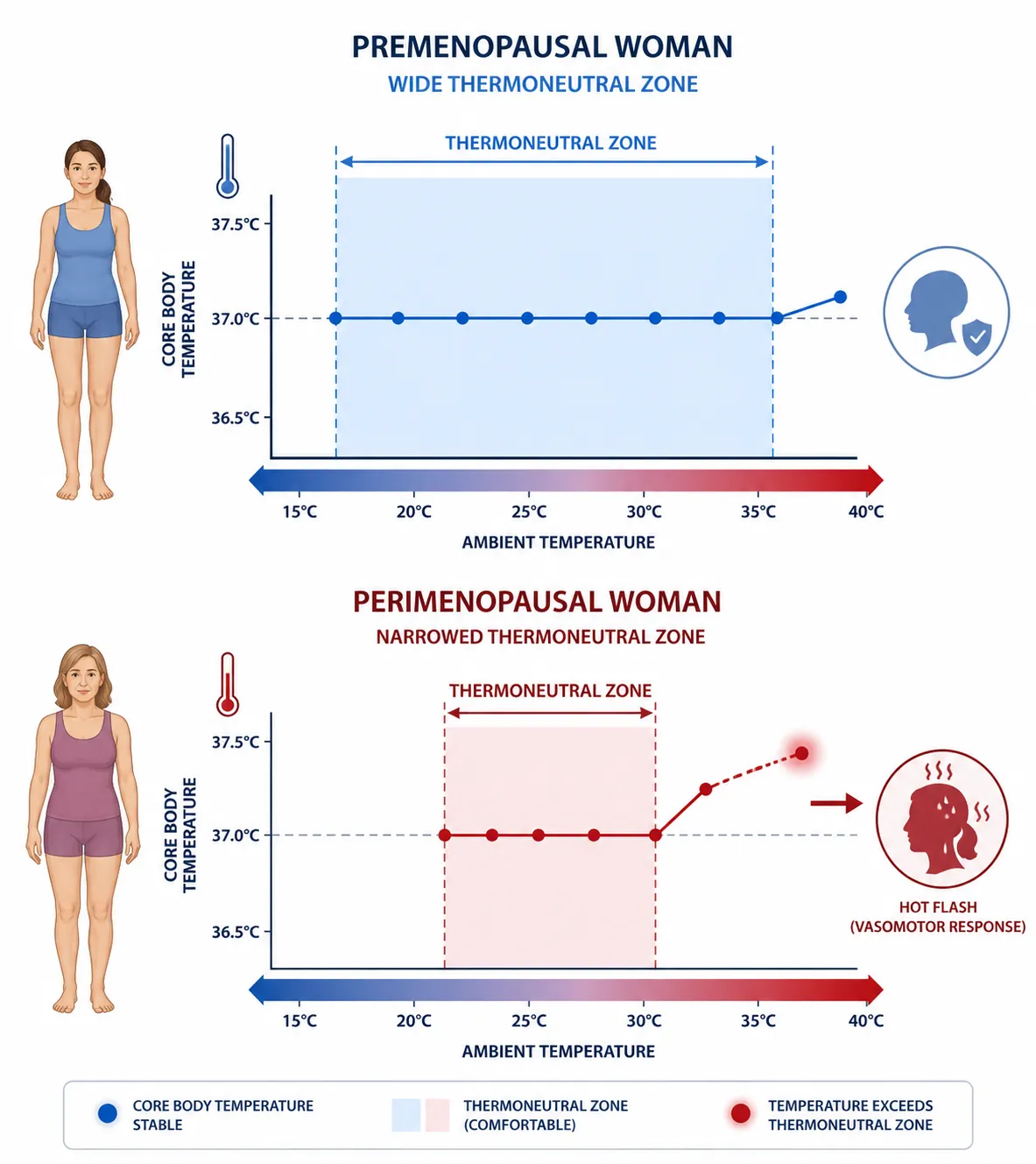
That reaction is not poor discipline, anxiety, or a failure to “just relax.” In perimenopause, estrogen fluctuations can narrow the hypothalamic thermoneutral zone—the small internal range where the body feels temperature is safe. Some clinical sources estimate that narrowing by up to about 60%, though that exact percentage should be treated as an illustrative clinical estimate rather than a large primary physiology finding.[1] When the National Weather Service issues a heat advisory, commonly tied to a heat index of at least 100°F for at least two hours, the outdoor environment is no longer ordinary summer background noise.[2] It becomes pressure on a body whose heat-response threshold may already be hair-trigger.
So the practical question is not whether a fan, a sheet set, a cool shower, or a gadget is “the answer.” The useful question is where heat is entering your night, where it is being trapped, and where your body needs help releasing it before the hot-flash cascade starts.
Start With the Bedroom Temperature, Even if You Cannot Hit the Ideal
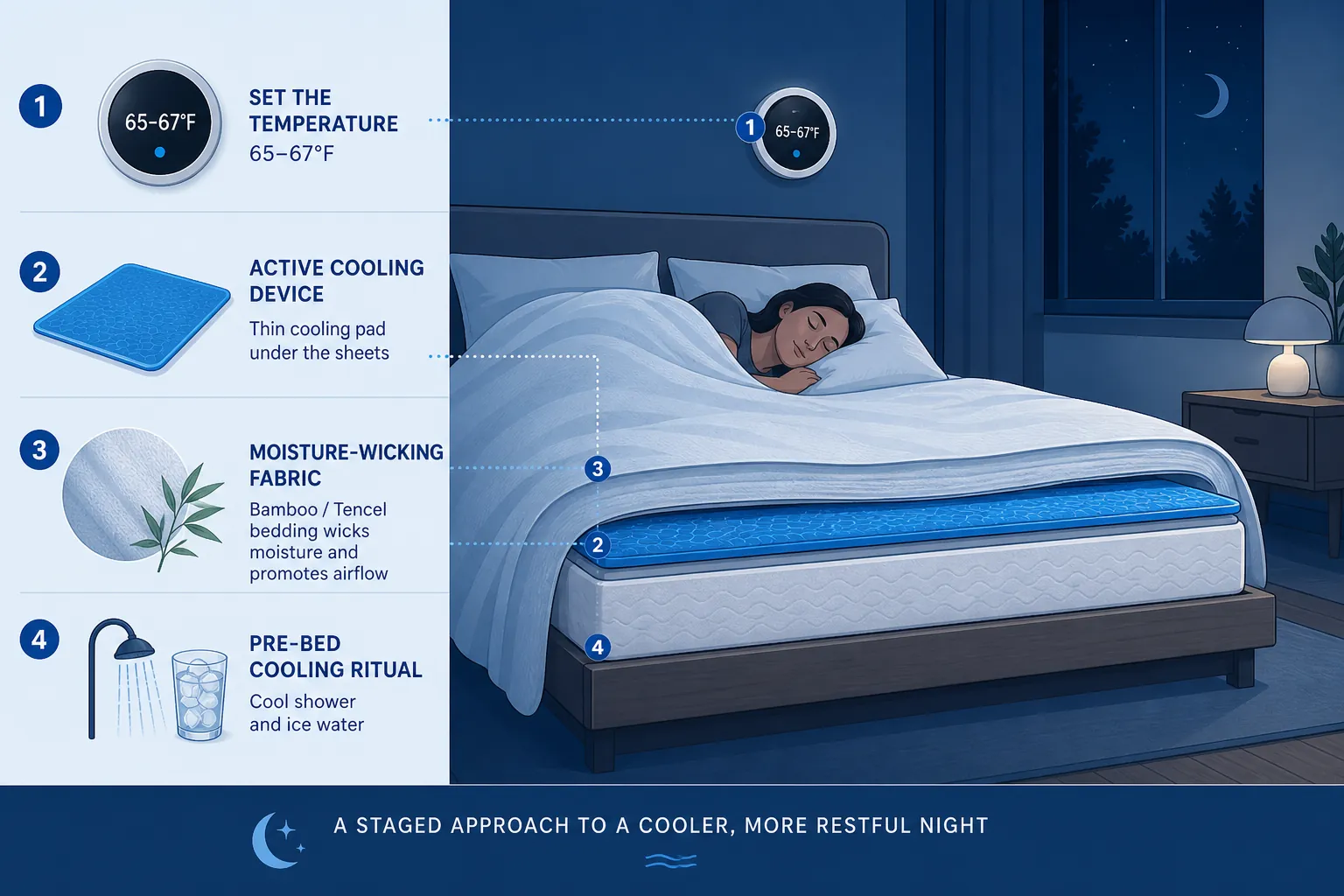
For perimenopause night sweats, the bedroom target worth taking seriously is roughly 65–67°F, or about 18–19°C. Yale Medicine, My Menopause Centre, and menopause-focused clinical guidance all point readers toward this cooler sleep range for hot flashes or menopausal sleep disruption.[1][3][4] It is concrete enough to guide decisions: if your room is 76°F at midnight during a heat advisory, a linen sheet swap alone is being asked to do the work of an air conditioner.
The number matters because it gives you a hierarchy. First cool the air around the bed. Then cool the sleep surface. Then manage moisture. Then add pre-bed cooling. Reversing that order is how people end up buying cooling pajamas while still lying on a heat-soaked mattress in a room that never drops below the mid-70s.
During an official heat advisory, you may not be able to reach 65–67°F safely or affordably. That does not make the target useless. It tells you what to protect. If the whole house cannot get there, make the bed zone cooler than the room: close off unused rooms, shade sun-facing windows before late afternoon, move sleep to the lowest or coolest room, run the air conditioner before bedtime if you have one, and point a fan so it moves cooled air across the bed rather than just stirring warm air near the ceiling.
If you are using a window unit or portable air conditioner, the goal is not a perfect-looking thermostat. The goal is to keep the air around your torso, neck, and head from crossing your personal trigger point. That may mean sleeping closer to the cooling source for a few nights, using a temporary mattress setup in a cooler room, or moving away from a partner, pet, or foam surface that is adding heat load.
For readers dealing with regional extremes, a more detailed heat-specific guide may help: how to sleep in extreme heat during perimenopause goes deeper into thermoregulation, while Florida heat and humidity night sweats is the better exit if the problem is sticky air that will not let sweat evaporate.
Add Active Cooling Where Your Body Actually Touches the Bed
Active cooling is the place where spending money can make sense, but only if the device changes the micro-climate you are actually sleeping in. A fan across the room may help sweat evaporate. A breathable sheet may reduce trapped heat. A cooling mattress pad, water-based cooling layer, or actively cooled topper works closer to the problem: the warm surface under your back, hips, and shoulders.
The strongest intervention-specific evidence in this small corner of the sleep world is a pilot study by Avis and colleagues, published in Menopause in 2022, that tested a cooling mattress pad for vasomotor symptoms and sleep. The PubMed abstract reports that the cooling mattress pad was associated with fewer and less severe hot flashes and improved sleep measures, but it was a pilot study, so it should not be read as a guarantee for every sleeper.[5]
That distinction matters. Manufacturer summaries of the same study highlight larger-sounding figures, including a 30% improvement in sleep score, up to a 50% reduction in hot flash severity, and 64% of pilot participants reporting fewer night sweats.[6] Those numbers are useful when you are comparing products, but the independent scientific abstract is more conservative. If a product page makes the pad sound like a menopause treatment, slow down. If it says it can cool the mattress surface consistently while you sleep, that is the claim that fits the evidence better.
For tonight, evaluate active cooling by asking what it can change before your first wake-up:
- Does it cool the sleep surface, not just the room air?
- Can it run for the first half of the night without needing you to wake up and reset it?
- Can you control your side separately if you share a bed?
- Will it add humidity, noise, light, or maintenance that makes sleep harder?
- Can it be returned if it cools the marketing copy better than the mattress?
Passive cooling still has a place. A fan, a lighter blanket, and a cooler pillowcase may be enough on an ordinary warm night. During a heat advisory, though, passive measures are often trying to borrow coolness from an environment that no longer has much to give. If the outside air is still hot at bedtime, opening the window can move air without lowering the temperature band your body is reacting to.
If you are comparing mattress setups, cooling layers, or lower-cost combinations, the product-focused guide to IKEA mattress combinations for perimenopause hot flashes is a better place to sort materials and trade-offs than trying to make that decision at 2 a.m.
Use Bedding and Sleepwear to Move Heat and Moisture Away
Sheets and pajamas do not prevent vasomotor symptoms. They can, however, change what happens after the flash begins. If sweat sits against your skin or soaks into dense bedding, the next sleep cycle starts in a damp, warm pocket. That is how one hot flash becomes a series of wake-ups.
Clinical menopause guidance points readers toward bamboo and Tencel because they tend to wick moisture faster than high-thread-count cotton, which can trap heat.[1] The practical rule is simple: choose fabrics that feel light, breathe easily, and dry quickly. A crisp heavy cotton sheet may feel luxurious in April and clammy in July.
| Swap | Why it helps during a heat advisory |
|---|---|
| High-thread-count cotton sheets to bamboo or Tencel | Reduces trapped heat and helps moisture move away from skin |
| Heavy comforter to one light layer | Makes it easier to uncover quickly without waking fully chilled afterward |
| Oversized old T-shirt to moisture-wicking sleepwear | Avoids holding sweat against the chest, back, and neck |
| Foam-heavy pillowcase to a cooler, breathable cover | Limits heat buildup around the head and neck |
Do not overbuy the fabric promise. “Cooling” in textiles usually means heat and moisture management, not refrigeration. If the room is too hot and the mattress is storing body heat, even good sheets are working downstream. Still, as part of a stack, they matter—especially because damp bedding can keep waking you after the original flash has passed.
Sleepwear deserves the same standard. If you wake soaked through the chest or waistband, prioritize fast-drying, loose sleepwear over style claims. A separate review of pajamas for hot sleepers can help if your main question is whether a specific fabric blend is likely to feel better overnight.
Cool Your Body Before Bed, but Do Not Make Rituals Carry the Whole Night
Pre-bed cooling is worth doing because it lowers the heat load you bring into bed. It is not a substitute for a hot room. Think of it as giving your narrowed thermoneutral zone a calmer starting point.
- Take a cool or lukewarm shower close to bedtime, avoiding a cold shock that leaves you alert.
- Keep lotion or a light moisturizer in the refrigerator and apply it to the neck, chest, or arms.
- Place ice water within reach so you do not have to fully wake and walk through a hot house.
- Use a cool cloth at the neck or upper chest during the first signs of a flash.
- Set a dry sleep shirt or towel nearby so a sweat-soaked wake-up does not become a 20-minute reset.
These are small interventions, but small is not the same as silly. They are low-risk, cheap, and available tonight. Their weakness is duration. A cool shower cannot keep a memory-foam mattress from storing heat for six hours; refrigerated lotion cannot pull a 78°F bedroom into a perimenopause-friendly range. Use them where they fit.
Why This Is So Common, and Why That Still Does Not Make It Trivial
Hot flashes and night sweats are common enough that many women are taught to expect them, but the scale is still striking. A 2025 Scientific Reports analysis of 147,501 symptom logs from 4,789 women found that 83.4% of perimenopausal women reported hot flashes and 62.2% reported night sweats; the authors noted that the app-user sample was mostly from the United States and was not fully representative of all women.[7] An American Academy of Sleep Medicine survey released in 2025 found that 35% of women ages 45–64 reported night sweats disrupting sleep, about double the rate of other age groups.[8]
Those figures do not prove what will work in your bedroom during a specific heat advisory. They do explain why “just open a window” lands badly. The problem is not ordinary warmth plus ordinary sleep. It is a common midlife vasomotor symptom pattern colliding with sustained environmental heat.
A Tonight-Level Cooling Order
If you are deciding what to do before bed tonight, work in this order:
- Measure the bedroom temperature near the bed, not in a hallway, and aim as close as possible to 65–67°F.
- If the room cannot cool enough, create a cooler bed zone with air conditioning, a fan positioned across the sleep surface, or a temporary move to the coolest room.
- Add active cooling at the mattress surface if night sweats are severe or repeated.
- Strip the bed down to breathable, moisture-wicking layers and remove dense bedding that stores heat.
- Use a cool shower, refrigerated lotion, ice water, and a dry clothing reset as support moves.
If the heat advisory is extreme—say the kind of night where local forecasts are still showing dangerous heat after sunset—the guide to sleep tips for 108°F weather and menopause hot flashes may be more relevant than ordinary summer sleep advice.
No single sheet set, shower, fan, or cooling pad has to be crowned the answer. Relief is more likely when each layer removes a little burden: cooler air around the bed, a cooler surface under the body, fabrics that do not hold sweat hostage, and a pre-bed routine that sends you into sleep with less heat to shed.
References
- Menopause and Sleep: Why Hot Flashes Disrupt Sleep and How to Fix It, Concierge Medicine of South Shore
- Heat Advisory, National Weather Service
- Hot Flashes, Yale Medicine
- Menopause and sleep, My Menopause Centre
- Results of a pilot study of a cooling mattress pad to reduce vasomotor symptoms and improve sleep, Menopause, 2022
- Cooling Mattress Pad Pilot Study Summary, sleep.me
- Scientific Reports study of perimenopause symptom logs, Scientific Reports, 2025
- AASM 2025 survey on night sweats and sleep disruption, American Academy of Sleep Medicine, 2025
Explore the mechanism
Next step
Spot an error or have clinical feedback?
Because this article covers clinical, medication, or safety information, we use a moderated correction channel instead of open public comments. Let us know if something about “How to Sleep in a Heat Advisory When You're Perimenopausal” needs a closer look.
Send feedback on this article