
When Does Sleep Return After a Heat Wave Ends?
Heat wave sleep disruption doesn't end the night temperatures drop. Learn how accumulated sleep debt takes 4–9 days to recover, with evidence from large-scale studies and practical strategies to speed recovery.
If the heat wave ended last night and you still woke up heavy-headed, the simplest answer is usually not that you failed at sleep. The date a heat wave ends is often not the date sleep disruption ends. After several hot nights, sleep commonly needs several more nights to normalize—roughly 4–9 days is a reasonable expectation for many adults—because the body is paying back accumulated sleep debt and recovering from degraded sleep quality, not merely reacting to the temperature in the room tonight. That range is a convergence of general sleep-debt recovery research and heat-related lag data, not the result of a clinical trial that followed people after a heat wave with a stopwatch.[1][2]
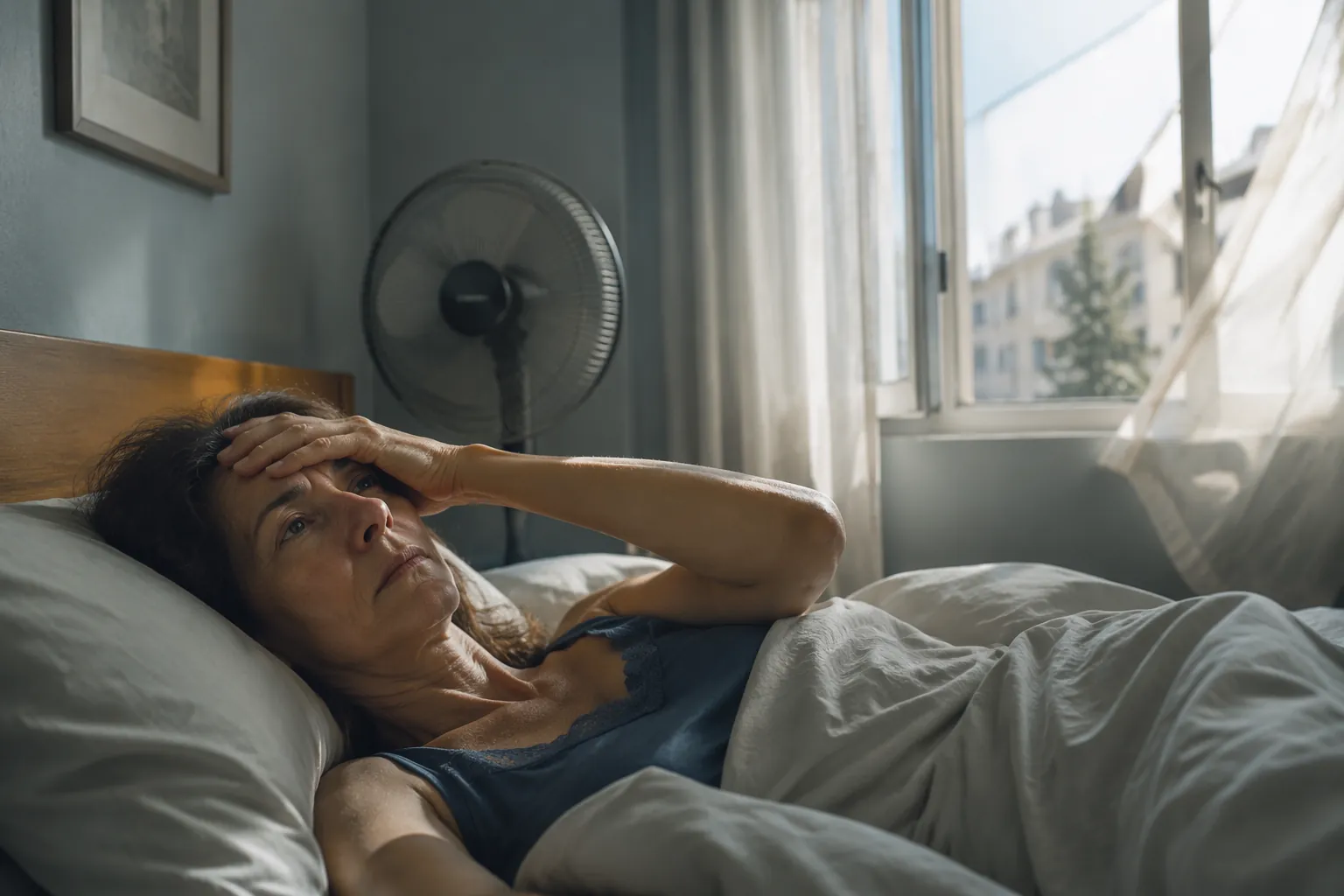
That distinction matters. A cooler room can remove the current stressor, but it does not erase the sleep that was lost on Monday, Tuesday, and Wednesday. Nor does it immediately rebuild the deep sleep that may have been thinned out while your body was trying to shed heat.
| After the first cooler night | What is happening |
|---|---|
| Night 1–2 | The room may finally be comfortable, but sleep pressure, circadian timing, and arousal from prior hot nights can still be unsettled. |
| Days 3–4 | Some recovery may begin, especially if you can extend sleep modestly and keep wake time stable. One hour of lost sleep can take up to 4 days to recover in general sleep-debt research.[1] |
| Days 5–9 | A fuller return toward baseline is plausible for many people. General sleep-debt research suggests complete elimination of sleep debt can take up to 9 days.[1] |
| Beyond roughly 3 weeks | Persistent poor sleep deserves evaluation as possible secondary or conditioned insomnia rather than being written off as normal heat-wave recovery. |
Why one cool night does not undo five hot ones
The strongest heat-specific evidence comes from a large international study by Minor and colleagues, which linked hotter nights with shorter sleep across 68 countries. On average, each 1°C increase in nighttime temperature cost about 14 minutes of sleep. The study also found no clear inter-day adaptation: people did not simply “get used to” consecutive hot nights in a way that protected sleep on later nights.[2]
That is the part many quick sleep tips miss. If a hot night trims sleep, and the next hot night trims it again, the relevant unit is no longer tonight. It is the stack. Minor’s lagged-effect model found cumulative sleep loss continuing to grow through day 5, with only partial rebound by days 6–7. In practical terms, a 5-night heat wave can leave a measurable sleep burden that is still visible after the weather itself has broken.[2]
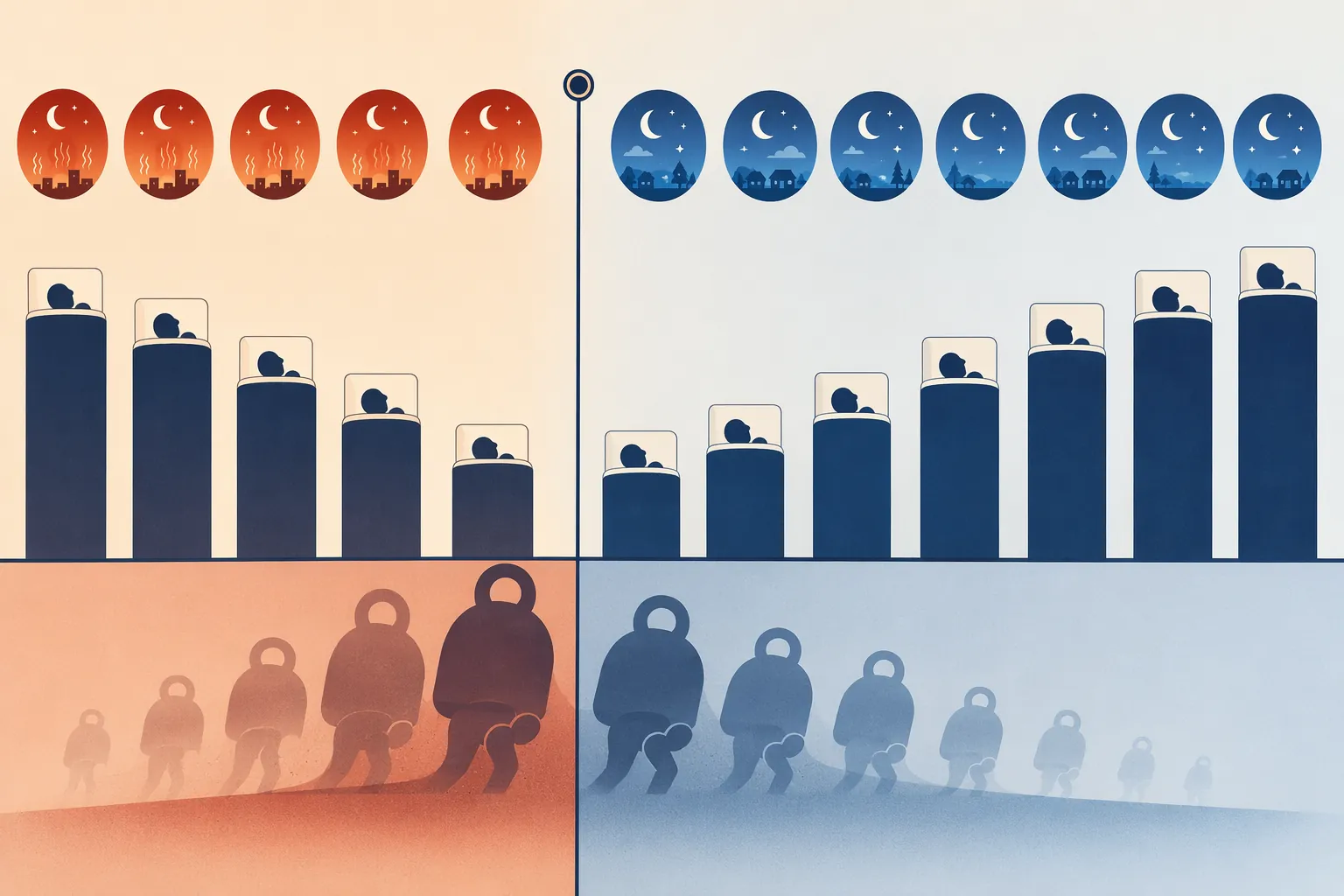
This is why “but I slept seven hours last night” does not always settle the matter. If the prior several nights were fragmented, shortened, or lighter than usual, a single acceptable night may be the first repayment, not the final receipt.
A similar recovery mismatch shows up after other environmental disruptions: the event can end before the nervous system, schedule, and sleep pressure have returned to baseline. Severe storm travel delays are a different situation, but the pattern is familiar—external disruption first, then lingering sleep and stress effects. For that related mechanism, see how severe storm flight delays disrupt sleep.
The “I slept, but I do not feel restored” problem
Total sleep time is only one piece of recovery. Heat can also change what kind of sleep you get. A 2025 Nature Communications study using 23 million wearable sleep records found that sleep insufficiency odds rose 20.1% per 10°C increase, total sleep decreased by 9.67 minutes per 10°C, and deep sleep declined by 2.82% per 10°C. In that analysis, deep sleep was the most affected stage.[3]
That helps explain the complaint people often struggle to describe: the night was not objectively terrible, but the morning still feels wrong. Deep sleep is one of the stages most associated with physical restoration and the blunt, bodily sense of having been reset. If heat has been shaving that stage down across several nights, a longer night in bed may still leave you feeling under-recovered.
The bedroom may have cooled, but the sleep system has not necessarily rebuilt its architecture. Recovery is not only “more minutes.” It is also getting enough consolidated sleep at the right circadian time, with enough of the deeper stages that hot nights tend to disturb.
Who may take longer to feel normal again
Adults over 60
Older adults should not be treated as overreacting when sleep stays poor after the heat breaks. In Minor’s analysis, adults over 60 lost about twice as much sleep per degree of nighttime warming as mid-aged adults, with sensitivity rising rapidly after age 60.[2]
That matters because the same heat wave can leave different sleep debts behind. A younger adult and a 72-year-old may both say, “It was five bad nights,” but the older sleeper may have lost more sleep per night and may have spent more time awake trying to cool down. The recovery clock starts from the amount of debt accumulated, not from the date the forecast improved.
Perimenopausal women
Perimenopause can make the post-heat-wave period especially unforgiving. Temperature regulation may already be unstable, night sweats may already be waking the body, and a heat wave can train the bed itself to feel like a place where overheating and alertness happen. Once that pairing forms, the cooler night is welcome—but it may not be enough by itself.
For a perimenopausal sleeper, stalled recovery may be partly sleep debt and partly conditioned insomnia: the body has learned to monitor, brace, and wake. If that sounds familiar, the more specific discussion in Heat Dome Night Sweats? Why CBT-I Helps Perimenopause Sleep is a better next step than another generic bedroom-cooling checklist.
What helps after the heat has passed
There is no peer-reviewed protocol that proves a specific post-heat-wave recovery routine will restore sleep on a fixed schedule. The useful moves are more modest: apply general sleep-debt and circadian recovery principles, then give them several nights to work.
- Extend sleep gradually rather than trying to “crash” for one enormous night. Adding about 15–30 minutes of sleep opportunity can help repay debt without pushing your schedule wildly later.
- Keep wake time steady. A consistent wake time gives the circadian system a clearer anchor while the body is recovering.
- Get morning light soon after waking. Light exposure helps reinforce daytime alertness and the timing of the next night’s sleep.
- Avoid alcohol during the recovery window. It may feel sedating, but it can fragment sleep and interfere with temperature regulation.
- Keep cooling measures, but do not make the room temperature the only target. A fan, lighter bedding, breathable sleepwear, or pre-bed cooling can help, but they are now supporting recovery rather than solving the whole problem.
The goal is not to force sleep back to normal in one night. It is to stop adding new debt, protect the timing of sleep, and let deeper sleep return as the body stops defending against heat.
Why the climate context is real but not the whole answer
Warming nights are not a small sleep issue at the population level. A USC All of Us analysis projected up to 24 hours of annual sleep loss by 2099 from rising temperatures.[4]
Still, if you are reading this after a specific heat wave, the immediate question is narrower: how long before this particular fog lifts? For many adults, the answer is several days, not one night. Older adults, perimenopausal women, people with prior insomnia, and anyone who accumulated heavy sleep loss may need longer.
When to stop blaming the heat wave alone
If sleep is gradually improving across the first week after the heat breaks, that fits the recovery pattern. It may be uneven: one better night, one disappointing night, then a clearer shift. That is different from being stuck.
If poor sleep persists beyond roughly three weeks after the heat wave, consider evaluation for secondary insomnia, medical contributors, medication effects, persistent night sweats, anxiety, or conditioned wakefulness. That three-week boundary is a standard insomnia framing, not a heat-wave-specific finding. The point is not that something is wrong on day 22; it is that the original heat event should no longer be the only explanation.
The cooler night is a necessary relief. It is just not always the finish line.
References
- Sleep Debt and Catching Up on Sleep — Sleep Foundation
- Rising temperatures erode human sleep globally — One Earth — 2022
- Ambient temperature and human sleep: evidence from wearable devices — Nature Communications — 2025
- Study links rising temperatures to reduced sleep in U.S. adults — Keck School of Medicine of USC
Safety & eligibility read
Cross-check against other interventionsExplore the mechanism
Next step
Spot an error or have clinical feedback?
Because this article covers clinical, medication, or safety information, we use a moderated correction channel instead of open public comments. Let us know if something about “When Does Sleep Return After a Heat Wave Ends?” needs a closer look.
Send feedback on this article