
Can non-opioid pain relief improve sleep after hysterectomy?
Opioids can quietly suppress the deep and REM sleep that healing depends on after hysterectomy, and poor sleep makes pain harder to bear. An opioid-sparing, non-opioid multimodal plan protects both pain control and recovery sleep, with the strongest evidence behind around-the-clock acetaminophen plus an NSAID.
The first night after hysterectomy is often when the pain plan becomes the sleep plan. A patient may have a button, a bottle, or a line on the discharge sheet that says “take as needed,” but the real decision happens at 2 or 3 a.m.: take enough opioid to dull the pain and risk the fog, nausea, itching, or hollow sleep, or wait too long and let pain take over the room.

So the short answer is yes: non-opioid pain relief can improve sleep after hysterectomy when it lowers opioid exposure without letting pain break through. The strongest sleep-specific evidence comes from a fast-track abdominal hysterectomy trial: more postoperative opioid use was linked with higher odds of bad first-night sleep, while the spinal-anesthesia group used about five times less opioid and slept significantly better. In that same study, excellent first-night sleep tracked with a shorter hospital stay, about 42 hours compared with about 54 hours after bad sleep [1].
That does not mean “opioid-free” is the goal at any cost. A useful plan makes the non-opioid baseline steady enough that opioids move into their proper role: rescue medication for pain that breaks through. For laparoscopic hysterectomy, the clearest procedure-specific recommendation is scheduled acetaminophen plus an NSAID, with dexamethasone as a perioperative component and opioids reserved for rescue [2].
Why the GASPI hysterectomy trial matters for sleep
The GASPI trial is useful because it does not treat pain control and sleep as separate recovery problems. It studied women having abdominal hysterectomy in a fast-track setting and compared general anesthesia with spinal anesthesia. The sleep finding was not vague: each unit of postoperative opioid use increased the odds of bad first-night sleep, with an odds ratio of 1.07 and a p value of 0.03 [1].
The trial also shows why a nighttime plan has to start before nighttime. The group receiving spinal anesthesia used much less opioid, slept better the first night, and had a recovery pattern in which sleep quality was tied to length of stay [1]. A patient does not have to remember those statistics after surgery. The practical point is simpler: the anesthesia and analgesia choices made before and during surgery can shape whether the first night is spent chasing pain after it has already escalated.
There is an important boundary here. GASPI studied abdominal hysterectomy, not laparoscopic or robotic hysterectomy. Laparoscopic and robotic approaches usually involve different tissue trauma, inflammation, and pain patterns, so the exact sleep effect should not be copied across procedures as if every hysterectomy recovery is the same. Still, the trial gives a clear recovery frame: when opioid exposure drops and pain remains controlled, first-night sleep can improve [1].
The loop: pain, opioids, unrestorative sleep, more pain
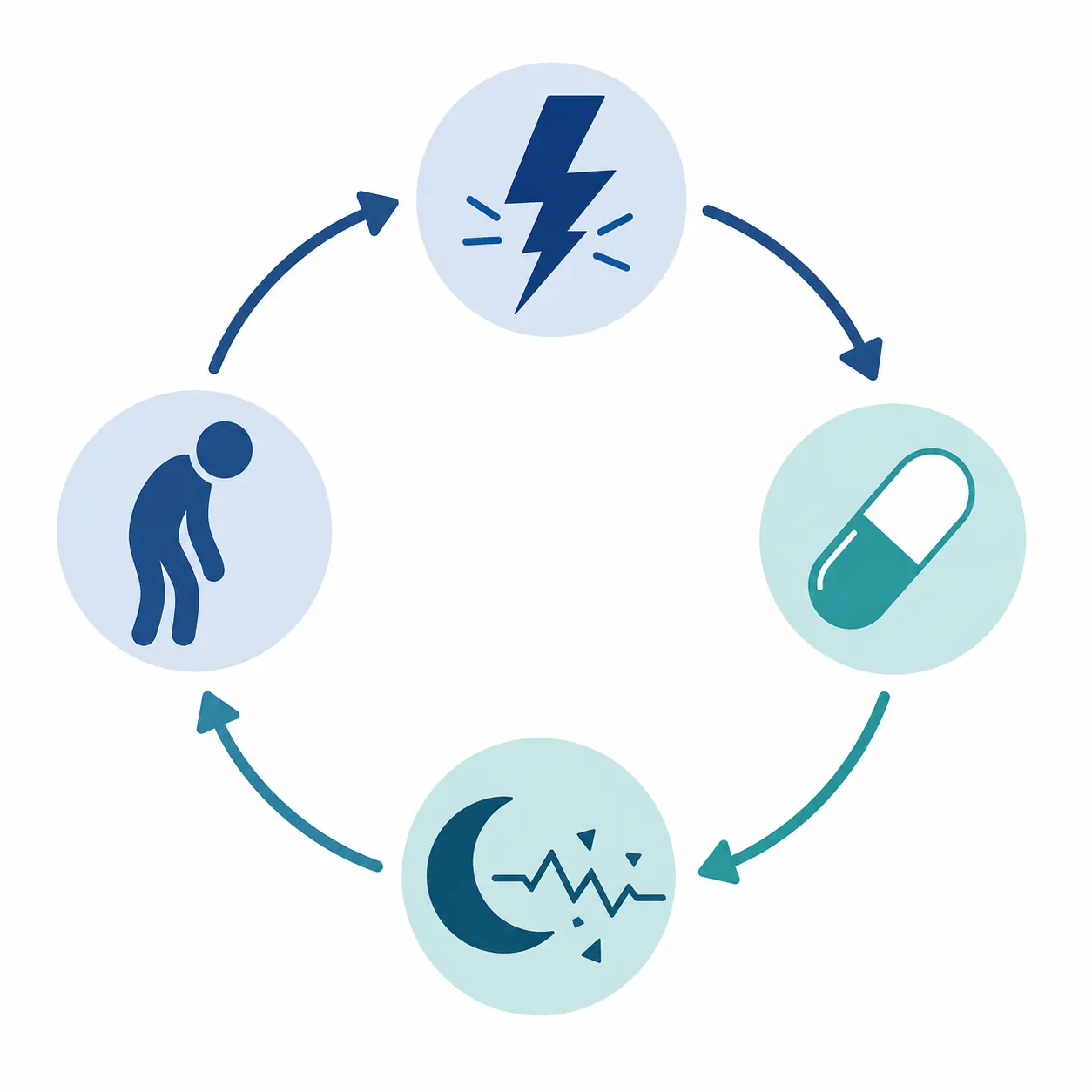
Opioids can make someone drowsy. That is not the same as protecting restorative sleep. In a polysomnography study, single bedtime doses of sustained-release morphine 15 mg or methadone 5 mg reduced slow-wave sleep and shifted sleep toward stage 2, while total sleep time did not change [3]. In plain language: a person can be asleep for about the same amount of time and still lose some of the deeper sleep architecture that makes sleep feel repairing.
A 2025 mechanistic review describes several pathways by which opioids may disrupt postoperative sleep architecture, including suppression of REM-related cholinergic activity and effects on brain systems involved in sleep-wake regulation [4]. The bedside translation matters more than the neuroanatomy: opioids may quiet pain enough to permit sleep, but they can also make that sleep lighter, more fragmented, or less restorative.
The other side of the loop is just as important. Postoperative sleep disturbance is commonly driven by pain, and one review identified pain as the most common cause of nighttime postoperative disturbance; analgesics were described as the most effective intervention for helping patients return to sleep [5]. If pain repeatedly wakes someone after hysterectomy, the next day can start with a lower tolerance for movement, coughing, bathroom trips, and the ordinary work of recovery.
This is why “just avoid opioids” is the wrong message. Undertreated pain can damage sleep too. The better question is whether the baseline pain plan is strong and regular enough that rescue opioids are needed less often, especially overnight.
What an opioid-sparing hysterectomy pain plan usually means

A multimodal plan is layered. The bottom layer is the medication schedule that keeps pain from repeatedly surging. The middle layer is what the surgical and anesthesia team can do around the operation. The top layer is rescue medication for pain that gets past the first two layers.
| Part of the plan | What it is meant to do | Evidence weight for hysterectomy |
|---|---|---|
| Scheduled acetaminophen plus an NSAID | Keep baseline pain lower so sleep is not repeatedly interrupted | Strongest procedure-specific baseline in PROSPECT laparoscopic-hysterectomy recommendations [2] |
| Dexamethasone during perioperative care | Reduce inflammatory pain and postoperative nausea risk as part of the non-opioid package | Included in PROSPECT baseline recommendations for laparoscopic hysterectomy [2] |
| Spinal, neuraxial, or regional anesthesia choices when appropriate | Reduce early opioid requirement and improve first-night recovery conditions | Most sleep-specific signal comes from fast-track abdominal hysterectomy, not all hysterectomy routes [1] |
| Gabapentinoids | Possibly reduce opioid use in selected patients, depending on dose, timing, and risk profile | Mixed evidence; one abdominal-hysterectomy RCT found lower morphine use after preoperative gabapentin, but this is not a blanket recommendation [6] |
| Opioids | Treat breakthrough pain that is not controlled by the baseline plan | Best positioned as rescue medication, not the center of the sleep plan [2] |
The baseline: acetaminophen plus an NSAID
For many patients, the most important question is not “What can I take if I wake up in severe pain?” but “What am I taking on schedule so I am less likely to wake up that way?” PROSPECT’s laparoscopic-hysterectomy review, based on 56 randomized controlled trials, recommends acetaminophen plus an NSAID as part of the basic regimen, along with dexamethasone, and places opioids in a rescue role [2].
That scheduled baseline is especially relevant at night. If a discharge sheet says only “as needed,” the patient has to decide whether to medicate after pain has already climbed. If the plan includes around-the-clock non-opioid doses for the first phase of recovery, the patient does less pain-management math while exhausted.
NSAIDs are not safe for everyone, and neither acetaminophen nor ibuprofen should be treated as casual because they are familiar. Kidney disease, stomach bleeding risk, liver disease, anticoagulants, medication interactions, and surgeon-specific bleeding concerns can change the plan. The sleep-friendly version is not self-prescribing; it is getting a clear schedule from the team that knows the operation and the patient.
Perioperative choices: dexamethasone and anesthesia planning
Some of the most useful opioid-sparing work happens before the patient is awake enough to notice it. PROSPECT includes dexamethasone in its laparoscopic-hysterectomy regimen [2]. In GASPI, spinal anesthesia was associated with much lower opioid use and better first-night sleep after abdominal hysterectomy [1].
This does not mean every patient should request the same anesthesia technique. Surgical route, medical history, anticoagulation status, prior reactions, the expected duration of surgery, and the anesthesiologist’s judgment all matter. But it is reasonable to ask, before surgery: “Are there anesthesia or perioperative medication choices that can reduce my opioid requirement the first night?”
Gabapentin and pregabalin: possible tools, not automatic sleep solutions
Gabapentinoids sit in a different evidence tier. In one abdominal-hysterectomy randomized trial, preoperative gabapentin 1200 mg reduced morphine use from 5.2 mg to 1.2 mg [6]. That is meaningful, but it does not settle the question for every patient or every hysterectomy route.
PROSPECT found limited or inconsistent evidence for several laparoscopic-hysterectomy components, including pregabalin, transversus abdominis plane blocks, and intraperitoneal local anesthetics [2]. Gabapentinoids can also cause sedation, dizziness, and balance problems, which may be unwelcome when someone is trying to walk safely after surgery. They are worth a clinician-led discussion, not a default request.
Ice packs, unused pills, melatonin, and sleeping pills
Ice can be a comfort add-on. A UT Southwestern study reported high satisfaction with ice packs after laparoscopic surgery, but ice did not reduce medication use [7]. That is still useful information. Comfort matters. It just should not be sold as the main opioid-sparing intervention.
Unused opioid-pill figures can also be informative without carrying the whole argument. The same UT Southwestern report noted that patients used an average of 2.9 out of 20 prescribed oxycodone tablets after laparoscopic surgery [7]. That raises a real overprescribing concern, but it comes from a specific setting. It should not be treated as a universal count of what every hysterectomy patient will need.
Melatonin and zolpidem belong behind a fence in this conversation. They may appear in broader postoperative sleep discussions, but they are not the standard core of hysterectomy pain-and-sleep planning in U.S. gynecologic surgery. If sleep medication is being considered, it should be handled by the surgical or anesthesia team, especially when opioids, nausea medicines, anesthesia aftereffects, and fall risk are also in the picture.
At home, “as needed” needs translation
The discharge period is where a good plan can become too vague. “Take as needed” may be medically accurate and still leave a recovering person guessing. A more useful discharge conversation separates the plan into three parts: the scheduled non-opioid baseline, the rescue medication, and the reasons to call.
- Baseline: What acetaminophen and NSAID schedule should I follow, and for how many days?
- Rescue: At what pain level, or after what failed measures, should I use the opioid?
- Night plan: Should I set alarms for non-opioid doses early in recovery, or should I sleep through and dose when awake?
- Safety limits: What is my maximum daily acetaminophen dose, and are NSAIDs safe for me?
- Escalation: What pain, bleeding, fever, urinary symptoms, vomiting, or sedation should prompt a call?
Some patient-facing surgical guidance describes alternating acetaminophen and ibuprofen after surgery as one way to keep non-opioid coverage steady, but the exact schedule should come from the operating team because dose limits and contraindications vary [8].
The ovary question belongs in the sleep plan too
Many hysterectomy patients are already in the years when sleep is more vulnerable to temperature swings, night sweats, stress reactivity, and circadian disruption. If both ovaries are removed, surgical menopause can add a new sleep stressor at the same time the body is healing from surgery. If ovaries are conserved, hormonal shifts may still occur, but the sleep conversation is different.
That distinction does not replace the pain plan. It changes what else might be waking the patient. A woman who is hot, flushed, anxious, and sore at 3 a.m. needs the team to sort out which part is pain, which part may be vasomotor symptoms, and which part may be medication effects.
For the temperature side of midlife sleep, see how cooler weather affects perimenopause sleep, how to sleep during a heat wave in perimenopause, and why August can be especially hard on perimenopause sleep. For the larger sleep-science context, the explainer on midlife sleep and women’s heart disease risk is a useful next step.
What to ask before surgery or before discharge
The most useful preoperative question is not “Can I avoid opioids?” It is more specific: “What is my around-the-clock non-opioid baseline, what is rescue-only, and what changes if my ovaries are removed or conserved?”
- Ask whether your planned hysterectomy route is abdominal, laparoscopic, robotic, or vaginal, because pain patterns and evidence do not transfer perfectly across routes.
- Ask for the exact acetaminophen and NSAID schedule you should use, including maximum daily doses and any reasons you personally should avoid them.
- Ask whether dexamethasone, spinal or neuraxial anesthesia, regional blocks, or other perioperative measures are appropriate for your case.
- Ask how the opioid should be used: what pain level, how often, what side effects to watch for, and when to stop.
- Ask whether gabapentin or pregabalin is being considered, and if so, why it fits your risk profile.
- Ask what to do if pain is controlled but sleep is still broken by hot flashes, anxiety, urinary symptoms, nausea, or medication side effects.
- Ask what symptoms should trigger a call rather than another dose at home.
The strongest sleep-specific evidence is still narrow: first-night recovery after abdominal hysterectomy in a fast-track setting. But the broader clinical logic is sturdy. After hysterectomy, pain and sleep are linked tightly enough that an opioid-sparing multimodal plan is not just a pain-control strategy. It is one of the most practical ways to protect restorative sleep while leaving rescue medication available when the body truly needs it.
References
- The Impact of Quality of Sleep on Recovery from Fast-Track Abdominal Hysterectomy, PMC, 2012
- Pain management after laparoscopic hysterectomy: systematic review of literature and PROSPECT recommendations, PubMed, 2019
- The effect of opioids on sleep architecture, PubMed, 2007
- Opioids worsen postoperative sleep, Springer, 2025
- Postoperative sleep disorders and their potential impacts on surgical outcomes, PMC, 2020
- Effects of gabapentin on pain and opioid consumption after abdominal hysterectomy, PMC, 2013
- Manage pain after laparoscopic surgery, UT Southwestern Medical Center, 2023
- Pain Control after Surgery: Patient Information from SAGES, SAGES
Safety & eligibility read
Cross-check against other interventionsExplore the mechanism
Next step
Spot an error or have clinical feedback?
Because this article covers clinical, medication, or safety information, we use a moderated correction channel instead of open public comments. Let us know if something about “Can non-opioid pain relief improve sleep after hysterectomy?” needs a closer look.
Send feedback on this article