
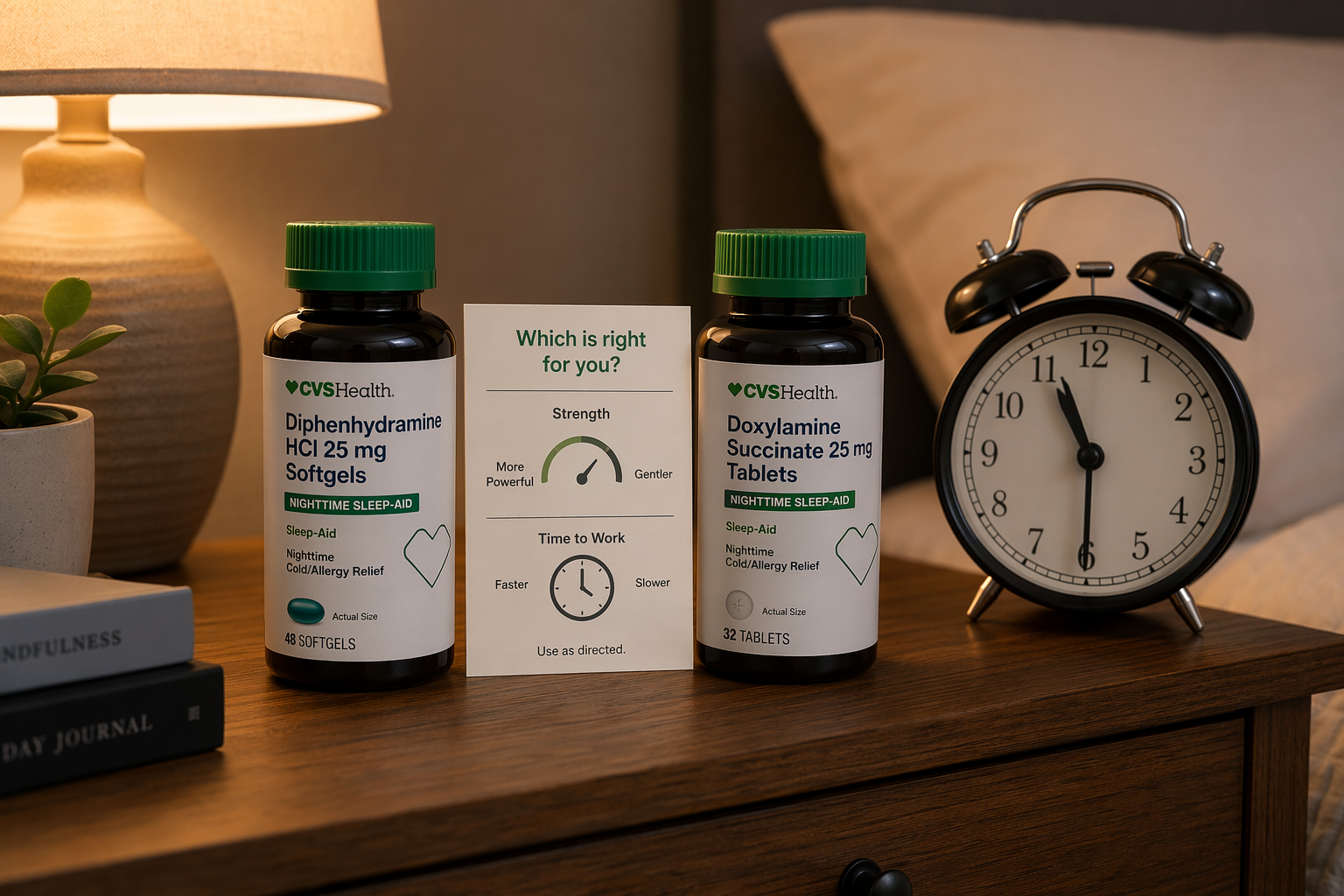
What Makes a Generic Sleep Aid 'Equivalent'?
When you pick up a CVS Health sleep aid bottle that says "Compare to Unisom SleepTabs active ingredient," it is not a marketing claim — it is a legal statement backed by a rigorous FDA review process. Store-brand OTC medications are approved through an Abbreviated New Drug Application (ANDA), which requires the manufacturer to prove the generic is bioequivalent to the brand-name reference drug.
Bioequivalence means the generic delivers the same amount of active ingredient into the bloodstream at the same rate as the brand-name product. The FDA does not allow generics to be weaker, stronger, or absorbed differently. The CVS doxylamine succinate 25 mg tablet, for example, carries ANDA number ANDA040167, confirming it passed this standard before reaching store shelves.
This regulatory framework is why the Mayo Clinic notes that generic versions with the same active ingredients as brand-name sleep aids are commonly available, carry the same risks and benefits, and are often available at a more reasonable cost. The key takeaway: CVS store-brand sleep aids are not "knockoffs" — they are FDA-approved generics that must meet the same quality and efficacy standards as the national brands they are compared to.
CVS Doxylamine Succinate 25 mg vs. Unisom SleepTabs: A Label Comparison
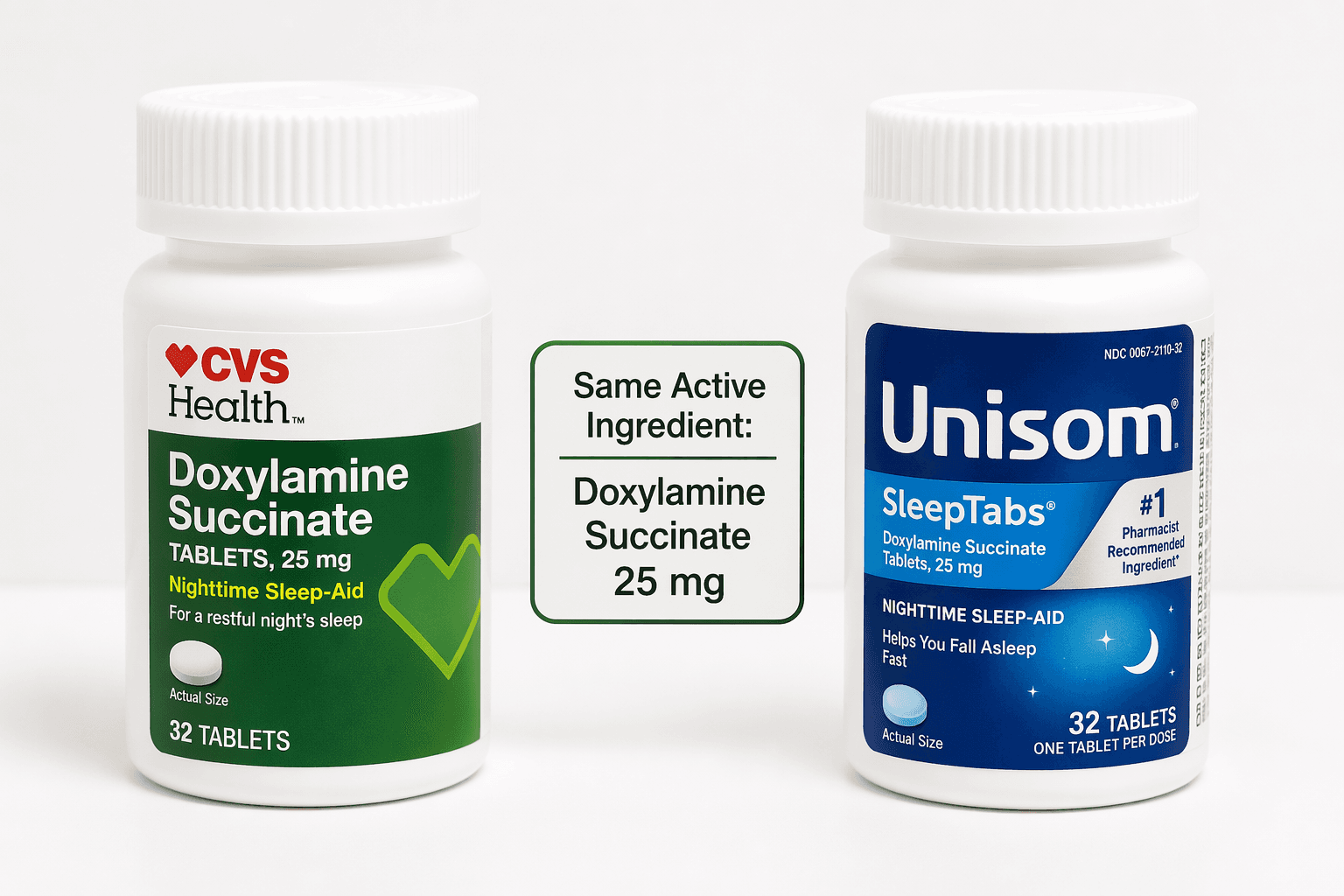
The CVS Nighttime Sleep-Aid doxylamine succinate 25 mg tablet (NDC 59779-441) is the most direct store-brand-to-brand comparison in the CVS sleep aid lineup. According to the official DailyMed label, the carton explicitly states "Compare to Unisom SleepTabs active ingredient." The active ingredient — doxylamine succinate 25 mg — is identical in both products.
Doxylamine is a first-generation antihistamine that causes more pronounced drowsiness than diphenhydramine and has a longer duration of effect, lasting up to 8 hours. This makes it better suited for people who have trouble staying asleep rather than just falling asleep. The CVS label warns not to use it unless you have time for a full night's sleep, and that sleeplessness persisting longer than 2 weeks may signal a serious underlying illness.
Inactive Ingredient Comparison
While the active ingredient is identical, the inactive ingredients differ between CVS and Unisom formulations. Here is what the CVS doxylamine tablet contains according to its DailyMed label:
| Ingredient | Function | Relevance |
|---|---|---|
| Doxylamine succinate 25 mg | Active ingredient (antihistamine) | Identical to Unisom SleepTabs |
| FD&C Blue No. 1 aluminum lake | Dye/colorant | May be relevant for people with dye sensitivities |
| Dibasic calcium phosphate (anhydrous) | Filler/binder | Common tablet excipient; generally well-tolerated |
| Dibasic calcium phosphate dihydrate | Filler/binder | Common tablet excipient; generally well-tolerated |
| Magnesium stearate | Lubricant | Standard tablet manufacturing ingredient |
| Microcrystalline cellulose | Filler/binder | Standard tablet manufacturing ingredient |
| Sodium starch glycolate | Disintegrant | Helps tablet break apart; generally well-tolerated |
The most notable difference is the inclusion of FD&C Blue No. 1 aluminum lake as a colorant. Unisom SleepTabs use different inactive ingredients. For the vast majority of people, this difference has no practical effect. However, individuals with known sensitivities to specific dyes or fillers may want to compare labels before purchasing.
CVS Diphenhydramine HCl Products vs. Benadryl and ZzzQuil
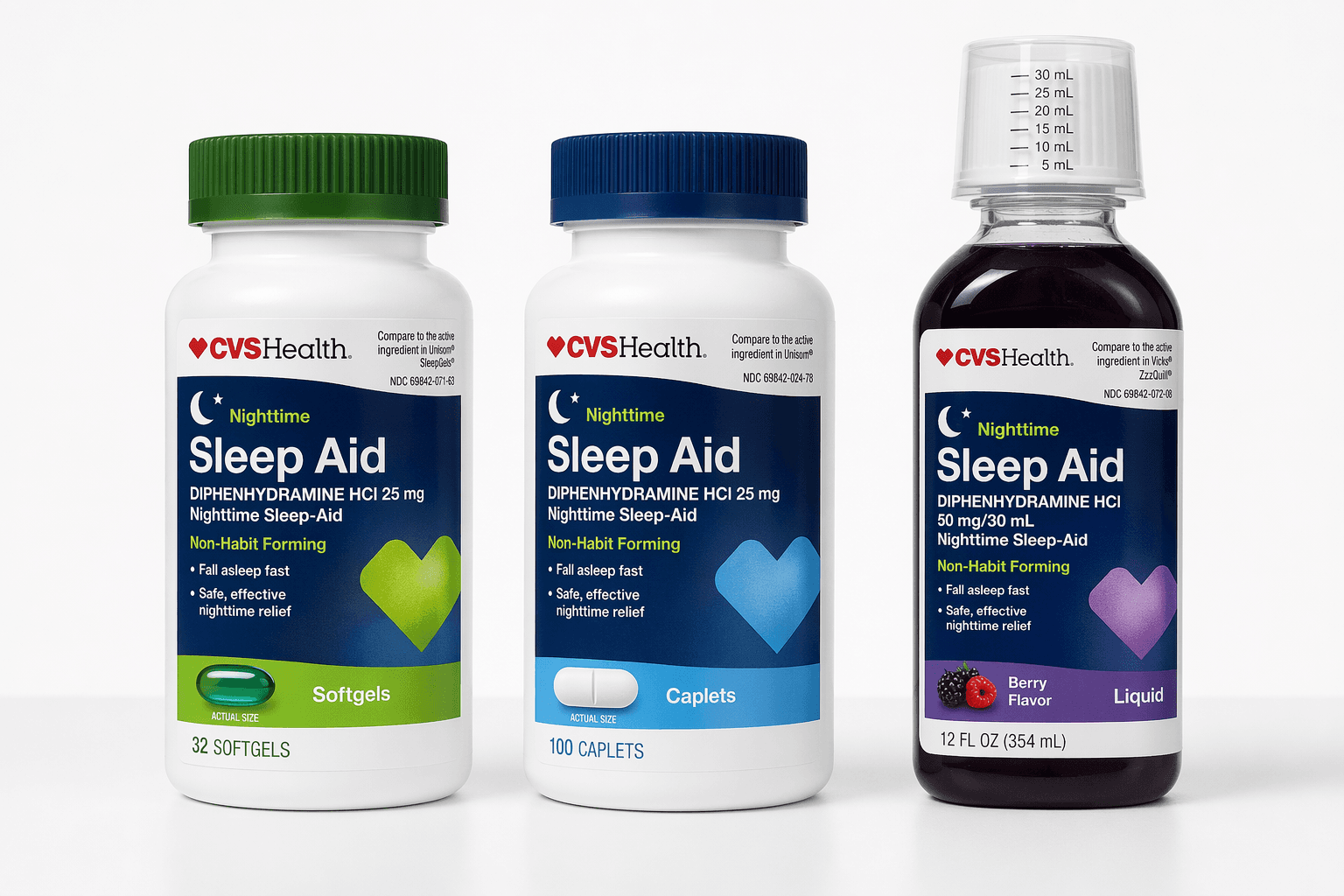
CVS carries a broader range of diphenhydramine HCl products than doxylamine options, matching the product lines of Benadryl (tablets, caplets, softgels) and ZzzQuil (liquid). Diphenhydramine is milder and shorter-acting than doxylamine, making it a better choice for people who primarily need help falling asleep rather than staying asleep.
| CVS Product | Dosage | Form | Brand Equivalent | Key Inactive Ingredients |
|---|---|---|---|---|
| CVS Health Diphenhydramine HCl 25 mg Softgels | 25 mg | Softgel | Benadryl 25 mg Softgels | Gelatin, glycerin, soybean oil |
| CVS Health Diphenhydramine HCl 25 mg Caplets | 25 mg | Caplet | Benadryl 25 mg Tablets | Microcrystalline cellulose, magnesium stearate |
| CVS Health Diphenhydramine HCl 50 mg Softgels | 50 mg | Softgel | Benadryl 50 mg Softgels | Gelatin, glycerin, soybean oil |
| CVS Health Nighttime Sleep-Aid Liquid | 50 mg/30 mL | Liquid | ZzzQuil Nighttime Sleep-Aid | Sorbitol, sucralose, FD&C Red 40, FD&C Blue 1 |
The Liquid Formulation: What to Know
The CVS Health Nighttime Sleep-Aid liquid (diphenhydramine HCl 50 mg/30 mL, NDC 59779-893) is labeled as an OTC Monograph Drug (M010) and states "Compare to the active ingredient in ZzzQuil Nighttime Sleep-Aid." Its inactive ingredients include sorbitol, sucralose, FD&C Red 40, and FD&C Blue 1.
These inactive ingredients have practical implications. Sorbitol, a sugar alcohol used as a sweetener and thickener, can cause gastrointestinal discomfort in some people, particularly those with irritable bowel syndrome or sorbitol intolerance. Sucralose, an artificial sweetener, is relevant for individuals monitoring their intake of non-nutritive sweeteners. The presence of FD&C Red 40 and Blue 1 means this product is not dye-free.
Why Inactive Ingredients Matter: Dyes, Fillers, and Allergens
For most people, the inactive ingredients in OTC sleep aids are irrelevant. But for individuals with specific sensitivities, medical conditions, or dietary restrictions, these differences can determine whether a product is suitable. Here is a breakdown of the inactive ingredients found across CVS sleep aid products and when they matter.
| Inactive Ingredient | Found In | Relevance |
|---|---|---|
| FD&C Blue No. 1 aluminum lake | CVS doxylamine tablets | Dye sensitivity; rare allergic reactions possible |
| FD&C Red 40 | CVS diphenhydramine liquid | Dye sensitivity; some individuals report intolerance |
| FD&C Blue 1 | CVS diphenhydramine liquid | Dye sensitivity; rare allergic reactions possible |
| Sorbitol | CVS diphenhydramine liquid | GI discomfort in sensitive individuals; relevant for IBS |
| Sucralose | CVS diphenhydramine liquid | Artificial sweetener; relevant for those avoiding non-nutritive sweeteners |
| Sodium starch glycolate | CVS doxylamine tablets | Common filler; generally well-tolerated |
| Aspartame | Some brand-name chewable tablets (not CVS) | Relevant for people with phenylketonuria (PKU) |
The practical takeaway: if you have known sensitivities to specific dyes (especially Red 40 or Blue 1), artificial sweeteners, or sugar alcohols, the liquid formulation may not be your best choice. The CVS doxylamine tablet contains Blue 1, while the diphenhydramine softgels and caplets do not contain synthetic dyes. Reading the Drug Facts label on each product is the only reliable way to confirm which inactive ingredients are present.
Cost Comparison: How Much Can You Save with CVS Brand?
The primary reason shoppers consider store-brand sleep aids is cost. While exact pricing varies by location, promotions, and CVS ExtraCare discounts, store-brand OTC medications typically cost 30–50% less than their national brand equivalents. The Mayo Clinic confirms that generic versions are "often available at a more reasonable cost" while carrying the same risks and benefits.
| Product Comparison | CVS Store Brand (Est.) | National Brand (Est.) | Estimated Savings |
|---|---|---|---|
| Doxylamine 25 mg tablets (24-count) | $5–7 | $10–14 (Unisom SleepTabs) | ~40–50% |
| Diphenhydramine 25 mg softgels (24-count) | $4–6 | $8–12 (Benadryl) | ~40–50% |
| Diphenhydramine 50 mg/30 mL liquid (12 oz) | $6–8 | $10–14 (ZzzQuil) | ~30–40% |
| Diphenhydramine 25 mg caplets (48-count) | $6–9 | $12–16 (Benadryl) | ~40–50% |
For a price-conscious shopper who uses OTC sleep aids occasionally (not daily), the savings from choosing CVS brand over Unisom or Benadryl can add up to $30–60 per year. For someone who uses them more frequently, the savings are larger — but that raises a separate question about whether frequent use is appropriate in the first place.
What Identical Active Ingredients Do and Don't Mean for You
Identical active ingredients mean the same therapeutic effect and the same safety profile. The CVS doxylamine tablet will make you just as drowsy as Unisom SleepTabs, and the CVS diphenhydramine liquid will have the same sedative effect as ZzzQuil. The FDA's bioequivalence standard ensures this.
However, identical active ingredients do not guarantee identical individual experience. Three factors can cause variation:
- Inactive ingredients: As discussed above, differences in dyes, fillers, and sweeteners can affect people with sensitivities. A dye-free brand-name product may be preferable for someone with a known Red 40 allergy.
- Formulation: A softgel may dissolve faster than a tablet, leading to slightly faster onset. A liquid is absorbed most quickly. These differences are usually minor but can matter for people who need rapid sleep onset.
- Personal physiology: Some people report that one brand "works better" for them than another, even when the active ingredient is identical. This is often placebo-adjacent or related to subtle formulation differences, but it is a real phenomenon that some shoppers experience.
More importantly, identical active ingredients also mean identical risks. Both diphenhydramine and doxylamine are first-generation antihistamines, and the American Academy of Sleep Medicine (AASM) does not recommend either drug for chronic insomnia due to limited evidence of benefits and known risks. Tolerance develops quickly — often within 3–7 days of daily use — meaning the same dose becomes less effective over time.
Practical Recommendation: When to Buy CVS Brand and When to Choose a Specific Formulation
For the majority of price-conscious shoppers, CVS store-brand sleep aids are the logical choice. You get the identical active ingredient at the same dosage, backed by FDA approval, for 30–50% less than the national brand. The inactive ingredient differences are irrelevant for most people.
Here is a decision framework to help you choose:
- Buy CVS brand (any form) if: You want the same active ingredient at a lower cost, have no known sensitivities to dyes or fillers, and are using the product for short-term, occasional use.
- Choose CVS doxylamine tablets if: You have trouble staying asleep through the night. Doxylamine has a longer duration of effect (up to 8 hours) and causes more pronounced drowsiness than diphenhydramine.
- Choose CVS diphenhydramine softgels or caplets if: You primarily need help falling asleep and want a shorter duration of effect to minimize next-day grogginess.
- Choose CVS diphenhydramine liquid if: You have difficulty swallowing pills. Be aware of the sorbitol and sucralose content if you have GI sensitivities or are avoiding artificial sweeteners.
- Choose a dye-free brand-name product if: You have a confirmed sensitivity to FD&C Blue 1 or Red 40. The CVS doxylamine tablet contains Blue 1, and the liquid contains both Red 40 and Blue 1.
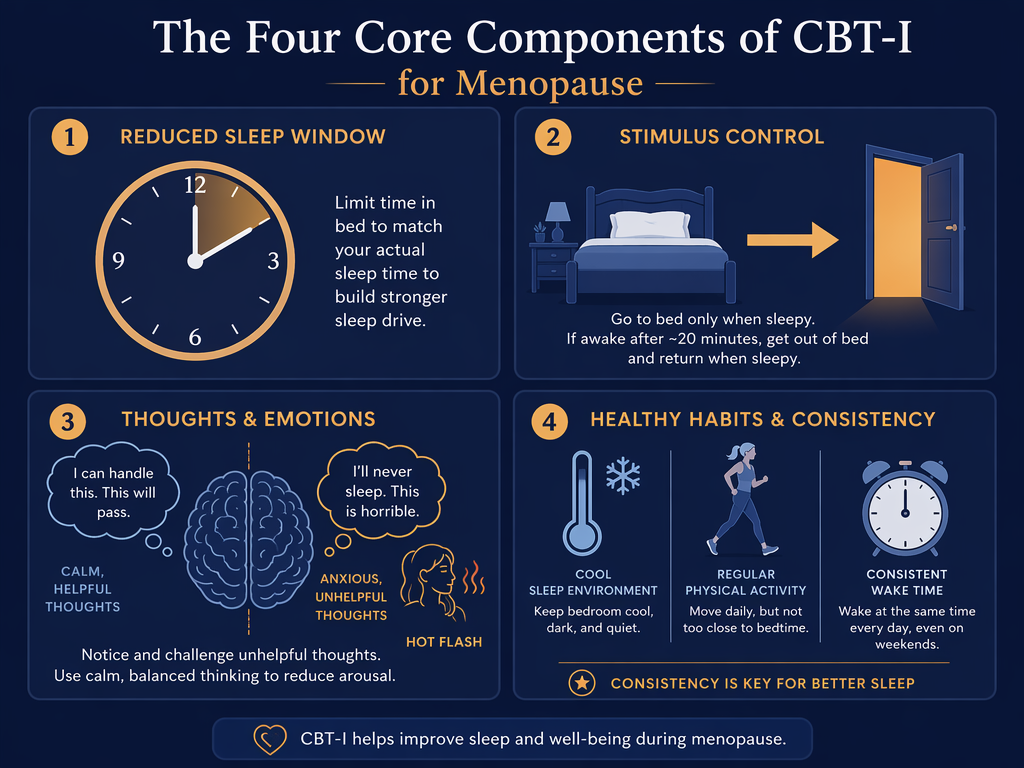
Finally, remember that OTC sleep aids are not a solution for chronic insomnia. According to CDC data from the 2024 National Health Interview Survey (n=31,509 adults), 12.9% of US adults used some form of sleep aid most days or every day, and 5.7% used OTC medications or supplements specifically. OTC use increased with age, reaching 7.6% among adults 65 and older. If you fall into this category of regular users, it is worth asking whether the underlying cause of your sleep difficulties is being addressed. First-line treatment for chronic insomnia is cognitive behavioral therapy for insomnia (CBT-I), not antihistamines.
Comments
Join the discussion with an anonymous comment.