
Introduction: A Brilliant Product That Couldn’t Survive
The Bose Sleepbuds II are a case study in how a product can be technically excellent, well-reviewed, and commercially dead on arrival. Launched in October 2020 at $249.95, the second-generation Sleepbuds fixed nearly every hardware complaint from the disastrous first generation. Reviewers praised the featherlight 1.35g earbuds, the side-sleeper-friendly design, and the immersive noise-masking library. Bose’s own internal study reported that 76% of users found it easier to stay asleep and 8 out of 10 said the buds improved their sleep quality.
Yet by 2023, Bose pulled the plug, citing low adoption. The product that solved the battery nightmare of v1, that earned a 48% five-star rating on Bose’s own product page, that had a 90-night trial — that product was discontinued. Why?
This is not a general retrospective. The existing article on this site covers the broader timeline of what happened and whether the Sleepbuds still work today. This piece is a narrower argument: that the singular fatal design decision was the closed audio system. Bose refused to add Bluetooth streaming, trapping users inside a fixed 35-sound library. At $250, that was a dealbreaker the market could not ignore.
The Battery Disaster That Defined the First Generation
To understand the Sleepbuds II, you have to understand the wreckage of the first generation. The original Bose Sleepbuds, released in 2018, used cutting-edge silver-zinc batteries. The chemistry was supposed to deliver high energy density in a tiny form factor. Instead, it delivered inconsistent battery life, premature battery failure, and charging malfunctions. By 2019, Bose discontinued v1 entirely and issued full refunds to every customer.
The recall was a reputational gut punch. Bose had bet on an exotic battery technology to achieve the all-night runtime that sleep earbuds require, and the bet failed spectacularly. When the engineering team went back to the drawing board for v2, they made a conservative but smart choice: they swapped the silver-zinc cells for a more conventional nickel-metal hydride battery. The result was a stable 10-hour battery life — enough to cover a full night’s sleep with margin to spare.
What the Sleepbuds II Got Right
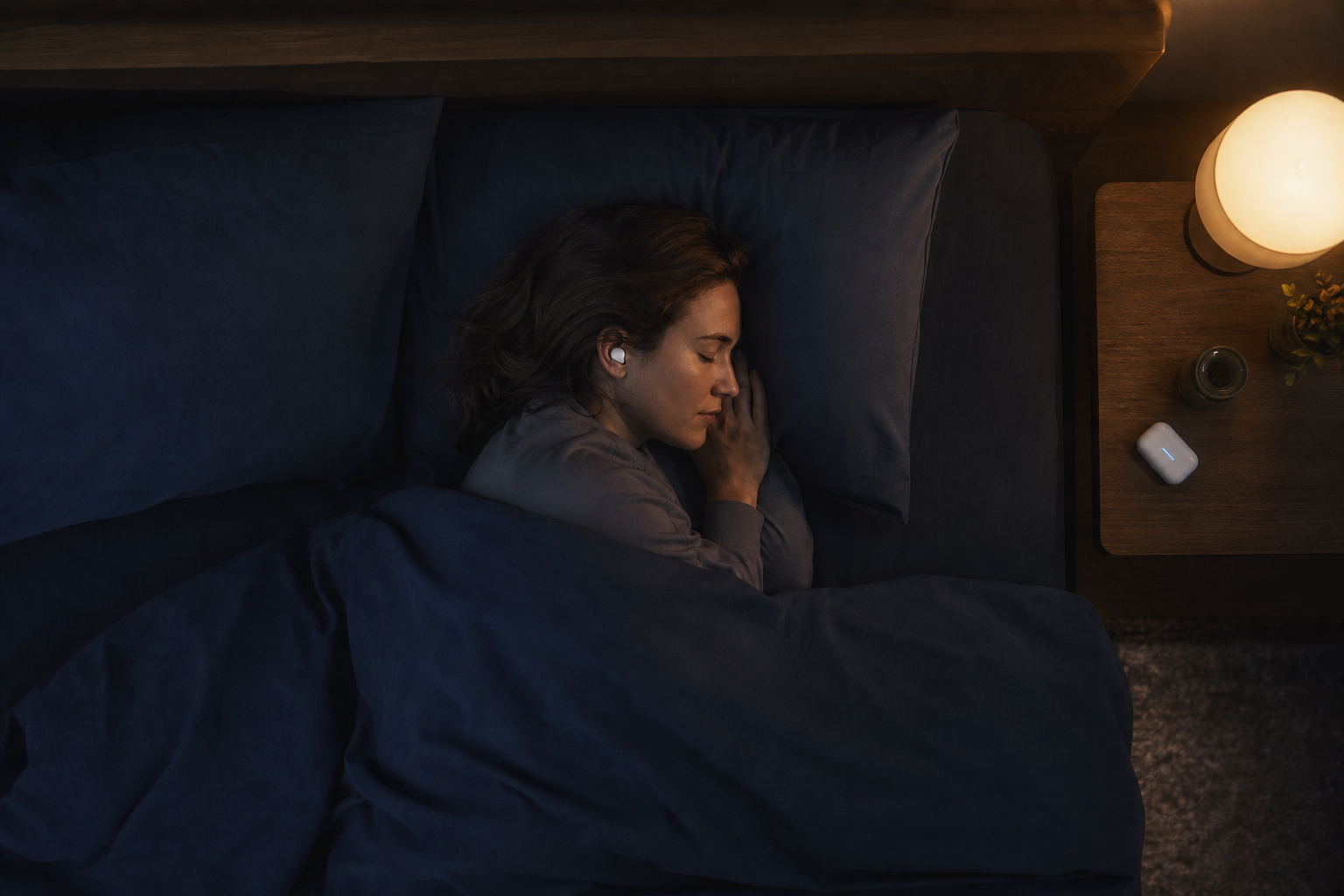
When the Sleepbuds II shipped in October 2020, the hardware improvements were immediately obvious. The buds weighed just 1.35 grams each and measured approximately 6.35mm deep — small enough to sit flush inside the ear canal with no protruding stem. The soft-touch plastic and antifriction coating prompted Engadget’s reviewer to call the fit better than basically any earbud, wireless or otherwise I've ever worn. Dr. Aaron Weiner, a licensed clinical psychologist, tested them and reported they did not fall out once during my testing and created an extremely quiet space in which to sleep.
The charging case held an extra 30 hours of battery life. The sleep sounds library expanded from 10 tracks in the original to 35 tracks across three categories: Noise Making, Naturescapes, and Tranquilities. The buds earned an IPX4 water-resistance rating, meaning they could handle sweat and minor moisture. And Bose backed the product with a 90-night trial period — an unusually long window that signaled confidence.
- Battery life: 10 hours per charge (nickel-metal hydride), case holds 30 additional hours
- Weight: 1.35g per bud, 6.35mm depth — flush fit for side sleeping
- Sound library: 35 tracks across 3 categories (Noise Making, Naturescapes, Tranquilities)
- Water resistance: IPX4
- Trial period: 90 nights
- Price: $249.95
The comfort was not universal — one of Engadget’s two testers, a side sleeper, had to position his pillow just right so that it wasn't shoving them deeper into his ear. But for most users, the Sleepbuds II solved the fundamental physical challenge of sleeping with earbuds: they stayed in place, they did not hurt, and they blocked noise effectively through passive isolation rather than active noise cancellation.
The Fatal Flaw: A Closed Audio System at a $250 Price Point
Here is the decision that killed the Sleepbuds II: Bose chose to build a completely closed audio system. The Sleepbuds could not stream music, podcasts, audiobooks, or any audio from third-party apps. You loaded a selection of soothing sounds from Bose’s library onto the buds, and that was it. No Spotify. No Calm. No Audible. No white-noise generator of your choice. Thirty-five sounds, period.
Engadget’s review was blunt: You can not use them to listen to music or podcasts. You load a selection of soothing sounds on them from Bose's library and... that's it. The review concluded that at $100 or even $150 they might be worth it for someone desperate to block the outside world, but a $250 wearable white-noise machine is borderline absurd.
A user review on Medium from February 2023 put it even more directly: There’s no listening to a Spotify playlist, podcast, or ebook with these. That same review noted that 48% of ratings on Bose’s product page were five stars — but 11% were one star. The one-star reviews were not about comfort or battery life. They were about the closed ecosystem.
The Data Conflict: High Satisfaction vs. Low Adoption
The Sleepbuds II present a paradox that makes the product-design postmortem genuinely interesting. The people who bought them loved them. Bose’s internal study — the same one cited by Dr. Aaron Weiner — reported that 76% of users found it easier to stay asleep and 8 out of 10 said their sleep quality improved. On Bose’s own product page, nearly half of all ratings were five stars.
Yet Bose discontinued the product, stating publicly that the Sleepbuds II did not reach the level of adoption we hoped they would. The company has never released exact sales figures, so we cannot quantify the gap precisely. But the shape of the gap is clear: the people who bought in were satisfied, but not enough people bought in.
| Metric | Value | Source |
|---|---|---|
| Users who found it easier to stay asleep | 76% | Bose internal study (manufacturer-funded) |
| Users who reported improved sleep quality | 8 out of 10 | Bose internal study (manufacturer-funded) |
| 5-star ratings on Bose product page | 48% | User review aggregation (Feb 2023) |
| 1-star ratings on Bose product page | 11% | User review aggregation (Feb 2023) |
| Adoption outcome | Low — product discontinued 2023 | Bose public statement |
The closed-audio flaw explains the paradox. The Sleepbuds II had a narrow but deep appeal: if you were the exact person who wanted only noise-masking sounds, who valued tiny size above all else, and who could afford $250, you were likely to be very satisfied. But that addressable market was too small to sustain the product. Everyone else — the much larger group of people who wanted flexibility, who wanted to fall asleep to a podcast or a playlist, who wanted a device that could serve multiple purposes — chose alternatives.
Aftermath: Ozlo and Soundcore Step Into the Gap
When Bose shut down the Sleepbuds line in 2023, the technology did not disappear. Three former Bose engineers founded a company called Ozlo and acquired the Sleepbuds technology from Bose. The Ozlo Sleepbuds, released at $349, use the same form factor that made the Bose version comfortable for side sleeping, but they add exactly what the Bose version lacked: Bluetooth streaming, sleep tracking, and environmental sensors in the charging case that track room temperature, light levels, and noise.
The Ozlo buds automatically switch from streaming audio to noise-masking when they detect that you have fallen asleep. CNET’s June 2026 roundup named them the Best overall sleep headphones at $349. For a deeper look at how wearable sleep tracking accuracy compares across devices, see our form-factor guide to sleep tracking accuracy.
At the same time, Soundcore (Anker’s audio brand) moved aggressively into the space. The Soundcore Sleep A30, priced around $200, offers Bluetooth 5.4 streaming, active noise cancellation, passive isolation, and adaptive snore-masking that adjusts in real time to block out snoring sounds. The charging case can even monitor and analyze snoring sounds to optimize the masking audio. Battery life runs 8–10 hours with full features enabled, and the buds weigh 3 grams each — slightly heavier than the Bose, but still comfortable for side sleeping.
- Ozlo Sleepbuds ($349): Bluetooth streaming, sleep tracking, environmental sensors, auto-switch to noise-masking on sleep detection. Founded by ex-Bose engineers.
- Soundcore Sleep A30 (~$200): Bluetooth 5.4 streaming, ANC, adaptive snore-masking, snore monitoring via charging case. 8–10 hour battery.
- Soundcore Sleep A20 (~$150): 10-hour battery with streaming, 14 hours with preloaded sounds. Wirecutter’s top pick for blocking noise.
- QuietOn 3.1 ($277): 28-hour battery life, passive noise cancellation only. No streaming.
The market that Bose abandoned is now crowded with options that combine streaming, sleep tracking, and noise masking in a single device. The lesson is clear: consumers will not accept a single-purpose sleep device that locks them out of their own audio library, no matter how comfortable or effective the noise masking is.
What the Market Learned: Single-Purpose Sleep Tech Now Requires Streaming
The Bose Sleepbuds II story is not just a product failure postmortem. It is a signal about what the sleep-tech market now expects. The generation of consumers who grew up with Spotify, podcasts, and on-demand audio will not accept a device that dictates what they can listen to. The closed-audio system was not a niche complaint — it was the central objection in nearly every critical review and user complaint.
The broader implication for sleep tech design is that multi-function capability is no longer optional. Consumers who are willing to spend $200–$350 on sleep headphones expect them to also serve as general-purpose earbuds, sleep trackers, and environmental monitors. The success of Ozlo and Soundcore — both of which combine streaming with sleep-specific features — confirms that the market wants convergence, not specialization.
For a data-driven comparison of how dedicated sleep trackers perform versus multi-purpose wearables, see our accuracy comparison of Oura, Apple, Whoop, Fitbit, and Samsung.
The Bose Sleepbuds II were almost perfect. They fixed the battery disaster. They delivered comfort that reviewers called the best in class. They had a 90-night trial and a library of 35 carefully crafted sounds. But Bose bet that the market would accept a closed system in exchange for tiny size and all-night battery. The market said no. And that single design decision — no Bluetooth streaming — turned a brilliant product into a footnote.
Comments
Join the discussion with an anonymous comment.