

The scale of the problem is bigger than the aisle makes it feel. In 2024, 12.9% of U.S. adults used sleep aids most days or every day, including 5.7% using OTC drugs or supplements, 5.2% using prescription sleep medicines, and 3.7% using marijuana or CBD [1]. That is not a niche habit, and it is not a sign that one product can solve every sleep complaint.

The better question is narrower: what kind of sleep problem is this? Trouble falling asleep, waking through the night, circadian disruption, or insomnia tied to stress and anxiety are not interchangeable. The strongest evidence also does not sit in the place most shoppers start. For chronic insomnia, AASM guidance keeps CBT-I first-line, while melatonin is treated as a timing tool rather than a universal insomnia fix, and common OTC antihistamines do not earn a recommendation for chronic use [2].
Match the sleep aid to the problem
A useful comparison starts with mechanism, not branding. A sedating antihistamine, a circadian signal, a wakefulness-pathway blocker, and a behavioral therapy are all called “sleep aids” in casual conversation, but they are trying to solve different problems. The table below is the practical version of that distinction.
| Sleep problem | Best fit | What matters most |
|---|---|---|
| Chronic insomnia | CBT-I first; if medication is needed, clinician-guided options such as low-dose doxepin or orexin receptor antagonists [2] | This is the case where “best sleep aid” is usually the wrong label. The evidence-supported answer is a treatment plan, not a bottle. |
| Jet lag or delayed sleep phase | Melatonin used for timing [2] | The goal is to shift the body clock, not simply sedate yourself. Product quality still matters [4]. |
| Occasional trouble falling asleep | Sometimes a short-term bridge is used, but OTC antihistamines have weak evidence and higher downside than the packaging suggests [2][5] | Availability is not the same as safety, especially if use starts drifting into most nights. |
| Older age, pregnancy, polypharmacy, or complex comorbidity | Clinician review before self-treatment [5][6] | The risk calculation changes fast when next-day impairment, drug interactions, or anticholinergic burden enter the picture. |
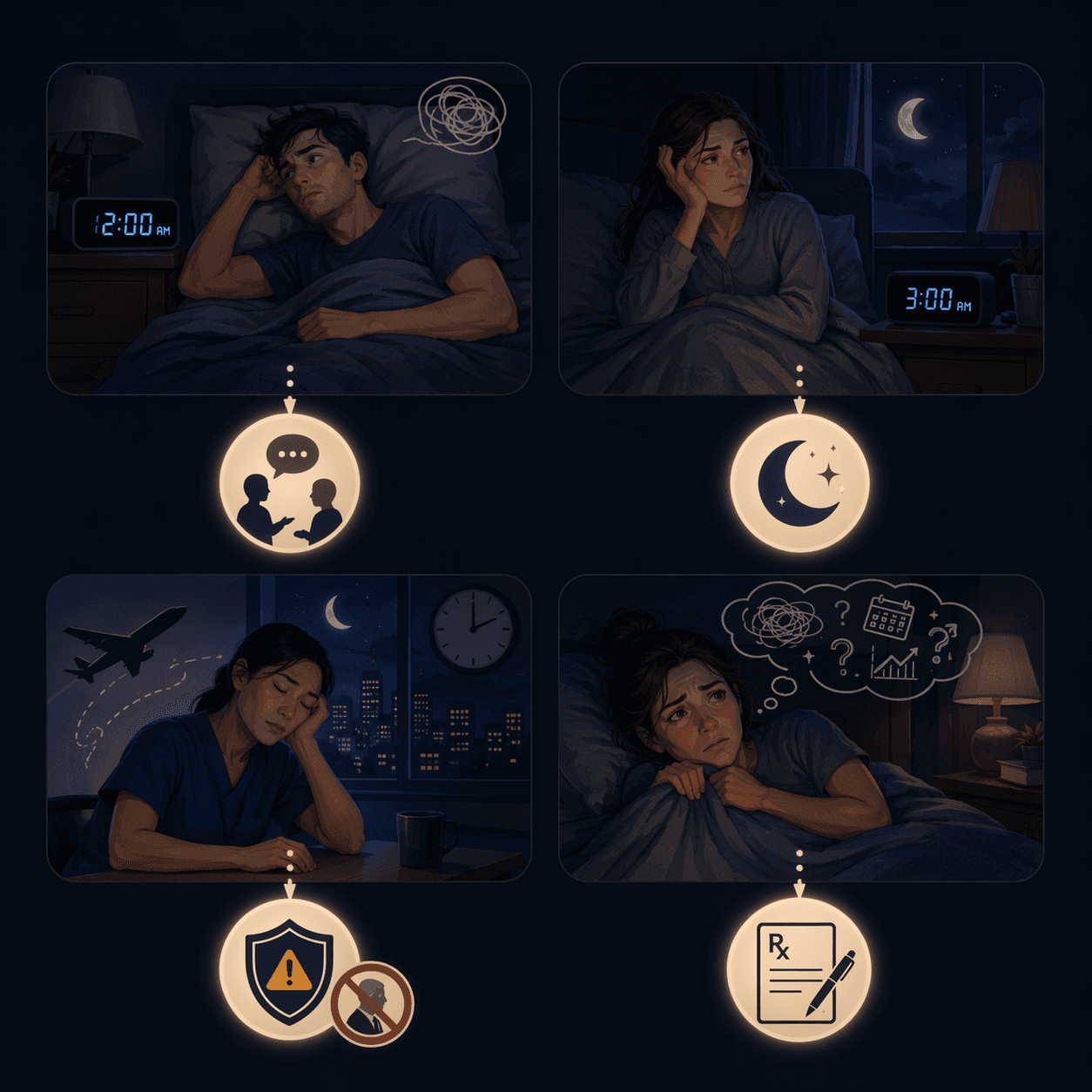
The strongest evidence sits with CBT-I
For chronic insomnia, CBT-I remains the anchor because it treats the pattern that keeps insomnia going, not just the next night’s sleep latency [2]. That matters more than it sounds like it should. Many people reach for a pill because they need something that works tonight, but long-running insomnia often turns into a cycle of conditioned alertness, irregular sleep timing, and growing worry about sleep itself. Medication can still have a role, especially as a short-term or strategic tool, but the main comparison is not “pill versus no pill.” It is whether the intervention is aimed at wakefulness pathways, sleep timing, or the learned insomnia loop.
That is also where the newer prescription options deserve attention. Orexin receptor antagonists such as suvorexant and lemborexant work by dampening wakefulness signaling rather than broadly sedating the brain, and low-dose doxepin has a different profile again [2]. None of that makes them harmless. Cleveland Clinic notes that residual effects are common with prescription sleep medicines, with 79% of users experiencing next-day effects and about 8 out of 10 reporting a hangover effect [7]. For anyone who drives early, works nights, cares for children, or already feels foggy before breakfast, that matters more than the label category.
Why OTC antihistamines are the easiest purchase and the worst habit
Diphenhydramine and doxylamine are familiar because they are everywhere, not because they are strong insomnia treatments. AASM guidance does not recommend them for chronic insomnia, and the main reason is not theoretical purity; it is the mismatch between modest benefit and meaningful downside [2]. They are sedating because they block histamine, but they also bring anticholinergic effects that become more consequential with repeated use. Harvard Health has warned that long-term anticholinergic burden is associated with dementia risk, and Mayo Clinic cautions against using these products in adults 65 and older [6][5].
That older-adult warning is not a minor edge case. It is the difference between a temporary drowsy morning and a medication class that can amplify confusion, falls, dry mouth, urinary retention, and next-day impairment. A person who starts with one bad week of sleep can easily slide into nightly use, especially when the package reads like a mild convenience product. The evidence does not support treating these medicines as low-risk sleep maintenance tools.
Melatonin needs a different question
Melatonin is useful in a much narrower but very real lane: circadian timing problems such as jet lag or delayed sleep phase [2]. That is a different task from keeping someone asleep through the night. It is also why melatonin can look helpful in the wrong comparison. If the problem is that sleep timing is off, a circadian signal is relevant. If the problem is maintenance insomnia, melatonin is usually not the tool you want [2].
The quality issue is the part people miss when they assume a supplement label means a predictable dose. AASM’s summary of supplement testing reported that more than 71% of melatonin products failed to meet label claims within 10%, and a later JAMA analysis found 88% inaccurately labeled; 26% also contained unlabeled serotonin [4]. That does not mean every product is bad. It does mean the label cannot be treated as a guarantee. If melatonin is being used for timing, third-party verification matters, and the dose on the bottle should be treated as a claim, not a fact [4].
What the newer supplement review actually changes
The May 2025 Sleep Medicine scoping review is useful because it pulls together 51 randomized controlled trials across valerian, melatonin, antihistamines, and other OTC or supplement options [3]. It suggests that valerian and melatonin have the largest study footprints among supplement-style aids. That is worth knowing, especially in a market where many products are promoted with little clinical backing. But more studies are not the same as a recommendation for chronic insomnia. The review is best read as calibration: these are the better-studied supplement options, not proof that they outperform CBT-I or clinician-guided prescription therapy for the wrong sleep problem [3].
When the answer is not an OTC aisle decision
The threshold for asking for help should be lower, not higher, when the reader is over 65, pregnant, taking other sedating or interacting medications, living with multiple comorbidities, or dealing with depression or anxiety that is clearly part of the sleep picture [5][6]. Those are the cases where the mechanism, the residual-effect risk, and the possibility of interaction matter more than the convenience of grabbing something after dinner.
That leaves a decision rule that is less glamorous than a ranked list and much more useful: identify the sleep problem first, then match mechanism to that problem, then check evidence strength, next-day impairment, age, pregnancy status, comorbidities, and product reliability before calling anything the best sleep aid. For chronic insomnia, CBT-I usually earns that title. For circadian timing problems, melatonin is the more appropriate tool if the product quality and timing are handled carefully. For routine antihistamine use, the fact that a drug is easy to buy should not be mistaken for proof that it is safe, effective, or worth repeating night after night.
References
- CDC NCHS HESTAT report on adult sleep aid use — CDC National Center for Health Statistics — 2026 — link
- AASM clinical practice guideline for specific insomnia drugs — American Academy of Sleep Medicine — link
- Scoping review of OTC and supplement sleep aids in Sleep Medicine — Sleep Medicine / ScienceDirect — 2025 — link
- AASM study on melatonin supplement content variability — American Academy of Sleep Medicine — link
- Sleep aids — Mayo Clinic — 2026 — link
- Drugstore sleep aids may bring more risks than benefits — Harvard Health — 2018 — link
- Sleeping pills — Cleveland Clinic — link


Comments
Join the discussion with an anonymous comment.