
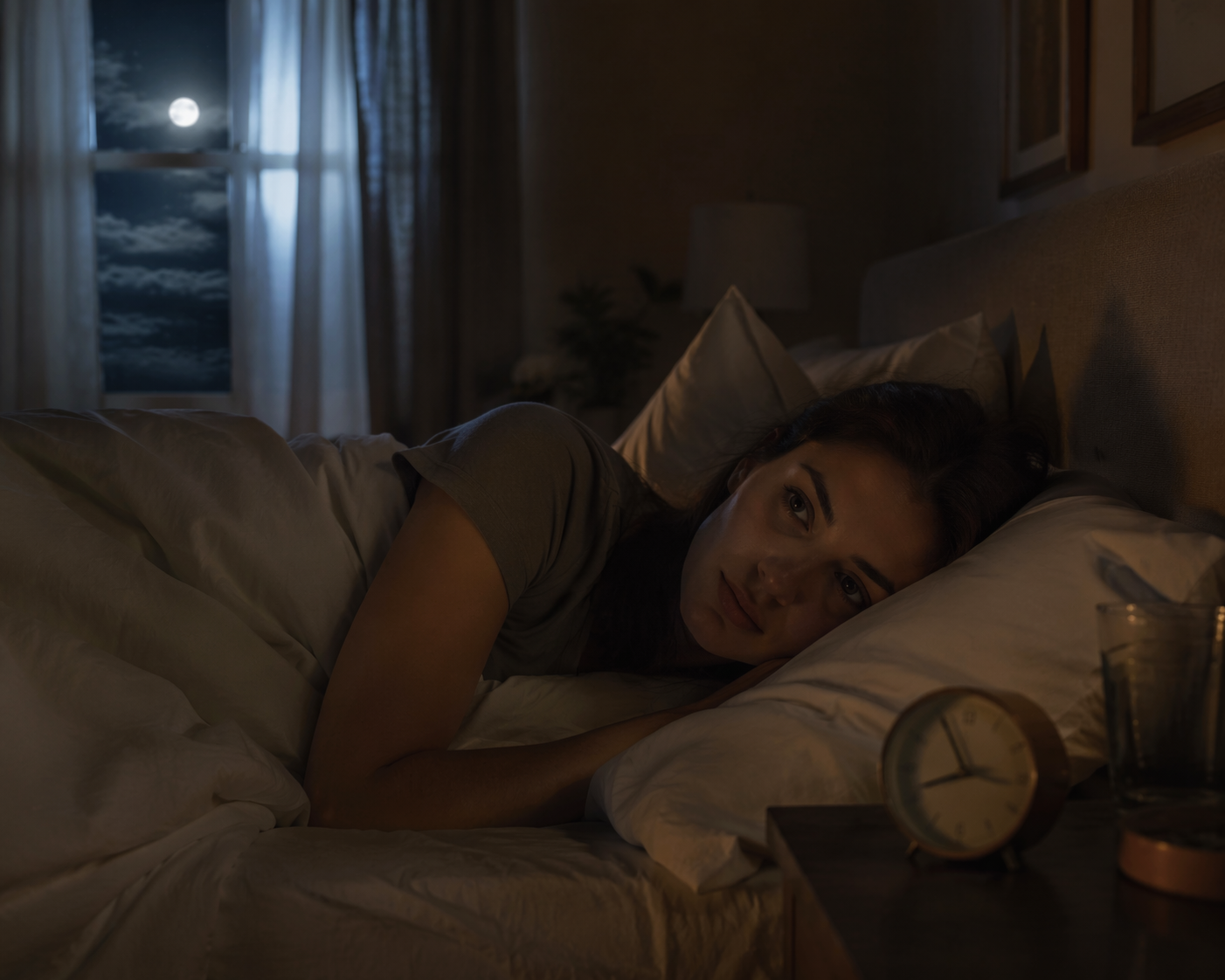

If you are awake right now, the goal is not to win sleep by force. It is to stop the usual loop that makes the bed feel like a place where you have to perform, fail, and try harder. A short burst of calming work is worth trying first; if sleep still does not come, leaving the bed is often the better move.
What to do in the next 20 minutes
Difficulty falling asleep is common. More than 80% of adults sometimes struggle to fall asleep, and 37% say it happens frequently, though that figure comes from consumer SleepScore profiles rather than a controlled population survey [1]. Tonight still feels personal, but it is not proof that something is broken.
- Try slow breathing for a few minutes. Count the exhale longer than the inhale, and keep the pace easy enough that it does not become another task.
- Use progressive muscle relaxation by tightening one small muscle group, then letting it go. Move from feet upward or from face downward.
- Do a body scan or guided imagery if your mind keeps grabbing at the clock. Follow one neutral image or move attention through the body without chasing sleep.
- If a fixed pattern helps, use 4-7-8 breathing or the military method as a structured calming routine, not as a guaranteed cure.
These techniques are best understood as ways to lower arousal in the moment. They can make the next step possible, but they do not treat recurring insomnia on their own [4].
When the bed stops helping
If you are still awake after roughly 15 to 20 minutes, get out of bed. That is the core of stimulus control, one of the clearest parts of CBT-I: the bed should stay linked to sleep, not to staring, bargaining, and getting more alert [2][3]. Leaving is not giving up; it is a way to keep the bed from becoming a training ground for frustration.
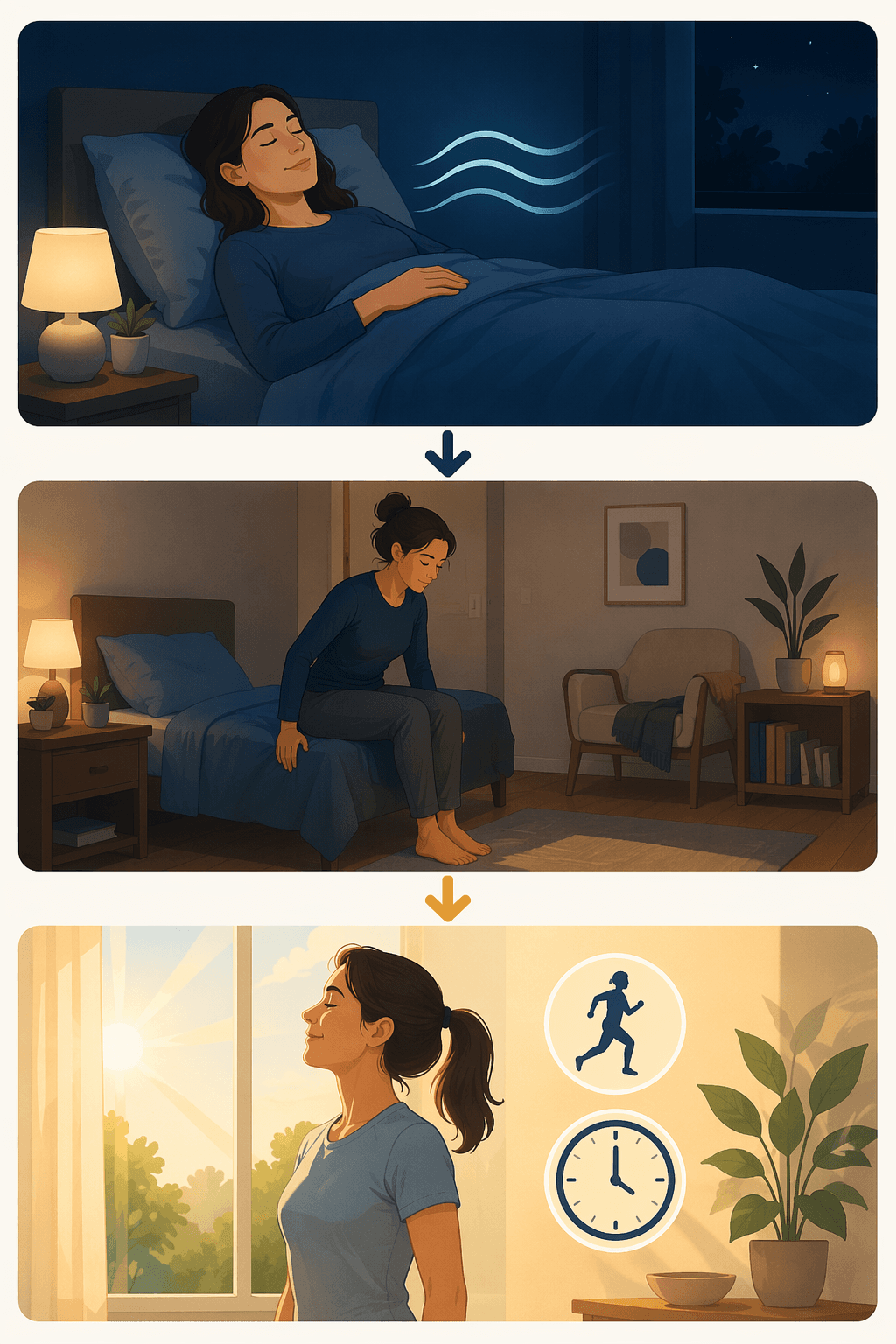
- Go somewhere dim and quiet.
- Do something boring and low-stimulation, such as reading something light, folding laundry, or sitting with a calm audio track.
- Avoid clock-checking and bright light.
- Return to bed only when you feel sleepy again, not merely tired or frustrated.
The point is to make wakefulness less rewarding and sleep more likely to happen in bed. That is why the protocol feels counterintuitive at first and still works better than staying put and trying harder [2][3].
What tomorrow can change
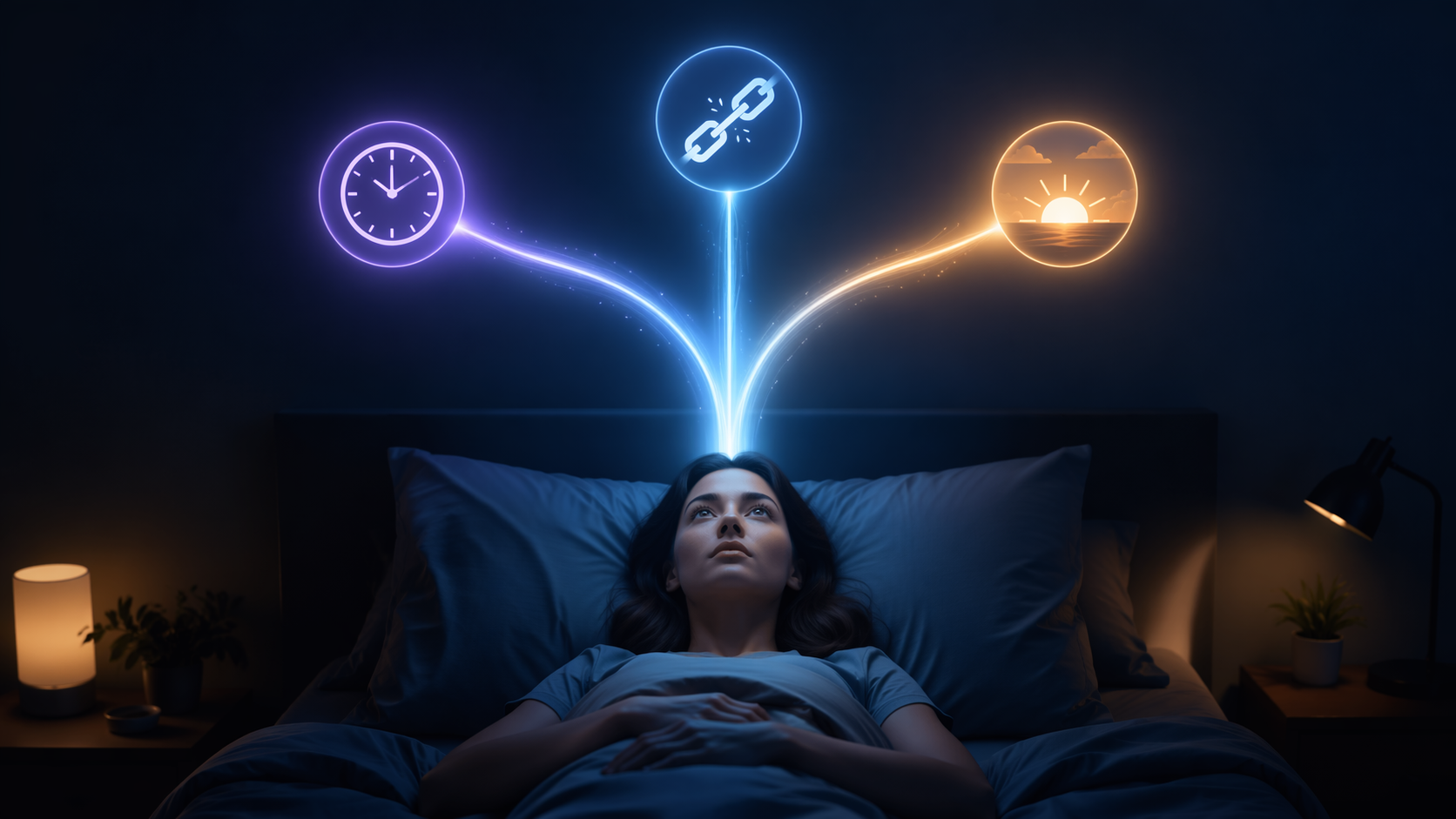
This is not a bedtime lecture about perfect habits. It is the short list of things that make another sleepless night less likely: morning light, a consistent wake time, exercise that does not land too close to bed, and a caffeine cutoff far enough before bedtime to matter.
| Habit | What it tends to do |
|---|---|
| Morning light exposure | Helps anchor the body clock and makes nighttime sleepiness arrive more predictably |
| Consistent wake time | Keeps the sleep window steadier, even after a bad night |
| Exercise timing | Supports sleep better when it is not too close to bedtime |
| Caffeine cutoff | Reduces the chance that alertness is still active when you want to sleep |
Harvard Health identifies morning sunlight, exercise timing, caffeine timing, and consistent wake time as some of the most important long-term levers for sleep [5]. If you want the mechanism behind those habits, Sleep Hygiene Fundamentals and The Hidden Limits of Sleep Hygiene are useful next reads.
For a broader comparison of which habits tend to matter most, Ranked by Evidence: Which Sleep Tips Actually Work can help sort the noise from the useful parts.
When this is no longer a one-off night
If trouble sleeping happens at least three nights a week for at least three months, it meets the usual definition of chronic insomnia [6]. At that point, it is worth treating the problem as a pattern instead of a bad night that keeps repeating.
The American Academy of Sleep Medicine says behavioral and psychological treatment, especially CBT-I, is the first-line approach for insomnia [7]. If the same cycle keeps returning, CBT-I Framework for Chronic Insomnia is the more relevant next step than another night of trying to outlast wakefulness.
References
- 126 Sleep Statistics: Facts and Data About Sleep 2026 — Sleep Foundation — https://www.sleepfoundation.org/how-sleep-works/sleep-facts-statistics
- Insomnia: What It Is, Causes, Symptoms & Treatment — Cleveland Clinic — https://my.clevelandclinic.org/health/diseases/12119-insomnia
- Cognitive Behavioral Therapy for Insomnia (CBT-I): What It Is — Cleveland Clinic — https://my.clevelandclinic.org/health/treatments/cognitive-behavioral-therapy-insomnia
- What to Do When You Can't Sleep — Sleep Foundation — https://www.sleepfoundation.org/insomnia/treatment/what-do-when-you-cant-sleep
- Top 4 reasons why you're not sleeping through the night — Harvard Health — https://www.health.harvard.edu/sleep/top-4-reasons-why-youre-not-sleeping-through-the-night
- Survey shows 12% of Americans have been diagnosed with chronic insomnia — AASM — https://aasm.org/survey-shows-12-of-americans-have-been-diagnosed-with-chronic-insomnia/
- New guideline supports behavioral, psychological treatments for insomnia — AASM — https://aasm.org/new-guideline-supports-behavioral-psychological-treatments-for-insomnia/


Comments
Join the discussion with an anonymous comment.