
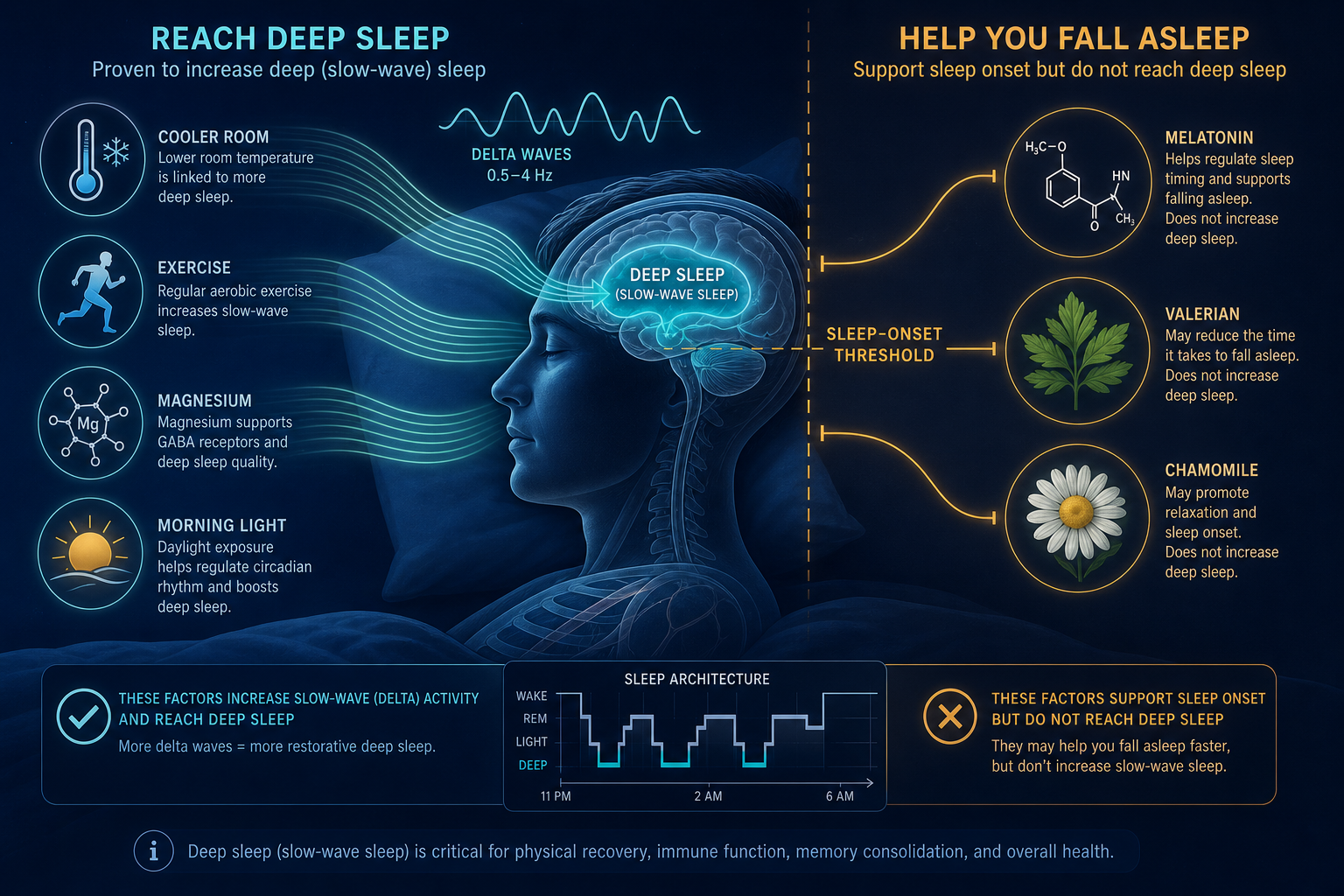
Why Deep Sleep Matters — and the 13–23% Benchmark
Deep sleep, also called slow-wave sleep or N3, is the stage your body uses for physical restoration. During this phase, your pituitary gland releases growth hormone for tissue repair, your glymphatic system clears metabolic waste from the brain, and your immune system strengthens its defenses. Without adequate deep sleep, you wake up feeling unrefreshed even if you spent enough total hours in bed.
Adults typically spend 13–23% of total sleep time in deep sleep, according to clinical benchmarks cited by Ubie Health. That percentage declines with age — a 60-year-old may get half the slow-wave sleep of a 20-year-old — but lifestyle factors exert a powerful influence on how much you actually get. A person who exercises regularly, eats at consistent times, and keeps a cool bedroom can maintain a higher proportion of deep sleep well into later decades.
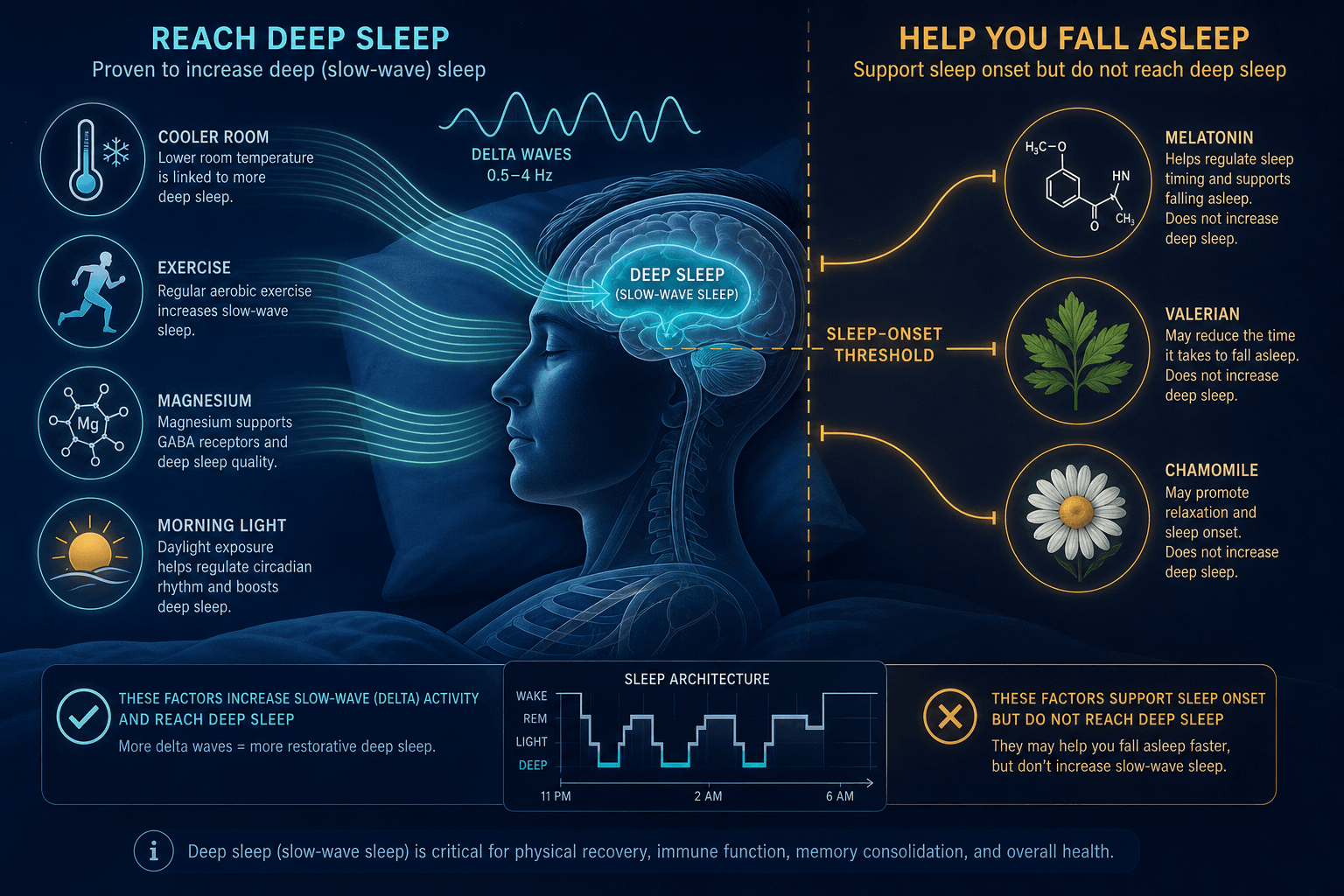
Remedies That Increase Deep Sleep: The Evidence
Four interventions have clinical data supporting their ability to increase slow-wave sleep specifically. They work through different mechanisms — mineral supplementation, amino acid modulation, metabolic conditioning, and thermoregulation — and they can be combined into a single nightly routine.
Magnesium Glycinate: The 500 mg RCT in Older Adults
A 2012 double-blind randomized controlled trial published in the Journal of Research in Medical Sciences (Abbasi et al.) gave 46 older adults 500 mg of magnesium daily for eight weeks. The results, cited in a 2024 PMC literature review by Yeom and Cho, showed significant increases in sleep time, sleep efficiency, and serum melatonin, along with reductions in the Insomnia Severity Index score, sleep onset latency, and serum cortisol. The magnesium group also had higher renin levels, which may help regulate sleep-wake cycles.
The form matters. Magnesium glycinate (magnesium bound to the amino acid glycine) is better absorbed and less likely to cause digestive upset than magnesium oxide or citrate. The 500 mg dose used in the trial is at the upper end of the typical range; starting at 200–300 mg and titrating up is reasonable for most adults.
Glycine: 3 g Before Bed with Polysomnography Data
Glycine is an amino acid that acts as an inhibitory neurotransmitter. A 2006 study found that 3 g of glycine before bed reduced next-morning fatigue, and a 2007 polysomnography study (Yamadera et al., Sleep and Biological Rhythms) showed improvements in objective sleep quality and faster sleep onset, as reported by Healthline. Unlike magnesium, which works partly through cortisol reduction, glycine appears to promote a core body temperature drop that facilitates slow-wave sleep entry.
Glycine is available as a standalone powder or capsule. The 3 g dose is well-tolerated and can be taken 30–60 minutes before bed. Because glycine is sweet, some people prefer capsules over powder mixed into water.
Moderate Aerobic Exercise: 150 Minutes Per Week
The Cleveland Clinic recommends 150 minutes of moderate-intensity aerobic exercise per week to boost slow-wave sleep. The mechanism is metabolic: exercise increases adenosine accumulation in the brain, and adenosine drives sleep pressure that preferentially deepens slow-wave sleep during the first half of the night.
Timing is critical. Intense workouts should finish at least three hours before bed. Late-evening high-intensity exercise raises core temperature and cortisol, both of which oppose the physiological conditions needed for deep sleep. A morning or early afternoon workout window is ideal for maximizing slow-wave sleep gains.
Cool Bedroom Temperature: 60–67°F (15–19°C)
Both the Cleveland Clinic and Ubie Health recommend a bedroom temperature of 60–67°F (15–19°C) for optimal deep sleep. The body's core temperature must drop by about 1–2°F to initiate and maintain slow-wave sleep. A warm room above 72°F prevents this natural decline, reducing both the duration and intensity of N3 sleep.
Practical adjustments include lowering the thermostat before bed, using breathable bedding, and taking a warm bath 60–90 minutes before sleep — the post-bath temperature drop accelerates core cooling and signals the brain to enter deep sleep.
Morning Light Exposure as a Circadian Anchor
Deep sleep is not just a nighttime phenomenon — it is regulated by your circadian clock, which is set by morning light. Ubie Health recommends 10–20 minutes of natural light within 30–60 minutes of waking. Morning light exposure advances the circadian phase, making it easier to fall asleep earlier and increasing the proportion of slow-wave sleep in the first sleep cycle.
| Intervention | Dose / Frequency | Evidence Source | Key Finding |
|---|---|---|---|
| Magnesium glycinate | 500 mg daily (8 weeks) | 2012 RCT (Abbasi et al.), cited in PMC 2024 review | Increased sleep time, sleep efficiency, serum melatonin; reduced ISI score and cortisol |
| Glycine | 3 g before bed | 2007 polysomnography study (Yamadera et al.) | Improved objective sleep quality and reduced next-day fatigue |
| Moderate aerobic exercise | 150 mins/week, finish 3+ hrs before bed | Cleveland Clinic | Boosts slow-wave sleep via adenosine accumulation |
| Cool bedroom | 60–67°F (15–19°C) | Cleveland Clinic, Ubie Health | Facilitates core temperature drop required for N3 sleep |
| Morning light exposure | 10–20 mins within 30–60 mins of waking | Ubie Health | Anchors circadian rhythm, increases early-night slow-wave sleep |
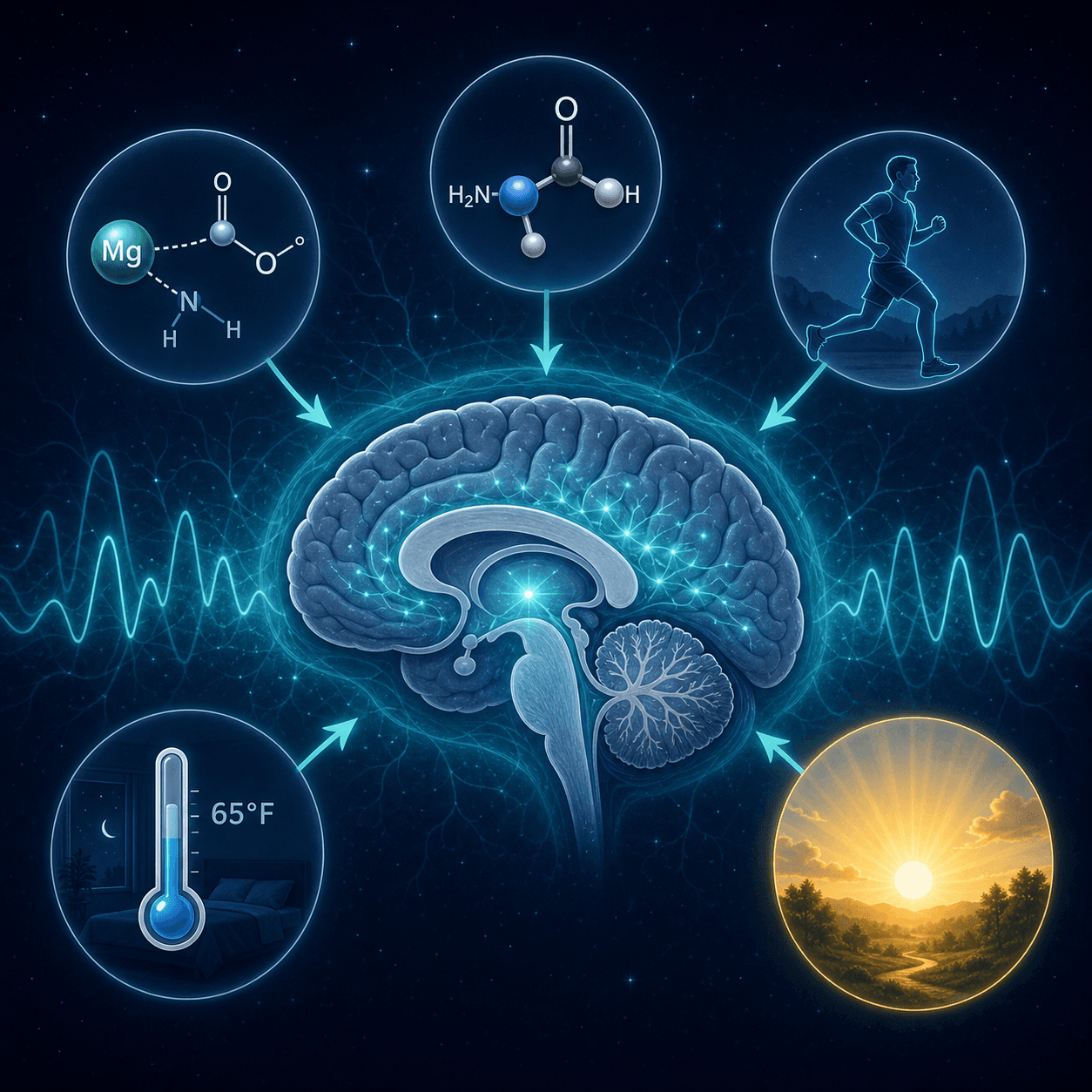
Remedies That Help You Fall Asleep — But Don't Increase Deep Sleep
Several popular natural sleep aids improve sleep onset and subjective sleep quality without measurably increasing deep sleep percentage. This distinction matters for anyone tracking sleep stages with a wearable: a supplement that helps you fall asleep faster may not move your deep sleep number at all.
Melatonin
Melatonin is effective for reducing sleep latency and managing jet lag or shift work, but both the Cleveland Clinic and Ubie Health state that melatonin does not increase deep sleep percentage in most healthy adults. Melatonin signals the brain that it is time to sleep, but it does not drive the neural oscillations that produce slow-wave activity. A combination supplement of 5 mg melatonin, 225 mg magnesium, and 11.25 mg zinc improved PSQI scores in a 2011 study of 43 older adults (Rondanelli et al.), but the improvement was in overall sleep quality, not deep sleep specifically.
Valerian Root
The 2024 PMC literature review found that valerian improves subjective sleep quality (standardized mean difference -0.70) and reduces sleep latency (SMD -0.71) across 16–18 RCTs. However, the review notes that all outcomes were subjective — no trials measured deep sleep architecture as a primary endpoint. Valerian may be useful for someone who lies awake for an hour before falling asleep, but it should not be expected to increase N3 sleep.
Chamomile
German chamomile has limited clinical evidence for sleep. The PMC review identifies only two RCTs — one in older adults and one in postpartum women — both using subjective PSQI scores. No objective data on deep sleep exists for chamomile. It remains a mild, low-risk option for promoting relaxation before bed, but it will not increase your slow-wave sleep percentage.
| Remedy | What It Does Well | What It Does Not Do | Evidence Quality |
|---|---|---|---|
| Melatonin | Reduces sleep latency; useful for jet lag and shift work | Does not increase deep sleep % in most healthy adults | RCT-supported for onset; absent for deep sleep |
| Valerian root | Improves subjective sleep quality (SMD -0.70); reduces sleep latency (SMD -0.71) | No trials measure deep sleep specifically | Meta-analysis of 16–18 RCTs; subjective outcomes only |
| Chamomile | May improve relaxation and subjective sleep quality | No objective deep sleep data | Limited: 2 RCTs, subjective PSQI only |
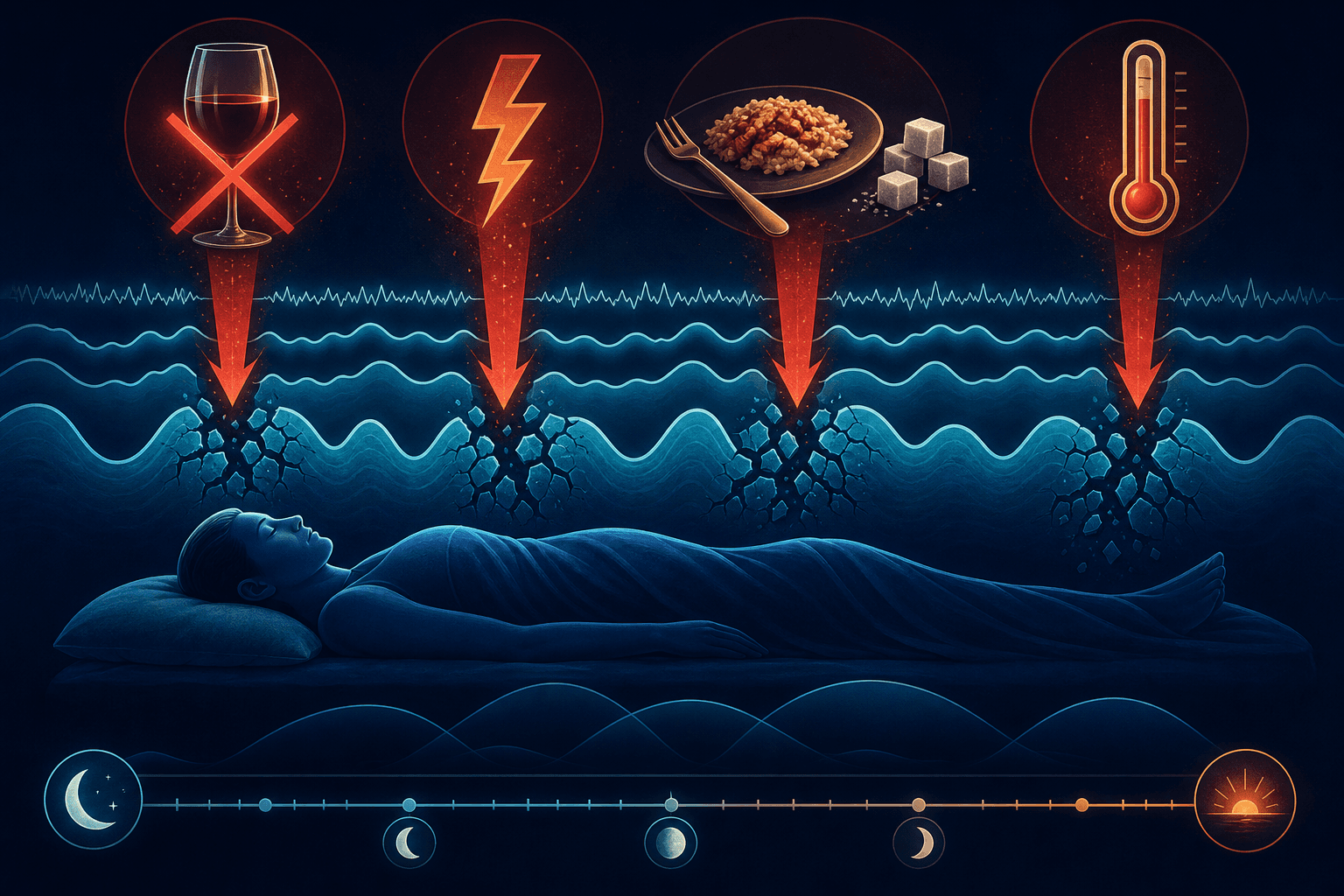
What Actively Suppresses Deep Sleep
Even if you adopt every evidence-based intervention above, certain lifestyle factors can override their benefits and actively reduce slow-wave sleep. These four suppressors are well-documented and worth auditing before adding supplements.
- Alcohol within 3–4 hours of bedtime. Alcohol is a central nervous system depressant that increases sleep pressure initially, but as it metabolizes, it fragments sleep architecture. The Cleveland Clinic notes that alcohol delays REM sleep in the first half of the night and causes more awakenings in the second half. Ubie Health specifies a 3–4 hour window: a drink at 9 PM can still suppress slow-wave sleep at midnight.
- Late high-sugar meals. Eating a meal high in refined carbohydrates or sugar within two hours of bed raises blood glucose and insulin, which suppresses growth hormone release and shifts autonomic balance toward sympathetic activation. Both effects reduce slow-wave sleep duration.
- Late-night intense exercise. While regular exercise boosts deep sleep, high-intensity training within three hours of bed raises core temperature and cortisol. The Cleveland Clinic advises finishing intense workouts at least three hours before bed. Evening yoga or light stretching is fine; HIIT or heavy lifting is not.
- Warm sleeping environment above 72°F. A bedroom above 72°F prevents the core temperature drop required for slow-wave sleep. Both the Cleveland Clinic and Ubie Health recommend 60–67°F. Even a few degrees above this range can reduce N3 sleep by 10–20% in a single night.
A Practical Nightly Protocol for Increasing Deep Sleep
The following sequence combines the evidence-based interventions from this review into a single routine. It is designed to be layered gradually — adopt one or two changes at a time rather than overhauling everything at once.
- Morning (within 30–60 minutes of waking): Get 10–20 minutes of natural light exposure. Open the blinds, go outside, or eat breakfast near a window. This anchors your circadian clock and increases the drive for slow-wave sleep later that night.
- Afternoon (before 3 PM): Complete your moderate aerobic exercise for the day. A 30–45 minute walk, jog, or cycling session at a conversational pace is sufficient. Finish at least three hours before your target bedtime.
- Evening (2–3 hours before bed): Eat your last meal. Avoid high-sugar or high-carb foods. Lower the thermostat to 65°F (18°C). Take a warm bath or shower 60–90 minutes before bed to accelerate the post-bath temperature drop.
- 30–60 minutes before bed: Take 200–500 mg magnesium glycinate and/or 3 g glycine. Start at the lower end of the magnesium range and increase gradually. Glycine can be taken as a powder mixed in water or in capsule form.
- At bedtime: Ensure the bedroom is dark, quiet, and between 60–67°F. Avoid screens for at least 30 minutes before lights out. If you use a wearable, check your deep sleep percentage in the morning — but do not obsess over single-night fluctuations.
When to See a Doctor
If you have consistently low deep sleep despite optimizing exercise, temperature, light exposure, and supplement timing for at least four weeks, an underlying sleep disorder may be the cause. Conditions that specifically reduce slow-wave sleep include:
- Obstructive sleep apnea (OSA): repeated airway collapses fragment sleep architecture and prevent sustained slow-wave activity. If you snore loudly, wake gasping, or have been told you stop breathing during sleep, a sleep study is warranted.
- Restless legs syndrome (RLS): the urge to move your legs at night delays sleep onset and prevents the sustained immobility required for deep sleep.
- REM behavior disorder: acting out dreams during REM sleep can reduce total sleep quality and may be an early sign of neurodegenerative conditions.
A primary care physician or sleep specialist can evaluate these conditions with tools like the Insomnia Severity Index, Epworth Sleepiness Scale, or a home sleep apnea test. This article is educational and does not substitute for clinical evaluation. If you suspect a sleep disorder, seek professional care rather than continuing to self-treat with supplements.
Comments
Join the discussion with an anonymous comment.