
The confusing part of levetiracetam sleep effects is that the complaints can sound as if they contradict each other. One person feels drugged and heavy in the morning. Another says they keep waking up. Someone else sleeps a normal number of hours but says the sleep does not feel deep. Clinically, that mix is not strange: the NHS lists drowsiness as the most common side effect of levetiracetam, affecting more than 1 in 10 people, while Mayo Clinic also lists trouble sleeping as a possible side effect.[1][2]
The sleep-lab evidence points to a more specific answer than “it makes you sleepy” or “it causes insomnia.” Levetiracetam may leave total sleep time and sleep efficiency relatively preserved while changing the internal structure of the night: less N3 slow-wave sleep, less REM sleep, more lighter N2 sleep, and more awakenings. That pattern can make an adequate-looking night feel thinner, more interrupted, or less restorative.
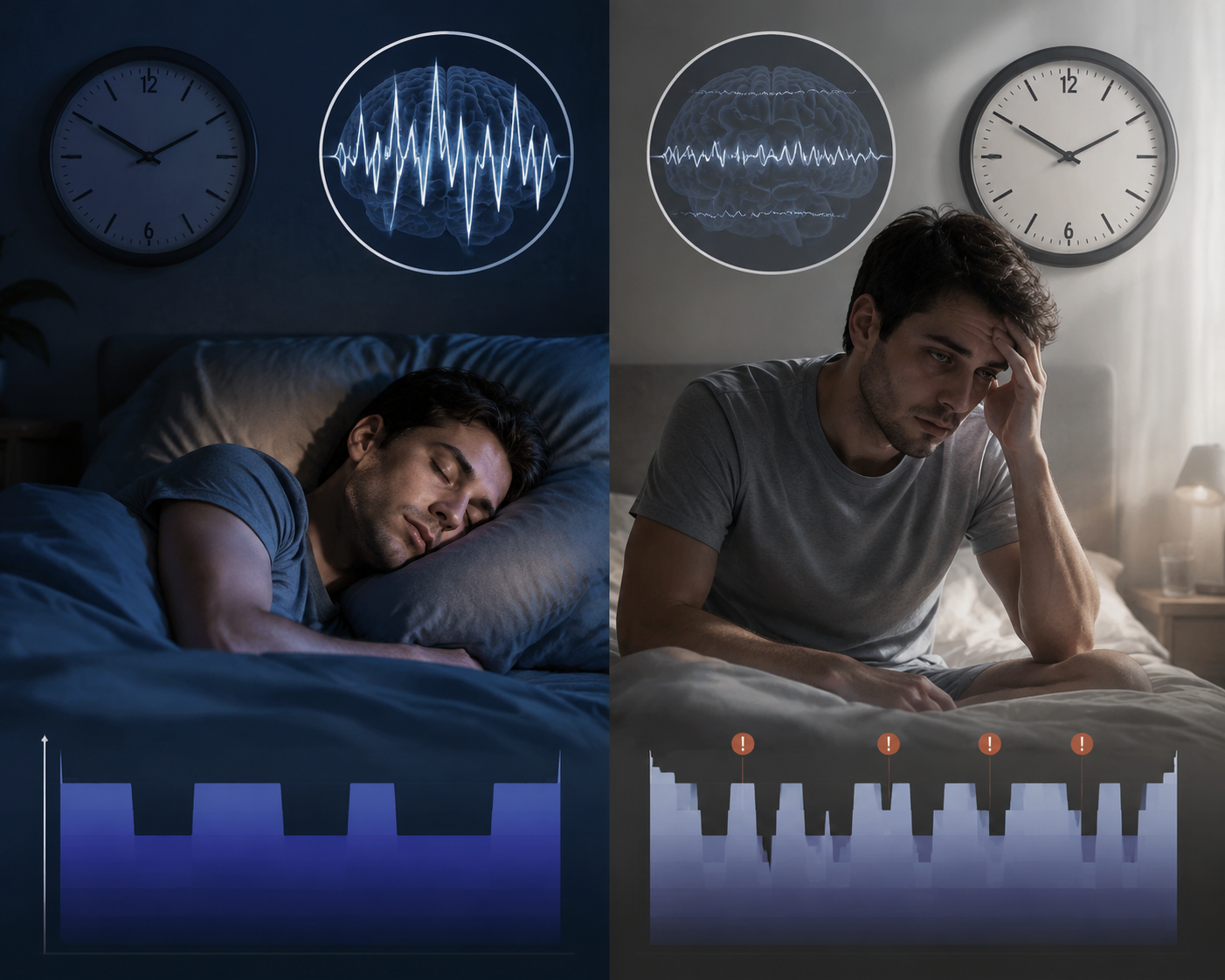
Sleep Duration Is Not the Same as Sleep Architecture
A sleep report can look reassuring if it focuses only on the broad measures. Total sleep time asks how long you slept. Sleep efficiency asks how much of your time in bed was spent asleep. Those numbers matter, but they do not tell you how the night was built.
Polysomnography, or PSG, separates sleep into stages. N2 is lighter non-REM sleep; it is real sleep, but not the deep slow-wave sleep most people have in mind when they say they “slept hard.” N3 is slow-wave sleep, the stage associated with high-amplitude delta activity and the kind of depth that is hard to replace with extra time in bed. REM sleep is the dreaming-associated stage with its own brain and body physiology. Awakenings count interruptions, including ones a person may not fully remember.
That distinction matters for levetiracetam because several studies do not show a simple collapse of sleep duration. Instead, they show a redistribution. A person may spend enough time asleep but spend less of that time in N3 and REM, more of it in N2, and more of the night briefly awake.
| Measure | What it captures | Why it matters for levetiracetam |
|---|---|---|
| Total sleep time | How long the person slept | May remain relatively preserved even when sleep feels different |
| Sleep efficiency | Percent of time in bed spent asleep | Can look acceptable while stage proportions shift |
| N2 sleep | Lighter non-REM sleep | May increase when deeper stages shrink |
| N3 sleep | Slow-wave deep sleep | Has shown measurable reduction in epilepsy patients taking levetiracetam |
| REM sleep | Dreaming-associated sleep stage | Has shown reduction across levetiracetam studies |
| Awakenings | Brief or remembered interruptions | May increase even when the person still logs enough sleep |
| MSLT | Objective tendency to fall asleep during daytime nap opportunities | May not match a patient’s subjective fatigue or unrefreshing sleep |
The clearest patient-facing signal: less N3 and more awakenings
One of the most concrete PSG findings comes from a 2022 study of 25 adults with epilepsy evaluated before and after 3 months of levetiracetam at 2000 mg/day. Median N3 slow-wave sleep fell from 12.4% to 5.9%, a statistically significant reduction, and median nighttime awakenings increased from 72 to 123.[3]
Those numbers are small-study numbers, so they should not be treated as a universal prediction for every person taking levetiracetam. They are still clinically useful because they describe exactly the kind of complaint that otherwise gets flattened into vague language. “I slept, but it didn’t feel deep” is not necessarily a contradiction. In that study, the amount of deep slow-wave sleep was cut by more than half as a proportion of the night, while awakenings rose substantially.[3]
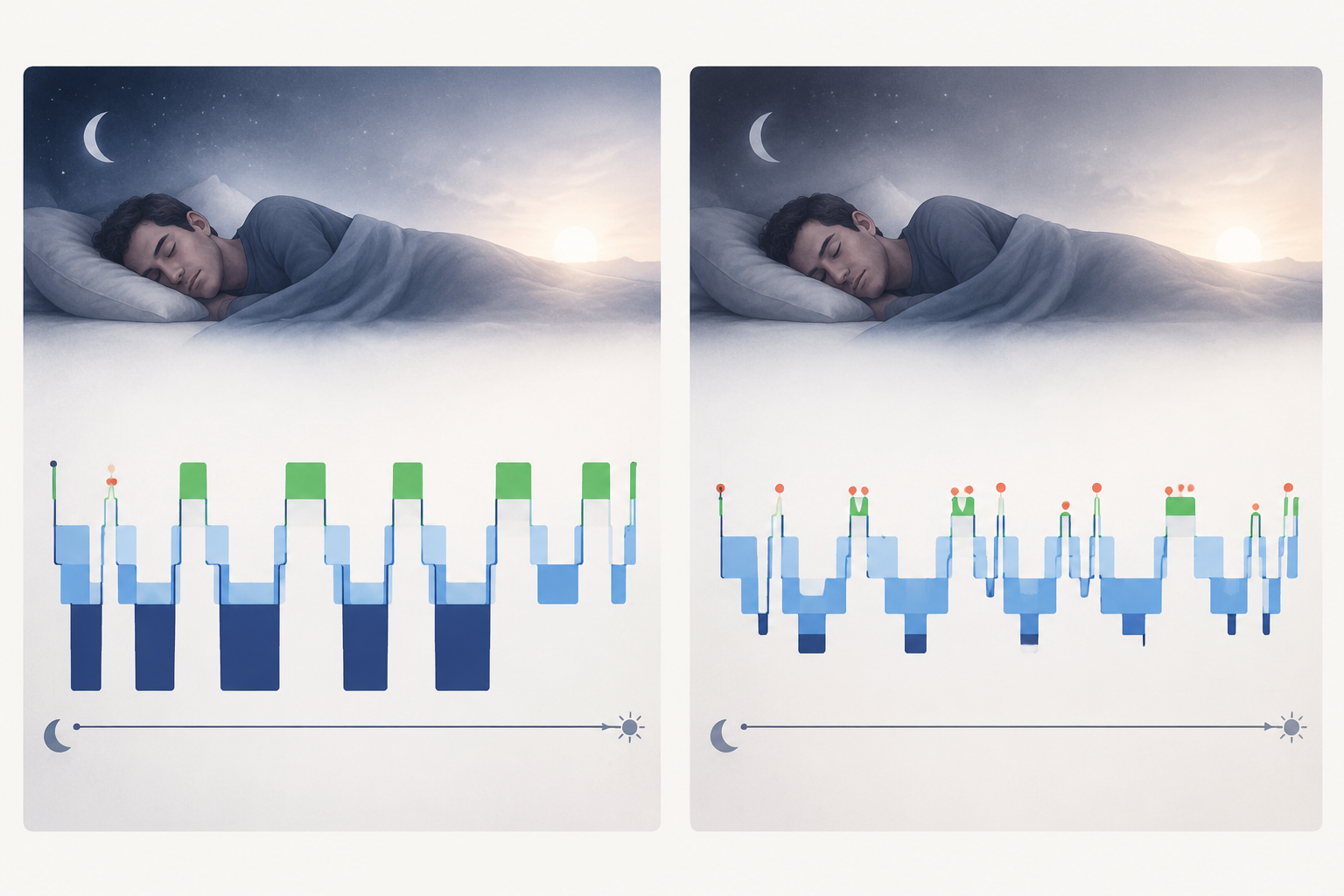
The important point is not that levetiracetam proves itself harmful every time N3 falls. Epilepsy itself can disturb sleep, seizures can fragment the night, and medication timing, monitoring anxiety, and daytime vigilance all sit in the background. The point is narrower and better supported: in PSG data, levetiracetam can be associated with a measurable shift away from deeper sleep and toward a more interrupted night.
REM reduction is the more reproducible pattern
The strongest overview comes from a 2022 systematic review and meta-analysis of 63 studies on antiseizure medications and sleep architecture. Its broad conclusion was that newer antiseizure medications tend to have less impact on sleep architecture than older classic drugs, but levetiracetam stood out for reducing REM sleep.[4]
That distinction is useful because “newer” and “sleep-friendly” can become too reassuring if they are used carelessly. A medication can be easier on sleep than some alternatives and still alter a specific sleep stage. REM reduction is not the same as total insomnia, and it is not the same as sedation. It is a stage-level change.
A healthy-volunteer study by Cicolin and colleagues gives one example of the REM finding: REM sleep fell from 17.55% to 14.99% on levetiracetam, while the Multiple Sleep Latency Test did not show a significant increase in objective daytime sleepiness.[5]
That combination matters. If a patient says they feel unrefreshed, and a daytime sleepiness test does not show pathological sleepiness, the complaint has not been disproved. The MSLT asks a specific question: how quickly does this person fall asleep under standardized daytime nap conditions? It does not fully measure whether the prior night had enough N3, enough REM, or too many interruptions.
More N2 can make sleep look preserved while feeling lighter
When N3 and REM shrink, the night does not simply disappear. Time can be redistributed into lighter non-REM sleep, especially N2. That is one reason levetiracetam can appear relatively benign on global sleep measures while still changing how the night feels.
N2 is not “bad sleep.” It normally makes up a large part of adult sleep. The problem is proportion. If a person spends more of the night in lighter sleep and less in slow-wave or REM sleep, they may be easier to wake, more aware of disruptions, or less likely to describe the night as restorative. PSG can detect that redistribution when total sleep time alone cannot.
This is where many side-effect lists become too blunt. Drowsiness and insomnia are often listed as separate reactions, which is administratively convenient but physiologically incomplete. A drug that changes stage proportions can plausibly leave someone tired during the day and also leave them aware of repeated awakenings at night. The same architecture shift can make both complaints understandable.
Awakenings are not a minor detail
Awakenings deserve more attention than they usually get. In the Chaneva and Viteva epilepsy study, median awakenings rose from 72 to 123 after 3 months of levetiracetam.[3] In a randomized placebo-controlled crossover study of 14 healthy volunteers, Bazil and colleagues also found that levetiracetam significantly increased nighttime awakenings compared with placebo.[6]
The healthy-volunteer finding is helpful because it reduces, though does not eliminate, the problem of epilepsy as a confound. If awakenings increase in people without epilepsy under controlled conditions, that supports the possibility of a drug-related effect. The epilepsy-patient data remain essential because they show what the issue looks like in the population actually taking the medication for seizure control.
Not every awakening is remembered. Some are brief EEG-defined interruptions; others are long enough for the person to notice the clock, worry about the next day, or become fully alert. A night with many short interruptions can still produce a respectable total sleep time if the person falls back asleep quickly. That is how a sleep diary, a PSG report, and a morning complaint can seem to tell different stories while all being partly right.
Why drowsiness, insomnia, and a normal MSLT can coexist
The most common real-world complaint is still drowsiness. The NHS describes feeling drowsy, sleepy, or dizzy as the most common side effect of levetiracetam and notes that it often improves after 1 to 2 weeks.[1] That statement is about clinical side effects as patients experience and report them; it is not a PSG claim about N3, REM, or awakenings.
Mayo Clinic’s listing of trouble sleeping belongs beside that, not opposite it.[2] Insomnia does not always mean a person got almost no sleep. It can mean trouble falling asleep, trouble staying asleep, early waking, or sleep that feels insufficient. If levetiracetam increases awakenings or shifts time toward lighter stages, the complaint of insomnia can coexist with daytime heaviness.
The MSLT adds another layer. In the Cicolin healthy-volunteer study, levetiracetam did not significantly increase objective sleepiness on MSLT despite the REM reduction.[5] That does not make patient fatigue imaginary. It means the person may not have the specific form of physiological sleep propensity that the MSLT is designed to measure. Fatigue, mental fog, low energy, unrefreshing sleep, and a short sleep latency on a nap test are related but not identical.
This distinction is especially important for epilepsy patients. Sleep can already be affected by seizures, nocturnal events, antiseizure medication schedules, anxiety about breakthrough seizures, and the practical burden of staying alert during the day. A sleep change that appears after levetiracetam starts or increases deserves attention, but it should not be automatically assigned to the drug without looking at seizure activity, timing, other medications, and the sleep pattern itself.
What the smaller studies add, and what they cannot prove
Individual PSG studies of levetiracetam are small, with samples ranging from 6 to 52 participants. That is one reason the 2022 systematic review is the steadier source for the overall architecture pattern.[4] Small studies can identify a signal, especially when PSG measures are detailed, but they cannot tell every patient what will happen at a specific dose or after a specific number of nights.
Bell and colleagues studied levetiracetam in both healthy volunteers and epilepsy patients, which helps bridge the gap between controlled drug exposure and real clinical use.[7] Cho and colleagues later compared levetiracetam with carbamazepine controlled-release monotherapy using subjective and objective sleep parameters in epilepsy patients.[8] These studies belong in the picture, but they should not be forced to carry more certainty than their size and design allow.
The most defensible reading is not that levetiracetam universally ruins sleep. It is that levetiracetam has a recognizable architecture profile in the available evidence: REM reduction appears across the broader review, N3 reduction and increased awakenings are clear in a patient PSG study, and increased awakenings also appear in controlled healthy-volunteer data.[3][4][6]
How to bring this to a neurology visit
The practical next step is not to stop levetiracetam because sleep feels different. For epilepsy, medication changes can affect seizure control, and that decision belongs with the prescribing clinician. The more useful move is to describe the sleep change in a way that separates duration from architecture-like symptoms.
- When the sleep change started: after beginning levetiracetam, after a dose increase, after a schedule change, or during another illness or stressor.
- What changed at night: trouble falling asleep, repeated awakenings, early waking, restless sleep, vivid dreaming changes, or feeling that sleep became lighter.
- What changed during the day: sleepiness, fatigue, mental slowing, dizziness, mood change, or a need for naps.
- What else may be contributing: seizures, nocturnal events, caffeine or alcohol timing, other medications, shift work, pain, anxiety, or sleep apnea symptoms.
- Whether the complaint is about too little sleep, too many interruptions, or sleep that feels unrefreshing despite enough hours.
That last point is often the one that changes the conversation. “I sleep 8 hours but wake unrefreshed” is not the same clinical statement as “I only sleep 4 hours.” Both matter, but they point to different measurements. A normal-looking total sleep time does not rule out less N3, less REM, or more awakenings.
If a clinician orders sleep testing, PSG and MSLT answer different questions. PSG can show sleep stages and awakenings. MSLT can show whether there is objective daytime sleep propensity under test conditions. Patient reports explain timing, distress, and the lived pattern that a single lab night may not capture. None of these measures is enough by itself.
The calibrated interpretation is this: levetiracetam does not appear to erase sleep duration for everyone, and many people tolerate it without a major sleep complaint. But the evidence does show a reproducible architecture shift that can make sleep feel lighter, more fragmented, or less restorative even when total sleep time and sleep efficiency look acceptable.
References
- Side effects of levetiracetam, NHS.
- Levetiracetam (Oral Route), Mayo Clinic.
- Effects of levetiracetam on nocturnal sleep in patients with epilepsy, Neurologia i Neurochirurgia Polska, 2022.
- Effects of antiepileptic drugs on sleep architecture parameters in adults, PMC, 2022.
- Effects of levetiracetam on nocturnal sleep and daytime vigilance in healthy volunteers, PubMed, 2006.
- Levetiracetam increases awakenings in a randomized placebo-controlled crossover sleep study, PubMed, 2005.
- Levetiracetam and sleep in healthy volunteers and patients with epilepsy, PubMed, 2002.
- Effect of levetiracetam monotherapy on subjective and objective sleep parameters in patients with epilepsy, Seizure Journal, 2011.


Comments
Join the discussion with an anonymous comment.