
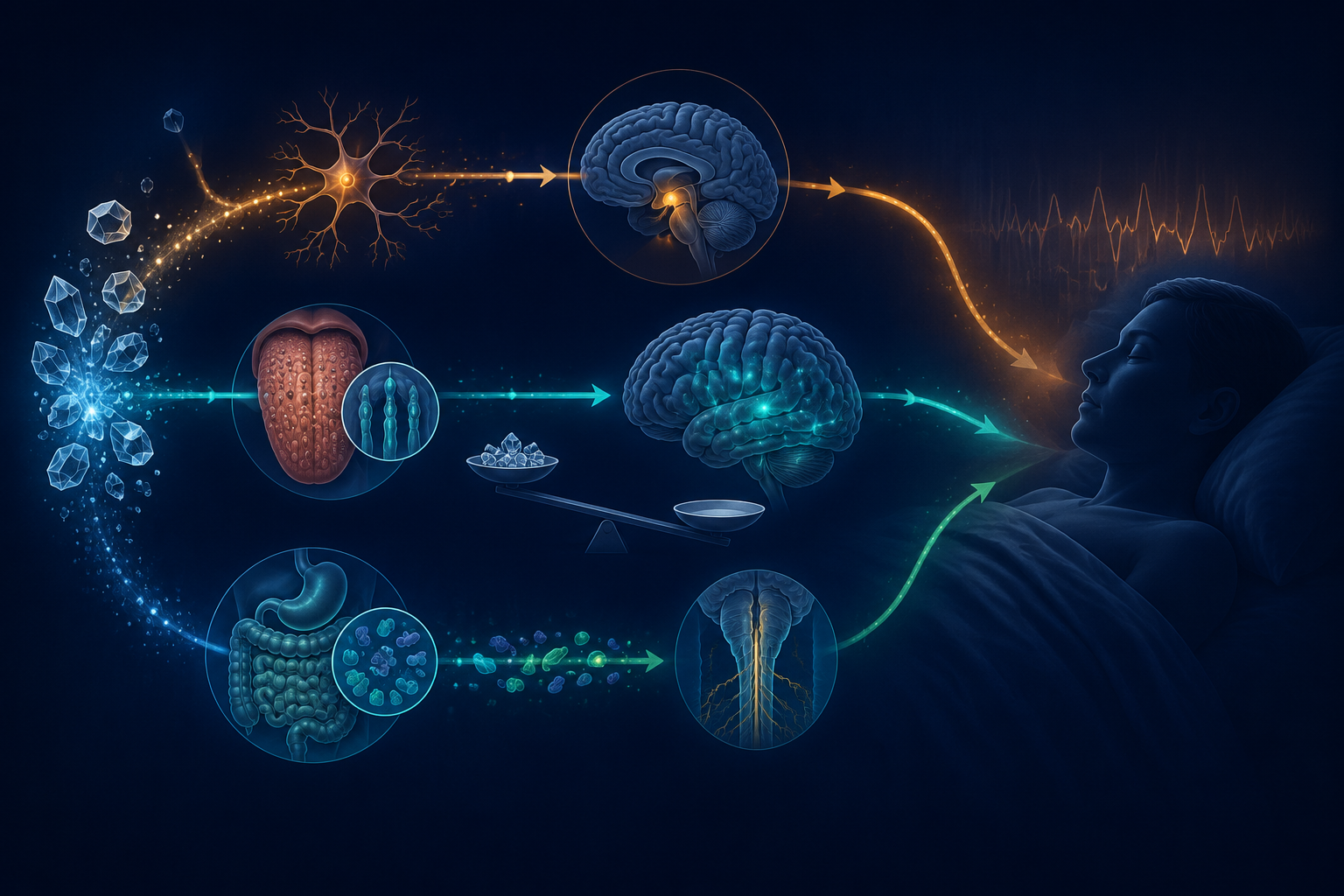
The claim that artificial sweeteners affect sleep quality is strongest when it stays specific. Saccharin has direct animal evidence connecting it to orexin activation and altered sleep-wake timing. Sucralose has animal evidence for a sweetness-without-energy signal that promotes wakefulness and food-seeking, plus human brain-imaging evidence showing hypothalamic activation and increased hunger. Aspartame has a more limited mouse finding on circadian sleep/wake behavior. The gut-brain route is biologically plausible, but it is the least sleep-specific of the three.
That calibration matters. The evidence does not justify telling every person with insomnia that a diet drink is the hidden cause. It does justify taking the symptom seriously when someone notices worse sleep after a saccharin- or sucralose-sweetened product, especially in the evening, and wants to know whether there is a real biological reason it could happen.
The strongest direct case: saccharin and orexin
Orexin is not a vague “energy” word. It is a wakefulness-promoting neuropeptide system, heavily tied to arousal stability. When orexin signaling is too low, the brain has trouble maintaining wakefulness; when orexin activity is pushed upward during a period that should be sleep-dominant, the expected concern is not simply “lighter sleep” but a shift in the architecture of sleep and wake.
That is why the saccharin mouse study by Oishi and colleagues deserves to sit near the center of this discussion. The researchers reported that moderately high doses of saccharin increased orexin neuron activity and disturbed circadian sleep-wake architecture in mice: wakefulness increased at the beginning of the sleep phase, while NREM sleep increased during the normally active phase.[1]
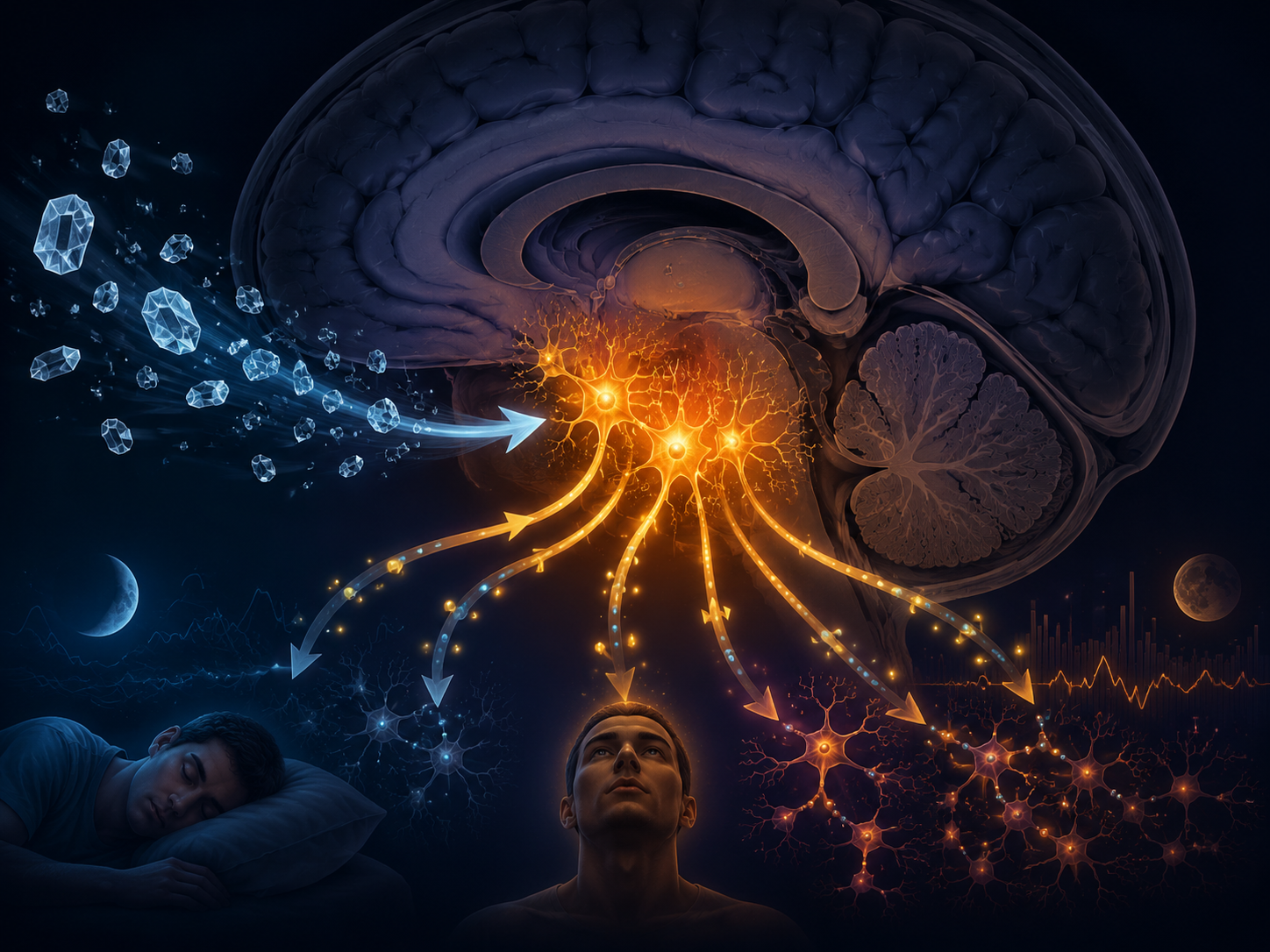
The useful part of that finding is its shape. It did not just show that mice moved around more after a sweetener exposure. It connected a named sweetener, saccharin, to a named arousal system, orexin, and then to a sleep-wake outcome measured across circadian timing. For a sleep question, that is a much better kind of evidence than a general statement that artificial sweeteners “stimulate the brain.”
The caveat is not small. The dose in the mouse study was approximately 10 times the FDA acceptable daily intake when adjusted for body weight.[1] That does not make the mechanism irrelevant; high-dose animal studies often reveal pathways worth following. But it does mean the result should not be translated into “ordinary saccharin use causes insomnia” without a human dose-response study that actually measures sleep.
A careful inference would be narrower: saccharin can activate an arousal system capable of altering sleep-wake timing in mice, and that makes saccharin one of the more credible artificial sweeteners to examine when a person reports a repeatable sleep change after exposure. It is not, by itself, proof of a common clinical effect in people using typical amounts.
Sucralose and the sweetness-energy mismatch
Sucralose raises a different sleep question. The concern is less about one wake-promoting peptide being turned on and more about what the brain does when sweetness arrives without the expected energy behind it.
In the University of Sydney and Garvan Institute work reported in 2016, chronic sucralose consumption produced a mild starvation-state response in studied animals. The sweetness signal was not followed by caloric energy, and the brain responded as if energy availability was insufficient. The observed behavioral pattern included wakefulness, food-seeking, hyperactivity, and measurably reduced sleep quality; the effects reversed within 3 days after stopping sweetener exposure.[2]
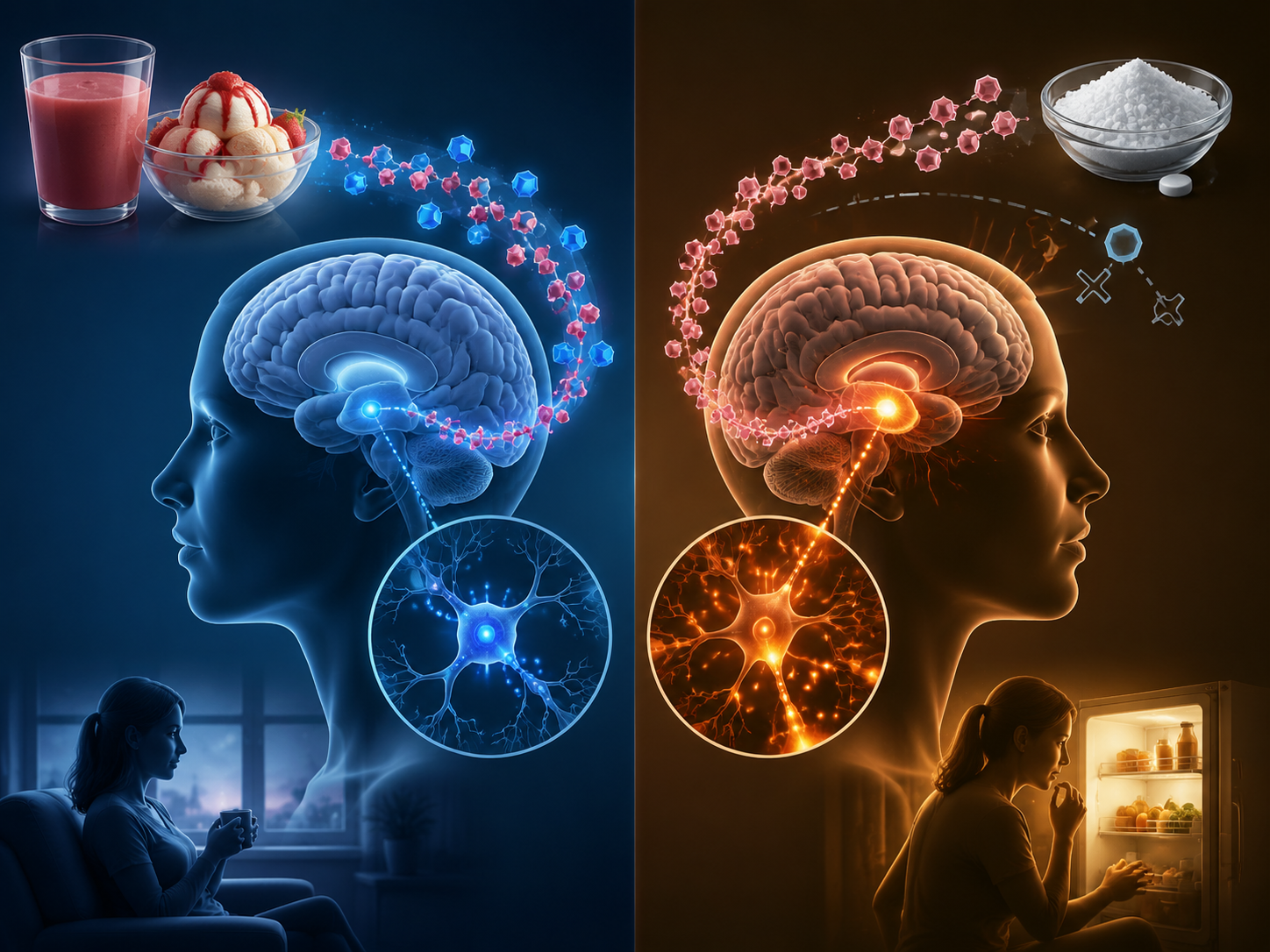
This pathway is useful because it resembles a pattern a person might actually recognize: lying awake, feeling oddly alert, wanting food, or feeling restless rather than sedated after a sweetened evening snack. The study does not prove that the same sequence happens at the same strength in humans. It does make the “sweetness without calories” idea more than a diet-culture hunch.
The human bridge became more interesting in 2025. A Keck School of Medicine of USC study published in Nature Metabolism reported that a sucralose-containing drink increased hunger by about 17% to 20% and activated the hypothalamus, with altered connectivity involving brain regions tied to motivation and decision-making.[3]
That is relevant to sleep, but it is not a sleep study. The researchers measured hunger and brain activity, not sleep architecture, awakenings, REM timing, NREM depth, or insomnia symptoms. The finding strengthens the plausibility that sucralose can engage human hypothalamic appetite-arousal circuitry. It does not show that sucralose worsens sleep quality in humans by a measured amount.
| Sweetener | Most relevant mechanism | What was measured | How far the sleep claim can go |
|---|---|---|---|
| Saccharin | Orexin activation | Orexin neuron activity and circadian sleep-wake architecture in mice | Direct animal evidence for altered sleep-wake timing |
| Sucralose | Sweetness-energy mismatch and fasting-state hyperarousal | Wakefulness, food-seeking, hyperactivity, and reduced sleep quality in animals; hunger and hypothalamic activation in humans | Strong mechanistic plausibility, with human evidence adjacent to sleep rather than directly measuring sleep |
| Aspartame | Circadian disruption | Sleep/wake behavior in mice at high concentrations | Suggestive but less developed for this specific sleep-quality argument |
| Artificial sweeteners as a group | Gut-brain axis disruption | Microbiome and neuroactive-metabolite plausibility | Biologically plausible but least sleep-specific |
Aspartame has a signal, but it carries less weight here
Aspartame should not be forced into the same evidence tier as saccharin or sucralose for this article’s question. A 2024 paper in the ACS Journal of Agricultural and Food Chemistry found that aspartame disrupted circadian sleep/wake behavior in mice at high concentrations.[4] That belongs in the conversation, especially because circadian timing is a real sleep variable, not a wellness metaphor.
Still, the case is thinner. The available evidence described here does not provide the same clean pathway-to-sleep sequence as saccharin and orexin, nor the same behaviorally rich mismatch pattern as sucralose. The most responsible placement for aspartame is as a supporting signal: worth watching, not strong enough to make it the headline mechanism.
The gut-brain axis is plausible, but easier to overstate
The microbiome route is the broadest proposed mechanism: artificial sweetener exposure may shift gut microbial composition; those shifts may alter neuroactive metabolites, including pathways related to serotonin and melatonin precursors; sleep signaling may then change. As a biological chain, it is coherent. As proof that a specific sweetener worsens sleep quality in typical users, it is not yet the strongest part of the case.
The reason to include it is not that every sleep article now needs a microbiome section. It is that gut changes can plausibly affect the same systems people notice as sleep disruption: timing, arousal, mood, appetite, and the ability to settle. Readers who have seen sleep change after a gastrointestinal event may recognize this broader pattern from the related discussion of post-infectious gut microbiome disruption and insomnia.
For artificial sweeteners, though, this pathway should stay in a lower-confidence lane unless the study names the sweetener, tracks the microbial or metabolite change, and measures a sleep outcome. Without those pieces, “gut-brain axis” can become a smooth explanation that sounds more settled than it is.
What this means if your sleep changed after a sweetened product
The practical question is not whether artificial sweeteners are “bad for sleep” as a category. The better question is whether a repeatable exposure pattern lines up with a plausible mechanism.
- If the product contains saccharin, the orexin finding gives you a direct sleep-wake mechanism to consider, while remembering the animal-dose caveat.
- If the product contains sucralose, the strongest concern is a sweetness-energy mismatch pattern: alertness, hunger, food-seeking, or restlessness when the body should be winding down.
- If the product contains aspartame, the current sleep-specific signal is more limited and mostly useful as a reason not to dismiss timing effects entirely.
- If several sweeteners are involved, or symptoms also include digestive changes, the gut-brain route becomes plausible but harder to isolate.
A short self-experiment can be more informative than a permanent pantry purge. Keep the rest of the evening routine steady, remove the suspected sweetener for several nights, then reintroduce it earlier in the day or in the evening and watch for a repeatable change. This does not diagnose a disorder, and it cannot separate every confounder, but it can tell you whether the signal is strong enough to take seriously.
If the problem is persistent insomnia, frequent middle-of-the-night waking, early-morning waking, or daytime impairment, sweetener timing should not become the whole explanation. Use a broader insomnia pattern check such as Not Being Able to Sleep? Identify Your Insomnia Pattern or the adult self-triage guide for sleep difficulty before treating one ingredient as the only cause.
Where WHO guidance fits
The World Health Organization’s 2023 guideline advises against using non-sugar sweeteners for weight control, citing lack of long-term benefit.[5] That guidance is useful context if someone is weighing why they use sweeteners in the first place. It is not evidence that artificial sweeteners cause sleep disruption.
For sleep, the strongest conclusion remains narrower: saccharin and sucralose have biologically credible pathways that could disrupt sleep quality, with the most direct sleep-disruption evidence still coming mainly from animal models. The human evidence for sucralose makes hypothalamic involvement harder to wave away, but it measured hunger and brain activation rather than sleep. Individual responses may vary, and typical real-world effect size is still unclear.
References
- Moderately high doses of the artificial sweetener saccharin potentially induce sleep disorders in mice. Nutrition, 2016.
- Research shows artificial sweeteners encourage a sweet tooth. ABC News Australia, 2016.
- Calorie-free sweeteners can disrupt the brain’s appetite signals. Keck School of Medicine of USC, 2025.
- Aspartame disrupts circadian sleep/wake behavior in mice at high concentrations. ACS Journal of Agricultural and Food Chemistry, 2024.
- Use of non-sugar sweeteners: WHO guideline. World Health Organization, 2023.


Comments
Join the discussion with an anonymous comment.