
If you have ADHD and insomnia, and you have already tried the respectable sleep hygiene checklist, the failure may not be yours. A dark room, a consistent wake time, less caffeine, and fewer late-night screens can help some sleep problems. They do not, by themselves, reliably move a delayed body clock, solve bedtime executive dysfunction, or untangle medication timing.
That distinction matters because sleep problems are common in ADHD. A conservative public-facing estimate places sleep problems in roughly 25% to 50% of people with ADHD, rather than treating the highest figures in the literature as the default for everyone.[1] The practical question is not whether ADHD and sleep overlap. It is which mechanism is keeping this particular adult awake, and which intervention is precise enough to reach it.

Why Sleep Hygiene Often Disappoints in ADHD
Generic sleep hygiene is aimed at reducing avoidable friction around sleep. It can lower noise, light, stimulation, and irregularity. Those are useful targets. But many adults with ADHD describe a different pattern: they are tired, the house is finally quiet, and their brain or body still will not shift into sleep at a socially convenient hour.
One ADHD-relevant explanation is circadian delay. In plain terms, the internal signal for biological night may be arriving too late. If that is the problem, then advice to “go to bed earlier” can become a nightly exercise in lying awake. The better target is timing: morning light, evening darkness, and, in some cases, carefully timed low-dose melatonin.
The marker researchers often use here is dim light melatonin onset, or DLMO: the point in the evening when melatonin begins rising under dim-light conditions. A later DLMO means the body is, biologically, starting night later. For a deeper explanation of that clock system, see this guide to circadian rhythm mechanisms.
An Evidence-Ranked Ladder for ADHD and Insomnia
This ladder is not a proven head-to-head sequence where every rung has been compared against every other rung in adults with ADHD. It is a practical ranking: ADHD-specific controlled circadian evidence first, ADHD-adapted behavioral treatment next, then clinician-guided medication timing and conditional add-ons.

| Rung | What it targets | Why it comes here |
|---|---|---|
| Morning bright light | Delayed circadian timing | Controlled ADHD studies show DLMO advances |
| Timed low-dose melatonin | Earlier biological night signal | ADHD trial data show a larger phase advance, especially with light |
| ADHD-adapted CBT-I | Insomnia patterns plus executive-function barriers | Pilot evidence is promising but small |
| Medication timing review | Stimulant or nonstimulant effects on evening arousal | Clinically important, but individualized and prescriber-led |
| Weighted blankets or prescription sleep treatment | Comfort, arousal, or severe persistent insomnia | Conditional options, not the core ADHD-specific evidence base |
Start With Morning Bright Light
Morning bright light is the first serious rung because it acts directly on the delayed-clock problem. In ADHD studies reviewed by Surman and Walsh, bright light therapy using 10,000 lux for about 30 minutes after waking advanced DLMO by 31 to 57 minutes across three controlled studies.[2] That is not a vague “light helps mood” claim. It is a measured shift in circadian timing.
The timing is the intervention. Bright light too late in the day can push the clock in the wrong direction. The usual clinical logic is to place strong light shortly after waking, then protect the evening from excess bright and blue-enriched light. If you want the mechanics behind that, this guide to circadian rhythm and light exposure explains why the same light can help or hurt depending on when it lands.
A useful trial looks less like buying a lamp and more like setting an anchor. Wake time stays as stable as possible. Light happens soon after waking. The session is long enough to matter. Evening light is reduced so the morning signal is not being contradicted later. The goal is not to become a perfect routine person overnight; it is to give the circadian system a clear repeated cue.
Do not read the 31-to-57-minute shift as a guaranteed new bedtime. DLMO is a biological marker, not a promise that sleep onset will move by the same amount for every person. Pain, anxiety, restless legs, sleep apnea, late stimulant effects, and revenge bedtime patterns can still keep someone awake after the body clock starts moving.
Add Timed Low-Dose Melatonin Carefully
Melatonin is often treated like a sedative gummy. For ADHD-related circadian delay, the more relevant use is different: a low dose, timed to shift the clock earlier. In a randomized chronotherapy trial in adults with ADHD and delayed sleep phase, 0.5 mg of melatonin taken 3 to 4 hours before DLMO advanced DLMO by 88 minutes and reduced ADHD symptoms by 14%.[3]
The same trial found the largest phase shift when melatonin was combined with bright light therapy, with an advance of about 2 hours.[3] That is why these first two rungs belong together. Morning light and early-evening low-dose melatonin are not two random wellness products; they are opposite ends of a timing plan.
The inconvenient part is that “3 to 4 hours before DLMO” is not the same as “right before bed.” Most people do not know their DLMO without lab testing. In practice, clinicians often approximate timing from the person’s current sleep pattern, then adjust cautiously. Taking melatonin too late may help some people feel sleepy, but it is not the same circadian intervention studied in delayed sleep phase ADHD.
Low dose also matters. More is not automatically more circadian-shifting, and higher doses may increase next-day grogginess for some people. Anyone who is pregnant, managing epilepsy, taking anticoagulants, treating a mood disorder, or giving melatonin to a child should treat this as a clinician conversation rather than a casual supplement experiment.
Keep the Basics, But Stop Making Them the Whole Treatment
Sleep hygiene still has a job. Caffeine cutoffs, a dark room, a cool bedroom, and a repeatable wind-down routine can remove obstacles that make any circadian plan harder. A basic evidence-based bedtime routine is worth having.
The problem is the scolding version: the idea that if sleep hygiene did not fix ADHD insomnia, the person must not have tried hard enough. For many adults with ADHD, the basics work best as support beams under a more specific plan. They are not a substitute for shifting a delayed rhythm or designing around impaired task initiation at night.
Use ADHD-Adapted CBT-I When the Pattern Persists
CBT-I is the best-established behavioral treatment for chronic insomnia in general, but adults with ADHD often need more than a standard worksheet and a sleep window. ADHD-adapted CBT-I keeps the insomnia tools while adding supports for the parts that commonly break: remembering the plan, starting the wind-down, resisting late-night task switching, and using light timing deliberately.
In the Jernelöv et al. pilot trial, 19 adults received 10 sessions of CBT-I adapted for ADHD, including light scheduling and executive-function supports. Insomnia Severity Index scores fell by 4.5 points after treatment, with an effect size of d=0.84, and by 6.8 points at 3-month follow-up, with an effect size of d=1.52. ADHD hyperactivity symptoms also improved at 3 months, with d=0.44.[4]
That is meaningful, but it is still pilot evidence. A 2025 systematic review of CBT-I in neurodevelopmental conditions rated the overall study quality as moderate and noted that effects were often not maintained at longer-term follow-up.[5] The fair conclusion is not “CBT-I cures ADHD insomnia.” It is that ADHD-adapted CBT-I is a serious next step when circadian work helps only partly, or when routines repeatedly collapse before they can help.
The adaptation is the point. A person with ADHD may understand stimulus control perfectly and still need phone alarms, visual cues, simplified rules, accountability, or environmental friction to carry it out at 11:30 p.m. If you are comparing options, start with a general explanation of CBT-I for insomnia, then look for a clinician or program willing to adapt it for ADHD rather than simply handing over the standard protocol.
Review Medication Timing With the Prescriber
Medication timing belongs later in the ladder because it is too individual for blanket advice, but too important to ignore. Stimulants, nonstimulants, antidepressants, decongestants, and other medications can all change sleep timing, evening arousal, or morning wakeability. The useful question is not “Are ADHD meds bad for sleep?” It is “Is this dose, formulation, and timing helping the day while damaging the night?”
Some clinicians report a paradoxical pattern in which a small stimulant dose before bed appears to calm certain patients enough to sleep; one clinical discussion describes using a stimulant about 45 minutes before bedtime in selected cases.[6] That should stay in its proper evidence category: interesting, clinician-reported, and not proven by large controlled trials. It is not a do-it-yourself experiment.
A prescriber review can look at whether an extended-release medication is lasting too long, whether a rebound effect is creating evening restlessness, whether a nonstimulant is sedating or activating at the wrong time, and whether untreated ADHD symptoms are driving late-night catch-up behavior. The answer may be a timing change, a formulation change, no change at all, or a sleep-focused referral.
Where Weighted Blankets and Sleep Medications Fit
Weighted blankets may help some people feel calmer in bed, and randomized evidence exists outside ADHD-specific adult insomnia populations. That makes them an optional comfort tool, not a core treatment for ADHD and insomnia. If a blanket makes bedtime less physically restless and does not create overheating or discomfort, it can sit alongside the main plan. It should not replace morning light, properly timed melatonin, or CBT-I when the main problem is delayed timing.
Prescription sleep medication is also not the moral opposite of behavioral care. It may be appropriate when insomnia is severe, dangerous, chronic, or complicated by other symptoms. But medication choices need a diagnosis, a risk review, and a plan for duration and monitoring. In ADHD, that review should include circadian delay, anxiety, substance use, restless legs symptoms, sleep apnea symptoms, mood episodes, and the full medication list.
Escalate sooner if sleep loss is affecting driving safety, work safety, caregiving, mood stability, or thoughts of self-harm. If you are unsure whether the pattern needs medical evaluation, this guide on when to see a doctor for trouble sleeping at night is the more appropriate next read than another sleep-tip list.
A Practical Order of Operations
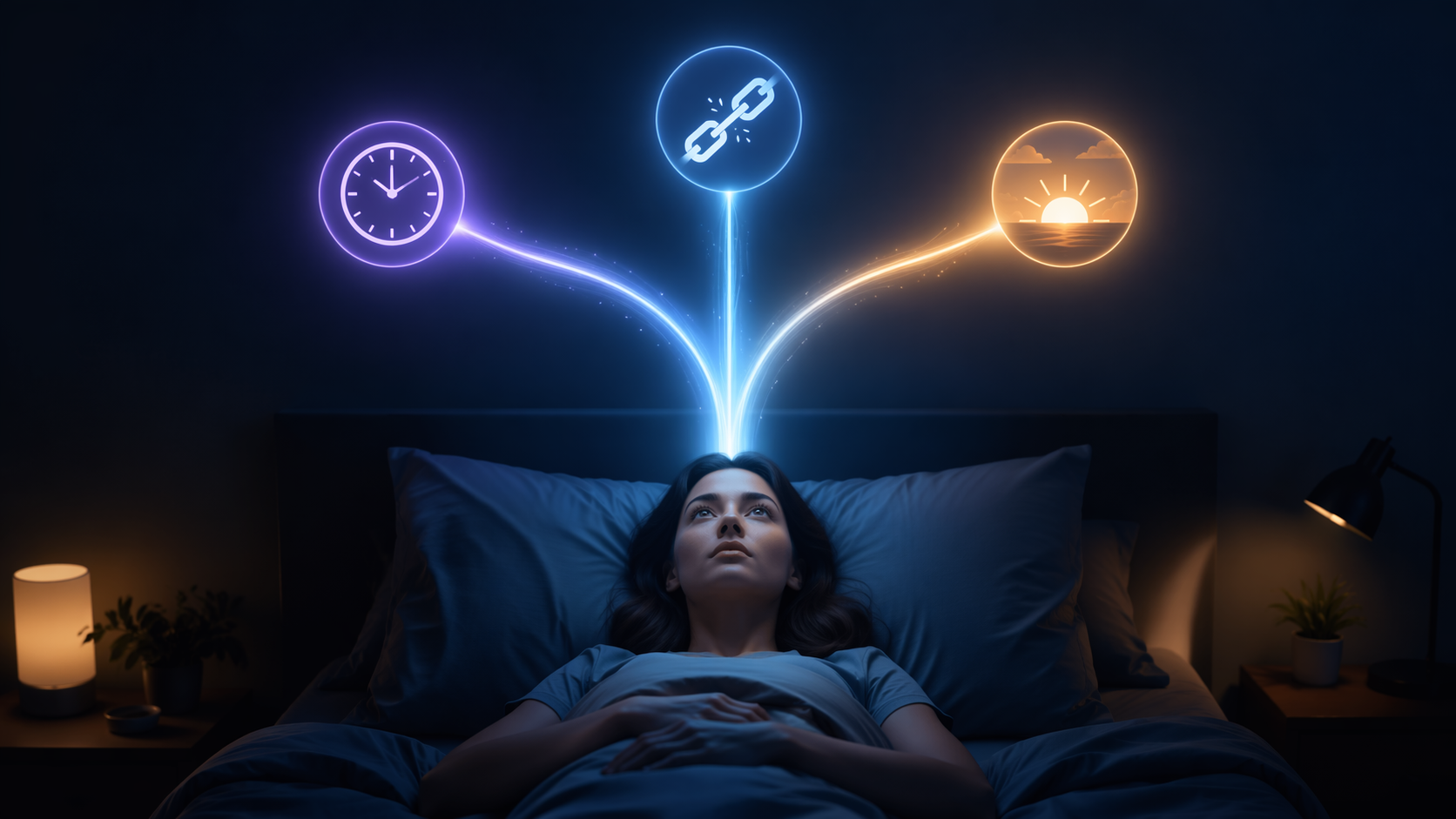
For adults with ADHD who already know the standard advice and are still awake too late, the most evidence-anchored path starts with circadian timing. Use morning bright light as the first anchor. Consider properly timed low-dose melatonin as the coordinated second signal, ideally with clinical guidance if timing, safety, or other medications are complicated. Keep sleep hygiene in place as support, not as the whole explanation.
If insomnia persists, or if routines repeatedly collapse before they can work, move toward ADHD-adapted CBT-I rather than another generic habit reset. If medication may be contributing, review timing and formulation with the prescriber. If sleep loss is severe, chronic, unsafe, or tangled with other symptoms, escalate to medical care instead of trying to solve it alone with supplements and willpower.
References
- ADHD and Sleep Problems: How Are They Related? Sleep Foundation.
- Managing Sleep in Adults with ADHD Surman & Walsh.
- Chronotherapy in Adults with Attention-Deficit/Hyperactivity Disorder and Delayed Sleep Phase Syndrome Van Andel et al.
- Effects and Clinical Feasibility of a Behavioral Treatment for Sleep Problems in Adult Attention Deficit Hyperactivity Disorder (ADHD): a Pragmatic Within-Group Pilot Evaluation Jernelöv et al., 2019.
- Effectiveness of Cognitive Behavioural Therapy for Insomnia in Neurodevelopmental Conditions: A Systematic Review Cullen et al., 2025.
- ADHD and Sleep Problems: This is Why You’re Always Tired ADDitude.


Comments
Join the discussion with an anonymous comment.