
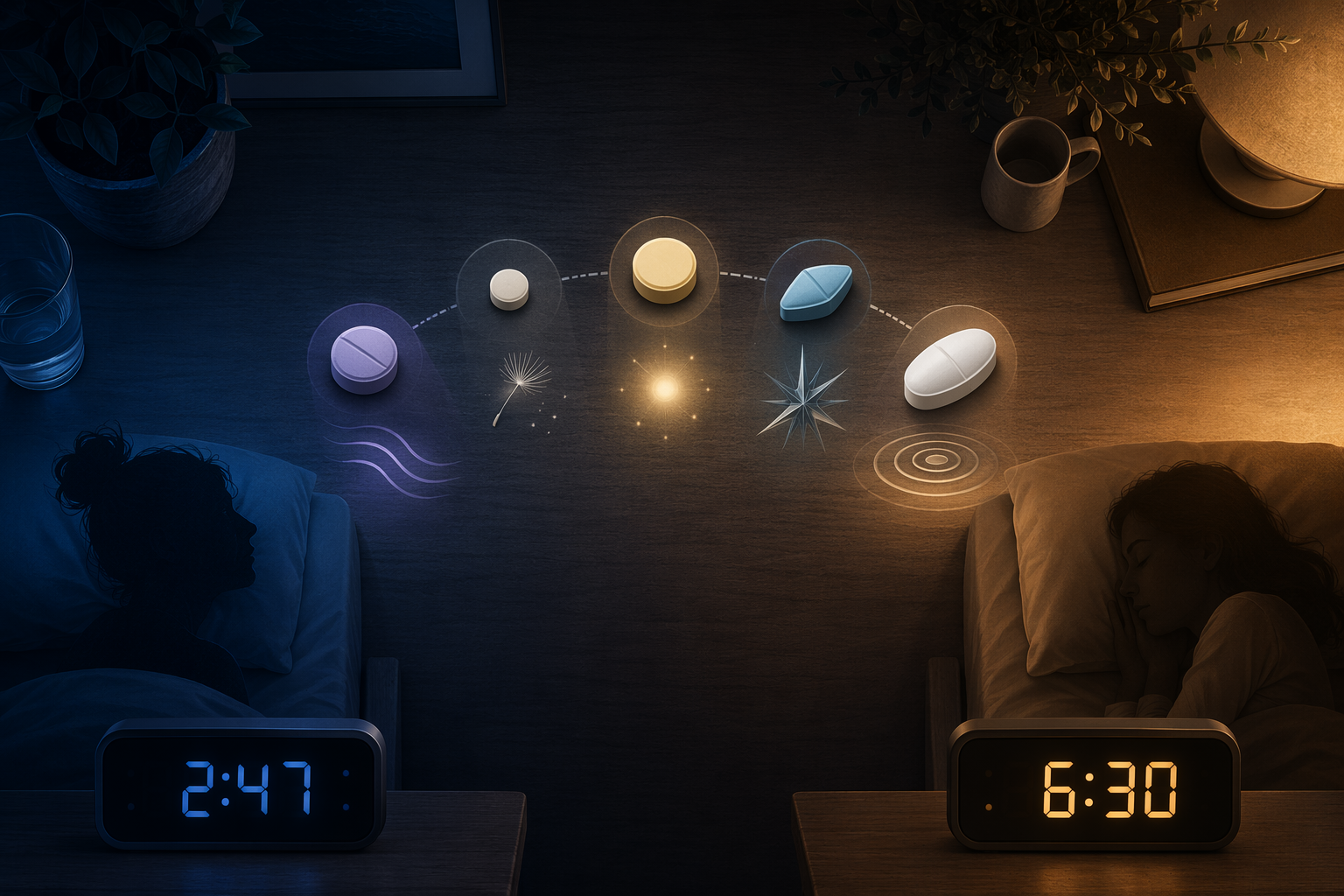
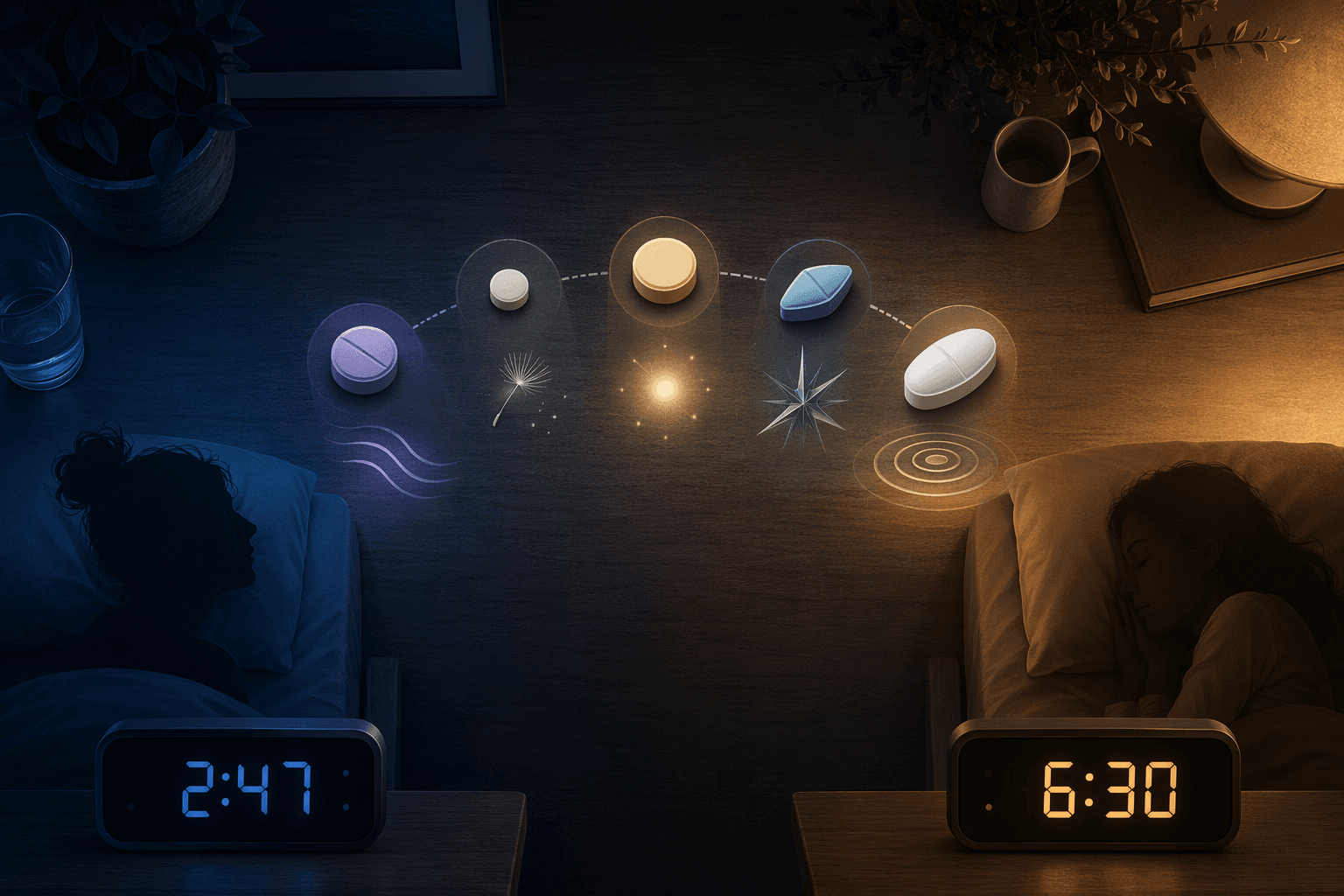
The useful question is not simply, “What medicine to help sleep is strongest?” It is, “Which prescription sleep medicine matches the part of sleep that is failing, and what will I have to live with the next morning?” A drug that helps someone fall asleep at 11 p.m. may be a poor fit for someone who wakes at 3 a.m. A drug that works quickly may still be a bad bargain for a person who drives early, has a fall risk, has a history of substance dependence, or is older.
The five prescription classes most often discussed for insomnia are Z-drugs, dual orexin receptor antagonists, low-dose doxepin, ramelteon, and benzodiazepines. They are not interchangeable. Some mainly shorten the time it takes to fall asleep. Some are better matched to staying asleep. Some carry dependence or withdrawal concerns that should not be treated as fine print.
| Drug class | Examples | Best fit | How it works in plain language | Efficacy signal | Dependence or withdrawal concern | Older-adult caution | Standout safety issue |
|---|---|---|---|---|---|---|---|
| Z-drugs | zolpidem, zaleplon, eszopiclone | Mostly sleep onset; some formulations may be used for maintenance | Acts on GABA-related receptors to sedate without being a benzodiazepine | AAFP cites a meta-analysis finding sleep latency fell by 42 minutes with Z-drugs versus 20 minutes with placebo | Yes; dependence concerns matter, especially with repeated or prolonged use | Use caution; next-day impairment and falls are key concerns | FDA boxed warning for complex sleep behaviors such as sleep driving or sleep cooking; zolpidem dosing differs by sex because women clear it more slowly |
| Dual orexin receptor antagonists, or DORAs | suvorexant, lemborexant, daridorexant | Sleep onset and sleep maintenance, depending on the specific drug and patient | Blocks orexin, a wakefulness signal, instead of broadly forcing sedation | A 2025 systematic review supports benefit across DORAs, while the evidence base is still newer than for older hypnotics | No evidence of physiological tolerance or withdrawal on abrupt discontinuation in the 2025 review | Often worth discussing when dependence or older-adult safety is a concern, but individual risks still need review | Next-day somnolence can still matter; newer evidence should not be treated as a blanket promise |
| Low-dose doxepin | Silenor; doxepin 3–6 mg | Sleep maintenance | At very low doses, mainly blocks histamine signaling involved in wakefulness | Best matched to people who wake during the night or too early rather than those who cannot fall asleep | No dependence liability reported in the AAFP review | Recommended as a first-line option for older adults by AAFP and AASM | The low insomnia dose is different from antidepressant dosing; side-effect expectations should be based on the 3–6 mg range |
| Ramelteon | Rozerem | Sleep onset | Acts on melatonin receptors involved in circadian sleep timing | Modest average effect; AAFP reports about 6 minutes shorter sleep latency versus placebo | Low concern for dependence | Generally favorable safety profile | Safety is the main appeal; hypnotic effect may feel too mild for some patients |
| Benzodiazepines | temazepam, triazolam | Sleep onset, sometimes maintenance, but generally poor long-term fit | Enhances GABA sedation more broadly than Z-drugs | Can work short term, but safety limits the role | Severe withdrawal rates of 15% to 40% on cessation have been reported | Contraindicated in older adults under AGS Beers Criteria | Can disrupt slow-wave sleep and create a difficult withdrawal problem |
First Separate Sleep Onset From Sleep Maintenance
Before comparing brand names, separate the complaint. Sleep-onset insomnia means lying awake at the beginning of the night. Sleep-maintenance insomnia means falling asleep but waking repeatedly, waking too early, or being unable to return to sleep. This distinction changes the medication conversation more than many people expect.
Ramelteon and many Z-drug prescriptions are aimed mainly at sleep onset. Low-dose doxepin is specifically a sleep-maintenance drug. DORAs can be relevant to both onset and maintenance because they reduce wakefulness signaling rather than simply pushing sedation. Benzodiazepines can make people sleep, but their risk profile makes “it works” too thin a standard.
For chronic insomnia, medication also should not be treated as the whole plan. CBT-I remains the stronger long-term treatment direction for chronic insomnia, even when a short-term prescription has a role. A patient who is exhausted enough to ask for medicine is not failing; they still deserve a plan that does not quietly turn a temporary prescription into a standing nightly habit.
Z-Drugs: Real Sleep-Onset Benefit, Real Next-Day Questions
Z-drugs are familiar because they often do what patients hope a sleeping pill will do: shorten the time spent awake in bed. In the AAFP review, a meta-analysis found that Z-drugs reduced sleep latency by 42 minutes, compared with 20 minutes for placebo.[1] That is not a trivial difference for someone who has been watching the clock for weeks.
The problem is that the same prescription has to be judged after waking, not only after swallowing it. Z-drugs carry an FDA boxed warning for complex sleep behaviors, including events such as sleep driving and sleep cooking. These are not ordinary “I felt groggy” side effects; they are behaviors done while not fully awake, with potential consequences for the patient and anyone nearby.
Zolpidem also has sex-specific dosing because women clear it more slowly: the research brief specifies a 5 mg maximum for women versus 10 mg for men. That detail belongs in the appointment, especially if the patient drives early, uses machinery, cares for children overnight, or has already noticed morning fog after OTC sleep aids.
This is where a familiar prescription can become too reassuring. A Z-drug may be reasonable for selected short-term use, particularly when sleep onset is the dominant problem. But it should not be requested or renewed as if its only meaningful risk is feeling a little sleepy. The doctor should know about alcohol use, other sedating medicines, prior unusual nighttime behavior, fall risk, and any history of dependence before choosing this class.
DORAs: Blocking Wakefulness Instead of Forcing Sedation

Dual orexin receptor antagonists, usually shortened to DORAs, include suvorexant, lemborexant, and daridorexant. Their appeal is partly mechanical: orexin is part of the brain’s wakefulness signaling, and DORAs block that signal. That is different from broadly pressing down on the central nervous system to sedate the patient.
Mechanism alone does not prove a drug is safer or better, but here it changes the questions worth asking. A 2025 systematic review in Translational Psychiatry reported no evidence of physiological tolerance or withdrawal after abrupt discontinuation of DORAs.[2] For a patient worried about dependence, that is a meaningful distinction from benzodiazepines and a useful contrast with the dependence concerns around Z-drugs.
The same review should not be inflated into “DORAs are best for everyone.” It is one systematic review, and the class is newer than older hypnotics. Patients can still have next-day sleepiness, interactions, cost barriers, or comorbidity questions that change the decision. Insurance formularies and cash prices also move, so cost should be checked at the time of prescribing rather than assumed from old price lists or coupon pages.
Still, DORAs often deserve an earlier conversation than they get, especially when the patient is trying to avoid medications with more obvious dependence or withdrawal concerns. They may be particularly relevant when both sleep onset and sleep maintenance are part of the complaint, though the exact choice among suvorexant, lemborexant, and daridorexant belongs with the prescriber and the patient’s medication list.
Low-Dose Doxepin: Narrow, Useful, and Often Misunderstood
Doxepin can sound confusing because many people recognize it as an older antidepressant. For insomnia, the dose is different: 3 to 6 mg. At that low range, the point is not to treat depression by sedation. The practical target is sleep maintenance, especially waking during the night or too early.
The AAFP review identifies low-dose doxepin as FDA-approved for sleep maintenance, with minimal anticholinergic effects at low doses and no dependence liability.[1] That combination matters because many sleep complaints in older adults are maintenance complaints, and many sedating medicines become more dangerous with age.
AAFP and AASM recommend controlled-release melatonin and low-dose doxepin as first-line agents in older adults.[1] That does not make doxepin automatically right for every older person, but it puts the discussion on different footing than a benzodiazepine or a casual refill of a Z-drug. If the main problem is waking at 3 a.m., a medication built for maintenance deserves to be considered before a drug aimed mainly at knocking someone out at bedtime.
The prescribing conversation should still include other medications, urinary symptoms, glaucoma concerns, cognition, fall history, and morning alertness. “Low dose” is not a magic shield. It is a reason to judge doxepin by the insomnia-dose evidence rather than by assumptions carried over from higher antidepressant doses.
Ramelteon: Safer Does Not Always Mean Stronger
Ramelteon, sold as Rozerem, acts on melatonin receptors and is mainly used for sleep-onset insomnia. It is one of the easier prescription sleep medicines to discuss from a dependence standpoint because its safety profile is favorable and it is not used as a controlled hypnotic.
The tradeoff is effect size. The AAFP review reports that ramelteon reduced sleep latency by about 6 minutes compared with placebo.[1] For some patients, especially those with circadian timing issues or a need to avoid dependence risk, that may be enough. For someone with severe, entrenched insomnia, it may feel underwhelming.
A small older-adult hospital study found hospital-associated delirium fell from 32% to 3% with ramelteon, but that kind of finding should be kept in its lane: it is not the same as proving ramelteon is a powerful outpatient sleeping pill for every adult. Its role is better understood as a safer, modest option when sleep onset is the main issue and stronger sedatives would create unacceptable risk.
Benzodiazepines: Short-Term Sleep Is Not the Whole Outcome
Benzodiazepines such as temazepam and triazolam can produce sleep. That is not the disputed part. The harder question is what they do to the sleep itself, what happens when the patient tries to stop, and who is most likely to be harmed along the way.
Severe withdrawal rates of 15% to 40% on cessation have been reported, and benzodiazepines can disrupt slow-wave sleep. They are also contraindicated in older adults under the AGS Beers Criteria. Those are not minor cautions to mention after the refill is already routine.
Older adults are the clearest place to be blunt. A medication that increases sedation, can impair balance or cognition, and can become difficult to stop is poorly matched to someone already at risk of falls or confusion. Even in younger adults, a history of substance use disorder, concurrent alcohol use, opioid use, or the need for early-morning driving should push the conversation away from casual benzodiazepine use.
If a benzodiazepine is already being taken nightly, the next step is not to abruptly stop without medical help. Withdrawal risk is part of the reason the class deserves caution in the first place. Tapering and substitution decisions should be supervised, especially when the medicine has been used for more than a brief period.
What to Bring Into the Appointment
A 12-minute visit can go sideways if the only request is, “Can I get something strong?” A better use of the visit is to make the risks visible before the prescription is chosen. The following points help the clinician match the drug class to the patient rather than to a habit of prescribing.
- Name the pattern: trouble falling asleep, waking during the night, waking too early, or all of these.
- Say what happens the next morning: driving, shift work, caregiving, school drop-off, machinery, falls, or confusion.
- Bring age-related risks into the open, especially falls, memory problems, dizziness, and prior medication hangover.
- Disclose alcohol use, cannabis use, opioids, anxiety medicines, antihistamines, and any history of substance dependence.
- Ask whether sleep apnea, pregnancy, breastfeeding, restless legs, pain, depression, or another condition needs separate evaluation before choosing a hypnotic.
- Ask whether the medication is meant as a short bridge while starting CBT-I or as an ongoing plan, and what the stopping plan would be.
Cost belongs in the same conversation, but not as a fixed ranking. A drug that looks expensive on one plan may be covered on another; a coupon price may change; a formulary may prefer one DORA and reject another. The clinically safer discussion can still fail at the pharmacy counter, so the prescriber may need to check alternatives rather than defaulting to an older sedative.
The Most Useful Way to Compare Them
For sleep onset with low dependence tolerance, ramelteon may be safe but modest, while a DORA may be worth discussing if a stronger effect is needed and the patient’s health profile allows it. For sleep maintenance, low-dose doxepin is often a cleaner match than a bedtime sedative chosen mainly because it is familiar. For mixed onset and maintenance insomnia, DORAs may be a more useful discussion than reaching first for a Z-drug.
Z-drugs still have a place, especially when sleep onset is the clear problem and short-term benefit is the immediate need. The decision should include boxed-warning behaviors, next-day impairment, dosing, and dependence concerns from the start. Benzodiazepines should be treated as a more exceptional choice, particularly in older adults, not as the next routine step after OTC products fail.
There is no universal safest prescription sleep medicine. The safer useful choice depends on the insomnia pattern and the patient’s risk profile. For many adults, especially those worried about dependence, withdrawal, falls, or older-adult safety, DORAs or low-dose doxepin are more favorable conversations to have than defaulting to Z-drugs or benzodiazepines.


Comments
Join the discussion with an anonymous comment.