
What Doxylamine Is and Where You'll Find It
Doxylamine succinate is an FDA-regulated over-the-counter drug — not a dietary supplement. That distinction matters: it means the dosage, labeling, and approved indications are governed by federal drug law, not the looser standards that apply to vitamins or herbal products.
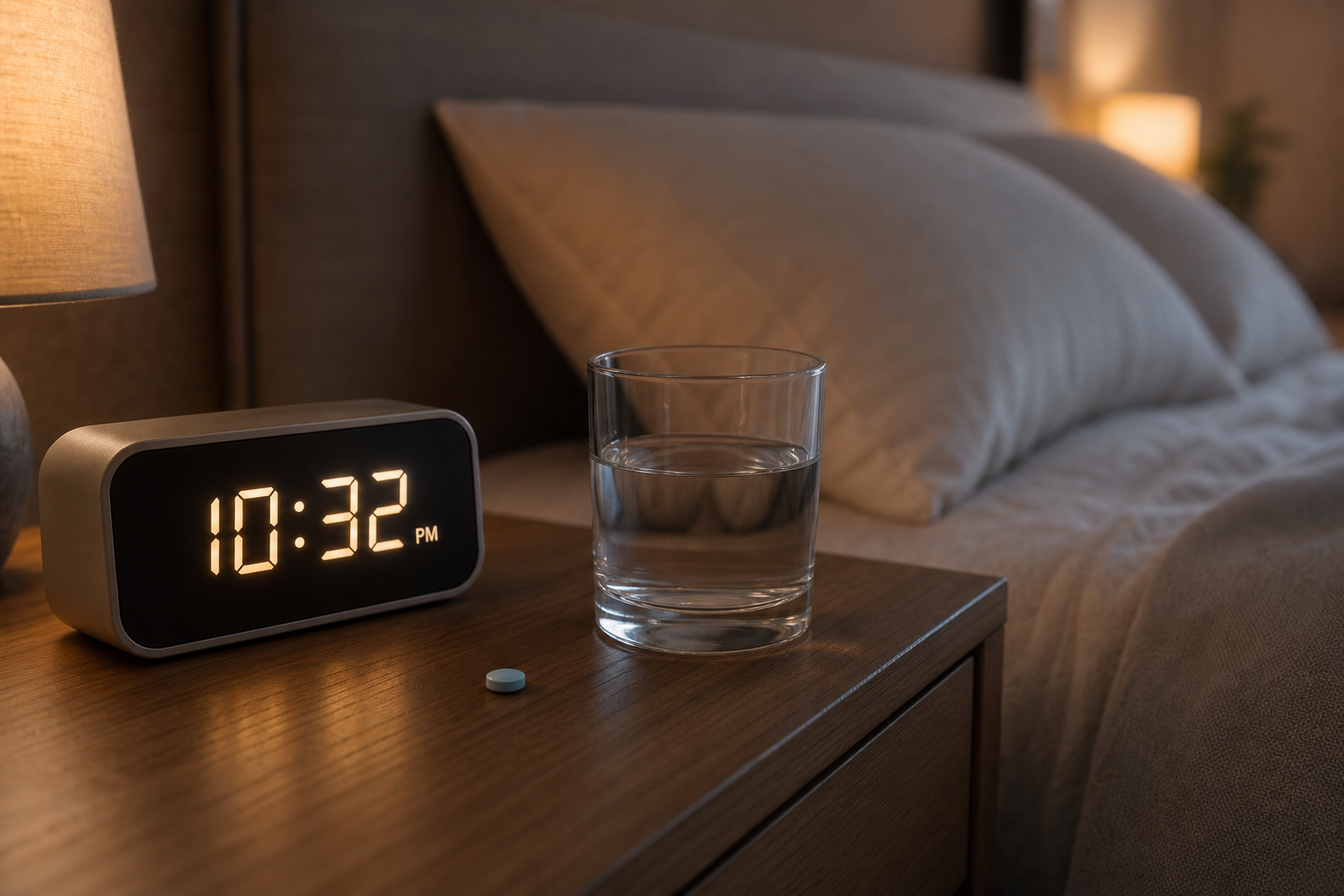
In its standalone sleep-aid form, doxylamine appears most recognizably as Unisom SleepTabs — the blue oval tablet sold specifically for occasional sleeplessness. It also turns up as an ingredient in several combination cold and flu products, including NyQuil Cold and Flu, Vicks NyQuil Sinex, Coricidin HBP Nighttime, and Tylenol Cold Nighttime, where it is paired with decongestants, cough suppressants, or analgesics.
How Doxylamine Works: H1 Blockade and Anticholinergic Off-Target Effects
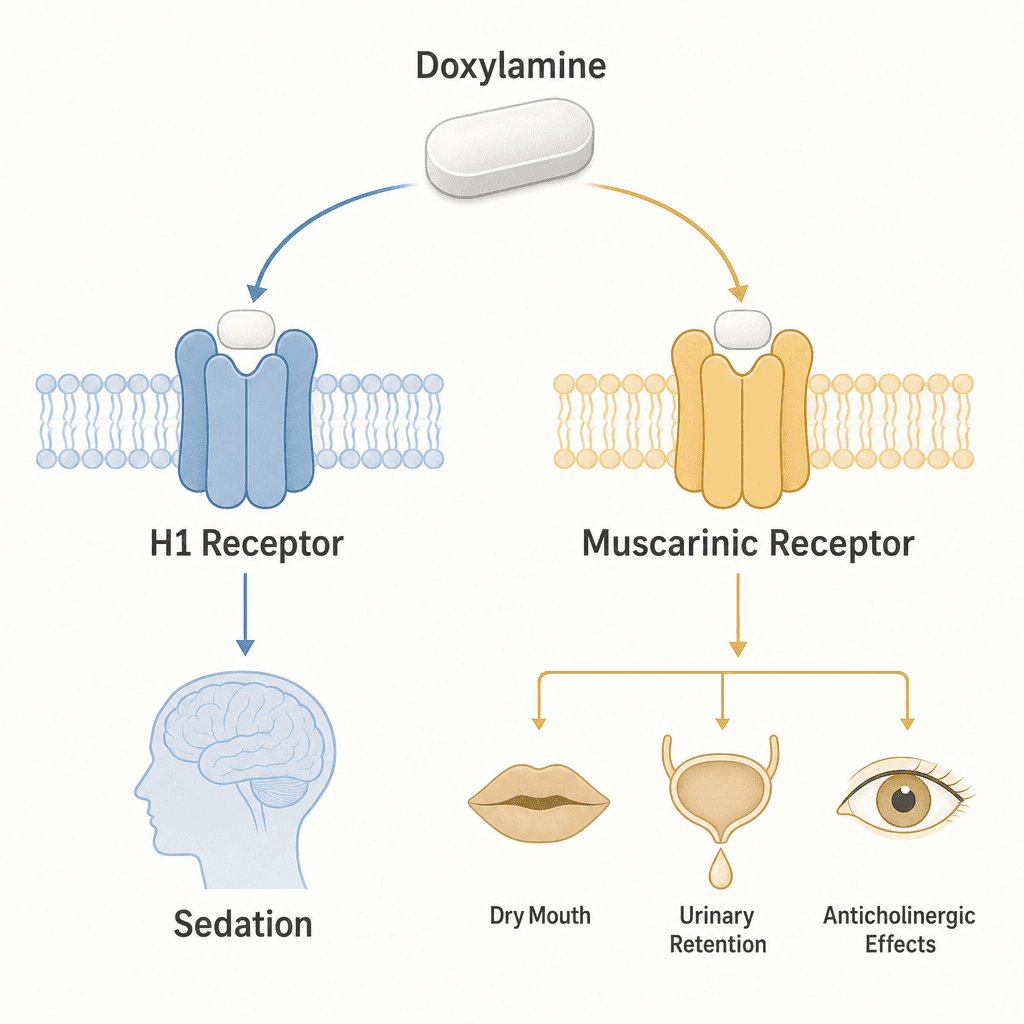
Doxylamine is a first-generation H1 antihistamine. Its primary pharmacological action is competitive, non-selective binding to histamine H1 receptors both in the brain and throughout the body. Histamine in the central nervous system plays a role in maintaining wakefulness, so blocking those receptors produces sedation — but this is an off-target consequence of the drug's receptor binding, not its intended therapeutic mechanism. Doxylamine was not designed as a sleep aid; sedation is a side effect that became the marketed use.
The same non-selective binding also blocks muscarinic acetylcholine receptors — which is why doxylamine carries a predictable and mechanistically unavoidable set of anticholinergic side effects. Dry mouth, urinary retention, blurred vision, and constipation are not rare reactions or individual sensitivities. They are the direct physiological result of blocking muscarinic signaling throughout the body. Understanding this makes it easier to see why certain medical conditions — enlarged prostate, narrow-angle glaucoma, severe asthma — are genuine contraindications rather than cautionary footnotes.
Doxylamine also depresses labyrinthine function and blocks the chemoreceptor trigger zone, which partly explains its use in nausea management (addressed separately in the pregnancy section below).
FDA-Approved Dosage and Administration
The FDA-approved adult dose for doxylamine as a sleep aid is 25 mg taken 30 minutes before bedtime. The label permits up to 50 mg, but the higher dose increases side effect burden without proportional improvement in sleep — the standard 25 mg dose is the appropriate starting point for most adults.
| Parameter | Guidance |
|---|---|
| Approved adult dose | 25 mg (up to 50 mg permitted; higher dose increases side effects) |
| Timing | 30 minutes before planned bedtime |
| Planned sleep duration | 7–8 hours minimum — do not take if you cannot sleep a full night |
| Re-dosing | Not permitted — one dose per night only |
| Maximum duration (OTC label) | 2 weeks; consult a physician if longer use is needed |
| Age restriction | Not for adults 65 or older (see contraindications); not for children under 12 |
Pharmacokinetics: Why the Half-Life Matters
Doxylamine's half-life is approximately 10–12 hours in healthy adults — with some sources citing a mean of roughly 11–12 hours. That is meaningfully longer than diphenhydramine, which clears the body in 2–9 hours. The practical consequence: if you take doxylamine at 11 PM, a substantial fraction of the drug is still active at 9 or 10 AM the next morning. Next-day grogginess, slowed reaction time, and psychomotor impairment are not unusual reactions — they are the predictable pharmacokinetic outcome of a drug with a long half-life.
In older adults, the half-life extends to 12–15 hours. There is also a clinically meaningful sex-specific difference: clearance is significantly reduced in elderly men but not in elderly women, according to pharmacokinetic data cited in a 2015 systematic review. This means older men face a longer effective drug exposure than older women at the same dose — a detail that reinforces why the 2023 Beers Criteria recommends against doxylamine use in all adults 65 and older, regardless of sex.
| Population | Approximate Half-Life | Key Implication |
|---|---|---|
| Healthy adults under 65 | ~10–12 hours | Residual sedation likely into the following morning |
| Adults 65+ (women) | ~12–15 hours | Extended sedation; increased fall and cognitive risk |
| Adults 65+ (men) | Extended further vs. elderly women | Reduced clearance amplifies anticholinergic and sedation risks |
Doxylamine is highly lipophilic and approximately 98% protein-bound. It undergoes hepatic metabolism primarily through dealkylation and is excreted renally. Liver disease or significant renal impairment would be expected to prolong its effects further, though these scenarios are not covered by the OTC label and warrant physician guidance.
Side Effects: Common, Serious, and Overdose
Doxylamine's side effects fall into three distinct tiers. Understanding which tier a symptom belongs to helps readers distinguish expected nuisances from warning signs that require medical attention.
Common and Expected
- Dry mouth, nose, and throat
- Daytime drowsiness and hangover grogginess (especially if less than 7–8 hours of sleep)
- Nausea
- Headache
- Constipation
- Increased chest congestion
Serious — Seek Medical Attention Promptly
- Difficulty urinating or inability to pass urine (urinary retention) — a direct anticholinergic effect; particularly dangerous in men with prostate enlargement
- Blurred vision or sudden eye pain — the latter may signal acute narrow-angle glaucoma, a medical emergency requiring immediate evaluation
Overdose and Toxicity
Doxylamine is widely perceived as a benign OTC product, but supratherapeutic doses carry serious toxicity risk. A documented overdose case involving 2,400 mg presented with grand mal seizure, reduced consciousness, tachycardia, and delayed rhabdomyolysis (with creatine phosphokinase peaking at over 9,000 U/L on day four).
- Seizures
- Rhabdomyolysis (muscle breakdown)
- Hallucinations and delirium
- Hyperthermia
- Coma
- Cardiac arrhythmias
- False-positive urine drug screen for methadone (due to structural similarity at toxic concentrations)
Who Should Avoid Doxylamine: Contraindications by Population and Condition
This is the section most readers are actually here for. The contraindications for doxylamine are specific, well-established, and in several cases absolute. The table below organizes them by population or condition, the underlying rationale, and the strength of the guidance.
| Population / Condition | Rationale | Recommendation |
|---|---|---|
| Adults 65 and older | 2023 AGS Beers Criteria (Table 2): highly anticholinergic; clearance reduced with advanced age (especially in elderly men); tolerance develops rapidly; elevated risk of falls, delirium, cognitive impairment, and dementia. Also listed in Table 7 under disease interactions for delirium, dementia/cognitive impairment, falls/fractures, and lower urinary tract symptoms/BPH. | Avoid — Strong recommendation, Moderate evidence (AGS 2023) |
| MAOI users (Carbex, Eldepryl, Marplan, Nardil, Parnate) | MAOIs prolong and intensify both anticholinergic and CNS-depressant effects of doxylamine. The interaction is pronounced and unpredictable. | Contraindicated |
| Narrow-angle glaucoma | Anticholinergic effects can elevate intraocular pressure, precipitating acute angle-closure glaucoma — a sight-threatening emergency. | Contraindicated |
| Benign prostatic hyperplasia (BPH) / urinary bladder neck obstruction | Anticholinergic blockade reduces urinary flow and can cause acute urinary retention in men with pre-existing obstruction. | Contraindicated |
| Stenosing peptic ulcer / gastric outlet obstruction | Anticholinergic effects reduce gastrointestinal motility and can worsen obstruction. | Contraindicated |
| Severe asthma or COPD | Anticholinergic effects can thicken bronchial secretions and reduce bronchial clearance; drying of mucous membranes may worsen respiratory status. | Contraindicated |
| Children under 12 | Not approved for pediatric use as a sleep aid; risk of paradoxical excitability and anticholinergic toxicity. | Not for use |
Drug Interactions
A 2015 systematic review documented 31 major drug interactions for doxylamine. The three categories that matter most for most readers are:
- MAOIs — Contraindicated. Monoamine oxidase inhibitors (including selegiline/Carbex/Eldepryl, isocarboxazid/Marplan, phenelzine/Nardil, and tranylcypromine/Parnate) intensify both the anticholinergic and CNS-depressant effects of doxylamine to a pronounced and dangerous degree. Do not combine.
- Alcohol — Contraindicated. Alcohol adds to doxylamine's CNS depression in a pronounced, not merely additive, way. The combination substantially increases sedation and psychomotor impairment — and, critically, alcohol itself disrupts sleep architecture even as it makes you feel drowsy, meaning the combination is counterproductive on both counts.
- Other CNS depressants — Use with caution. Opioids, benzodiazepines, sedative-hypnotics, and other antihistamines all add to doxylamine's sedative effect. Combining them without physician guidance increases the risk of excessive sedation, respiratory depression, and impaired next-day functioning.
Pregnancy and Breastfeeding: A Necessary Distinction
Doxylamine's relationship with pregnancy involves two clinically distinct uses that are frequently conflated — and conflating them leads to either unnecessary alarm or inappropriate reassurance.
Doxylamine + Pyridoxine for Pregnancy Nausea (Diclegis)
The combination of doxylamine succinate with pyridoxine (vitamin B6), sold as Diclegis, is FDA-approved as first-line treatment for nausea and vomiting of pregnancy (NVP). Studies involving hundreds of thousands of women have found no increased risk of birth defects. The American College of Obstetricians and Gynecologists (ACOG) recommends it. This is a well-evidenced, approved indication with a strong safety record.
Standalone Doxylamine as a Sleep Aid During Pregnancy
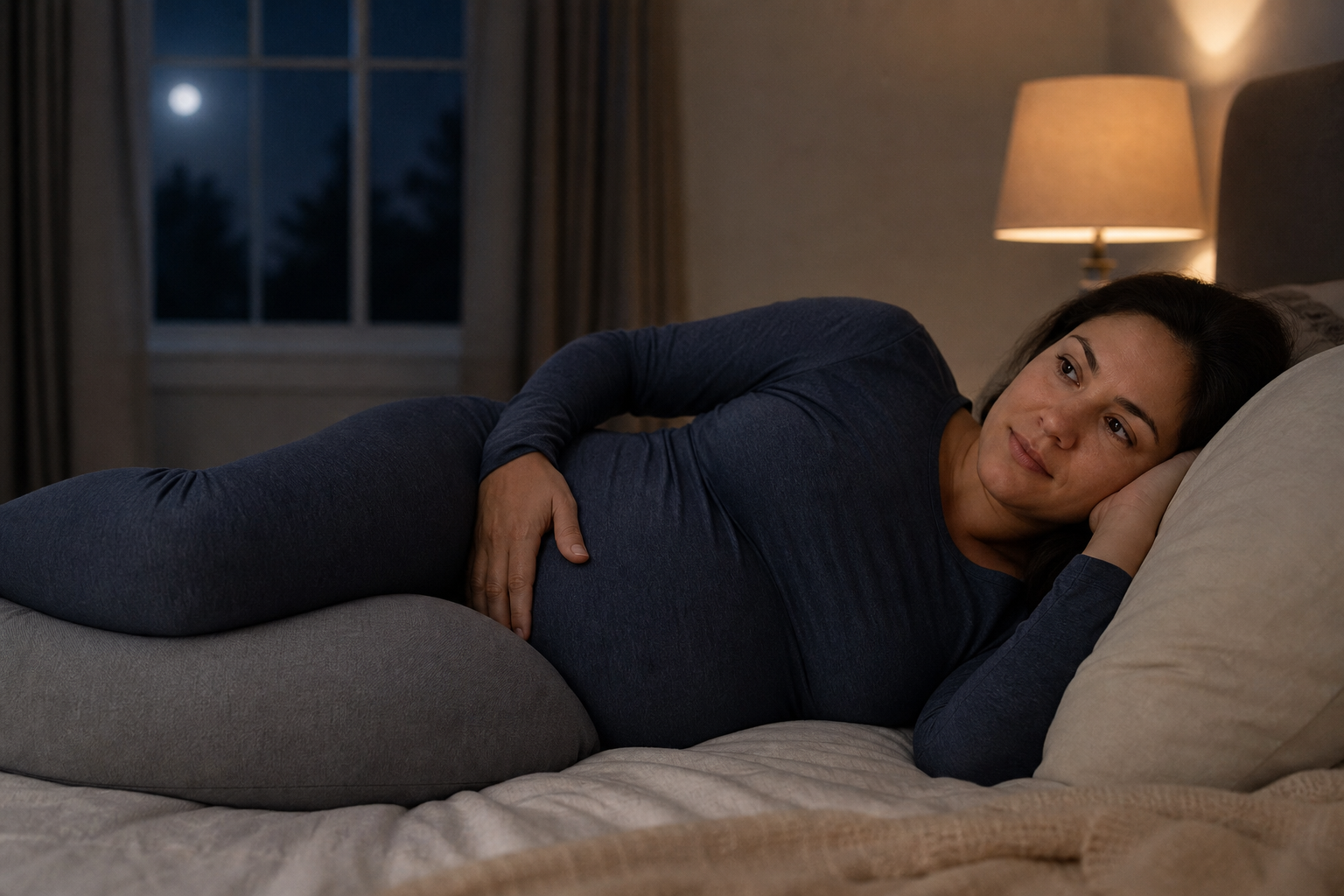
This is a different situation. Standalone doxylamine used as a sleep aid during pregnancy is not specifically FDA-approved for that indication. The safety data from the NVP combination studies cannot simply be transferred to standalone sleep use at different doses or for different durations. Pregnant readers considering doxylamine for sleep difficulties should discuss it with their physician before use. For broader guidance on sleep during pregnancy, the insomnia during pregnancy guide covers evidence-based approaches by trimester.
Breastfeeding
Small, occasional doses of doxylamine are generally considered safe during breastfeeding. However, at higher or longer-term doses, doxylamine may decrease milk production and cause drowsiness or irritability in the breastfed infant. The Diclegis product label specifically recommends against use while breastfeeding. If you are breastfeeding and considering doxylamine for sleep, discuss the timing, dose, and duration with a physician or lactation consultant.
Tolerance, Use Limits, and Why Nightly Use Backfires
Tolerance to doxylamine's sedative effect develops rapidly with repeated use — typically within days of nightly dosing. This means the drug becomes progressively less effective at producing sleep as the body adapts to its receptor-blocking action. Nightly use is, in a straightforward sense, self-defeating: the more consistently you use it, the less it works.
The FDA-directed OTC label caps use at two weeks for this reason. Beyond two weeks, a physician should be consulted — not because the drug becomes suddenly dangerous after day 14, but because persistent sleep difficulty lasting more than two weeks is a signal that something more than occasional sleeplessness is occurring, and that something warrants proper evaluation rather than continued OTC self-treatment.
There is also a sleep quality dimension to the tolerance problem. Regular antihistamine use can disrupt sleep architecture — the structured progression through NREM and REM stages that determines whether sleep is actually restorative. Sedation and sleep are not the same thing. A drug that reliably makes you drowsy does not necessarily produce the sleep your brain needs.
When OTC Doxylamine Is Not the Right Tool
Doxylamine has a legitimate but narrow window of appropriate use: occasional sleeplessness in healthy adults under 65 who do not have the contraindicated conditions listed above. An occasional night of disrupted sleep before a stressful event, during a brief period of adjustment, or from a one-time environmental disruption is the scenario the OTC label is designed for.
It is worth being honest about the evidence base here. The available clinical trial evidence for doxylamine's sleep efficacy is thinner than many readers might expect. A 2015 systematic review of OTC sleep aids found no qualifying randomized placebo-controlled trials specifically on doxylamine that met its inclusion criteria — the qualifying antihistamine RCTs used diphenhydramine, not doxylamine. Doxylamine does appear to produce modest subjective benefit for occasional sleeplessness, and specific formulations like Unisom SleepTabs have received FDA approval, but the doxylamine-specific RCT evidence base is limited. This is not a reason to dismiss the drug's real-world utility for its narrow intended use — but it is a reason not to treat it as a well-validated long-term sleep intervention.
If your sleep difficulty occurs three or more nights per week and has persisted for three or more months, that pattern meets the clinical definition of chronic insomnia — and doxylamine is not indicated for chronic insomnia. The evidence-based first-line therapy for chronic insomnia, endorsed by the American Academy of Sleep Medicine and the NIH, is cognitive behavioral therapy for insomnia (CBT-I) — a structured behavioral treatment with a substantially stronger evidence base than any OTC sleep aid, including for people managing other health conditions alongside their insomnia.
Comments
Join the discussion with an anonymous comment.