
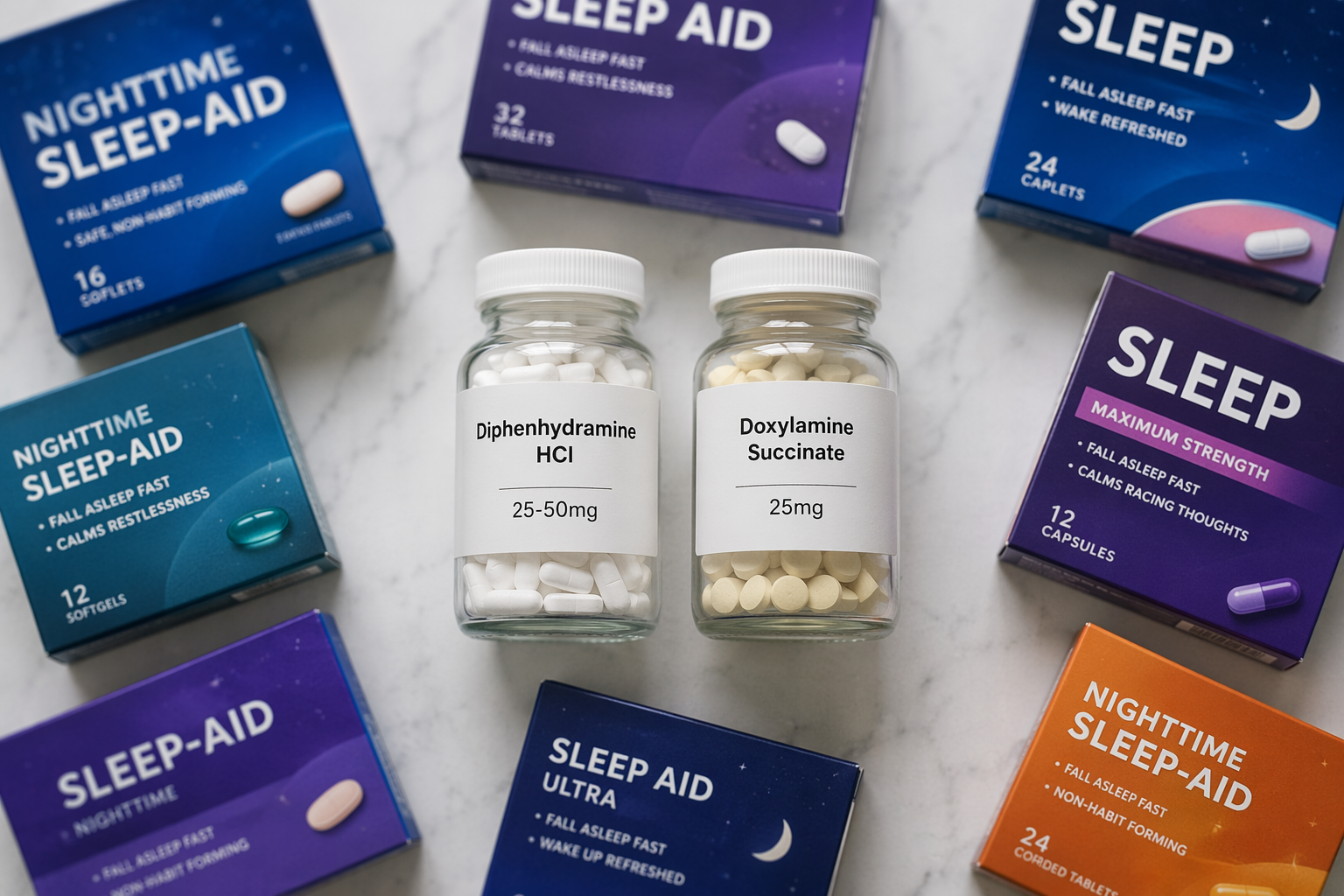
The drugstore shelf makes a nighttime sleep aid look like a crowded category. There are tablets, caplets, liquids, gels, store brands, “PM” versions, “nighttime” versions, and boxes that seem to promise a softer landing after a bad day. Turn the boxes around, though, and the variety gets much smaller. Most over-the-counter nighttime sleep aids reduce to one of two sedating antihistamines: diphenhydramine HCl, usually 25 to 50 mg, or doxylamine succinate, usually 25 mg.[1][2]
That is the first useful move: stop reading the front of the box as if it is the medicine. Read the Drug Facts panel. The active ingredient tells you whether you are choosing diphenhydramine, doxylamine, or a combination product that adds something else you may not have meant to take.
The two active ingredients behind the shelf
Diphenhydramine and doxylamine are first-generation antihistamines. They were not invented as elegant insomnia treatments; their sleep effect comes from sedation. That distinction matters because feeling knocked down is not the same thing as getting more restorative sleep.
| What the label may say | What to check on Drug Facts | Why it matters |
|---|---|---|
| Sleep aid, nighttime sleep aid, sleep gels | Diphenhydramine HCl or doxylamine succinate | The brand name is less important than which antihistamine you are taking. |
| PM pain reliever | An antihistamine plus acetaminophen or ibuprofen | You may be adding a pain medicine you do not need or duplicating one you already took. |
| Nighttime cold or flu product | An antihistamine plus other cold ingredients | You may be taking several drugs for symptoms you do not have. |
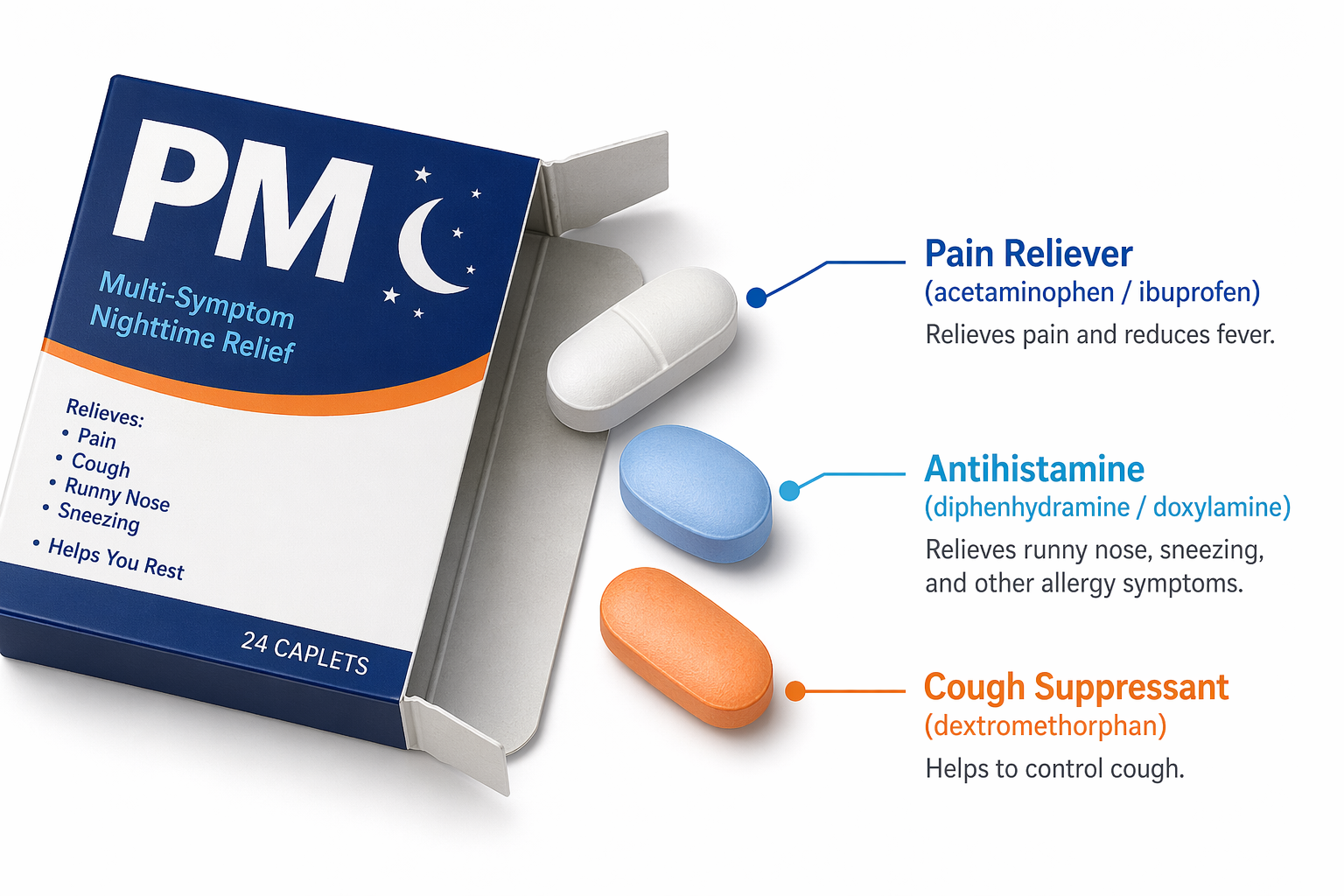
This is where many shopping comparisons become noisier than the label itself. A “PM” product is not automatically stronger, gentler, or more sleep-specific than a plain sleep-aid box beside it. It may simply be the same sedating antihistamine bundled with acetaminophen, ibuprofen, or other ingredients used for pain or cold symptoms.[1][5]
That bundling is not a small detail for someone who already took a pain reliever earlier in the evening. A person who reaches for a PM product to sleep may also be increasing their total acetaminophen or ibuprofen exposure without noticing. The package front usually tells a story about nighttime relief; the Drug Facts panel tells you what organs and side effects are actually being invited into the night.
What the evidence says they do
The most defensible claim for these products is narrow: they may help some people fall asleep a little sooner in short-term situations. The evidence summarized by GoodRx, citing 2017 AAFP and AASM reviews, reports that diphenhydramine shortened time to sleep by about 8 minutes and increased total sleep time by about 12 minutes compared with placebo, with no improvement in perceived sleep quality.[3]
Those numbers are not nothing. Eight fewer minutes awake can feel meaningful when the clock is being watched minute by minute. But they also do not support the larger promise many people hope they are buying: reliably better sleep. The evidence cited here points to modest changes in sleep timing, not a demonstrated improvement in how good sleep feels or how restored someone is the next day.[3]
There is also a difference between sedation and sleep architecture. One weakly sourced claim sometimes repeated in consumer materials is that users of over-the-counter sleep aids may spend less time in deep sleep. The specific figure is not tied to a named primary study, so it should not be treated as a settled number. The safer point is narrower: the evidence here does not establish that these antihistamines improve sleep quality.
Why doxylamine can linger longer
The main practical difference between diphenhydramine and doxylamine is not a glamorous one. It is time. GoodRx lists diphenhydramine’s half-life at about 3 to 9 hours, while doxylamine’s half-life is about 10 hours and can be up to 15 hours in older adults.[2]
Half-life is the time it takes for the body to reduce the amount of a drug by half. A longer half-life does not guarantee a worse morning, but it makes next-day effects easier to understand. If a medication is still hanging around when the alarm goes off, “grogginess” is not a mysterious personal failure. It is a predictable consequence of taking a sedating drug whose clock may not match yours.
Sleep Foundation reports that up to 80% of people taking sleep aids report lingering sedation the next day, citing NIH data.[4] That figure should be read as a broad warning signal rather than a guarantee for any one product. Still, it fits the everyday pattern: a pill used to solve midnight wakefulness can move part of the problem into the morning commute, the workday, or the first hours of caregiving.
Nightly use changes the calculation
The phrase “non-habit-forming” does a lot of work on sleep-aid packaging. It usually means these products are not the same as prescription sedative-hypnotics associated with dependence. It does not mean they are a good nightly sleep plan.
Mayo Clinic notes that tolerance to the sedating effects of over-the-counter sleep aids can develop after just a few nights, and that these products are intended for short-term use, not for more than 2 weeks without medical consultation.[1] That is a very different message from the quiet implication on the shelf, where a bottle of tablets can look like a simple household backup.
Tolerance creates a particularly unrewarding trade. The sleepiness effect may fade while side effects and drug-interaction concerns remain part of the bargain. At that point, the person is not buying the original promise anymore; they are repeating a routine with less obvious benefit.
Who should be especially cautious
The safety question changes sharply by person. A healthy younger adult taking a single dose during a short-term disruption is not in the same situation as an older adult, a pregnant person, or someone with urinary retention, glaucoma, asthma, or COPD.
For adults 65 and older, the warning is especially clear. The 2023 AGS Beers Criteria lists both diphenhydramine and doxylamine as potentially inappropriate medications for older adults, a concern highlighted in Harvard Health and Banner Health discussions of drugstore sleep aids.[5][6]
The issue is anticholinergic burden. First-generation antihistamines can cause effects such as confusion, dry mouth, constipation, urinary problems, and sedation; in older adults, those effects can be more consequential. A foggy morning is not just unpleasant if it increases the chance of a fall, medication mistake, or unsafe driving.
Several medical conditions also belong in the decision before the purchase, not after the side effect. GoodRx, Harvard Health, and Banner Health flag caution or avoidance for people with conditions including glaucoma, urinary retention or enlarged prostate, COPD, asthma, and pregnancy.[2][5][6] These are not decorative label warnings. They are reasons to ask a clinician or pharmacist before treating a nighttime sleep aid as casual.
How to read the box without getting pulled into the branding
A useful label check takes less time than comparing brand promises on the front:
- Find “Active ingredient” on the Drug Facts panel and identify diphenhydramine HCl or doxylamine succinate.
- Check the dose rather than assuming one brand’s wording means a different medicine.
- Look for added acetaminophen, ibuprofen, cough suppressants, or cold medicines in “PM” and “nighttime” products.
- Ask whether you need every active ingredient in the product, not just the sleep-related one.
- Treat next-day driving, work, caregiving, and fall risk as part of the medication decision.
This approach does not require treating every nighttime sleep aid as dangerous. It requires treating it as medicine. The shelf is designed to make brand differences feel large and ingredient differences feel small. The body experiences it the other way around.
The practical bottom line
If you are considering an over-the-counter nighttime sleep aid, the first question is not which box looks most sleep-specific. It is whether you are choosing diphenhydramine or doxylamine, whether the product adds another medication, and whether your age, pregnancy status, health conditions, or other drugs make that choice risky.
The best-supported benefit cited here is modest and short-term: for diphenhydramine, falling asleep about 8 minutes sooner and sleeping about 12 minutes longer, without a demonstrated improvement in perceived sleep quality.[3] Against that, the label has to carry next-day sedation, rapid tolerance, anticholinergic effects, and hidden combination ingredients.
For a narrower head-to-head look at the two main ingredients, see which OTC sleep aid is safer: doxylamine or diphenhydramine.
References
- Sleep aids: Understand options sold without a prescription, Mayo Clinic
- Doxylamine vs. Diphenhydramine: Here Are the Differences, GoodRx
- Over-the-Counter Sleep Aids: Do They Really Work?, GoodRx
- Sleep Aids: Know the Types, Benefits, & Risks, Sleep Foundation
- Are drugstore sleep aids safe?, Harvard Health
- The Potential Risks of Over-the-Counter Sleep Aids, Banner Health


Comments
Join the discussion with an anonymous comment.