
The best sleep aid for older adults is not the pill that knocks someone out fastest. After 65, the safer question is: which option is least likely to leave that person confused, unsteady, unable to urinate, or on the floor the next morning?
That is why the American Geriatrics Society Beers Criteria belong at the front of this decision, not in the fine print. The 2023 Beers Criteria list several familiar sleep medicines as potentially inappropriate for many older adults: first-generation antihistamines such as diphenhydramine and doxylamine because of strong anticholinergic effects, benzodiazepines because of risks including cognitive impairment, delirium, falls, fractures, and motor vehicle crashes, and “Z-drugs” such as zolpidem, eszopiclone, and zaleplon because they can cause harms similar to benzodiazepines with only minimal improvement in sleep latency and duration.[1]
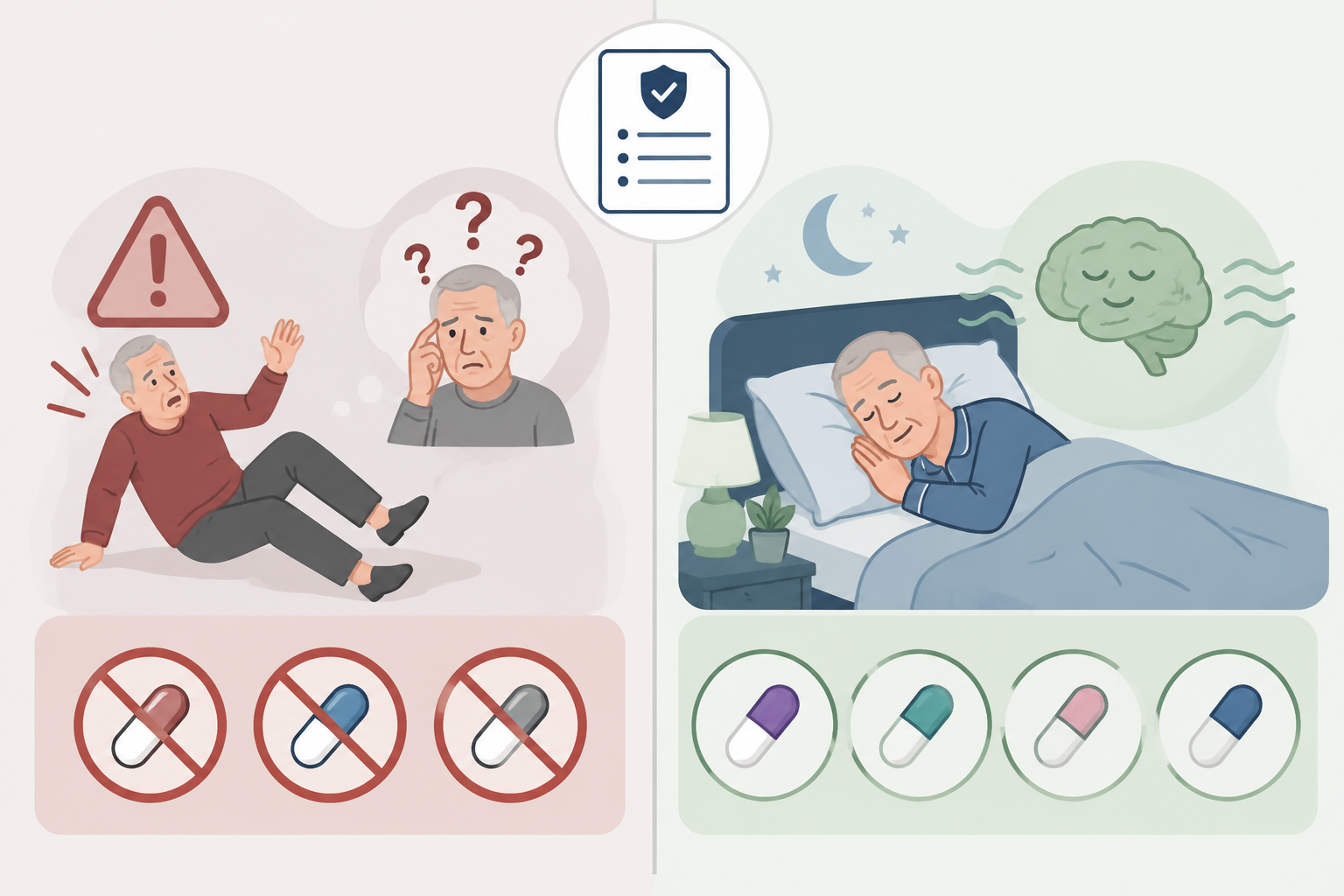
That does not mean sleeplessness is trivial. A bad night can make pain worse, raise anxiety, strain a caregiver, and turn the next day into a long negotiation with fatigue. But medication safety in late life is usually less about whether a drug can cause sleep and more about whether the sleep it produces is worth the next-morning trade.
Start With The Medicines Most Older Adults Should Avoid
The most important first move is to check the medicine cabinet, not the supplement aisle. Many risky sleep aids for older adults are not obscure prescriptions. They are common over-the-counter products, combination pain relievers, allergy pills, or old prescriptions that stayed in a drawer after a hospitalization or stressful season.
| Sleep aid type | Common examples | Why it matters after 65 |
|---|---|---|
| First-generation antihistamines | Diphenhydramine, including Benadryl, Tylenol PM, Advil PM; doxylamine, including Unisom | Strong anticholinergic effects; Beers Criteria warn about confusion, dry mouth, constipation, urinary retention, and increased risk of falls, delirium, and dementia with cumulative exposure |
| Benzodiazepines | Prescription sedatives used for sleep or anxiety | Beers Criteria warn of increased sensitivity in older adults and risks including cognitive impairment, delirium, falls, fractures, and motor vehicle crashes |
| Z-drugs | Zolpidem/Ambien, eszopiclone/Lunesta, zaleplon/Sonata | Beers Criteria warn of adverse events similar to benzodiazepines, including delirium, falls, fractures, emergency department visits, hospitalizations, and motor vehicle crashes, with minimal improvement in sleep outcomes |
Diphenhydramine is the one that often hides in plain sight. Someone may say they are not taking a sleeping pill because the bottle says “PM,” “allergy,” or “nighttime pain relief.” The sedating ingredient can still be diphenhydramine. Doxylamine has the same basic problem: it may make a person drowsy, but it also adds anticholinergic load, and older bodies are less forgiving of that load.[1]
Anticholinergic effects are not just nuisance side effects. Dry mouth may be tolerable. Constipation may not be. Urinary retention can become urgent. Confusion can become a fall, a panicked caregiver call, or an emergency visit. The Beers Criteria specifically warn that cumulative anticholinergic exposure is associated with increased risk of falls, delirium, and dementia.[1]
Benzodiazepines and Z-drugs raise a different but related safety concern. They can sedate, impair balance, slow reaction time, and blur the line between sleep and next-day functioning. For an older adult who already uses blood pressure medication, gets up at night to urinate, has neuropathy, or walks in a dim hallway, that next-morning or middle-of-the-night impairment is not theoretical.
Match The Option To The Sleep Problem
Once the high-risk familiar drugs are off the starting line, the medication question becomes narrower. Is the problem falling asleep? Staying asleep? Waking too early? Anxiety at bedtime? Pain? Nighttime urination? A sleep aid that helps sleep onset may do little for 3 a.m. awakenings. A drug that helps sleep maintenance may be unnecessary for someone who sleeps through the night once they finally drift off.
| Option to discuss with a clinician | Best fit | What the evidence suggests |
|---|---|---|
| Prolonged-release melatonin | Sleep onset, especially when circadian timing is part of the problem | In adults 65 to 80 with insomnia, 2 mg prolonged-release melatonin reduced sleep-onset latency by about 14 to 16 minutes in randomized trials, with adverse event rates similar to placebo |
| Ramelteon | Sleep onset | In adults 65 and older, 8 mg ramelteon reduced sleep-onset latency by 12.9 minutes at 5 weeks; a large retrospective Medicare cohort found no severe accidents in the ramelteon group |
| Low-dose doxepin | Sleep maintenance | At 1 to 3 mg, doxepin is FDA-approved for sleep maintenance; a 12-week trial in older adults found no significant residual sedation compared with placebo |
| Dual orexin receptor antagonists | Sleep onset and/or sleep maintenance, depending on the drug and patient | Trials show promising efficacy and relatively low harm signals, but cost, coverage, and industry-sponsored evidence matter |
Those numbers are deliberately modest. A 12- to 16-minute improvement can matter to someone lying awake every night, but it is not a miracle. Seeing the size of the benefit helps keep the decision honest: if a medication offers minutes of improvement, it should not buy those minutes by creating a serious fall risk.
Prolonged-Release Melatonin: Modest Benefit, Real Quality Questions
Melatonin is often described as “natural,” which is true in one sense and incomplete in the only sense that matters at the pharmacy counter. Melatonin is a hormone involved in sleep-wake timing. A prolonged-release form is meant to mimic a more sustained overnight signal rather than hit quickly and disappear.
In randomized trials of adults 65 to 80 with insomnia, prolonged-release melatonin 2 mg shortened sleep-onset latency by about 14 to 16 minutes, and adverse event rates were similar to placebo.[2] That makes it a reasonable discussion point for some older adults, especially when the complaint is trouble falling asleep rather than unsafe nighttime wandering, severe pain, untreated sleep apnea, or another condition that needs its own treatment.
The catch is supplement quality. A study of melatonin supplements found actual melatonin content ranging from 83% below the label claim to 478% above it, and 26% of tested products contained serotonin.[3] That does not prove every melatonin product is unreliable, but it does mean “over the counter” should not be treated as “predictable.” For older adults taking multiple medications, that uncertainty belongs in the risk conversation.
Ramelteon: A Prescription Option For Sleep Onset
Ramelteon works through melatonin receptors rather than by broadly sedating the central nervous system. That distinction matters because the main goal is to help the body initiate sleep without adding the same kind of balance, memory, and delirium concerns that drive caution with benzodiazepines, Z-drugs, and anticholinergic sleep aids.
In adults 65 and older, ramelteon 8 mg reduced sleep-onset latency by 12.9 minutes at 5 weeks.[2] A retrospective cohort study of 445,329 Medicare patients reported zero severe accidents, defined as falls, fractures, head injuries, or motor vehicle crashes, in the ramelteon group, compared with 0.28% to 0.40% in benzodiazepine and Z-drug groups.[2]
That zero-event finding is reassuring, but it should be read carefully. The study was retrospective, so it can show an observed safety signal in a large Medicare population, not prove that ramelteon eliminates severe accident risk. It also does not mean ramelteon is the right answer for every older adult with insomnia. It is mainly an onset medication; if the problem is waking repeatedly at 2 or 3 a.m., the fit may be poor.
Low-Dose Doxepin: Keep The Dose And The Goal Narrow
Doxepin can be confusing because the same drug name appears in very different dosing contexts. At higher antidepressant doses, doxepin has more anticholinergic concern. At very low doses, 1 to 3 mg, it is used differently: the target is sleep maintenance, not depression treatment or heavy sedation.
Low-dose doxepin is FDA-approved for sleep maintenance, and in a 12-week trial of older adults, 1 to 3 mg did not cause significant residual sedation compared with placebo.[2] That is the useful version of the doxepin conversation: low dose, sleep maintenance, and attention to the person’s full medication list.
It should not be casually substituted for “something stronger.” If the actual problem is delayed sleep onset, low-dose doxepin may not address the complaint. If the person already has urinary retention, glaucoma concerns, constipation, cognitive impairment, or a long list of medications with anticholinergic effects, the prescriber needs to see the whole picture before adding even a low-dose option.
DORAs: Promising, But Not A Free Pass
Dual orexin receptor antagonists, often shortened to DORAs, include suvorexant, lemborexant, and daridorexant. Instead of pushing sedation through older pathways such as benzodiazepine receptors or anticholinergic effects, they block orexin signaling, which helps regulate wakefulness. That mechanism is one reason they are drawing attention for older adults.
The available numbers look encouraging. In older adults, reported number needed to treat and number needed to harm estimates include suvorexant with an NNT of 8 and NNH of 13, lemborexant with an NNT of 3 and NNH of at least 10, and daridorexant with an NNT below 10 and NNH of 78.[2][4] In plain language, those figures suggest clinically meaningful benefit with relatively low measured harm in the studied populations.
The pause is not about dismissing them. It is about not overselling them. These figures come from industry-sponsored trials and may reflect selected patients who are healthier, more closely monitored, or less complicated than many older adults seen after a hospital discharge or in a busy primary care visit.[2][4] DORAs can also be expensive, and insurance coverage can decide whether a theoretically good option is actually available.
CBT-I Is Not A Lifestyle Footnote
Cognitive behavioral therapy for insomnia, or CBT-I, deserves a different place in the conversation than “try better sleep hygiene.” Sleep hygiene advice can be useful but often stays generic: reduce caffeine, keep a schedule, make the room dark. CBT-I is a structured treatment that works on the behaviors and conditioned arousal that keep insomnia going.
A 2025 clinical review described CBT-I as the gold standard, with an effect size of 0.96 compared with 0.87 for pharmacotherapy, more durable effects, and no medication side effects.[2] That last part matters for older adults because the side effect burden is often what turns a sleep decision into a safety decision.
The practical problem is access. CBT-I may not be offered, covered, nearby, or available quickly. Some people need a medication decision tonight while waiting for therapy, recovering from illness, grieving, or trying to stabilize a routine. That is not failure. It is exactly why the medication conversation needs to be safer rather than shaming.
What To Review Before Adding Any Sleep Aid
Before starting or continuing a sleep aid, the most useful review is often boring in the best way: gather the actual bottles. Prescription drugs, over-the-counter “PM” products, allergy medicines, supplements, cannabis products where legal, and anything borrowed from a spouse all belong on the table. A medication list typed into a portal may miss the pill that is doing the most harm.
- Name the sleep problem precisely: trouble falling asleep, waking often, waking too early, or feeling unrefreshed despite enough time in bed.
- Check for causes a sleep aid will not fix: pain, restless legs, nighttime urination, depression, anxiety, alcohol use, untreated sleep apnea, or a medication taken too late in the day.
- Look for next-day consequences: morning confusion, grogginess, dizziness, near-falls, new memory problems, constipation, or urinary difficulty.
- Ask whether the current sleep aid appears in the Beers Criteria avoid group, especially diphenhydramine, doxylamine, benzodiazepines, or Z-drugs.
- Discuss safer candidates based on the sleep pattern: CBT-I as the foundation, ramelteon or prolonged-release melatonin for sleep onset, low-dose doxepin for sleep maintenance, and possibly a DORA when benefits, risks, and cost make sense.
Stopping a long-used sedative can also require planning. Benzodiazepines, in particular, should not be abruptly stopped without medical guidance because withdrawal can be dangerous. Even when a medication is a poor long-term fit, the safer path may be a supervised taper, a substitution plan, and CBT-I support rather than a sudden cleanout of the nightstand.
So What Is The Best Sleep Aid For Older Adults?
For most adults 65 and older, the answer starts with what not to choose. Diphenhydramine, doxylamine, benzodiazepines, and Z-drugs should not be the casual first answer to insomnia after 65 because the Beers Criteria flag them for risks that matter in real homes: confusion, falls, fractures, delirium, cognitive effects, and anticholinergic burden.[1]
CBT-I should be considered first when it is available and appropriate, because it treats insomnia without adding medication side effects and has more durable benefit than drug therapy in the reviewed evidence.[2] When medication is still needed, the better conversation is not “Which pill is strongest?” It is “Which lower-risk option matches this person’s sleep problem and health profile?”
That may mean ramelteon or prolonged-release melatonin for sleep onset, low-dose doxepin for sleep maintenance, or a DORA when the expected benefit, adverse-effect profile, drug interactions, coverage, and cost line up. None of these is a universal winner. The safest choice is the one that lets the older adult sleep without making someone else discover the cost at breakfast, on the bathroom floor, or in another stack of discharge paperwork.
References
- American Geriatrics Society 2023 updated AGS Beers Criteria® for potentially inappropriate medication use in older adults. Journal of the American Geriatrics Society. 2023.
- Insomnia in older adults: A review of treatment options. Cleveland Clinic Journal of Medicine. 2025.
- Melatonin Natural Health Products and Supplements: Presence of Serotonin and Significant Variability of Melatonin Content. American Family Physician. 2021.
- Dual orexin receptor antagonists for insomnia in older adults. PMC.


Comments
Join the discussion with an anonymous comment.