
If you have ADHD and keep finding yourself alert at midnight, annoyed at 1 a.m., and barely human when the alarm goes off, the usual sleep advice can feel strangely accusatory. It assumes the problem starts with discipline: turn off your phone, keep a diary, dim the lights, repeat the same relaxing routine. Those steps can help some people. But they do not explain why so many ADHD adults feel most awake when the day is supposed to be ending.
The better starting point is the clock. A large share of ADHD adults appear to run on a delayed sleep-wake phase, meaning the body’s biological night starts later than the social day allows. One 2025 perspective describes delayed sleep-wake phase in about 73–78% of ADHD adults and reports an approximately 90-minute delay in dim-light melatonin onset, or DLMO, compared with non-ADHD controls.[1] That does not mean every adult with ADHD has the same sleep problem. It does mean that for the adult whose energy rises late and collapses in the morning, “natural sleep aid for ADHD adults” should not begin with a shelf of calming products. It should begin with circadian timing.

This is the argument made more briefly in ADHD Adults Need a Circadian Sleep Aid, Not a Pill. The deeper version is less glamorous and more useful: sleep hygiene can support a reset, but it usually cannot move a delayed biological clock by itself.
The problem may be late biological night, not weak bedtime discipline
DLMO is the moment, measured under dim-light conditions, when melatonin begins to rise in the evening. It is not the same thing as the time you decide to go to bed. It is closer to a timestamp from the body: night has started internally. If DLMO is delayed, a person can be lying in bed at a reasonable hour while their circadian system is still broadcasting “not yet.”
That distinction matters because many ADHD adults are not simply refusing sleep. Their external obligations start at 7 or 8 a.m., while their internal night may be shifted later. The result is predictable: sleep onset drifts, wake time stays fixed by work, school, parenting, or appointments, and the person accumulates short, mistimed sleep.
Insomnia symptoms are also common in ADHD, but the numbers need careful handling. Some summaries report insomnia symptoms in as many as 80% of ADHD adults, while broader educational overviews give a more conservative range of 25–50% for sleep problems or insomnia symptoms.[1][2] Those figures are not interchangeable with a diagnosis, and they do not prove that every ADHD sleep complaint is circadian. They do show why the “just go to bed earlier” script is too thin for this population.
For readers trying to separate a racing mind from a late clock, the practical clue is pattern. Cognitive hyperarousal often feels like wanting sleep but being kept awake by rumination, worry, or mental noise. Circadian delay often feels like being genuinely awake until late, then sedated by morning. The two can overlap. A differential guide such as Can’t fall asleep? Check if it’s your mind or your clock can help frame that first fork before choosing an intervention.
What actually moves the clock
A circadian reset is not one habit. It is a set of time cues aimed in the same direction. Morning light tells the brain that day has begun. Evening dimness removes the signal that keeps the clock late. A stable wake time anchors the rhythm. Exercise in the morning adds another daytime cue. Low-dose melatonin, when timed correctly, can nudge the internal night earlier.
The timing is the treatment. That sentence is worth taking literally. Melatonin taken as a late-night knockout aid is not the same intervention as melatonin taken earlier, at a low dose, to shift circadian phase. Bright light used whenever convenient is not the same as bright light placed soon after waking. A protocol that works with the clock can fail if the same pieces are scattered randomly across the day.
| Cue | Circadian job | Practical direction |
|---|---|---|
| Fixed wake time | Anchors the day and prevents the schedule from drifting later | Keep wake time as stable as possible, including after a bad night |
| Morning bright light | Advances the body clock earlier when used after waking | Use bright outdoor light or a clinically appropriate light box in the morning |
| Morning movement | Adds a daytime timing signal and reduces inertia | Keep it simple enough to repeat: walk, commute light, or brief exercise |
| Evening light restriction | Reduces late signals that push the clock later | Dim lights and reduce bright/blue-rich exposure in the evening |
| Low-dose melatonin | Can advance DLMO when timed to the individual circadian phase | Use chronobiotic timing, not casual late-night dosing |
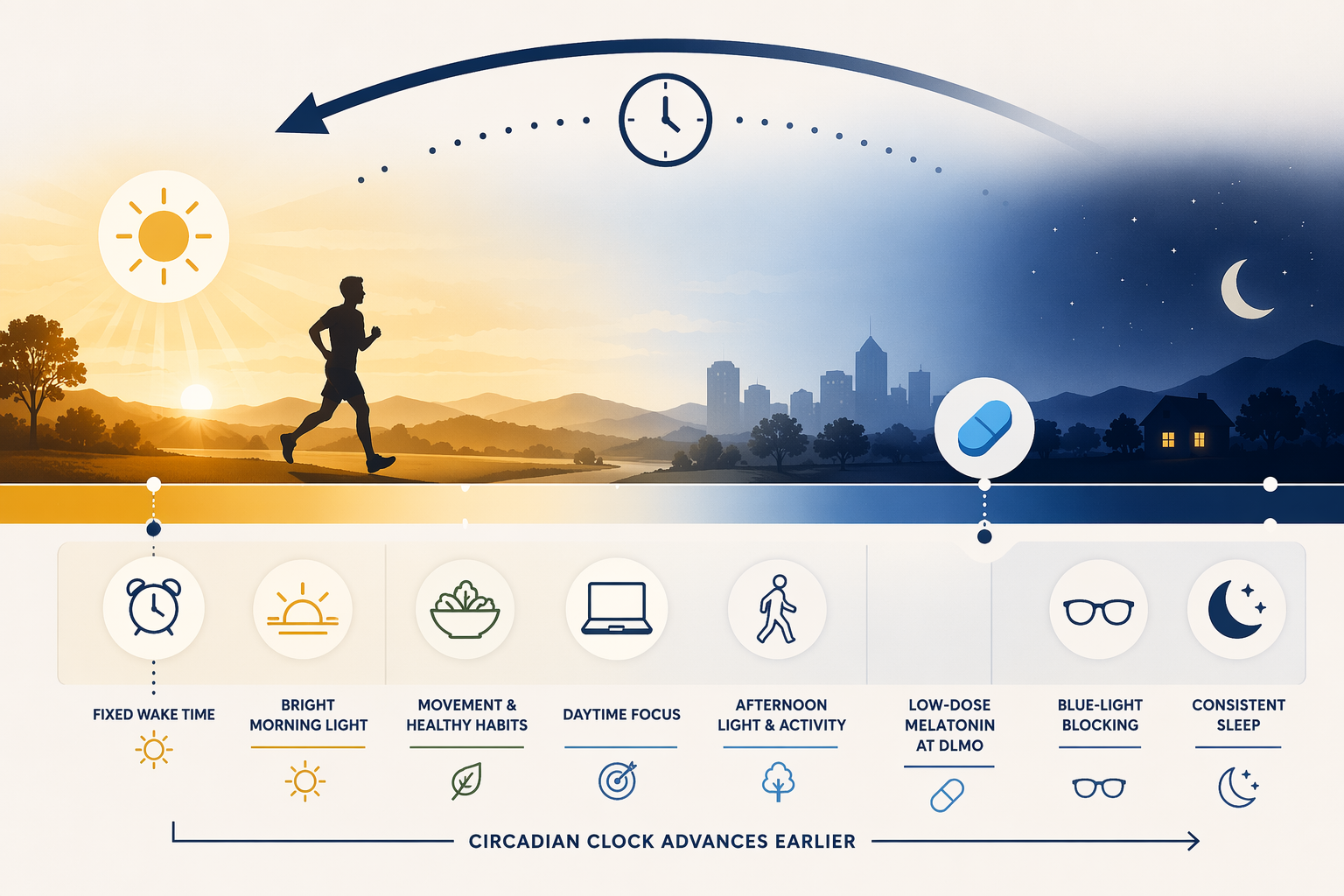
For the biology behind why these cues matter, the short version is that the brain’s master clock responds strongly to light and coordinates sleep pressure, melatonin, temperature, and alertness. A more detailed walkthrough of the SCN, clock-gene feedback loops, and the two-process model belongs in a circadian mechanism explainer, not in a supplement aisle. Readers who want that layer can use Circadian Rhythm Mechanisms: How Your Body Clock Controls Sleep and Wake Cycles.
Morning bright light has the right target
Bright light therapy is one of the more plausible natural interventions for ADHD adults with delayed phase because it acts on the circadian system directly. A review of adult ADHD light studies described morning bright light at 10,000 lux, generally for 10–30 minutes, with DLMO advances of 31–57 minutes and improvements in Pittsburgh Sleep Quality Index scores and ADHD symptoms across small studies.[3]
That evidence is encouraging, not settled. Much of the adult ADHD bright-light literature is small or open-label. It supports the direction of effect more confidently than it supports a one-size-fits-all protocol. Still, the mechanism fits the complaint: if the clock is late, a properly timed morning signal is a rational tool.
Implementation details matter enough to justify a separate guide. Morning light should not become another vague command to “get sunlight.” Timing, intensity, eye safety, bipolar history, migraine sensitivity, and medication context can all matter. A practical light-focused walkthrough is here: Circadian Rhythm and Light Exposure: How Light Affects Sleep.
Low-dose melatonin is different from using melatonin as a sedative
Melatonin is often sold as if it were a natural sleeping pill. That framing is sloppy for delayed sleep phase. In the circadian literature, the more interesting use is chronobiotic: a small dose timed to shift the body clock.
The most relevant placebo-controlled adult ADHD trial enrolled 51 adults with ADHD and delayed sleep phase syndrome. Participants received 0.5 mg melatonin timed to individual DLMO, and the treatment advanced circadian phase by 88 minutes and reduced ADHD symptoms by 14%.[4] That is unusually on-point evidence for this topic because it did not ask whether melatonin made a random group of adults sleepy. It tested a timed intervention in ADHD adults whose clocks were delayed.
The limitation is just as important: this was a small, specific trial. It does not prove that every ADHD adult should take melatonin, that larger doses are better, or that melatonin treats ADHD itself. The finding is narrower and more useful: in ADHD adults with delayed sleep phase, low-dose melatonin timed to DLMO can move circadian timing earlier.
That distinction changes the buying decision. A 0.5 mg chronobiotic dose used before the body’s natural melatonin rise is not the same as a 1–3 mg dose taken near bedtime in hopes of feeling drowsy. Product form also affects timing: liquids, capsules, and gummies can differ in dose precision and onset expectations. For readers already considering melatonin, When Melatonin Actually Works for Insomnia and How to Choose Between Melatonin Gummies, Capsules, and Liquids are better next stops than a generic “best supplement” list.
The strongest version combines the cues
The reason morning light and timed melatonin are often discussed together is that they can push from opposite sides of the same rhythm. Morning light pulls the clock earlier after waking. Evening darkness stops delaying it. Melatonin, when placed correctly, can signal biological night earlier. In the adult ADHD light-therapy literature summarized by Surman and Walsh, combining melatonin with bright light produced the largest phase advance, roughly two hours.[3]
A realistic protocol for an ADHD adult has to be simpler than a perfect protocol on paper. The wake alarm needs to be visible. The light source needs to be where the morning actually happens. The evening plan needs friction removed before 11:45 p.m., not after executive function has left the building. If the routine depends on remembering a six-item checklist at the worst hour of the day, the design is the problem.
Why generic sleep hygiene often collapses in ADHD
Sleep hygiene advice is not useless. A cool room, lower evening light, less caffeine late in the day, and a more predictable schedule can make sleep easier. But these habits are supports, not necessarily the active ingredient that advances a delayed clock.
There is also a practical problem that many sleep articles ignore: standard protocols often require the very executive functions ADHD impairs. One bright-light pilot study noted that ADHD subjects’ core deficits interfered with completing sleep diaries.[5] That small detail deserves more attention than it usually gets. A diary can be a measurement tool in a clinic and a shame machine at home. If the intervention depends on flawless tracking, the intervention may be mismatched to the patient.
ADHD-adapted behavioral care tries to solve that mismatch. In a 2019 trial of CBT-I adapted for ADHD, the program used calendars, alarms, and structured prompts, and insomnia improvement was sustained at 3-month follow-up.[6] That is the right direction: keep the behavioral tools, but stop pretending ADHD adults can execute them like a non-ADHD sleep-lab brochure.
For a broader care sequence that includes insomnia treatment beyond circadian timing, see What Actually Works for ADHD and Insomnia. The ladder matters because a delayed clock, anxiety, restless legs, medication effects, sleep apnea, and irregular routines can sit on top of each other.
Comfort aids can help, but they are not chronotherapy
A weighted blanket, a calmer room, or a familiar wind-down cue may help someone stay in bed long enough for sleep to arrive. That is different from advancing DLMO. The distinction is not snobbery; it prevents disappointment. A comfort aid can reduce arousal or improve adherence while leaving the circadian phase mostly unchanged.
Weighted blankets have some relevant evidence, though not the same kind as timed light and melatonin. A controlled study in psychiatric patients, including patients with ADHD, found that 20–30 lb weighted blankets significantly improved insomnia severity compared with light blankets.[7] Because ADHD was part of a broader psychiatric sample, this should not be read as definitive ADHD-specific proof. It is better treated as a possible support for sleep comfort, especially when restlessness or sensory regulation is part of the bedtime problem.
The same sorting rule applies to supplements such as magnesium, valerian, L-theanine, or broad “calming” stacks. Some people may find individual products subjectively helpful, but they are not the center of the evidence for delayed sleep phase in ADHD. For a wider comparison of supplement evidence, use Natural Sleep Aids Ranked by Clinical Evidence rather than treating every relaxing ingredient as a clock-shifting tool.
| Intervention | Best supported role | Main caution |
|---|---|---|
| Morning bright light | Direct circadian phase advance | Adult ADHD evidence is promising but mostly small or open-label |
| 0.5 mg melatonin timed to DLMO | Direct circadian phase advance in ADHD adults with delayed sleep phase | Trial evidence is small and specific; timing matters |
| Fixed wake time and evening light restriction | Stabilizes the reset and reduces late delays | Hard to maintain without ADHD-friendly environmental design |
| Weighted blanket | Sleep comfort and insomnia severity support | Not proven to advance circadian phase |
| ADHD-adapted CBT-I | Behavioral support with prompts and structure | Works best when adapted to executive-function realities |
Medication timing belongs in the conversation, even in a natural-aid article
ADHD medication is not a natural sleep aid, and changing it is not a do-it-yourself circadian protocol. But it would be artificial to leave it out. Stimulant timing, formulation, rebound, untreated evening symptoms, and daytime under-treatment can all affect sleep.
A 2025 UK Delphi consensus of 212 health care professionals reached at least 90% agreement on several adult ADHD sleep statements, including support for melatonin availability for ADHD adults with delayed sleep onset when non-pharmacological measures fail. The same consensus reported 97% agreement with the statement that optimizing ADHD medication timing or formulation can improve sleep in about half of cases.[8]
That consensus is useful but not neutral terrain: it was funded by AGB Pharma, a melatonin manufacturer.[8] It should inform a clinician conversation, not replace one. If sleep worsened after a medication change, if afternoon rebound drives late-night scrolling or snacking, or if morning sedation makes stimulant timing chaotic, the medication plan deserves review.
A practical circadian reset for an ADHD adult
The clean clinical version would measure DLMO, set exact melatonin timing, prescribe light exposure, monitor response, and adjust. Most adults are not living inside that clean version. The home version should preserve the logic while reducing the number of failure points.
- Pick a wake time you can defend for several weeks. The wake time is the anchor; sleeping in after a bad night often pushes the clock later again.
- Get bright light soon after waking. Outdoor light is simplest when available; a light box requires attention to intensity, distance, duration, and safety.
- Put movement in the morning if possible. It does not need to be athletic; it needs to be repeatable.
- Make the evening darker before you feel motivated to behave. Lower lamps, screen brightness, and blue-rich light early enough that the plan is already running when impulse control drops.
- If using melatonin for phase shifting, treat dose and timing as the intervention. Low-dose, correctly timed melatonin is a different tool from taking a larger dose at bedtime.
- Use supports that reduce friction: alarms, automatic lights, pre-set chargers outside the bed, visible morning shoes, and a tracking method that does not punish missed entries.
The hardest instruction is usually the fixed wake time. It asks the person who is already sleep-deprived to stop using the one lever that gives immediate relief. That is why the rest of the protocol matters. Morning light, morning movement, evening dimness, and correctly timed melatonin are not moral upgrades. They are ways to make the earlier wake time biologically more plausible.
If the schedule is extremely delayed, if attempts trigger severe sleep loss, or if work and caregiving make a stable wake time impossible, a clinician or sleep specialist can help adjust the pace. Pushing too aggressively can backfire.
Where the evidence stops
The best-supported natural sleep aid for ADHD adults with delayed sleep phase is not a single calming product. It is a timed circadian protocol, with morning bright light and low-dose melatonin as the most clock-specific tools, and sleep hygiene serving as scaffolding.
That conclusion is narrower than many supplement claims and stronger than generic bedtime advice. It applies most directly to ADHD adults whose sleep is delayed, not to every adult with ADHD, every case of insomnia, or every person who feels tired in the morning. DLMO testing, pregnancy, older age, bipolar disorder, complex psychiatric comorbidity, eye disease, photosensitizing medications, and medication changes all move this out of casual self-experiment territory and into clinical guidance.
For the adult who has failed the usual chart, routine, and “no screens” lecture, the point is not that behavior does not matter. It is that behavior has to be aimed at the right target. When the clock is late, the first question is not how to become a better sleeper. It is how to move night earlier.
References
- ADHD as a circadian rhythm disorder: evidence and implications for chronotherapy, Frontiers in Psychiatry, 2025.
- ADHD and Sleep Problems, Sleep Foundation.
- Managing Sleep in Adults with ADHD: From Science to Pragmatic Approaches, PMC, 2021.
- Chronotherapy in adults with attention-deficit/hyperactivity disorder: A randomized controlled trial, PubMed, 2021.
- Bright light therapy for adults with attention-deficit/hyperactivity disorder: A pilot study, PubMed, 2006.
- Behavioral and cognitive behavioral therapy for insomnia in adults with ADHD: A randomized controlled trial, PubMed, 2019.
- A randomized controlled study of weighted chain blankets for insomnia in psychiatric disorders, PubMed, 2020.
- Expert consensus on the management of sleep disturbances in adults with attention-deficit hyperactivity disorder, PMC, 2025.


Comments
Join the discussion with an anonymous comment.