
Shift Work Disorder: Symptoms, Causes, and Treatment
Shift work disorder is a clinically recognized circadian rhythm sleep disorder — not simply the expected tiredness of working odd hours — that affects an estimated 10–40% of shift workers and carries real long-term health risks if left unmanaged. This guide explains the diagnostic criteria, the biology of circadian misalignment, and a tiered treatment approach that prioritizes light therapy and melatonin before pharmacology.
What Is Shift Work Disorder?
Shift work disorder (SWD) is a clinically recognized circadian rhythm sleep-wake disorder classified under the International Classification of Sleep Disorders, Third Edition (ICSD-3). It is not simply the tiredness that comes with working unusual hours — it is a distinct medical condition with defined diagnostic criteria, measurable impairment, and a specific biological mechanism.
The diagnostic threshold matters. To qualify as SWD, a person must experience insomnia, excessive sleepiness, or both that are directly caused by their shift schedule, lasting for at least one month, and causing measurable impairment to social, family, or work functioning. Transient fatigue during the first days of a new shift — the kind most workers experience during adjustment — does not meet this threshold.
The scale of the problem is significant. An estimated 10–40% of shift workers develop SWD, and approximately 20% of the full-time US workforce works non-traditional hours — meaning tens of millions of people are potentially affected. Despite this, SWD remains widely underdiagnosed and undertreated.
Core Symptoms: Insomnia and Excessive Sleepiness
SWD has two defining symptoms that typically occur together, not as separate complaints. Understanding why they appear as a pair — rather than as independent problems — is essential for recognizing the condition.
The first is insomnia during the intended sleep window: difficulty falling asleep, staying asleep, or waking earlier than intended when trying to sleep during daytime hours. The second is excessive sleepiness during the work shift: a level of fatigue and impaired alertness that goes beyond ordinary tiredness and interferes with safe, effective performance on the job.
Both symptoms arise from the same source: the body's internal clock is driving wakefulness when the person is trying to sleep, and driving sleepiness when the person needs to be alert. They are two sides of the same circadian misalignment.
Secondary symptoms are common and often what motivate people to seek help:
- Difficulty concentrating or sustaining attention during the shift — a direct consequence of sleep loss and circadian-driven sleepiness.
- Headaches, often related to disrupted sleep architecture and accumulated sleep debt.
- Low energy and physical fatigue that persist even after the shift ends.
- Irritability and mood disturbance — both sleep loss and circadian misalignment independently impair emotional regulation.
- Reduced motivation and social withdrawal, which can compound over time if the disorder goes unmanaged.
Why Shift Work Disrupts the Body Clock
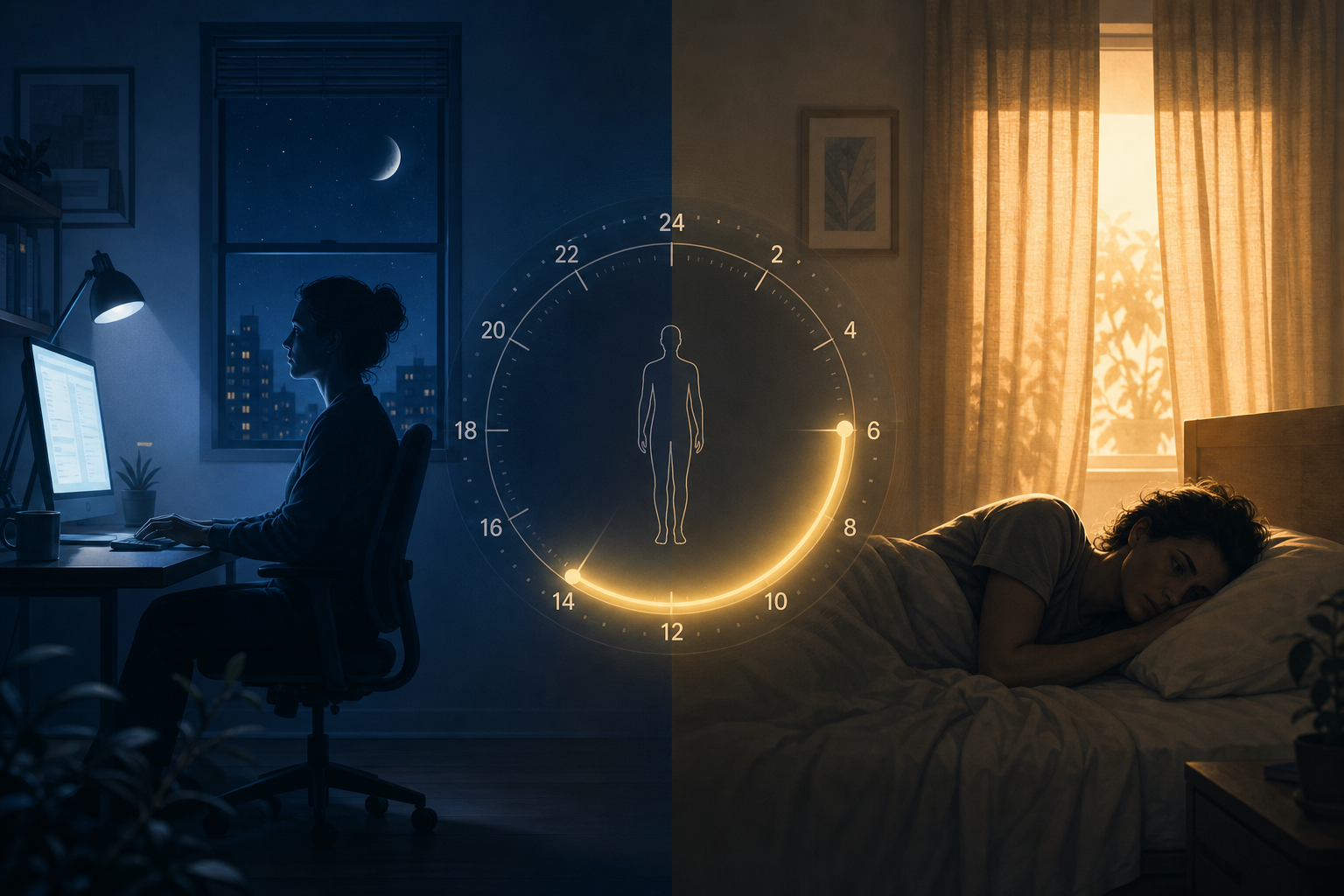
The root cause of SWD is a conflict between the body's internal timing system and the external demands of the work schedule. The suprachiasmatic nucleus (SCN) — the brain's master circadian clock — governs when the body releases melatonin, when cortisol peaks, and when core body temperature rises and falls. These signals are calibrated to a day-active, night-sleeping pattern and do not adapt quickly to schedule changes.
For a night shift worker, the mismatch works against them at both ends of the day. Melatonin — the hormone that promotes sleep — is released at night, precisely when the night shift worker must be alert and performing. Cortisol — the hormone that promotes wakefulness and peaks in the early morning — surges at the time when the night shift worker is trying to fall asleep.
The result is that night shift workers are trying to sleep against a biological tide. Circadian pressure actively opposes daytime sleep, compressing sleep duration and fragmenting sleep architecture. Research consistently shows that night shift workers sleep 1–4 hours less per day than day workers — not because of lifestyle choices, but because the circadian clock is actively promoting wakefulness during their sleep window. This also means the proportion of restorative slow-wave sleep is reduced, since circadian timing influences which sleep stages predominate at different hours.
For a deeper explanation of the molecular clock mechanism — including the CLOCK/BMAL1 feedback loop and how light resets the SCN — see the article on circadian rhythm mechanisms and how the body clock controls sleep and wake cycles. For how circadian timing affects which sleep stages appear and when, see the guide on sleep architecture and NREM and REM stages.
Who Is Most at Risk
Not every shift worker develops SWD. Several factors determine whether a person experiences transient adjustment difficulty or crosses into a clinical disorder.
Chronotype is one of the strongest moderating factors. A person's chronotype reflects the natural timing preference of their circadian clock — whether they are biologically inclined toward earlier or later sleep and wake times. Morning chronotypes ("early birds") experience significantly greater circadian misalignment on night shifts than evening chronotypes ("night owls"), who tolerate late and overnight schedules more easily because their circadian phase is already shifted toward later timing. This is not a matter of willpower or adaptation effort — it reflects a genuine biological difference in clock timing.
Shift type also matters considerably:
- Rotating shift workers face the greatest adaptation burden because the circadian clock is repeatedly forced to re-anchor to a new schedule before it has adapted to the previous one. This group has the highest SWD risk.
- Fixed night shift workers have a more stable schedule, which allows some degree of circadian adaptation — though this is often undermined by reverting to daytime activity on days off.
- Early morning shift workers are required to wake before the circadian clock's natural wake signal, leading to chronic sleep curtailment at the beginning of the sleep period rather than the end.
Rotation direction also affects adaptation. Forward rotation — shifting from morning to evening to night shifts — is better tolerated than backward rotation (night to evening to morning). This is because the human circadian clock has a natural tendency to delay — it is easier to stay up later than to fall asleep earlier. Forward rotation works with this tendency; backward rotation works against it.
How Shift Work Disorder Is Diagnosed
Diagnosis begins with a structured clinical history and a sleep diary kept for at least two weeks. The diary documents sleep timing, duration, work schedule, and subjective sleep quality — giving the clinician enough data to identify the pattern of misalignment and rule out other explanations for the sleep complaints.
The ICSD-3 criteria for SWD require all of the following:
- Insomnia and/or excessive sleepiness, accompanied by a reduction in total sleep time.
- Symptoms are directly associated with a recurring work schedule that overlaps the habitual sleep period.
- The sleep disturbance has been present for at least one month.
- The sleep disturbance causes clinically significant distress or impairment in social, occupational, or other areas of functioning.
- The disorder is not better explained by another sleep disorder, medical condition, mental disorder, medication use, or substance use.
Clinicians may observe patterns over a longer period before confirming the diagnosis, particularly when a worker's schedule is irregular or the history is complex. Actigraphy — a wrist-worn device that records movement and light exposure continuously — is sometimes added to objectively document the sleep-wake pattern across the full work cycle. Polysomnography is not a routine diagnostic tool for SWD but may be ordered to rule out comorbid sleep apnea, which can independently cause excessive daytime sleepiness and is more common in shift workers.
| Feature | Shift Work Disorder | Chronic Insomnia Disorder |
|---|---|---|
| Primary cause | Circadian misalignment with shift schedule | Learned arousal, hyperarousal, conditioned wakefulness |
| Timing of sleep difficulty | Tied directly to shift schedule; improves on days off or when schedule changes | Persistent regardless of schedule; does not resolve with schedule change |
| Excessive sleepiness | Core symptom — present during work hours due to circadian misalignment | Less prominent; fatigue is more common than true sleepiness |
| First-line treatment | Circadian realignment: timed light therapy and melatonin | Cognitive Behavioral Therapy for Insomnia (CBT-I) |
| Diagnostic anchor | Schedule-linked symptom pattern over ≥1 month | Insomnia ≥3 nights/week for ≥3 months, not schedule-dependent |
Treatment: A Tiered Approach Starting with Circadian Realignment
Treatment for SWD follows a clear priority order: address the circadian misalignment first, optimize the sleep environment second, and use pharmacology only when behavioral and circadian interventions are insufficient or when safety is an immediate concern. This hierarchy reflects both the biology of the disorder and the available evidence.
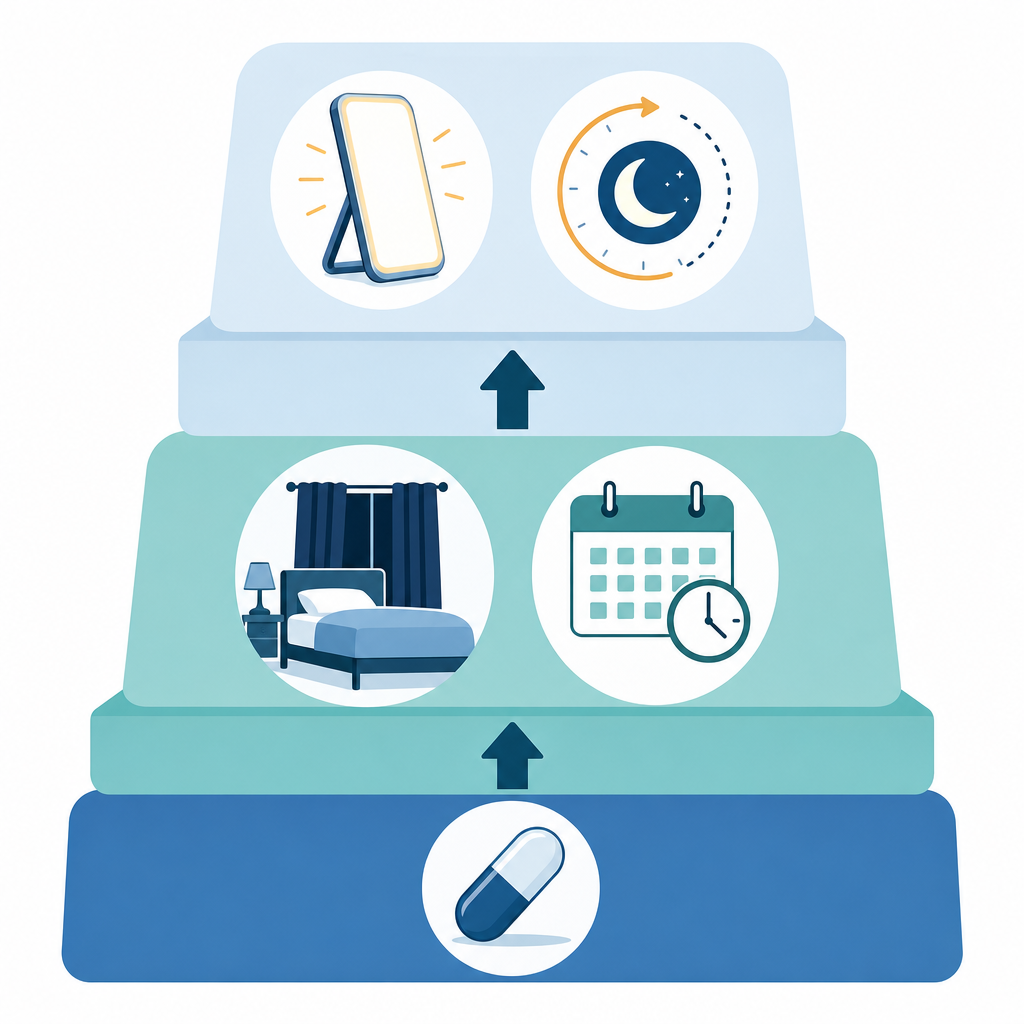
Tier 1: Schedule Optimization
Before any other intervention, the shift schedule itself should be evaluated. Where employers allow flexibility, the following schedule features reduce circadian burden:
- Forward-rotating schedules (Morning → Evening → Night) rather than backward rotation — this accommodates the circadian clock's natural delay tendency and allows longer recovery intervals between shifts.
- Limiting consecutive night shifts — the more consecutive nights worked, the deeper the sleep debt accumulates before any recovery sleep can occur.
- Adequate rest days between shift rotations — insufficient recovery time between schedule changes prevents any meaningful circadian adaptation.
Tier 2: Bright Light Therapy and Light Avoidance
Light is the most powerful external signal for resetting the circadian clock. Timed bright light exposure — particularly blue-enriched light — applied during the early portion of the night shift suppresses melatonin, promotes alertness, and gradually shifts the circadian phase toward the new schedule. The AASM recommends timed light exposure as a treatment for SWD.
Light avoidance after the shift is an equally important complement. When a night shift worker travels home in morning sunlight, the light exposure signals to the SCN that it is time to be awake — directly counteracting any circadian adaptation achieved during the shift. Wearing blue-light-blocking sunglasses during the commute home and using blackout curtains in the sleep environment are standard recommendations for this reason.
Tier 3: Melatonin as a Circadian Phase-Shifter
Melatonin's role in SWD management is frequently misunderstood. It is not a sedative. It does not directly cause sleep. Instead, it functions as a circadian timing signal — taken at the right time, it can advance the circadian phase and make it easier for the body to initiate sleep during the daytime window when the shift worker needs to rest.
The AASM notes that melatonin can help night shift workers sleep during the day, though it does not reliably improve alertness during the work shift itself. Research shows improvements are most consistently observed in total sleep time, sleep efficiency, and subjective sleep quality — but only when dosing and timing are appropriate. Studies that used low or inconsistent doses, or timed the dose incorrectly relative to the circadian phase, tended to show no significant effect.
Because melatonin is sold in the US as a dietary supplement rather than an FDA-regulated drug, there is no standardized regulated dosage — and commercial products vary widely in actual melatonin content. For detailed guidance on dosing, timing protocols, and population-specific safety considerations, see the article on melatonin for sleep: evidence, dosage, and safety by population.
Tier 4: Sleep Hygiene Adapted for Daytime Sleeping
Standard sleep hygiene recommendations need to be adapted for shift workers, because the circadian challenges of daytime sleep are different from those of nighttime sleep. Generic advice to "maintain a consistent sleep schedule" may be impossible for rotating shift workers. The goal is to optimize the sleep environment to work with, not against, the body's circadian state during the available sleep window.
- Blackout curtains or a sleep mask — daytime light is a powerful circadian wake signal; eliminating it from the sleep environment reduces the competing stimulus that shortens daytime sleep.
- Household coordination — communicating sleep windows to family members and managing noise sources (phone, doorbells, children's schedules) reduces the fragmentation that daytime sleep is particularly vulnerable to.
- Strategic caffeine timing — caffeine taken early in the shift can support alertness, but caffeine consumed in the final hours before the intended sleep window will delay sleep onset by blocking adenosine receptors. Cutting off caffeine 4–6 hours before the planned sleep time is a standard guideline.
- Planned napping before or during the shift — a short nap (20–30 minutes) before a night shift or during a break can reduce sleepiness and improve alertness without significantly disrupting subsequent sleep.
Tier 5: FDA-Approved Pharmacology
When circadian realignment and sleep hygiene measures are insufficient — particularly when excessive on-shift sleepiness creates safety risks — pharmacological support may be appropriate. Two medications are specifically FDA-approved for the excessive sleepiness associated with SWD:
- Modafinil (Provigil) — taken approximately 60 minutes before the shift begins, it promotes wakefulness through mechanisms distinct from traditional stimulants.
- Armodafinil (Nuvigil) — the R-enantiomer of modafinil, with a longer effective duration, also taken before the shift.
A 2025 systematic review found that all seven included RCTs on modafinil and armodafinil demonstrated consistent improvements in alertness, vigilance, and cognitive performance in shift workers. However, these medications do not replace sleep — they improve the ability to function while sleep-deprived, but they do not eliminate the underlying sleep deficit or its health consequences. They also do not restore alertness to a fully rested baseline, which is an important safety consideration for workers operating heavy machinery or making high-stakes decisions.
Tier 6: Emerging Options
Two additional approaches show early promise but should be understood as emerging rather than established treatments:
- Suvorexant — an orexin receptor antagonist used for insomnia, one small RCT (Zeitzer 2020, n=19, rated low risk of bias) found it improved daytime sleep duration in shift workers. The evidence base is currently too limited to make a general recommendation.
- Behavioral therapy adapted for SWD — a pilot RCT (Vallières et al., 2024, n=43) found benefits for sleep quality and mental health using a modified behavioral protocol. However, the study was rated high risk of bias in a 2025 systematic review and should not be equated with the established evidence base for standard CBT-I.
| Treatment | Primary Mechanism | Evidence Level | Key Limitation |
|---|---|---|---|
| Schedule optimization (forward rotation, rest days) | Reduces circadian adaptation burden | Expert consensus, observational | Requires employer flexibility |
| Bright light therapy (timed, blue-enriched) | Advances circadian phase; suppresses melatonin | Heterogeneous RCTs — 10 of 16 studies positive | Effectiveness depends on timing consistency and shift type |
| Light avoidance post-shift (sunglasses, blackout curtains) | Prevents circadian phase reversal from morning light | Expert consensus; complementary to light therapy | Requires consistent daily use |
| Melatonin (timed) | Circadian phase-shifter; improves daytime sleep initiation | Moderate — improvements in sleep time and efficiency; no reliable effect on alertness | FDA dietary supplement; no regulated dosing; timing is critical |
| Shift-adapted sleep hygiene (blackout, caffeine timing, napping) | Optimizes sleep environment; reduces competing wake signals | Mixed for standalone use; effective as part of multimodal plan | Not sufficient as sole treatment for SWD |
| Modafinil / Armodafinil | Promotes wakefulness; improves alertness and vigilance | Strong — all 7 RCTs showed consistent improvements | Does not replace sleep; does not restore full baseline alertness |
| Suvorexant | Orexin receptor antagonist; may extend daytime sleep duration | Emerging — 1 RCT (n=19) | Insufficient evidence for general recommendation |
| Behavioral therapy adapted for SWD | Modified CBT-I elements for shift work context | Emerging — 1 pilot RCT (n=43, high risk of bias) | Not yet established; should not be equated with standard CBT-I evidence |
Long-Term Health Risks of Untreated Shift Work Disorder
Chronic circadian disruption does not only affect sleep. Population studies have identified consistent associations between long-term shift work and a range of serious health outcomes. These are epidemiological associations — they indicate that shift workers are more likely to develop certain conditions, not that shift work directly and mechanistically causes them in every individual. The distinction matters, but so does the pattern.
- Cardiovascular disease — rotating night shift work for five or more years has been associated with higher risk of cardiovascular mortality in population studies. The plausible mechanism involves chronic autonomic dysregulation, disrupted blood pressure rhythms, and inflammatory pathways affected by sleep loss.
- Metabolic disorders — shift work is linked to elevated rates of obesity, metabolic syndrome, and type 2 diabetes, likely through circadian disruption of hormones that regulate appetite, glucose metabolism, and insulin sensitivity.
- Gastrointestinal disorders — the gut has its own circadian timing system; chronic misalignment between eating patterns, digestive timing, and the master clock is associated with increased gastrointestinal complaints.
- Mental health — in a study of over 175,000 individuals, shift work was associated with higher rates of depression and anxiety. Both sleep loss and circadian disruption independently affect mood regulation and stress response systems.
- Cancer — population studies have found associations between long-term shift work and elevated rates of breast and prostate cancer. The National Toxicology Program has noted that chronic circadian disruption may interfere with DNA repair and cell cycle regulation. These are correlational findings; causality has not been established in humans.
When to See a Doctor
Self-recognition is important precisely because SWD is underdiagnosed. Many shift workers attribute their sleep problems to the job and never seek evaluation, even when the symptoms have crossed into clinical territory.
Seek a clinical evaluation if any of the following apply:
- Sleep problems have persisted for several weeks after starting or significantly changing a shift schedule, with no sign of improvement.
- Self-managed strategies — light management, sleep environment optimization, melatonin — have not meaningfully improved symptoms.
- Excessive sleepiness during the shift is affecting safety — particularly if you drive to or from work, operate machinery, or make decisions where errors have serious consequences.
- Mood, concentration, or functioning at home or work has deteriorated in ways that feel disproportionate to the schedule itself.
- You are unsure whether your sleep problem is SWD or something else — including whether sleep apnea might be contributing to your symptoms.
At a clinical appointment, expect the provider to review a sleep diary (they may ask you to keep one for two weeks before the visit), ask about your full shift history and rotation pattern, screen for comorbid conditions such as sleep apnea, and discuss the full treatment hierarchy described above. Depending on the clinical picture, they may refer you for actigraphy or, less commonly, polysomnography.
Explore the mechanism
Next step
Spot an error or have clinical feedback?
Because this article covers clinical, medication, or safety information, we use a moderated correction channel instead of open public comments. Let us know if something about “Shift Work Disorder: Symptoms, Causes, and Treatment” needs a closer look.
Send feedback on this article