
How to choose the best kids movies for bedtime relaxation
You can know the no-screens-before-bed rule and still have a night when a bedtime movie is on the table. Maybe one parent is doing the whole routine alone. Maybe a child is overtired but not ready to separate. Maybe the usual bath-book-bed sequence has already gone sideways. The safer answer is not to pretend those nights never happen. It is to keep the medical default visible, then make the exception narrow.
For children, the default advice is still no screens close to bedtime. The American Academy of Child and Adolescent Psychiatry recommends keeping screens out of children’s bedrooms and avoiding screen use 30–60 minutes before bedtime.[1] CHOC’s summary of updated American Academy of Pediatrics guidance advises avoiding digital media for at least 1 hour before bed.[2] That is the safest baseline, especially for bright screens, fast edits, loud scenes, games, autoplay, or anything emotionally intense.
If you are looking for the best kids movies for bedtime relaxation, the title is only half the decision. The other half is how the movie is watched: dim and warm screen, low and even volume, slow story, no threat, and an ending that leaves 15–20 minutes before lights-out. A movie running until a child “falls asleep” is not the same thing as a wind-down ritual.
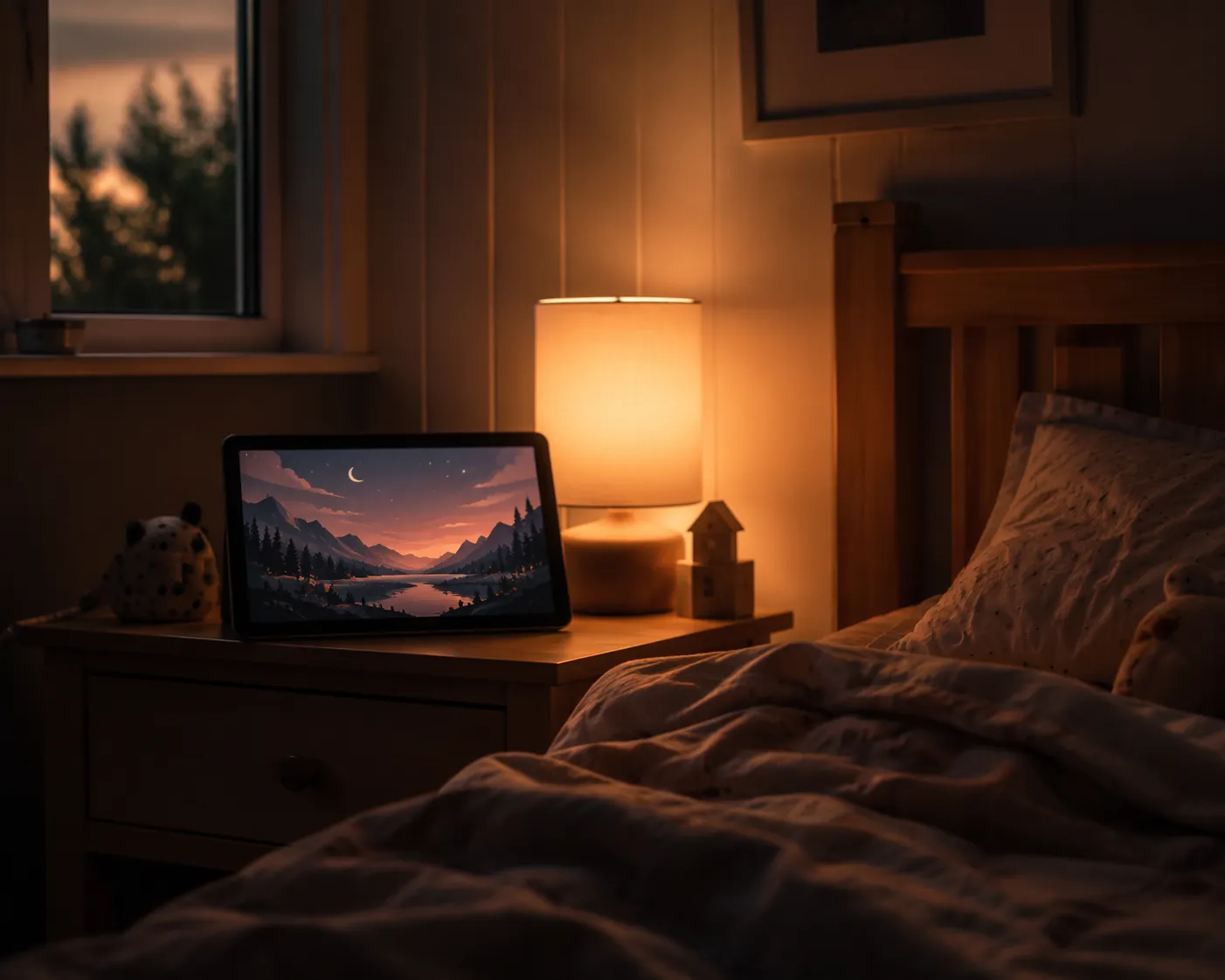
The bedtime movie has to end before bedtime
The most common mistake is letting the movie become the thing that puts the child to sleep. That turns the screen into the last sensory input of the night: light in the eyes, dialogue in the ears, story tension in the body, and one more reason to keep watching. Even a gentle movie can become a bedtime delay if the child is waiting for the next scene.
A better use is to treat the movie like an earlier wind-down activity. Start it early enough that it can end 15–20 minutes before lights-out. Then close the screen, do the predictable last steps, and let the room become boring again. Pajamas, bathroom, water, one short book, a song, or a quiet check-in can carry the child from screen time into sleep time.
That buffer also protects you from the bedtime negotiation that comes with “just five more minutes.” If the movie ends at lights-out, the parent has to enforce the transition at the most tired and least flexible point of the evening. Ending earlier gives the nervous system and the household a little room.
Brightness is not a fussy detail for children
Evening light matters more for children than many adults realize. Sleep Foundation reports that children experience about twice the melatonin suppression from evening light compared with adults; in one cited study, children had 88% melatonin suppression compared with 46% in adults under identical light conditions.[3] Another preschool study cited by Sleep Foundation found that even dim light before bed suppressed melatonin by about 78%, with no recovery within 50 minutes after the light ended.[3]
That is why “turn on night mode” is not a decorative wellness tip. If a child is going to watch anything near bedtime, reduce screen brightness, use the warmest color setting available, avoid a large bright television if a smaller dimmed screen is the only practical option, and keep the room softly lit rather than letting the screen become the brightest object in a dark room.
Dimming the screen does not erase the pediatric guidance. It only makes a less-ideal choice less disruptive. For a deeper look at why children are so sensitive to evening screen light, see why screens before bed disrupt kids’ sleep more than adults.
A calming movie is slow, quiet, and emotionally low-stakes
“Calming” is not a clinical category on a streaming menu. For bedtime, it needs to mean something specific. Look for lingering camera movement, soft transitions, conversational audio, predictable emotional tone, and scenes where nobody is being chased, tricked, abandoned, trapped, or threatened.
| Bedtime-friendly signal | Why it matters |
|---|---|
| Slow pacing and long scenes | The child has less novelty to track and less reason to perk up for the next cut. |
| Low, even audio | Sudden crescendos can re-alert a child who was starting to settle. |
| No villain or looming threat | A child can relax without monitoring danger. |
| No chase, battle, or rescue sequence | The body often responds to motion and peril before the parent can talk it down. |
| No heavy grief or separation arc | A sensitive child may carry the feeling into the dark bedroom. |
CPCMG Pediatrics cautions against the idea that TV before bed helps children fall asleep; what looks like sleepiness may be cognitive exhaustion rather than true sleep readiness.[4] That distinction matters. A child who goes blank in front of a screen is not necessarily calmer. They may simply be overloaded enough to stop moving.
Volume deserves its own check. A movie can look gentle and still fail at bedtime because the soundtrack swells, the comic relief shrieks, or the action suddenly gets bigger than the room. Keep the volume low enough that dialogue sounds conversational. If you keep reaching for the remote, the movie is probably doing too much for this time of night.

Vet the story, not just the rating
Ratings help, but they do not know your child. One child can watch a mild villain and move on. Another will ask about it for three nights. Bedtime is not the moment to test that difference.
Before choosing a movie, scan for the part that will become the bedtime problem: the missing parent, the dark forest, the animal in danger, the loud rescue, the villain reveal, the death or grief beat, the frantic chase. A gentle color palette does not cancel out a scary emotional premise. LoveToKnow’s low-stimulation toddler list, for example, flags that some toddlers may be sensitive to Hexxus in Ferngully despite the movie’s otherwise gentle appearance.[7]
This is also where adult nostalgia can mislead us. A movie that feels cozy because we loved it at 8 may not land the same way for a 3-year-old watching close to bedtime. The question is not “Is this a good movie?” It is “Will this specific child carry any part of this movie into the dark?”
Examples that can work, with caveats
Use title lists as screening tools, not proof that a movie improves sleep. Screenwise identifies The Red Balloon, a 34-minute nearly wordless film, and My Neighbor Totoro, an 86-minute film with no villain, as among the safest and gentlest first features; it also notes that some Studio Ghibli films can feel slow to adults while young children track them well because the camera lingers.[5] That observation is useful for bedtime because lingering is often exactly what fast children’s entertainment refuses to do.
- The Red Balloon: Short and nearly wordless, which makes it easier to fit before the final bedtime routine. Still, watch for how your child responds to the emotional tone.
- My Neighbor Totoro: Often a strong candidate for children who do well with quiet wonder and low threat. The length means it may need to start earlier than parents expect.
- Ponyo and Kiki’s Delivery Service: Frequently included in calming-movie roundups, but individual sensitivity still matters, especially around big emotions, movement, or tension.[6]
- The Snowman and Winnie the Pooh: Often better aligned with bedtime pacing than louder adventure movies, though the child’s age and familiarity still matter.[6]
- Nature documentaries: These can work when the episode is visually slow and narration-led, but predator-prey sequences, storms, or dramatic music can make them poor bedtime choices.
Scary Mommy’s calming-movie roundup includes titles such as Kiki’s Delivery Service, Ponyo, The Snowman, Winnie the Pooh, Babe, and nature documentaries, while quoting psychotherapist Joanna Fortune’s warning that exciting sword-fighting scenes can make children “jump up on your sofa,” which is the opposite of calming.[6] That is a useful practical test: if the scene makes a child want to act it out, it probably does not belong in the last hour before bed.
Age guidance still matters. Common Sense Media rates Paddington as age 6+ and notes a mildly tense taxidermist scene; it rates Babe as age 6+ and notes some peril.[8] Those can still be lovely family movies. They are just not automatically bedtime movies for every 4-year-old, every anxious child, or every night.
Streaming availability changes, and roundups can go stale quickly. Check the current platform before promising a title, and have a backup that is shorter or already familiar. Familiarity is underrated at bedtime; a child who knows what happens next has less to monitor.
A practical way to run the exception
If a bedtime movie is going to happen, decide the boundaries before pressing play. Pick the title yourself instead of browsing with the child. Set the brightness and color temperature first. Lower the volume before the opening music. Tell the child when the movie will end and what comes next. If the movie is long, watch only a planned portion rather than drifting toward a late ending.
The sequence can be simple: movie, screen off, bathroom, one short book or song, lights-out. Do not let trailers, autoplay, bonus clips, or “one more episode” attach themselves to the plan. The more choices that appear after the screen turns on, the less bedtime belongs to you.
The next morning matters too. If your child fell asleep later, woke more often, asked worried questions, replayed scenes, or resisted bedtime harder the next night, count that as data. The movie may be fine for a Saturday afternoon and wrong for bedtime. Children do not owe us the same response to the same content.
If screen time is regularly pushing bedtime later, the issue is bigger than one movie. Restful Ground’s guide to how screen time disrupts children’s sleep through three mechanisms looks at displacement, arousal, and circadian timing together. For device-level guardrails, see how to choose a kid-safe smartphone that protects sleep.
Where the responsible line falls
A bedtime movie is not a sleep aid, and it should not replace a predictable routine. It is a controlled exception that works only when the adult controls the conditions: low-stimulation content, warm and dim screen, low and even volume, no villains or chase energy, no grief or separation trigger for a sensitive child, and a firm ending 15–20 minutes before lights-out.
Children’s sleep is also shaped by light outside the screen. If evening light changes are part of the struggle in your household, related guides on what the Sunshine Protection Act means for children’s sleep and why Daylight Saving Time affects kids’ sleep differently at every age can help connect the bedtime routine to the larger circadian picture. And if you want a grown-up version of the same low-stimulation idea, see calming Prime Video movies to wind down for sleep.
References
- Children And Watching TV #054, AACAP
- Updated AAP recommendations for screen time, CHOC
- How Blue Light Affects Kids’ Sleep, Sleep Foundation
- True or False: Watching TV Before Bed Helps Kids Fall Asleep, CPCMG Pediatrics
- Non-Violent Movies for Young Kids, Screenwise
- Calming Movies for Kids, Scary Mommy
- Low-Stimulation Movies for Toddlers, LoveToKnow
- Feel-Good Family Movies, Common Sense Media
Read the full guide: Free Movies to Stream Before Sleep, Chosen by Your Life Stage