
Does Pixel Glow Affect Sleep Differently by Life Stage?
FAQ: Does Pixel Glow Affect Sleep Differently by Life Stage?
Yes. Pixel glow can affect sleep differently by life stage, but not because every adult brain responds to a phone like an adolescent brain. The likely effect depends on circadian timing, brightness, daytime light exposure, hormone state, sleep continuity, and what the person is doing on the screen.
The best starting point is proportion. A 2024 review discussed in BBC Future found that screen light before bed delayed sleep by about nine minutes at worst across 11 studies, which is enough to matter for some people and not enough to explain every bad night by itself.[1] That estimate should cool down the panic without turning the phone into a nonissue.
Brightness also changes the question. A Mayo Clinic study found that only the highest smartphone brightness setting produced enough light to potentially affect melatonin, while medium and low settings stayed below that threshold; the caveat is that the study used older device models, so the exact light output should not be treated as a permanent rule for every current phone.[2]
Adult evidence is still unsettled. A 2024 National Sleep Foundation consensus statement reported only 56% agreement with the statement that blue light impairs adult sleep, and the panel emphasized how difficult it is to separate light exposure from alerting content, timing, and behavior.[3] That uncertainty is not a reason to ignore screens. It is a reason to stop handing the same advice to a pregnant person, a perimenopausal person, an ADHD adult, and someone in their seventies.
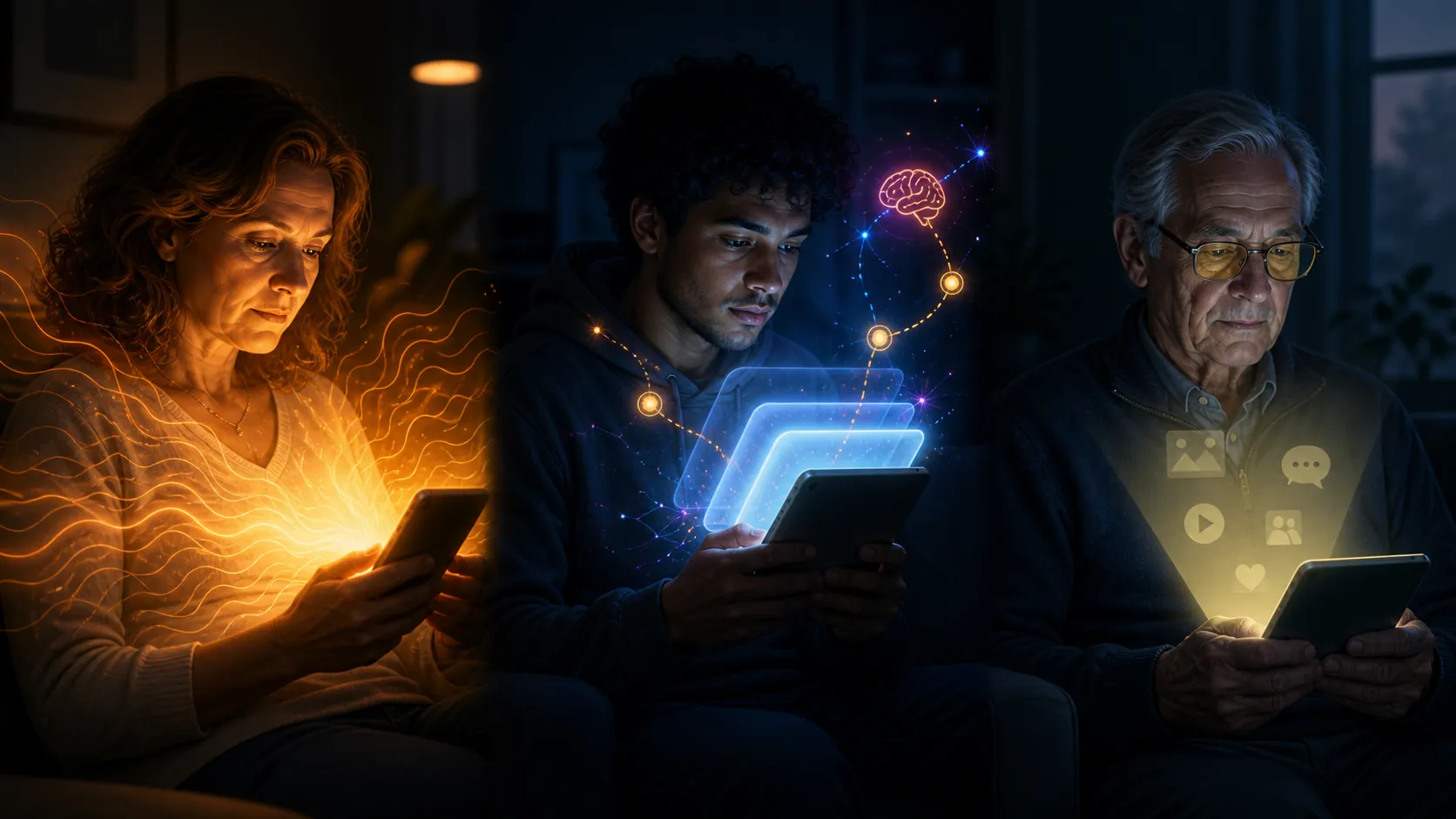
The Same Screen Is Not the Same Exposure
A phone at 10:30 p.m. can mean several different things. For one person, it is a bright light source hitting the melanopsin pathway at the wrong circadian phase. For another, it is an emotionally charged feed. For someone else, it is a caregiving tool, a pregnancy symptom search, a game that will not release attention, or a quiet distraction from a hot flash.
| Group | Why pixel glow may matter | What is often bigger than the glow |
|---|---|---|
| Perimenopause | Melatonin changes, hormonal fluctuation, and possible heightened light sensitivity may make a small evening light nudge feel larger. | Hot flashes, night waking, temperature swings, anxiety, and irregular sleep continuity. |
| ADHD adults | Light exposure can combine with reward-driven scrolling, gaming, novelty seeking, and executive-function load. | Content arousal, compulsive engagement, sensory regulation needs, and difficulty stopping. |
| Older adults | Earlier bedtimes can place evening screen use in a circadian window where light timing still matters. | Arousing content, caregiving stress, medications, pain, nocturia, and age-related sleep fragmentation. |
| Pregnancy | Screen use before bed may be associated with longer sleep latency. | Hormonal disruption, physical discomfort, fetal movement, reflux, urination, and fragmented sleep. |
| Adolescents | Puberty is associated with higher melanopsin sensitivity, making teen findings a poor template for all adults. | School schedules, social pressure, delayed circadian timing, and nighttime media use. |
Large adult data also suggest that timing and chronotype matter. In a JAMA Network Open study of 122,058 adults, screen use close to bedtime was associated with later sleep timing, with evening chronotypes showing an association of up to 15.6 minutes later on workdays.[4] That does not prove that light alone caused the delay. It does show why “I used my phone and slept late” is usually a mixed exposure: light, timing, habit, and content arrive together.
Why Perimenopause Deserves More Precision
Perimenopause is where generic screen advice can become especially unfair. If someone is waking from heat, sweating through sleepwear, or lying awake after a 3 a.m. hormonal jolt, the phone did not create the whole problem. But evening light may still add pressure to a system that has less margin.
The mechanism is plausible, but it should be described carefully. Melatonin signaling, circadian timing, and light sensitivity interact with reproductive hormone changes. The same melanopsin pathway that responds to daylight, moonlight, and artificial light is part of the reason timing matters. That does not mean there is a large clinical trial proving that a dim phone is a major cause of perimenopausal insomnia. It means a small circadian nudge may feel less small when sleep is already being broken by temperature and hormone volatility.
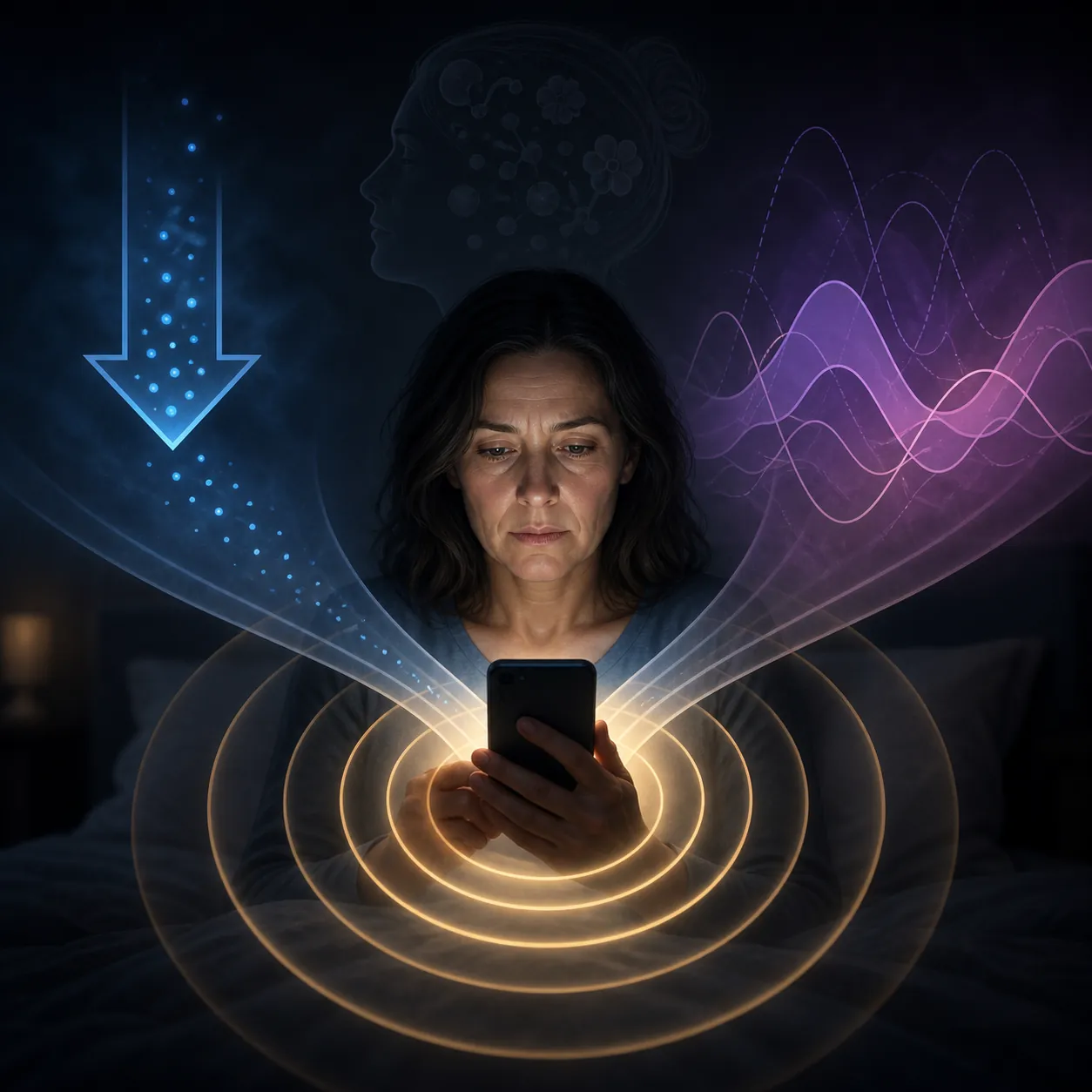
This is why perimenopausal screen advice should start with control, not shame. Lowering brightness, using warmer display settings, keeping the phone farther from the face, and avoiding high-arousal content are modest interventions. They are also realistic when someone is already waking at night. If a screen is being used after a hot flash, the most important decision may not be “phone or no phone” but whether the phone becomes a bright, close, stimulating second event.
Restful Ground’s piece on full-moon sleep in perimenopause uses the same sensitivity frame: light is rarely the only force, but it can become more noticeable when melatonin rhythm, temperature regulation, and sleep continuity are already unstable. Pixel glow belongs in that same category. It is not the villain. It is one more input to calibrate.
ADHD Changes the Screen Question
For ADHD adults, “put the phone away” can sound like a light recommendation while functioning like an executive-function test. The screen is not only emitting pixels. It is delivering novelty, reward, social feedback, task switching, sensory input, and sometimes relief from under-stimulation.
There is some evidence and mechanistic interest around differences in the melanopsin system in ADHD, but the stronger everyday problem is usually the convergence of light exposure and engagement. A dim boring screen and a bright competitive game are not equivalent. A calm audiobook interface and a conflict-heavy comment thread are not equivalent. The light may be part of the burden; the loop is often the trap.
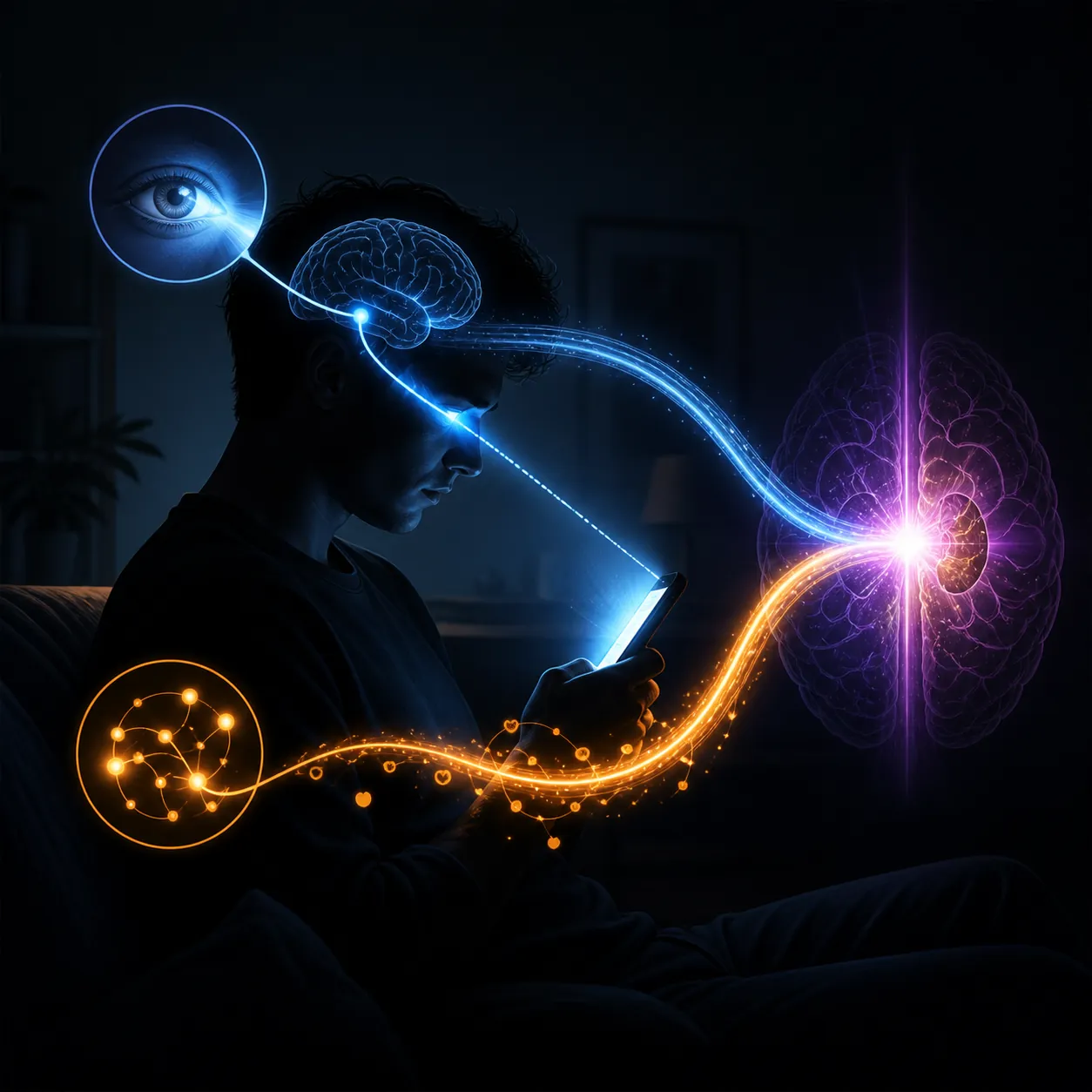
That distinction changes the practical target. The best ADHD screen strategy may be less about moral discipline and more about changing the wind-down environment before the reward loop starts. A phone set to low brightness is better than one at full brightness, but a low-brightness app that keeps refreshing still asks the brain to keep choosing, reacting, and resisting.
For some ADHD adults, the replacement also needs enough sensory interest to work. A sterile, silent, screen-free room may be technically correct and functionally unusable. Restful Ground’s guides to a maximalist bedroom for ADHD relaxation and ADHD wind-down cues are closer to the real problem: the brain still needs a landing strip.
Older Adults May Be Less Blue-Light Sensitive, Not Screen-Proof
Older adulthood complicates the usual blue-light warning in the opposite direction. Age-related yellowing of the eye’s lens can filter more blue light before it reaches the retina, which may reduce melatonin-suppression risk from blue wavelengths.[3] That is a real distinction, and it is one reason adolescent screen findings should not be pasted onto older adults.
But reduced blue-light sensitivity does not make screens harmless. Many older adults have earlier bedtimes, earlier waking, more fragmented sleep, and more time in bed. A screen used at 8:30 p.m. may still land in an important circadian window. More importantly, content can keep the nervous system active even when the light itself is modest: medical portals, family messages, financial stress, breaking news, and caregiving coordination do not become sleep-neutral because the lens filters blue light.
Pregnancy: Treat Screen Light as a Smaller Lever
Pregnancy is another place where the phone can be blamed too quickly. Screen use before bed has been associated with longer sleep latency in pregnant women, but those studies cannot cleanly isolate light from pregnancy-related hormone shifts, discomfort, reflux, urination, fetal movement, anxiety, and cognitive stimulation.
So the useful advice is narrower: if a pregnant person is already struggling to fall asleep, reducing bright and emotionally activating screen use near bedtime is reasonable. But if sleep is breaking because of physical symptoms, treating pixel glow as the main cause can send attention away from the bigger problem. For that broader context, Restful Ground’s pregnancy insomnia strategies are a better next stop than another rule about screens.
Where the Blue-Light Panic Came From
A lot of screen-sleep worry comes from adolescent research, and adolescents really are a high-sensitivity group. A systematic review on blue light in young adults notes that puberty is associated with increased melanopsin sensitivity, which helps explain why teen findings have carried so much weight in public advice.[5]
The problem is not that the adolescent science is irrelevant. The problem is overextension. A puberty-linked sensitivity profile does not automatically describe a 52-year-old with hot flashes, a 34-year-old ADHD gamer, a pregnant person waking every two hours, or a 76-year-old reading family texts after an early dinner.
Separate Light From What the Screen Is Asking You to Do
Pixel glow has two main routes into sleep: biological light exposure and behavioral activation. The first route runs through brightness, wavelength, distance from the eyes, timing, and the contrast between daytime light and evening dimness. The second route runs through attention, emotion, reward, vigilance, and the inability to stop.
This is why “night mode” helps only part of the problem. Warmer color settings and lower brightness may reduce one type of exposure, but they do not make a stressful work message relaxing. They do not make a game less rewarding. They do not make medical anxiety less sticky. Harvard Health has long emphasized that blue wavelengths are especially potent for circadian effects, while broader sleep guidance also points to device-related alertness and delayed bedtimes as part of the same pattern.[6]
Daytime light matters too. People who get stronger bright-light exposure during the day tend to be less sensitive to evening screen light, because the circadian system has received a clearer day-night contrast.[1] For many adults, the most useful screen intervention may begin hours before bedtime: morning outdoor light, brighter daytime rooms, and a dimmer evening environment.
How to Decide Whether Pixel Glow Is Your Main Lever
Instead of asking whether screens are bad, ask what would change if the screen exposure changed. The answer usually falls into one of three categories.
- Pixel glow is probably a major lever if your screen is bright, close to your eyes, used late in a dark room, and your sleep problem is mainly delayed sleep onset.
- Pixel glow is probably a minor-but-worth-adjusting lever if you are perimenopausal, highly light-sensitive, an evening chronotype, or using screens after night waking.
- The screen is probably more of a content-arousal problem if you lose time scrolling, gaming, messaging, reading alarming news, or checking symptoms.
- The screen may be mostly a proxy if pregnancy discomfort, hot flashes, pain, caregiving, nocturia, or medication timing is waking you before the phone enters the story.
The first experiment does not need to be a perfect screen ban. Try the smallest change that tests the likely mechanism: lower brightness to the minimum comfortable level, keep the device farther from your face, use warm display settings, switch from interactive apps to passive audio, or move the high-reward app cutoff earlier while leaving a low-stimulation tool available.
For perimenopause, pair the screen change with temperature control and a plan for night waking. For ADHD, design the replacement before bedtime rather than relying on willpower at bedtime. For older adults, pay attention to content and timing more than blue-light panic. For pregnancy, reduce activating screen use if it helps, but do not let that obscure the physical causes of broken sleep.
Pixel glow can affect sleep. It just does not affect every sleeper through the same pathway, and it is rarely the only thing happening in the room.
References
- The blue light from your phone isn't ruining your sleep — BBC Future, 2026
- Are Smartphones Disrupting Your Sleep? Mayo Clinic Study Examines the Question — Mayo Clinic News Network
- The impact of screen use on sleep health across the lifespan: a National Sleep Foundation consensus statement — National Sleep Foundation, 2024
- Electronic Screen Use and Sleep Duration and Timing in Adults — JAMA Network Open, 2025
- The influence of blue light on sleep, performance and wellbeing in young adults: A systematic review — PMC
- Blue light has a dark side — Harvard Health
Read the full guide: How summer 2026 heatwaves disrupt sleep, by life stage