
Sleep Well During Regaip Kandili Without Missing Worship
The simplest way to sleep well during Regaip Kandili is to stop treating the night as one long choice between worship and rest. Sleep soon after Isha, wake for the last third of the night, worship during the window you most want to be awake for, sleep again after Fajr if your morning allows, then take a short Qailulah-style nap the next day. For many adults, that pattern can produce roughly 5–7 total hours of sleep without asking you to miss the heart of the night.
For 2026, Regaip Kandili is expected on Thursday night, December 10, corresponding to 1 Rajab 1448 in the Turkish Diyanet calendar. Because Islamic dates may be observed differently depending on moon-sighting and calculation methods, some calendars may show another date; confirm with your local mosque or community before building the night around it. Regaip Kandili is especially observed in Turkey and Turkish diaspora communities, and readers may also know it by the Arabic name Laylat al-Raghaib, the night that opens the season leading toward Ramadan.[1][2]

Many Muslims mark the night with extra prayer, Qur’an recitation, dhikr, and du’a between Maghrib and Fajr. Some communities also mention a special 12-rakat prayer for Laylat al-Raghaib, but its status is not treated the same way across Muslim scholarly traditions, so it is better to plan around voluntary worship rather than assume a single required form. The sleep question is therefore practical: how do you stay present for worship without arriving at Friday morning brittle, unsafe to drive, or too exhausted to fulfill the rights already on you?
A Regaip Kandili Sleep Plan You Can Actually Use
Use your local prayer timetable for the exact clock times. The structure matters more than the example times: protect a first sleep block, wake for the last third of the night, and make a realistic plan for recovery after Fajr.
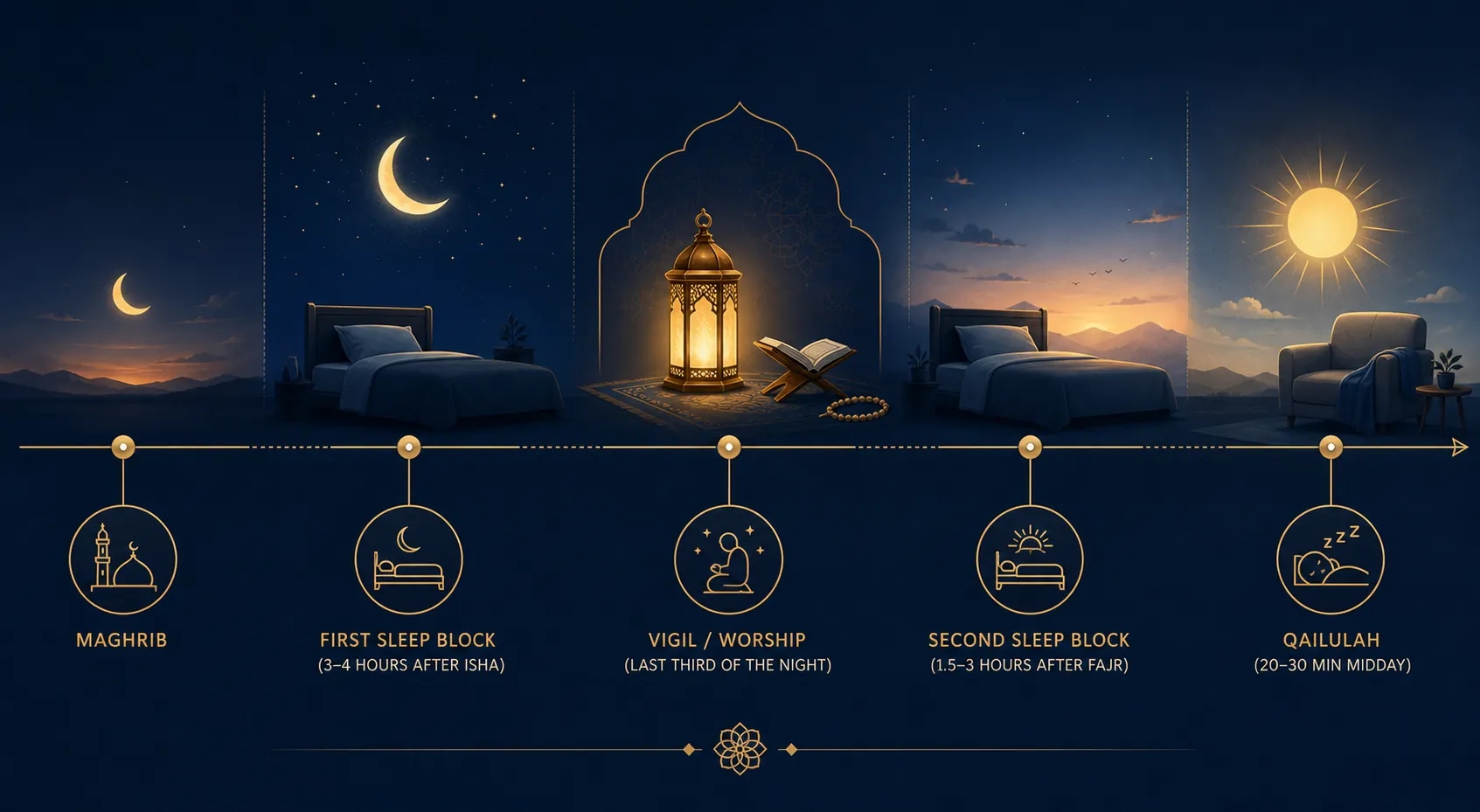
| Part of the night | What to do | Why it helps |
|---|---|---|
| After Maghrib and Isha | Keep food, family visits, and screen use modest; prepare for sleep as soon as Isha is complete. | This prevents the night from becoming an accidental all-nighter before worship has even begun. |
| First sleep block | Sleep for about 3–4 hours. | This is the anchor sleep that protects attention, mood, and next-day function. |
| Last third of the night | Wake for tahajjud, Qur’an, dhikr, du’a, or the extra worship your community observes. | This places wakefulness in the devotional window many people most want to preserve. |
| After Fajr | If possible, sleep again for about 1.5–3 hours. | A second sleep block reduces the cost of the early-morning vigil. |
| Next day | Take a 20–30 minute Qailulah-style nap before or around early afternoon, if your schedule allows. | A short nap can restore alertness without usually creating heavy sleep inertia. |
The hadith “Your body has a right over you” is not a decorative quote for this topic. It changes the frame. Rest is not the opposite of devotion; it is one of the trusts that keeps worship from becoming careless with the body, family duties, work responsibilities, and safety.[3]
The First Sleep Block Is the Part Most People Lose
The most important decision happens early, not at 3 a.m. If you drift through the evening after Isha, answer messages, watch religious videos for “just a little longer,” eat heavily, or keep hosting until the house finally quiets down, the last third of the night arrives when your body has already been awake too long. Then the vigil becomes a debt instead of a chosen act.
A 3–4 hour first sleep block is not a full night, but it is enough to give the brain a real sleep episode before you wake for worship. Research on biphasic sleep describes split sleep as a pattern where total sleep is divided into two periods, and the Sleep Foundation notes that some studies have found similar cognitive performance between biphasic and monophasic sleepers when total sleep opportunity is adequate.[4] That does not prove a Regaip-specific benefit; no sleep study on Regaip Kandili itself is available. It does support the practical idea that splitting sleep is not automatically the same as simply losing sleep.
This is where planning has to be honest. If you need to drive early, supervise children, work with tools, care for a patient, or make decisions that affect other people, do not build the night on optimism. Start the first sleep block soon after Isha, set one alarm and one backup, and decide before sleeping what you will do if you wake up feeling unsafe or unwell. Devotion does not require pretending the body has no limits.
Wake for the Last Third, Not for the Whole Night
For many people, the last third of the night is the best compromise between religious intention and sleep physiology. It is late enough to carry the meaning people associate with night worship, but it does not require being awake from Maghrib until Fajr. Yaqeen Institute’s discussion of the night in Islam emphasizes how deeply nocturnal worship is woven into Muslim devotional life, including the quietness and sincerity associated with standing at night.[5]
Keep the vigil deliberate. If you have 60–90 minutes, you do not need to fill it with every possible act. Choose the worship you can offer with attention: two or more rakats, a portion of Qur’an, dhikr, salawat, quiet du’a, repentance, or a community practice you trust. A shorter period done awake and emotionally present is often more meaningful than a long plan carried out in a fog.
If you are attending the mosque, protect the first sleep block even more carefully. Lay out clothes, keep wudu logistics simple, and decide how you will get home before you leave. If you are worshiping at home because of children, caregiving, disability, fatigue, or safety, treat that as a valid plan rather than a lesser version of the night. The goal is not to perform exhaustion; it is to meet the night with as much steadiness as your circumstances allow.
After Fajr, Take the Second Sleep Block Seriously
The sleep after Fajr is where many plans either recover or collapse. If Friday allows it, return to sleep after Fajr for about 1.5–3 hours. That may mean arranging school lunches the night before, asking a spouse or family member to cover the first child shift, moving non-urgent errands, or telling yourself in advance that you are not available for early social scrolling.
This second block is not laziness after worship. It is part of making the night sustainable. Ramadan sleep research is useful here because it shows what happens when religiously meaningful schedule changes simply reduce total sleep: Sleepstation summarizes studies in which daytime sleepiness rose by about 15–36% during Ramadan, especially when nighttime sleep was shortened or fragmented.[6] Regaip Kandili is only one night, not a month, but the warning transfers cleanly: the body notices when wakefulness is added and sleep is not replaced.
If you cannot sleep after Fajr because of work, commuting, childcare, or caregiving, lower the ambition of the vigil. Wake later in the last third, shorten the worship window, and protect a nap later. A person with a long Friday commute needs a different plan from a person who can sleep until midmorning. The same night can be honored with different amounts of wakefulness.
Use Qailulah as Recovery, Not as a Rescue Mission
A short Qailulah-style nap the next day can help protect Friday afternoon. In Islamic sources, midday rest has long been treated as a beneficial practice, and a PubMed-indexed review on Qailulah discusses it from both neuroscientific and Islamic perspectives.[7] For this plan, the useful version is modest: 20–30 minutes, early enough that it does not push your next bedtime later.
Do not ask the nap to erase a badly planned night. If you skipped the first sleep block, stayed awake through Fajr, drank too much caffeine, and then tried to function on a short doze at lunch, that is not biphasic sleep; it is sleep deprivation with a patch on it. The nap works best when it completes a plan already built around sleep.
- If you are sleepy but functional, take a 20–30 minute nap and get bright light afterward.
- If you are severely drowsy, avoid driving if at all possible and choose a longer recovery sleep opportunity.
- If caffeine helps you, keep it early and moderate so it does not damage Friday night sleep.
- If you feel emotionally raw after the night, do not schedule your hardest conversation or most demanding task for the afternoon.
Readers who want the science of recovery after a shortened night can use Restful Ground’s guide to sleep debt and recovery science or the more specific explainer on how many nights it can take to recover sleep debt. The main point for Regaip Kandili is simpler: do not turn a one-night observance into a two- or three-night sleep problem.
If Your Friday Is Demanding, Adjust the Worship Window
Some readers can sleep after Fajr. Others have a baby, an aging parent, a warehouse shift, a clinic schedule, a long commute, or a classroom full of children waiting at 8 a.m. A sleep plan that ignores those realities can sound pious while quietly shifting risk onto other people.
| Friday reality | Better Regaip Kandili adjustment |
|---|---|
| You must drive early | Prioritize the first sleep block; keep the last-third vigil shorter; do not rely on willpower behind the wheel. |
| You care for children overnight | Plan a home-based worship window and coordinate one protected sleep block with another adult if possible. |
| You work a safety-sensitive job | Avoid an all-nighter; choose a shorter vigil and schedule recovery sleep before the shift if available. |
| You can sleep after Fajr | Use the fuller biphasic plan: first sleep, last-third worship, second sleep, short Qailulah. |
| You cannot nap the next day | Move more sleep into the first block and reduce the length of the vigil. |
This is the same scheduling principle Restful Ground uses for other meaningful night events: sleep before the important window instead of staying awake through hours that are not the point. The approach is similar to the site’s guides on seeing the northern lights without losing sleep and watching a blood moon without ruining your sleep, though Regaip Kandili carries a different kind of intention and should not be reduced to an event on the calendar.
Who Should Modify This Plan
The biphasic plan is a general adult strategy, not medical advice. Pregnant readers may need more total sleep and more flexibility around nausea, reflux, pain, or nighttime awakenings. Older adults may find the early waking easier but the second sleep block harder. Adults with ADHD may need to think carefully about stimulant timing, evening hyperfocus, and alarm reliability. Anyone managing insulin, sedating medication, seizure risk, bipolar disorder, severe insomnia, sleep apnea, or a condition affected by sleep loss should be more cautious than a general article can be.
If you already know that one short night destabilizes your mood, pain, blood sugar, migraines, or attention, make the worship window smaller and the sleep protection larger. Regaip Kandili is brief; your obligations continue after it.
A Modest Plan Honors Both the Night and the Body
Regaip Kandili does not have to mean choosing between worship and health. A planned split sleep—first sleep after Isha, waking for the last third, sleeping again after Fajr when possible, and taking a short Qailulah the next day—can often preserve both. The key is to treat sleep as part of the night’s adab, not as something to clean up after devotion has already spent the body.
References
- Muslims mark Laylat al-Raghaib, opening Islam’s holy months, Daily Sabah
- Regaip Kandili, Inside Out In Istanbul
- Sleep from an Islamic Perspective, National Library of Medicine
- Biphasic Sleep, Sleep Foundation
- The Nocturnal Religion: What the Night Means in Islam, Yaqeen Institute
- Sleep and Ramadan, Sleepstation
- Qailulah: A Short Midday Nap from Neuroscientific and Islamic Perspectives, PubMed
Read the full guide: How to sleep during thunderstorms with anxiety