
How to sleep during thunderstorms with anxiety
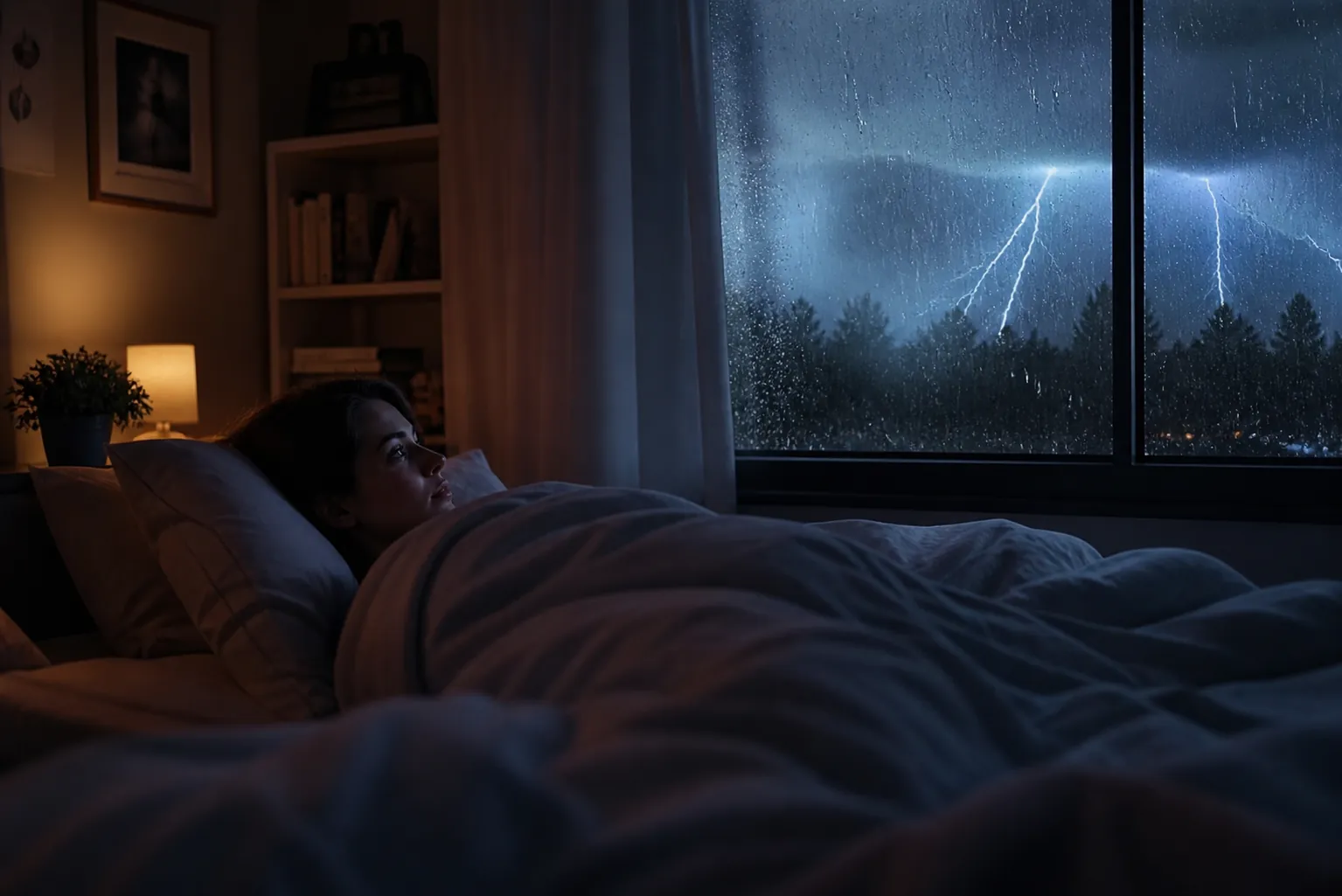
If thunder just woke you up, start with the body before you try to reason with the fear. Sudden thunder can trigger the amygdala and set off a fight-or-flight response even when you consciously know you are indoors and not in immediate danger; UAB psychologist Dr. Merida Grant describes this as the nervous system reacting to the abrupt sound before the thinking brain has caught up. [1]
For tonight, use a layered order: mask the thunder, add steady pressure if that is safe and comfortable, then give your attention a quiet task in bed. You are not trying to make the storm pleasant. You are giving your body enough competing safety signals that sleep has a chance to return.
- Turn on brown noise, a fan, or another steady low sound before checking the radar again.
- If you use a weighted blanket safely, pull it over your torso and legs without trapping yourself or overheating.
- Lie on your back or side and do a quiet 5-4-3-2-1 grounding scan adapted for bed.
- Pair the scan with 4-4-6 breathing: inhale for 4, hold gently for 4, exhale for 6.
- If alerts are active, keep one reliable alert source on and stop rotating through apps unless conditions change.
Why Thunder Can Keep Resetting Your Body
Thunderstorm anxiety at night is often a loop: sound, startle, alertness, scanning, more alertness. The loudest crack does not have to be nearby to make your body brace. Once the nervous system is listening for the next boom, every pause can feel like waiting.
That gap between what you know and what your body does is important. Telling yourself “I am safe” may be true and still not be enough, because the startle response is fast, physical, and protective by design. The goal is not to win an argument with the amygdala. The goal is to reduce the inputs that keep telling it to stay on duty.
First, Mask the Thunder Without Making the Room Feel Busier
Brown noise is a good first move because thunder is not only loud; it is low, rolling, and unpredictable. Brown noise emphasizes lower frequencies more than white noise, so it may blend more naturally with rumbles instead of adding a sharper hiss on top of them. A box fan, air purifier, rain track, or speaker can do the same job if the sound is steady and boring.
Set the volume just high enough that distant thunder loses its edges. Do not try to drown out every crack. If the masking sound becomes its own stressor, the room has not become calmer; it has only become louder.
- Choose lower, steady sounds when thunder is the main trigger.
- Keep the source close enough that you do not need a high volume.
- Avoid storm recordings if rain and thunder sounds make you monitor the weather more.
- Use headphones only if they feel safe and do not interfere with needed alerts.
Then Add Deep Pressure, If a Weighted Blanket Works for Your Body

A weighted blanket is one of the more evidence-backed tools in this toolkit, but the evidence needs a careful label. The strongest numbers come from a clinical insomnia study, not from a trial of thunderstorm anxiety.
In the AASM-reported randomized controlled trial, 120 adults with insomnia and co-occurring psychiatric disorders used either a weighted chain blanket or a lighter sham blanket. After four weeks, 42.2% of the weighted-blanket group reached remission compared with 3.6% of the sham group; at 12 months, 92% of participants who continued with weighted blankets were responders. [2]
Those numbers are striking, and they matter for anxious sleepers because insomnia and arousal live in the body, not just in thoughts. Still, they do not prove that a weighted blanket specifically treats fear of thunder. A more honest claim is narrower: deep pressure may help some people feel physically settled enough to stop bracing between thunderclaps, especially when it is combined with sound masking and breathing.
Use the blanket in a way that leaves you in control. It should feel like firm, even contact, not restraint. Skip it or remove it if you feel trapped, overheated, short of breath, dizzy, or unable to move comfortably. If you have mobility, respiratory, circulatory, or temperature-regulation concerns, choose lighter pressure from a regular blanket, a tucked duvet, or a pillow against the torso instead.
| If the blanket feels like... | Try... |
|---|---|
| A steady hug | Keep it over the torso and legs while you breathe slowly |
| Too hot | Use it only over the lower body or switch to a lighter blanket |
| Trapping | Remove it and use a pillow or tucked sheet for gentler pressure |
| Not enough | Do not keep adding weight; combine it with sound masking and grounding instead |
Use Grounding When Your Body Is Still Listening for the Next Crack
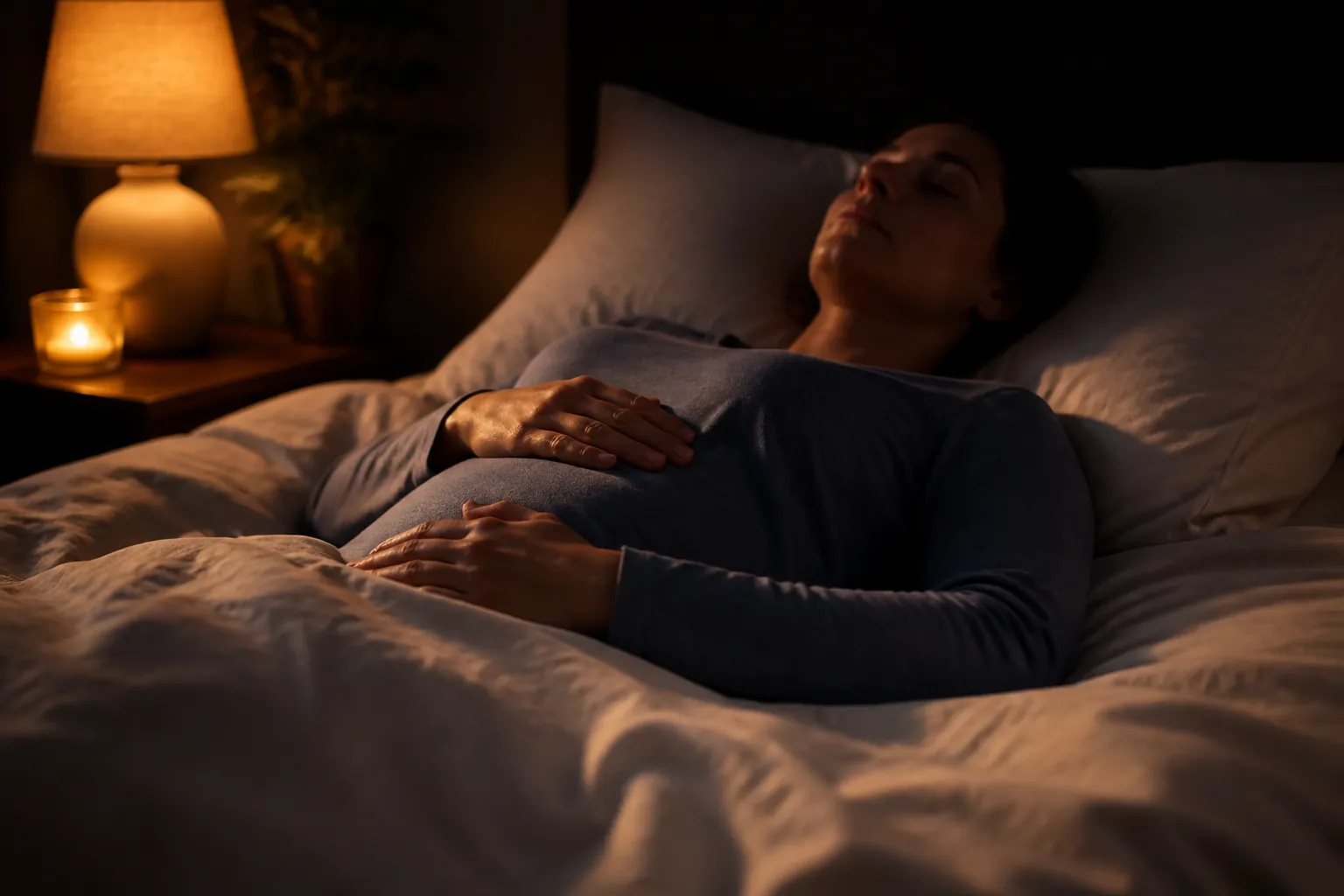
Grounding helps most when it is specific enough to occupy attention but quiet enough not to wake the whole house. The familiar 5-4-3-2-1 technique is commonly used to shift attention from threat scanning to present-moment sensory information, and weather-anxiety guidance also uses breathing and grounding as practical regulation tools. [3][4]
For a thunderstorm at 1:40 a.m., do it lying down. Keep your eyes soft, half-open, or closed if the window makes you more alert. You do not need to sit up, turn on a bright lamp, or do the exercise perfectly.
- Notice 5 things your body is touching: pillow, sheet, mattress, blanket, pajama fabric.
- Notice 4 sounds without ranking them as safe or unsafe: brown noise, rain, house hum, your own breathing.
- Notice 3 places with steady pressure: shoulder against mattress, calves under blanket, hand on ribs.
- Notice 2 temperature signals: cool air on your face, warmth under the covers.
- Notice 1 sentence that is plain and physical: “I am in bed, and my feet are supported.”
Now add 4-4-6 breathing. Inhale through your nose or mouth for 4 counts, hold gently for 4, then exhale for 6. The longer exhale is the useful part; it gives the body a slower rhythm to follow. If holding your breath feels uncomfortable, skip the hold and breathe in for 4, out for 6.
Do three to five rounds, not twenty forced rounds. If thunder interrupts, let it interrupt. Start again at the next touch point or the next exhale. The exercise is not a test of calmness; it is a way to keep returning your attention to the room you are actually in.
Before the Next Storm, Remove Decisions From the Night
Pre-storm preparation helps because nighttime anxiety gets worse when every sound requires a decision. Severe-weather anxiety guidance commonly emphasizes having a plan, choosing reliable information sources, and limiting repeated checking once reasonable safety steps are in place. [5][6][7]
The plan does not need to be elaborate. It needs to be boring enough that you can follow it half-asleep.
- Pick one alert source before bed, such as a weather radio or trusted phone alert.
- Charge the phone outside the bed if scrolling radar keeps you awake, but close enough to hear alerts.
- Place shoes, glasses, medications, and a flashlight where you can reach them.
- Decide in advance where you would go for a warning, so you are not solving that problem during thunder.
- Set up brown noise and the blanket before the storm line arrives.
Preparation is not the same as monitoring all night. Once the reasonable steps are done, the next task is sleep unless an alert tells you otherwise.
When Storm Anxiety Is More Than a Bad Night
Fear of thunder and lightning has a name, astraphobia, and Cleveland Clinic describes it as among the most common specific phobias. [3] That does not mean every anxious night during a storm is a phobia. A person can be startled, vigilant, and sleepless during severe weather without needing a diagnosis.
Consider extra help if storm anxiety repeatedly costs you sleep, leads you to avoid ordinary life, causes panic symptoms that feel unmanageable, or continues long after the weather has passed. Therapy can be especially relevant when the fear is tied to a past disaster, repeated warnings, or a sense that no amount of checking creates safety.
If the warning has ended but your body is still acting as if it has not, the post-event wind-down problem is slightly different; Tornado Warning Ended — Now How Do I Sleep? walks through that after-alert state. If weather anxiety has become stronger during hormonal sleep disruption, Why perimenopause makes flood watch sleep anxiety worse may be the more precise route.
The same sleep pattern can show up after other environmental threats, too: a body that keeps checking for danger after the immediate event has passed. For that version of the question, see Is Earthquake Sleep Anxiety Normal or a Sign of PTSD? or How to sleep during a wildfire evacuation.
What Is Realistic Tonight
A storm toolkit does not have to erase fear to be useful. Brown noise can soften the sensory shock. Deep pressure can give the body a steadier signal than the sky is giving it. Grounding and paced breathing can interrupt the scan-and-brace loop without asking you to pretend you are serene.
Thunder may still make you flinch. The room may still brighten with lightning. But if the next few minutes contain fewer sharp inputs, fewer decisions, and more physical cues of support, returning to sleep becomes more possible tonight.
References
- Understanding and managing storm anxiety during tornado season, UAB
- Study shows weighted blankets can decrease insomnia severity, American Academy of Sleep Medicine
- Cleveland Clinic astraphobia page, Cleveland Clinic
- Finding Calm in the Storm: How to Cope with Weather-Related Anxiety, Nashville Psych
- Storm Stress guide, National Weather Service
- Navigating pre-storm anxiety, Baylor College of Medicine
- Hurricane Season Is Here: How to Reduce Your Anxiety, Anxiety & Depression Association of America
Read the full guide: How to sleep during a power outage thunderstorm