
How to Sleep During Severe Storm Warnings and Still Wake Up
If you came here searching for how to sleep during severe storm warnings, the safest short answer is this: you can often go to sleep on a watch night after you have set up alerts that can physically wake you, but you should not go to sleep while a tornado warning or other shelter-now instruction is active for your location. A watch means conditions are favorable and you should be ready; a warning means dangerous weather is happening or expected soon in the warned area, and the next step is shelter, not bed.[1][2]
That distinction matters because the goal changes on a warning-risk night. On an ordinary thunderstorm night, you may be trying to reduce noise and arousal. If that is the problem tonight, the related guide on sleeping through a severe thunderstorm is the more comfortable protocol. On a severe-weather night, comfort has a limit: do not bury the warning under earplugs, loud white noise, a phone across the house, or a Do Not Disturb setting you have not verified.
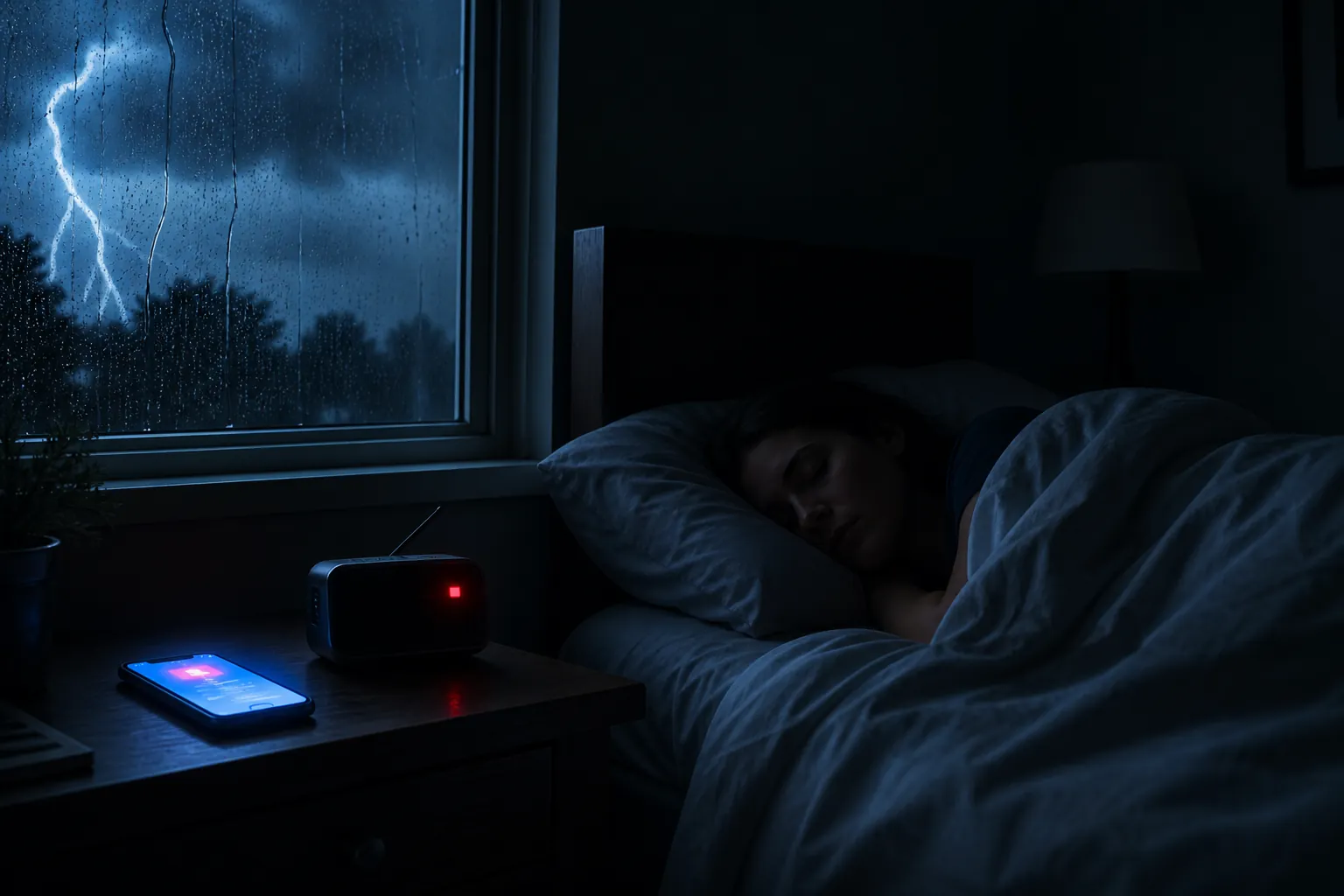
Last reviewed: August 1, 2026. Evidence basis: National Weather Service and American Red Cross safety guidance first; peer-reviewed tornado vulnerability research for nighttime risk; local lead-time data labeled only for the area that published it.
The sleep decision: go to bed, stay ready, or shelter now
| What is happening tonight | Safer sleep decision |
|---|---|
| Severe thunderstorm or tornado watch only | You may be able to sleep, but only after setting up loud, redundant alerts and choosing your shelter path. |
| Tornado warning for your location | Do not go to sleep. Move to shelter now and stay there until the threat has passed or local guidance changes. |
| Severe weather is already arriving where you are | Do not treat bedtime as the plan. Get away from windows and follow local warning instructions. |
| You are in a mobile home and tornadoes are possible | Resolve the shelter plan before sleeping. A mobile home is not a tornado shelter. |
| Local officials, emergency managers, or NWS messaging says to stay awake or shelter | Follow that instruction. Your bedtime routine comes after the immediate safety step. |
The shelter standard is plain: go to a basement if you have one, or to a small interior room on the lowest floor, away from windows. Mobile homes, vehicles, and overpasses are not safe places to ride out tornado danger.[2]
If you are responsible for children, an older adult, pets, medications, or someone with mobility limits, make the decision earlier than you think you need to. The hard part is not understanding the warning while fully awake; it is doing the right thing at 2:17 a.m. with a child crying, the power flickering, and shoes missing.
Why nighttime warnings deserve more respect than daytime ones
Nighttime tornadoes are not just frightening because it is dark. They are deadlier in part because people are asleep when warnings are issued, and many never receive the warning in a way that wakes them.
The commonly cited Ashley, Krmenec, and Schwantes analysis of U.S. tornadoes from 1950 through 2005 found that 27.3% of tornadoes occurred at night but caused 39.3% of tornado deaths and 42.1% of killer tornadoes. The same research is summarized as finding nighttime tornadoes roughly 2.5 times more likely to be deadly, about 1 in 20 compared with about 1 in 50 daytime tornadoes.[3][4]
A caution belongs beside those numbers: they are from a commonly cited older analysis, summarized in the sources below, and should be checked against the full Weather and Forecasting article and later updates when exact figures matter. The practical conclusion does not depend on squeezing the statistic for drama. Sleeping through the alert is one of the dangerous parts of nighttime severe weather.
Set up warnings that can wake a sleeping person
Do not make outdoor sirens your bedroom warning plan. They may be useful if you are outside, but a sleeping person indoors needs an alert source beside the bed, loud enough to break through real sleep.
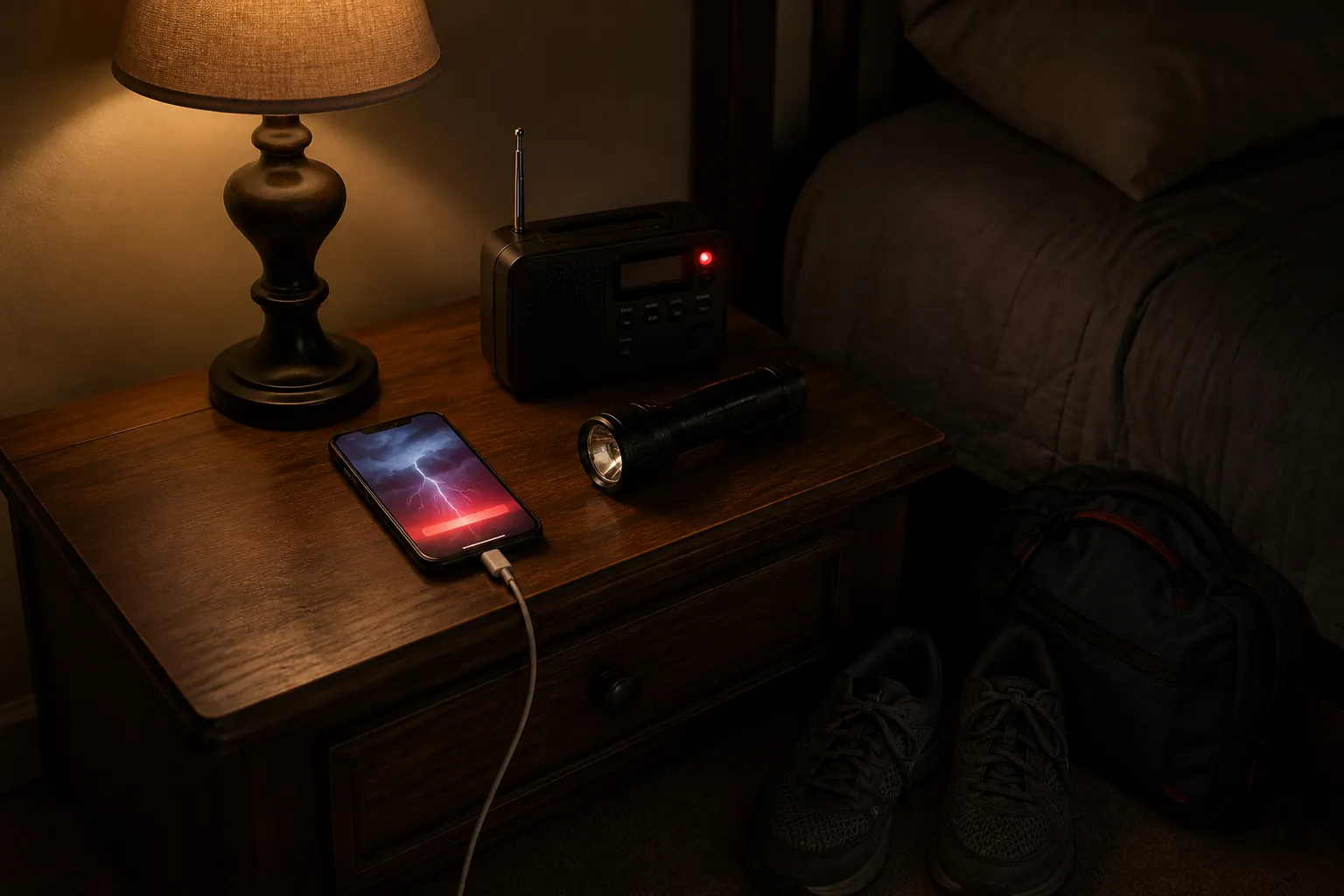
Start with Wireless Emergency Alerts on your phone. NWS describes WEA as free, no-signup alerts sent by cell towers in the threat area, using a special tone and vibration repeated twice.[5] That does not mean every phone setting behaves the same way. Before you sleep, look at your current device’s emergency-alert settings, make sure alerts are enabled, keep the phone charged, and confirm the sound and vibration are not buried under a sleep mode you do not understand.
If you have a NOAA Weather Radio, put it near the bed, not in the kitchen. NWS specifically recommends having a weather radio with a tone alert and keeping it beside you while you sleep when severe weather is possible.[1] Check the batteries as a storm-season habit, and check them again when a serious overnight setup appears.
- Phone charging within arm’s reach, with emergency alerts enabled and volume/vibration set to wake you.
- NOAA Weather Radio near the bed if available, with tone alert on and backup batteries installed.
- One more human or device backup if possible: another adult’s phone, a family member who will call, or a second alert source in the hallway.
- White noise low enough that an alert can cut through it. Earplugs only if you have verified that the alert still wakes you.
- Phone not tucked under a pillow, lost in bedding, or left in another room.
This is where sleep advice can become unsafe. A fan, sound machine, or earplug setup that is fine for rain may be the wrong setup for a tornado-risk night. If the warning cannot reach your body, the bedroom is not ready.
Choose the shelter before you lie down
The shelter choice should be made while you are still awake enough to think. Basement first. If there is no basement, choose a small interior room on the lowest floor, away from windows: a bathroom, closet, hallway, or interior room may be the best available option, depending on the building.[2]
Put shoes where your feet will find them. Put a flashlight where your hand will find it. If you need glasses, medications, keys, a leash, a baby carrier, or a mobility device, keep them between the bed and the shelter path, not scattered through the house. This is not emergency-theater clutter; it is friction removed from the one minute when friction is expensive.
For parents, the pre-bed version can be short: “If the weather alarm goes off, we go to the bathroom/hallway/basement. Bring your blanket if it is in your hand. Do not look out the window.” A half-asleep child does better with a rehearsed sentence than with a weather lecture.
The mobile-home boundary is not negotiable
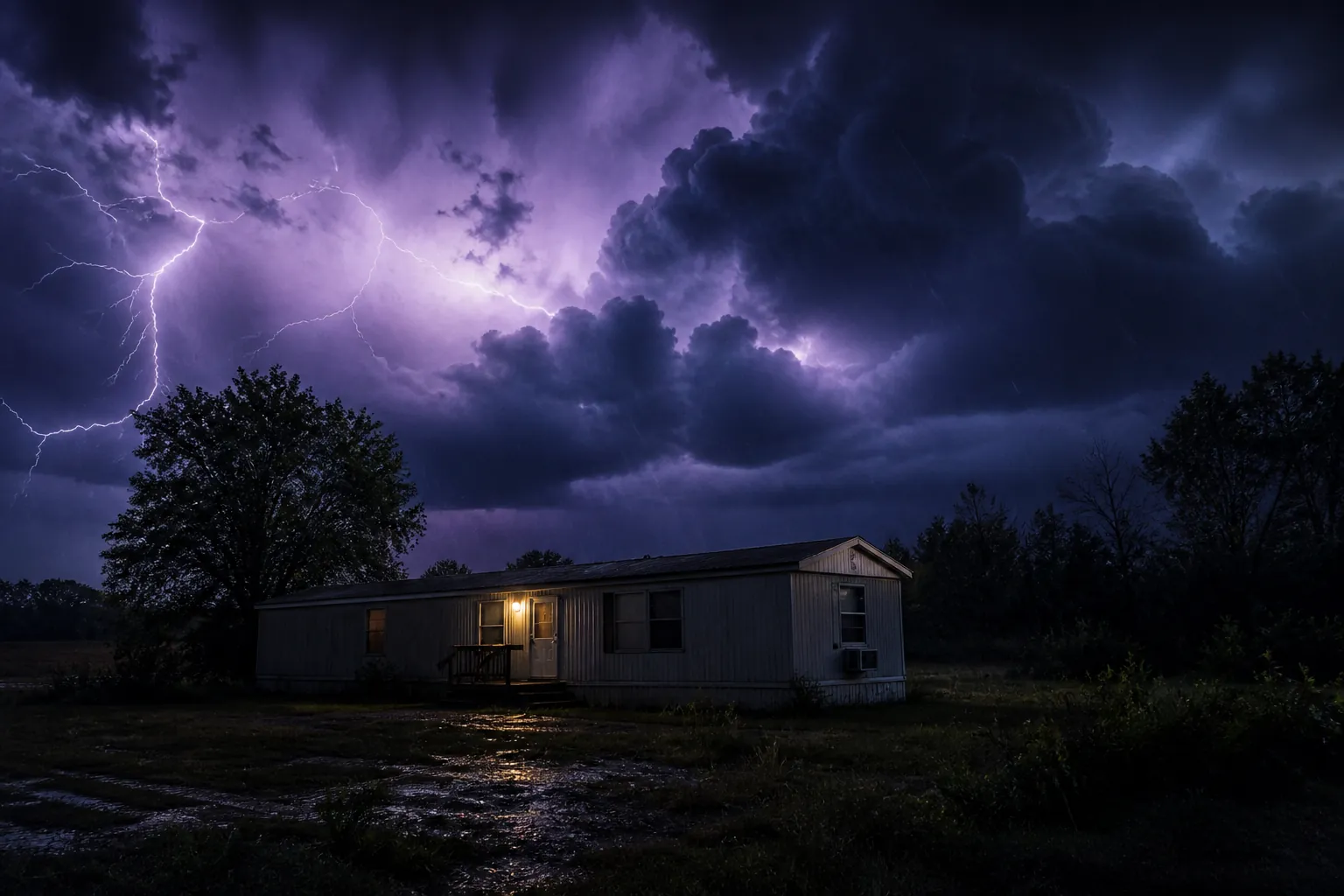
If you are in a mobile home and tornadoes are possible overnight, “I will wake up if it gets bad” is not a shelter plan. NWS guidance is blunt: sleep on the lowest floor possible and never in a mobile home when tornado danger is present.[1] Red Cross guidance also says mobile homes are not safe shelter in this kind of threat.[2]
The safer plan has to be decided before bed: a nearby storm shelter, a sturdy building you are allowed to enter, a neighbor’s or family member’s site-built home, or another location local emergency management identifies as appropriate. If you cannot identify where you would go, how you would get there, and when you would leave, sleeping is not the safe answer yet.
How much lead time can you count on?
Enough, sometimes, to save your life; not enough to waste it looking for shoes. NWS Norman says that in Oklahoma, 97% of the most violent tornadoes, EF3 through EF5, were preceded by a warning with an average lead time of 16 minutes, and 75% of all Oklahoma tornadoes had a warning.[6]
Keep that example in its proper place. It is Oklahoma-specific, from the NWS Norman forecast area; it is not a promise that your town will usually get 16 minutes. It is still a useful reminder that a warning is not just noise. It can be the time between bed and shelter, if your alert reaches you and your path is already chosen.
What if anxiety is what keeps you awake?
Storm anxiety is real, and some people will not relax just because the phone is charged. But on a severe-weather night, the first treatment is not reassurance; it is a working safety setup. Once alerts, shelter, shoes, and the mobile-home question are handled, the remaining fear belongs in a different lane.
If the main problem is worry after the safety plan is in place, use the guide to sleeping with thunderstorm anxiety. If you are dealing with the aftermath of a tornado, outage, or damaged home, the next useful page is how to sleep after a tornado or power outage. For blackout-specific alert planning, see power-grid emergency sleep tips.
The last check before you sleep
- No tornado warning or shelter-now instruction is active for your location.
- WEA alerts are enabled, audible, and not silently blocked by a setting you have not checked.
- A NOAA Weather Radio or second alert path is close enough and loud enough to wake you, if you have one.
- Your phone is charging beside the bed, not across the room or under bedding.
- The shelter is chosen: basement or lowest-floor interior room away from windows.
- Shoes, flashlight, glasses, keys, medications, and any child or pet essentials are reachable.
- If you are in a mobile home, the safe-shelter plan is already resolved.
If those conditions are met, the aim tonight is reachable sleep, not perfect sleep. If they are not met, do that work before you close your eyes.
References
- NWS Social Media: Tornado Safety, National Weather Service
- Thunderstorm Safety, American Red Cross
- Vulnerability due to Nocturnal Tornadoes, Weather and Forecasting, 2008
- Nighttime tornadoes far more likely to turn deadly than those during the day, FOX Weather
- Weather warnings on the go!, National Weather Service
- Storm Anxiety, National Weather Service Norman
Read the full guide: How to Sleep During a Tornado Warning When Pregnant