
How to Sleep During a Wind Advisory
Yes—if you are in a sturdy home and the basic prep is done
If you are in a sturdy house or apartment, it is generally safe to sleep during a wind advisory after you have taken the practical steps the alert is asking for: secure loose outdoor objects, sleep away from windows in the safest available interior space, and set warnings that can wake you indoors. A National Weather Service wind advisory is a “Take Action!” product for strong winds; it is not the same thing as an evacuation order, shelter order, or High Wind Warning.[1]
The important exception is a mobile home. National Weather Service high-wind safety guidance says mobile-home residents should move to a sturdy building before winds pick up.[2] That is not a small-print caveat. If tonight’s sleeping place is a mobile home, the safer bedtime plan is not better earplugs or more weather-checking; it is relocating before the wind makes that harder.
There is no clinical sleep study that directly tests “sleeping during a wind advisory.” The advice here is a safety synthesis: it starts with National Weather Service wind products and warning guidance, then applies ordinary sleep judgment. Once the real safety tasks are complete and the alerts can reach you, staying awake all night is not a better safety system.
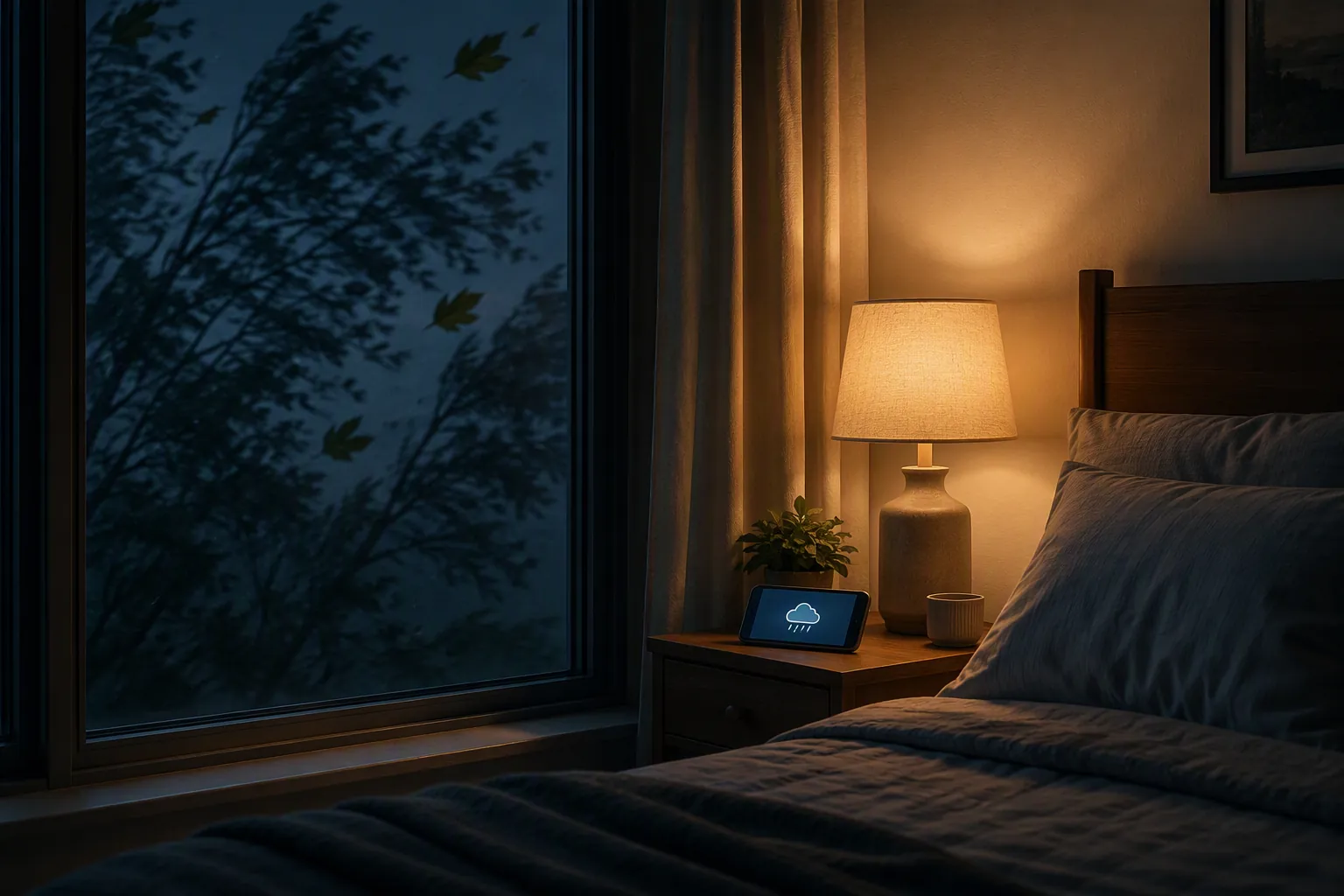
What a wind advisory means tonight
Under standard National Weather Service definitions, a wind advisory is issued for sustained winds of 31 to 39 mph lasting an hour or more, and/or gusts of 46 to 57 mph. A High Wind Warning begins at 40 mph sustained winds or 58 mph gusts.[3] Those numbers matter because they separate a night that calls for preparation from a higher-tier wind event where your plan may need to change.
| NWS product | Standard wind criteria | Bedtime meaning |
|---|---|---|
| Wind Advisory | Sustained winds of 31–39 mph for an hour or more and/or gusts of 46–57 mph.[3] | Take action before bed: secure loose objects, stay inside a sturdy building, avoid windows, and keep warnings active.[1] |
| High Wind Warning | Sustained winds of 40 mph or higher, or gusts of 58 mph or higher.[3] | Treat it as a higher-risk night. Move to the safest interior area of a sturdy building and follow the exact wording of your local alert. |
Use those thresholds as the standard frame, not as permission to ignore local wording. Local National Weather Service offices may issue products using criteria suited to local hazards and terrain. If your local alert names a stronger threat, tells you to avoid a particular area, or updates from an advisory to a warning, the local alert wins.
That is the difference between responsible sleep and wishful sleep. Responsible sleep is not “nothing bad can happen.” It is: the advisory-level hazards have been handled as far as a household can handle them, and you have not made yourself the overnight warning system.
The before-bed checklist that actually matters
Do this before you stop watching the weather. Not because every wind advisory becomes dangerous, but because these are the few actions that reduce the ordinary ways a windy night turns into a 2 a.m. problem.
- Read the local alert once, including the start and end time, the expected gusts, and any location-specific language.
- Bring in or tie down loose outdoor items: patio chairs, umbrellas, trash bins, lightweight planters, decorations, toys, and anything that could hit a window or car. NWS wind-advisory guidance specifically calls out securing outdoor objects.[1]
- Move your sleeping spot away from windows if your usual bed is beside large glass, old windows, or trees close to the house.
- Choose the safest available interior space in a sturdy building: a basement if you have one, or an interior room or hallway away from exterior walls and windows. NWS high-wind guidance says to stay inside a sturdy building and move to an interior room or basement during high winds.[2]
- Charge your phone before bed, leave it where you can hear it, and turn off any focus mode that blocks emergency alerts.
- Set more than one alert path that can wake you indoors: phone emergency alerts, a weather app or local alert app, and ideally a NOAA Weather Radio with battery backup.
- Put shoes, glasses if you need them, a flashlight, and any essential medication where you can reach them without searching in the dark.
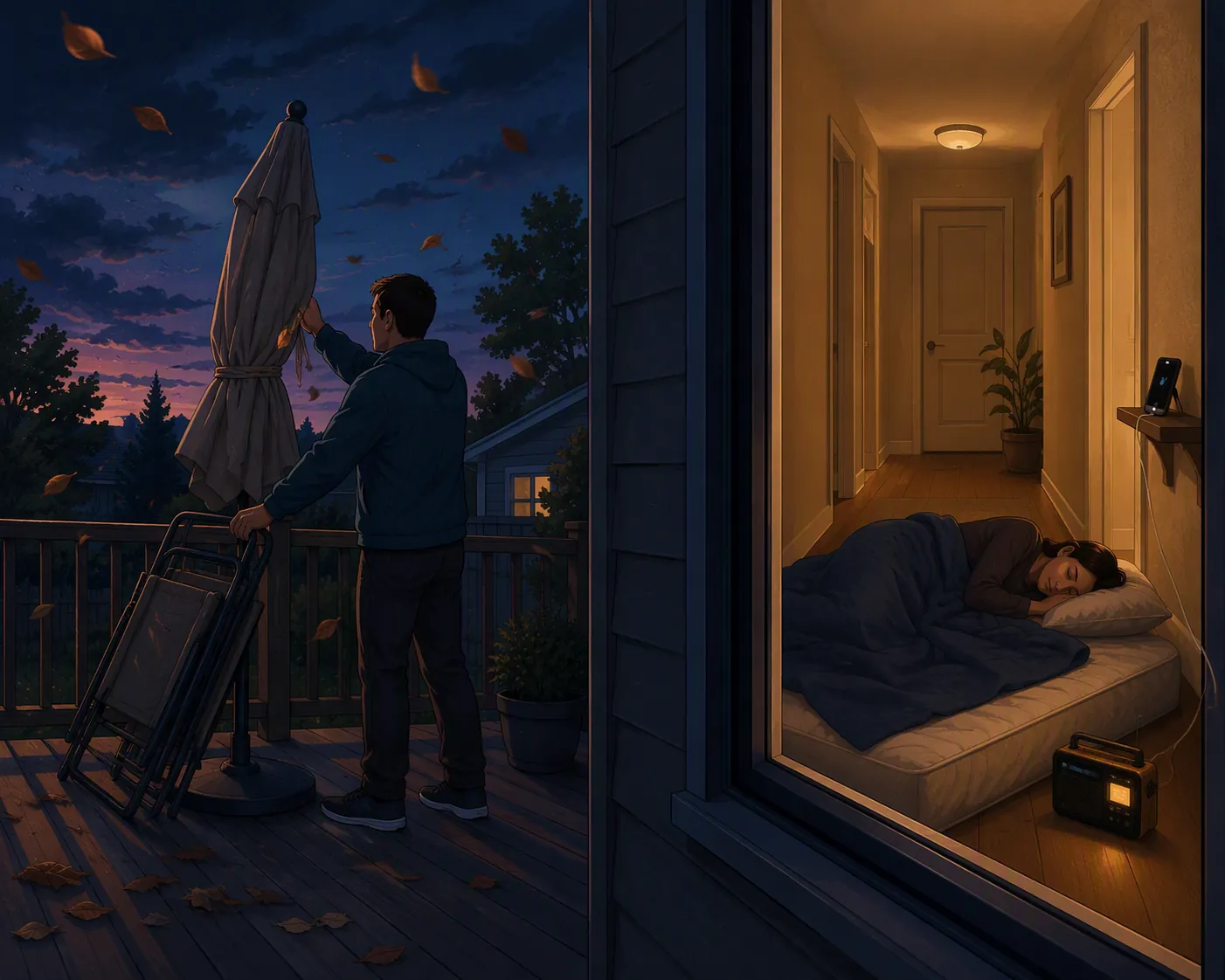
The checklist is short on purpose. You do not need to patrol the yard repeatedly, refresh radar for hours, or listen to every gust to decide whether it sounded worse than the last one. If the objects are secured, the sleep spot is sensible, and the alerts are set, you have done the useful part.
Where to sleep in a house, apartment, or mobile home
In a sturdy house, the best wind-advisory sleep spot is usually the one with the fewest nearby hazards: away from large windows, exterior glass doors, and rooms directly under large overhanging branches. If you have a basement that is comfortable and accessible, it is a strong choice. If not, an interior bedroom, hallway, or central room is usually enough for an advisory-level night.
In an apartment, you may not control the trees, parking lot, or roofline. Control what you can: move away from windows, close curtains or blinds to reduce glass exposure if something breaks, and keep your phone and shoes close. If your bed is directly beside a large window and you have an interior hallway or windowless room, it is reasonable to sleep there for the night.
In a mobile home, do not treat the mobile home as the safe overnight place for high wind. The National Weather Service guidance is plain: mobile-home residents should move to a sturdy building before winds pick up.[2] That may mean a friend’s house, a community building, a shelter if one has been opened locally, or another sturdy structure you can reach before the advisory window starts.
The decision is easier if you make it early. Relocating at 9 p.m. with a charged phone and dry shoes is annoying. Relocating after branches are down, visibility is poor, or power is out is a different risk.
Do not rely on outdoor sirens to wake you
Alert setup is the bridge between safety and sleep. The National Weather Service recommends having at least three ways to receive warnings, and it warns that outdoor sirens are designed for people outdoors, not to be heard inside or to wake sleepers.[4] If your bedtime plan is “the siren will wake me,” the plan has a hole in it.
- Keep Wireless Emergency Alerts enabled on your phone, with the ringer loud enough to wake you.
- Use a NOAA Weather Radio if you have one, especially in areas where cell service is unreliable.
- Add one local source: a county emergency alert system, local TV weather app, local radio, or a trusted weather app that sends push alerts.
- Have a power backup: phone battery above 80 percent, a charged power bank, or a weather radio with batteries.
- If you use Do Not Disturb, Sleep Focus, or an equivalent mode, check that emergency alerts and your chosen weather app are allowed through.
If the wind advisory is part of a broader outage risk in your area, set up the alert and charging side before you get in bed. The power-grid emergency sleep FAQ is the better route for battery backup, blackout lighting, and what to do if the power goes out overnight.
Test once, then stop fiddling. Rechecking the same settings every few minutes feels like control, but it usually just keeps your nervous system on duty after the household safety work is finished.
If the noise is keeping you awake after you are prepared
Wind noise can keep you alert even when the actual advisory plan is handled. Once alerts are reliable, use light sound masking if it helps: a fan, white noise, brown noise, or steady rain sounds at a low enough volume that your warning source can still cut through. Avoid sealing yourself off from alerts with loud headphones unless another alert device is clearly able to wake you.
If the hard part is not the sound but the urge to monitor, borrow the storm-anxiety approach: decide what you will respond to, then stop treating ordinary gusts as new information. The thunderstorm anxiety sleep FAQ has grounding and sound-masking options that fit once the safety checklist is already done.
If you are in a phase of life where sleep is already fragile, match the support to the problem. Perimenopause-related night waking and weather vigilance may need a different plan, such as the perimenopause storm-anxiety guide. If you are just a very light sleeper and the advisory has become one more reason to stay alert, the fragile-sleeper route may be more useful than more weather information.
Cues that change the overnight plan
A wind advisory sleep plan depends on the situation staying advisory-level and the building still being the safe place. Change the plan if any of these happen:
- Your phone, weather radio, or local authority issues a new higher-tier alert, especially a High Wind Warning.
- Your local alert language says winds are reaching warning-level criteria: sustained winds of 40 mph or higher, or gusts of 58 mph or higher.[3]
- You hear or see structural damage: broken windows, roof damage, a damaged door, or anything that suggests the building is no longer protecting you normally.
- Trees, large limbs, or power lines are down immediately nearby.
- Water is entering near electrical outlets or you smell smoke, gas, or burning.
- You are in a mobile home and have not yet moved to a sturdy building before winds pick up.[2]
- Your alert system fails and you have no other way to receive warnings indoors.
If one of those cues appears, do not stay in bed to see whether it passes. Move to the safest interior area available, follow the local alert wording, and avoid going outside to inspect damage while winds are still active.
For an ordinary wind advisory in a sturdy home, the safe answer is calmer than the noise outside makes it feel: secure what can blow around, sleep away from windows, set indoor alerts that can wake you, and go to bed. Once that is done, sleep is an appropriate safety choice, not negligence.
References
- NWS Wind Warnings, Watches and Advisories, National Weather Service.
- During a High Wind Event, National Weather Service.
- NWS Watch/Warning/Advisory Definitions, National Weather Service.
- NWS Storm Stress and Anxiety, National Weather Service.
Read the full guide: How to Sleep During a Heat Wave Without AC