
The first question is not whether thunder sounds scary. It is what the National Weather Service has issued for your location.
A thunderstorm becomes “severe” by official criteria when it can produce hail at least 1 inch in diameter, wind gusts of at least 57.5 mph, or a tornado. That line matters at bedtime because it separates a loud night from a night when windows, trees, power lines, vehicles, and weak structures can become part of the risk calculation.[1]
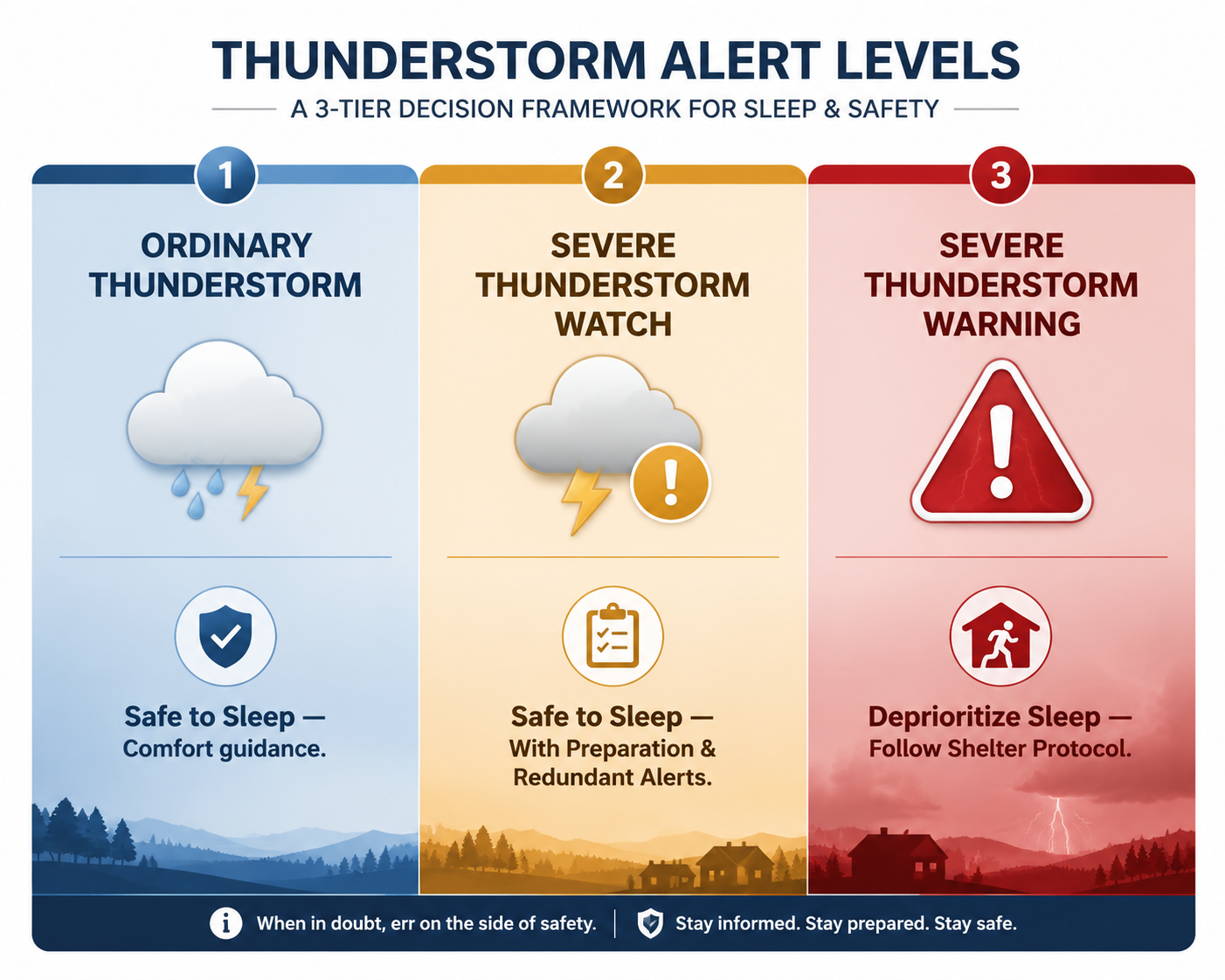
For sleep, the practical split is simple: if there is no watch or warning, you can usually treat the storm as a comfort and sleep-disruption problem. If there is a severe thunderstorm watch, conditions are favorable for severe storms, and sleep can still be reasonable if your alert chain and shelter plan are ready. If there is a severe thunderstorm warning, severe weather is occurring or imminent, and sleep in a regular bedroom should drop behind sheltering and monitoring until the threat passes.[2]
Start With the Alert, Not the Noise
Thunder can make a harmless storm sound personal. A quiet radar scan can make a dangerous storm look abstract. Neither feeling is enough to decide whether to go to bed. The alert status is the anchor because it tells you whether the problem is discomfort, readiness, or immediate protection.
| Current status where you are | What it means | Sleep decision |
|---|---|---|
| Ordinary thunderstorm, no severe thunderstorm watch or warning | Storms may be loud, but no official severe thunderstorm alert is active for your location | Sleep is usually reasonable; manage sound, light, and anxiety |
| Severe thunderstorm watch | Conditions are favorable for severe thunderstorms | Sleep can be reasonable after you set layered alerts, charge devices, choose shelter, and secure obvious hazards |
| Severe thunderstorm warning | Severe weather is occurring or imminent | Do not make ordinary sleep the priority; follow shelter guidance and monitor until the warning expires or moves away |
This is also where some common advice gets thin. White noise, blackout curtains, and breathing exercises can help you sleep through ordinary thunder. They do not replace an alert system during a watch, and they are not the right first move during a warning.
If There Is No Watch or Warning
If your area is not under a severe thunderstorm watch or warning, the safety question is usually much simpler. You still want a working way to receive emergency alerts overnight, especially in storm-prone regions, but you do not need to treat every clap of thunder like a deployment.
This is the place for comfort tools: close curtains, move away from a window if lightning flashes keep waking you, reduce sudden indoor noises if they startle you, or use steady background sound if it helps mask thunder. If ordinary storms keep you awake even after you have checked the alert status, a more detailed sleep-comfort guide such as how to sleep during a thunderstorm when nothing else works is the better lane.
The one caution: do not turn on so much masking noise that you defeat your own alert system. A phone, NOAA Weather Radio, or other alerting device should still be able to wake you if the situation changes.
During a Severe Thunderstorm Watch, Prepare First and Then Sleep
A watch is the hard middle. Nothing may be happening at your house yet. You may have work in the morning. You may also know that the atmosphere is capable of producing a storm you do not want to meet half-awake, barefoot, and searching for the flashlight that was definitely in the drawer last year.
The point of watch-night preparation is not to stay scared longer. It is to reduce how many decisions you would have to make after being jolted awake. The NWS explicitly connects storm-anxiety reduction with advance preparation and knowing what to expect, which is exactly how a watch becomes manageable at bedtime: you decide before the house is dark what will wake you, where you will go, and what you will take.[2]
Set More Than One Alert
Do not rely on outdoor sirens to wake you indoors. The NWS warning on this point is blunt: sirens are designed for people outside, not for sleeping people inside homes with walls, fans, air conditioners, rain, and closed windows between them and the sound.[2]
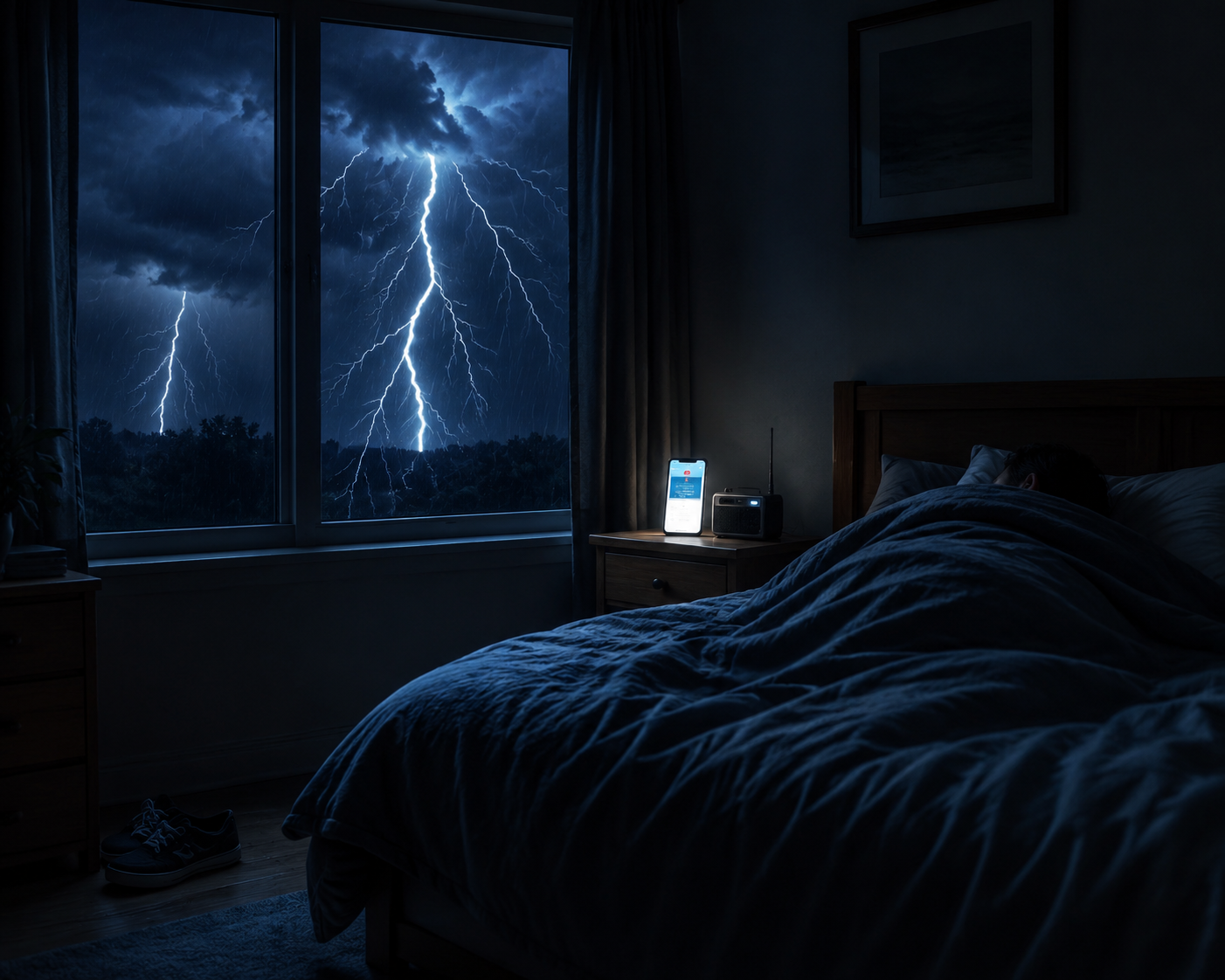
For a watch night, use layered alerting. A reasonable setup includes Wireless Emergency Alerts enabled on your phone, a weather app or local alert app allowed to make sound overnight, and a NOAA Weather Radio or equivalent dedicated alert device if you have one. If your phone has Focus, Do Not Disturb, bedtime mode, or silent mode scheduled, check whether emergency alerts and the weather app you rely on can break through.
- Plug in your phone before lying down.
- Turn the ringer and alert volume high enough to wake you.
- Allow critical or emergency alert overrides where your device supports them.
- Place the phone close enough to hear, but not somewhere it will fall behind the bed.
- Keep a backup alert source in the room or hallway if overnight severe weather is common where you live.
If you have slept through alerts before, treat that as useful information, not a character flaw. Some people need a louder device, a second device across the room, or a partner plan. The related problem of sleeping through tornado warnings deserves its own attention because waking from deep sleep is not just a matter of good intentions.
Make the Shelter Decision Before Bed
Choose the place you would go if the warning escalates. For severe thunderstorm wind and hail, that usually means an interior room on the lowest practical level, away from windows. If your area is also under tornado risk, use the stronger tornado shelter standard rather than negotiating with yourself at 2 a.m.
Put shoes beside the bed. Put a flashlight where your hand will actually find it. If children, older adults, guests, or pets are in the house, decide who wakes whom. The person who has to move everyone should not be expected to invent the plan while a warning tone is going off.
If tornado alerts overlap your thunderstorm concern, use a more specific plan. A severe thunderstorm watch and a tornado watch are not identical alerts, and a tornado warning is a different level of urgency. For that scenario, see what to do during a tornado watch when you need sleep or how to sleep safely during tornado season.
Clear the Easy Hazards
Before you go to sleep during a watch, take the quick outside pass if it is safe to do so. Bring in or secure the things that become projectiles or broken-window problems in strong wind: patio chairs, lightweight planters, trash bins, umbrellas, toys, loose tools. You are not storm-proofing the whole property at midnight. You are removing the obvious items you do not want moving around later.
Inside, keep the route to shelter clear. A dark hallway with shoes, cords, laundry baskets, and a half-asleep household is a bad place to discover that “we know where to go” was only true in daylight.
Use the Warning System as Calibration, Not a Guarantee
Good warning systems are one reason sleep can be reasonable during a watch. NWS Oklahoma material reports that warnings are in effect before about 97% of dangerous tornadoes develop, with roughly 16 minutes of average advance notice.[2] That is a useful corrective to the midnight thought that danger always arrives without any chance to respond.
It is not a promise that your phone will be charged, your settings will be right, your bedroom will hear an outdoor siren, or you will wake instantly. That is why the preparation comes first. The warning system gives you a chance; your household setup has to be able to receive it.
During a Severe Thunderstorm Warning, Sleep Is No Longer the Main Task
A severe thunderstorm warning means the storm is no longer hypothetical. Severe weather is occurring or imminent in the warned area.[2] At that point, the bedtime question changes from “Can I get some rest?” to “Where is the safest place for the next part of this storm?”
If you are in the warning polygon, move away from windows and into your chosen interior shelter area. Bring your phone or alert device. Put on shoes if you can do so quickly. If you have children or anyone who needs help moving, wake them and get them settled rather than waiting to see whether the storm sounds worse.
This does not mean every warning will damage your house. It means the official threshold has been crossed: hail large enough to break things, winds strong enough to bring down limbs or power lines, or an associated tornado threat can make a regular bedroom the wrong place to be. Once the warning expires or moves away and no adjacent warning applies, you can reassess sleep.
Do not use severe-thunderstorm sleep advice to override a tornado warning or flash flood warning. Those alerts have their own safety protocols. If the alert is a tornado warning, use tornado-warning guidance, not a comfort routine; how to sleep safely during a tornado warning covers that separate decision.
When the Weather Is Handled but Your Body Is Still on Alert
Storm nights are physically noisy and mentally noisy. Even after you have checked the alert, charged the phone, found the shelter spot, and decided what would make you move, your body may still act as if it has been assigned to watch the radar all night.
That reaction is not rare. In a 2024 American Academy of Sleep Medicine survey, 74% of Americans reported disrupted sleep due to stress, and 68% reported disrupted sleep due to anxiety.[3] The Anxiety and Depression Association of America has also cited research in which 19.8% of participants experienced anxiety symptoms after an extreme weather event in the past year.[4]
Those numbers do not mean every person awake during a storm has a clinical phobia. Ordinary situational fear can be appropriate when the sky is loud and alerts are possible. Clinical astraphobia, broader anxiety, or insomnia is a different matter, especially if the fear persists when no storm threat exists or starts shaping your life well outside storm season.
Once the safety pieces are in place, use the calmer tools without asking them to do the job of the alert system. Slow your breathing. Keep the room cool and dark enough to sleep. Use a steady sound that does not cover alerts. Remind yourself of the actual next action: if this alert sounds, I go there; if it does not, I stay in bed.
If storm worry keeps turning into general nighttime vigilance, it may help to treat it as an anxiety-insomnia pattern rather than a weather-information problem. A guide such as what to do when anxiety keeps you up at night fits that situation better than checking one more radar loop.
The Bedtime Rule
If there is no severe thunderstorm watch or warning, sleep with ordinary alert access and manage the noise. If there is a severe thunderstorm watch, sleep only after you have layered alerts, charged devices, chosen shelter, cleared easy hazards, and made the wake-up plan. If there is a severe thunderstorm warning, stop trying to sleep in a regular bedroom and follow shelter protocol until the warning is no longer a threat to your location.
References
- Severe Weather 101: Thunderstorms, NOAA National Severe Storms Laboratory.
- Storm Anxiety, National Weather Service.
- Stress, anxiety and depression: Survey shows mental health conditions disrupt a majority of Americans’ sleep, American Academy of Sleep Medicine, 2024.
- Hurricane Season Is Here: How to Reduce Your Anxiety, Anxiety and Depression Association of America.
Comments
Join the discussion with an anonymous comment.